Blast-Resistant Window Film: How It Works and When You Need It
Published: August 25 2026 · 8 min read · Category: Safety & Security Film
About this article: KSB Window Film manufactures heavy-duty safety film for security applications. Blast film specifications are among the most technically demanding in our product range — this guide reflects our direct experience with security consultants and institutional building owners.
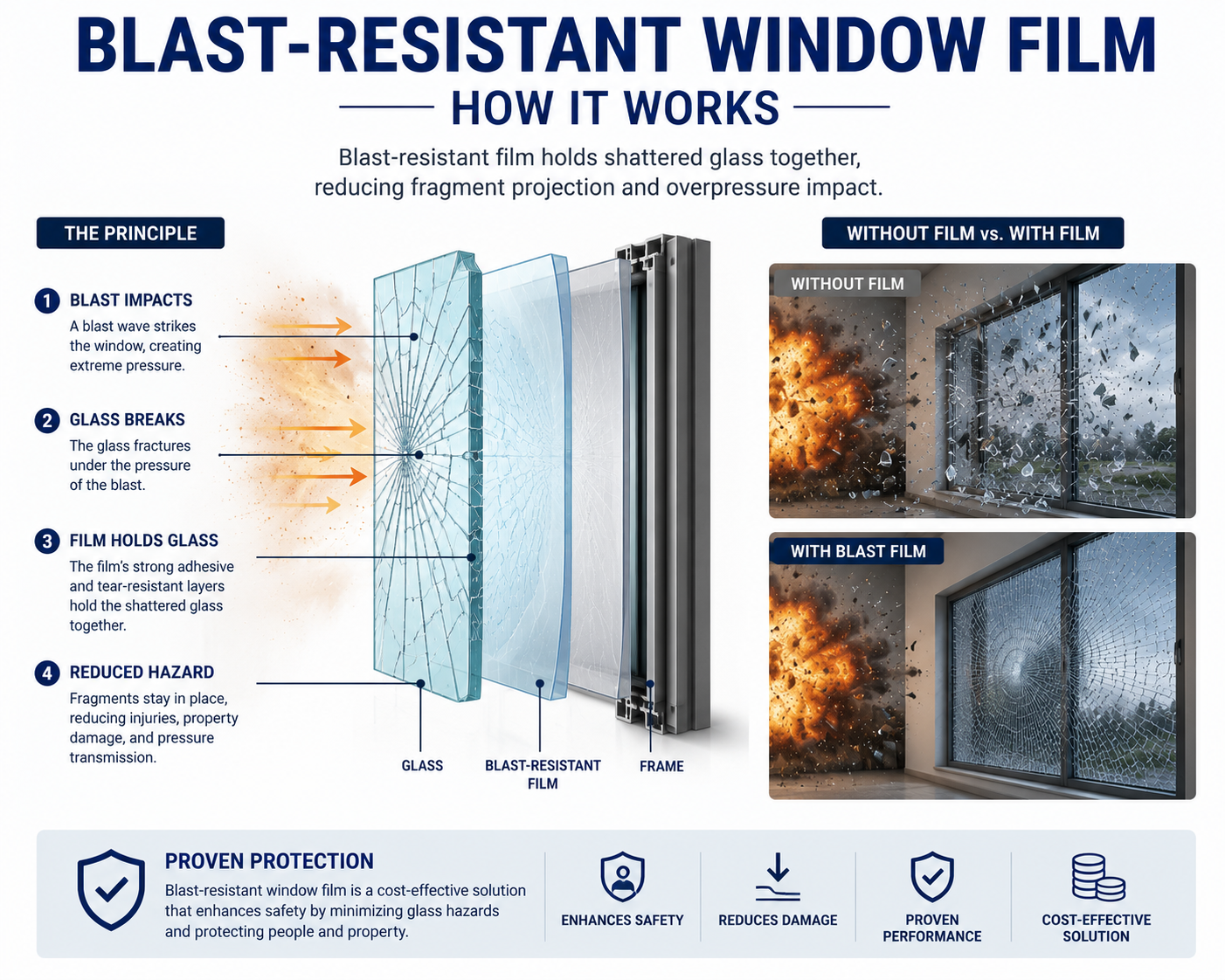
Technical diagram illustrating how blast-resistant window film absorbs impact energy and retains broken glass fragments during blast events.
Blast-resistant window film is a niche product with a specific threat profile, specific certification requirements, and a specific installation methodology. It’s not appropriate for every building, and it’s not a substitute for comprehensive building security design. But for buildings in credible blast-threat environments, properly specified and installed blast film is a proven, cost-effective component of a protective glazing strategy.
Why Glazing Matters in Blast Events
Historical analysis of bombing incidents — from the 1993 World Trade Center bombing through to more recent events — consistently identifies glazing failure as the primary source of blast casualties. The mechanism:
A bomb detonation creates a rapidly expanding pressure wave (blast overpressure). This wave travels at supersonic speeds and arrives at building glazing before occupants have any meaningful response time. The pressure shatters glass, which then becomes high-velocity secondary projectiles accelerated by the blast wind. These glass fragments — razor-sharp and travelling at hundreds of kilometres per hour — cause the majority of blast-related injuries at distances beyond the direct explosion zone.
In the Oklahoma City bombing (1995), analysis showed that glass-related injuries affected people over a kilometre from the blast. The scale of the glazing fragment hazard in major blast events is consistently underestimated.
How Blast Film Works
Blast film doesn’t prevent glass breakage. At the pressures involved in a significant bomb blast, glass will break regardless of film treatment. What blast film does is control what happens to the broken glass.
The mechanism:
When blast overpressure shatters glass protected by blast film:
The glass breaks into fragments, but the fragments are held together in the film matrix
The film-glass unit (still largely intact as a structure) absorbs blast energy through plastic deformation
The energy absorption slows the acceleration of the glass-film unit into the building interior
With proper frame attachment, the glass-film unit may remain partially in the frame, reducing the mass of material entering the interior
The comparison to unprotected glass: without film, the glass shatters into thousands of sharp fragments, each of which becomes a high-velocity projectile. With blast film properly installed, the glass-film unit behaves as a larger, slower-moving object — far less lethal than thousands of individual shards.
The Frame Attachment Imperative
This cannot be overstated: blast film without structural frame attachment provides substantially reduced blast protection.
Blast overpressure creates both a positive pressure phase (pushing inward) and a negative pressure phase (suction, pulling outward). An unattached glass-film unit — even if the film is excellent — can be pushed off its adhesive bond with the glass and become a large projectile entering the building interior.
Structural frame attachment — using a combination of structural silicone wet-glazing and mechanical fasteners — anchors the glass-film unit to the frame structure. The frame must absorb the energy transmitted through the glass-film system.
Types of frame attachment for blast applications:
Structural silicone wet-glazed system: The film edge is bedded into a structural silicone bead bonded to the frame. The silicone provides both adhesion and elastic energy absorption. The most common blast-grade attachment method.
Mechanical fastener channels: Metal channels mechanically fixed to the frame capture the film edge. Provides the highest resistance and is required for the most demanding blast specifications.
Combination systems: Wet-glazing plus mechanical channels for the highest-level protection.
The frame itself must be structurally adequate to receive the attachment and transmit forces to the building structure. Not all window frames are suitable without reinforcement.
When Blast Film Is Specified
Blast film is specified for buildings in credible blast threat environments:
Mandatory for most US government buildings: The GSA PBS-P100 standard and US Army Corps UFC 4-010-01 require blast-resistant glazing on all publicly accessible federal facilities. Safety film with structural attachment is one of the compliant solutions.
Embassy and diplomatic facilities: All US embassies are required to meet Department of State blast resistance standards. Equivalent requirements exist for embassies and high-value diplomatic facilities of most Western governments.
Military and critical infrastructure: Hardened facilities, command centres, and critical infrastructure (power plants, water treatment, communications) typically require blast-rated glazing.
High-profile private sector buildings: Banks of national importance, landmark corporate headquarters, and high-profile targets in high-risk environments.
Buildings in historically elevated threat environments: Buildings in cities with historical terrorism activity, or within proximity to regular protests, civil unrest, or conflict zones.
Certification Standards
GSA PBS-P100 (US Federal): The standard governing blast protection in US federal buildings. Film systems must be tested and certified under this framework for use in federal facilities.
UFC 4-010-01 (US Military/DoD): Unified Facilities Criteria for antiterrorism. Glazing requirements are specified by standoff distance, threat level, and occupancy type.
ISO 16933: International standard for blast testing of building components. Increasingly referenced in international specifications.
LPS 1270 (UK/Europe — forced entry, relevant overlap): While primarily a forced entry standard, LPS 1270 high-rating products are often used alongside or instead of blast-specific products in European security specifications.
ASTM F1642: US standard for glazed systems subject to airblast loadings.
Is Blast Film a Complete Solution?
For buildings requiring formal blast resistance certification (government facilities, embassies), blast film is one component of a protective glazing system — not a complete solution by itself. A comprehensive blast-protective glazing design includes:
Appropriate glazing type (laminated glass is preferred over annealed + film in the highest threat levels)
Blast-rated frame system
Structural attachment of film and/or glass to the frame
Building structural design to handle transmitted loads
Standoff distance management (keeping threats at distance)
For buildings not subject to formal blast certification requirements but wanting to improve resilience: blast film with structural attachment provides meaningful improvement in blast resistance at manageable cost and without requiring glass replacement.
FAQ
Does blast film make windows bulletproof?
No. Blast film and bullet-resistant glazing are different products addressing different threat types. Ballistic protection requires laminated glass with specific polycarbonate or glass-clad-polycarbonate interlayers — not film. Blast film addresses the pressure wave and fragment hazard from explosive events; ballistic glass addresses direct projectile impact.
How do I know if my building needs blast film?
A threat and vulnerability assessment (TVA) conducted by a qualified security consultant is the appropriate process for determining whether blast protection is required and at what level. Buildings in publicly identified high-risk categories (federal buildings, diplomatic facilities, critical infrastructure) have formal requirements. Private sector buildings should base the decision on an informed threat assessment.
Can blast film be applied to existing double-glazed windows?
With appropriate product and installation: yes. Thermal stress compatibility must be verified for the specific film product and IGU. For blast applications specifically, the frame attachment system must be compatible with the IGU frame construction. A structural engineer and blast consultant review is recommended for institutional blast film projects.
KSB Window Film manufactures heavy-duty safety film for institutional and government security specifications. Our technical team can advise on product selection and connect you with qualified security installation contractors for blast and high-security applications.