Windshield Film and Heads-Up Display (HUD): What You Need to Know
Published: October 13, 2026 · 6 min read · Category: Windshield Film
About this article: KSB Window Film includes HUD compatibility evaluation in our windshield film product testing. This is a growing specification requirement as HUD becomes standard on premium and mid-range vehicles.
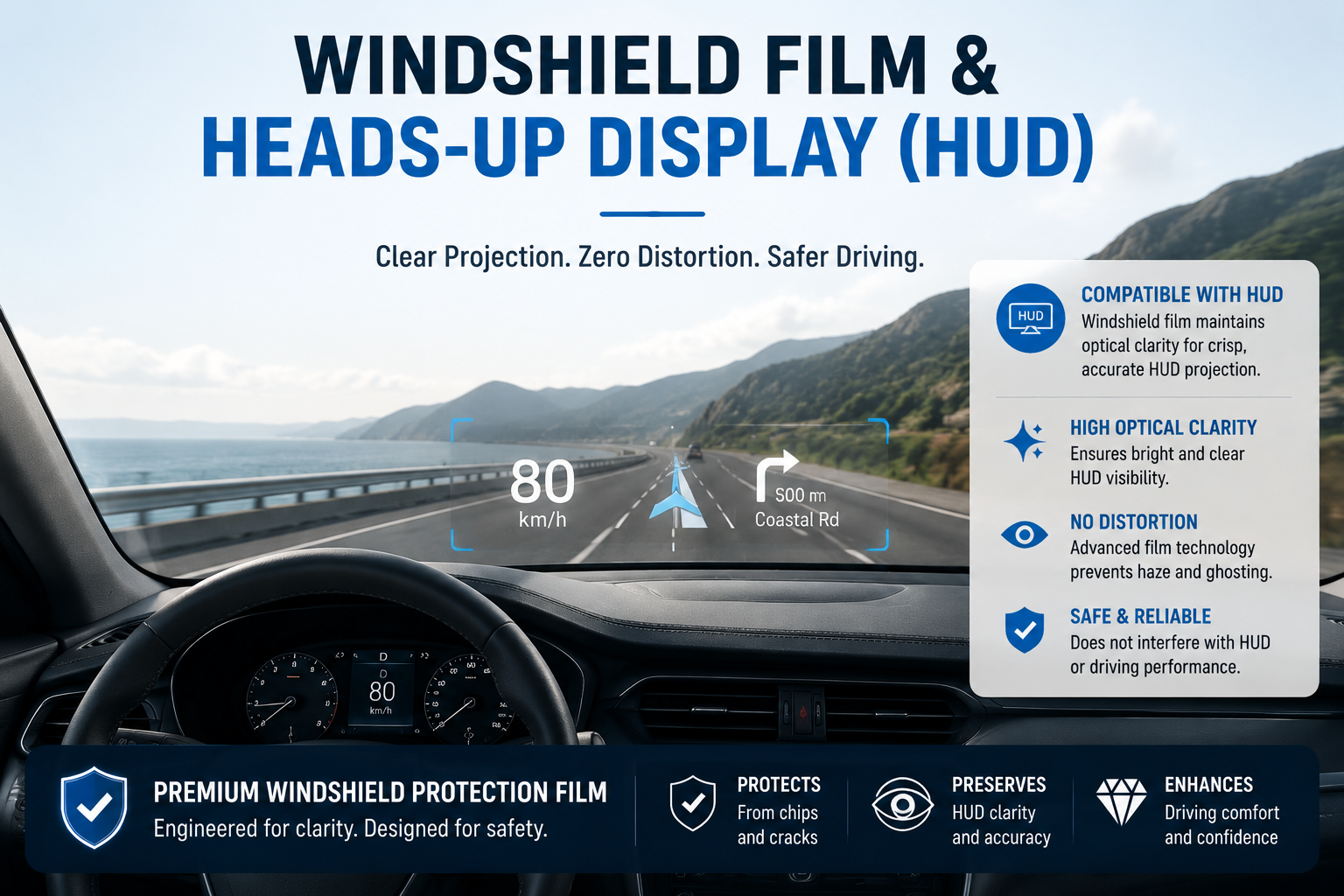
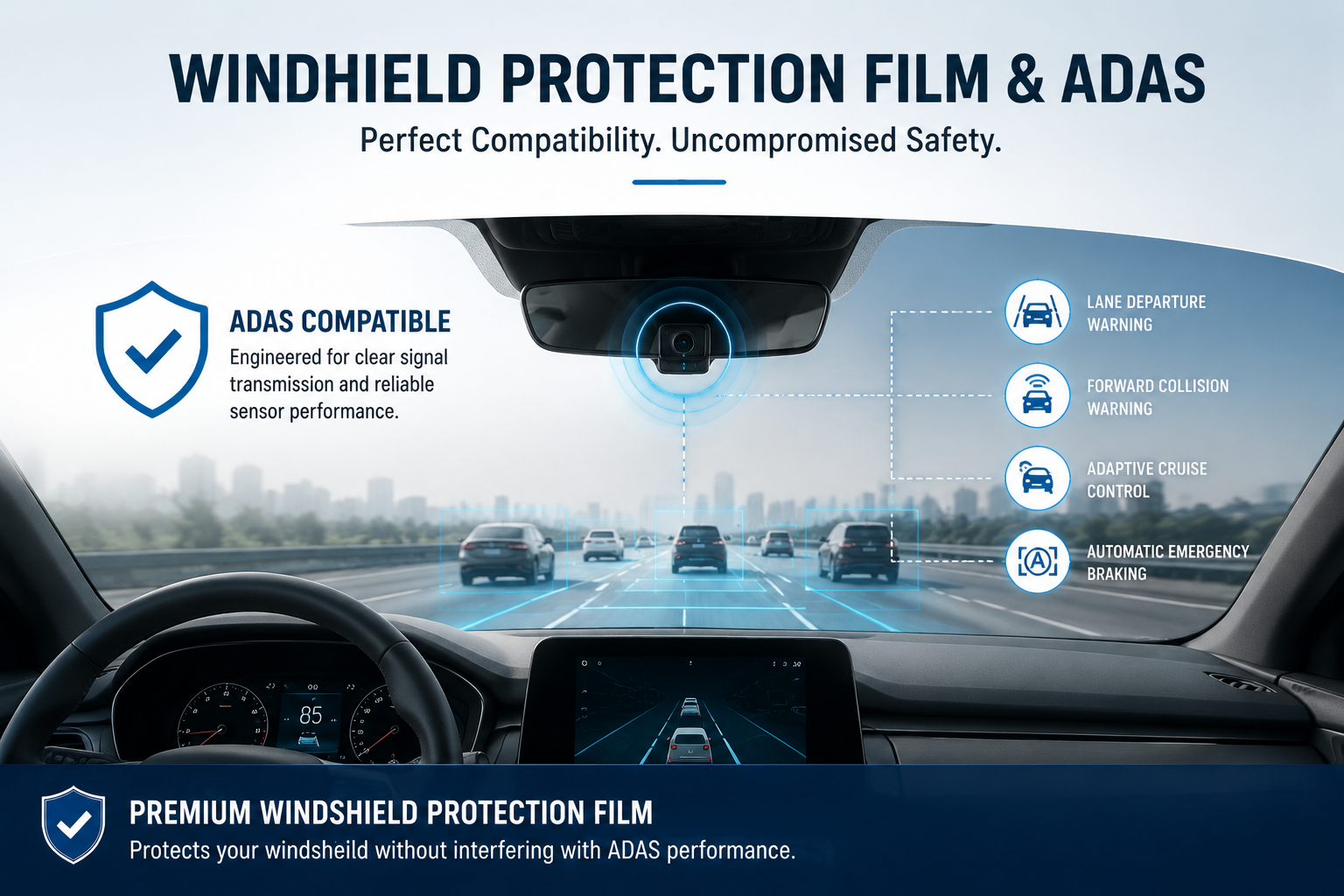
Windshield protection film ensures clear and distortion-free HUD projection for safer and more accurate driving information display.
Heads-up display (HUD) is one of the fastest-growing features on new vehicles — projected to be standard equipment on over 30% of new vehicles globally by 2027. For windshield film installers, this creates a compatibility challenge that didn’t meaningfully exist five years ago: film on a windshield with HUD can create double images that are distracting or disabling for the HUD function.
How HUD Works and Why Film Matters
A HUD system projects an image (typically speed, navigation, ADAS alerts) from a projector unit in the dashboard upward onto the windshield at a specific angle. The windshield surface — specifically a treated area of the inner surface — partially reflects this projected light toward the driver’s eyes, creating a virtual image that appears to float above the bonnet.
The windshield’s partial reflectance in the HUD zone is carefully engineered: enough reflectance to create a visible HUD image, but not so much that it significantly reduces forward view clarity.
The double image problem:
Standard window glass has two reflective surfaces — the outer glass surface and the inner glass surface. Windshields are manufactured with a slight wedge angle between these surfaces (typically 0.05–0.1°) precisely to prevent double images by separating the two reflections beyond perceptibility at normal HUD viewing distances.
When film is applied to the inner windshield surface, it creates an additional reflective interface — the film’s inner surface. This new interface can create a third reflection of the projected image, at a slightly different angle from the primary HUD image, creating a visible “ghost” image above or below the primary image.
The ghost image is the primary HUD compatibility problem with windshield film.
Products That Cause HUD Double Images
Standard high-reflectance films: Films with significant internal reflection (such as reflective tinted films) create strong secondary reflections and almost always produce HUD double images. These should never be applied to windshields with HUD regardless of zone placement.
Optically thick clear films (incorrect specification): The separation between the primary and ghost image depends on the optical path length through the film. Thicker films with higher refractive index produce larger secondary image separation — more visible as a distinct ghost.
Films with reflective coatings: Any film with a metallic or reflective coating layer creates a strong partial mirror on the windshield inner surface, dramatically increasing the ghost image intensity.
Products That Are Generally HUD-Compatible
Ultra-low-reflectance clear film: Windshield film specifically designed for HUD compatibility uses:
Anti-reflective (AR) coating on the inner surface of the film facing the vehicle interior
Optical formulation that minimises the refractive index contrast at the film-air interface
Very thin optical path to minimise image separation even if secondary reflection occurs
AR-coated windshield film: Some premium windshield film products specifically include anti-reflective coating specifically for HUD compatibility. These are the correct specification for any vehicle with HUD.
Film applied outside the HUD zone: If full-windshield coverage is not required, applying film only to the lower windshield (impact zone) where the HUD zone is not located avoids the compatibility question entirely.
Identifying the HUD Zone on a Windshield
The HUD projection zone is typically:
Located in the lower centre portion of the upper windshield (roughly 200–400mm from the bonnet line, centred on the driver’s line of sight)
Usually 200–350mm wide × 100–200mm tall
Sometimes visible as a slightly different optical appearance area in certain lighting conditions
May be printed/etched on the glass with a subtle marking in some vehicles
For any vehicle with HUD, check the owner’s manual for HUD zone location or consult the vehicle-specific application guidance from your film manufacturer.
What to Do If the HUD Zone Cannot Be Avoided
If the customer requires full-windshield film coverage and the vehicle has HUD:
Option 1: Specify an AR-coated windshield film product designed for HUD compatibility. Test on a sample vehicle before committing to a customer installation.
Option 2: Apply film with a precision cutout around the HUD zone. This requires accurate HUD zone mapping and precise cutting — achievable with digital cutting systems but demanding for hand-cut installations.
Option 3: Advise the customer of the HUD compatibility limitation and apply film to the lower windshield only (below the HUD zone).
FAQ
Can HUD be re-calibrated if film causes a double image?
HUD double images from film are an optical issue — they can’t be calibrated away. The solution is either removing the film from the HUD zone or replacing it with an HUD-compatible product. Dealership recalibration addresses sensor alignment, not optical interference.
Does film outside the HUD zone affect HUD?
Generally no. Film applied well below the HUD zone (on the impact protection area of the lower windshield) doesn’t affect HUD because it’s not in the optical path between the projector and the driver’s eyes at HUD viewing distance.
KSB Window Film produces anti-reflective coated windshield film tested for HUD compatibility. Contact our technical team for HUD-compatible product specifications.