Safety Window Film for Schools: How to Protect Students from Glass Hazards
Published: August 28, 2026 · 8 min read · Category: Safety & Security Film
About this article: KSB Window Film supplies safety film to educational building projects. School safety film specifications involve a distinct combination of code compliance, occupant safety, and security considerations — this guide addresses them in an integrated way.
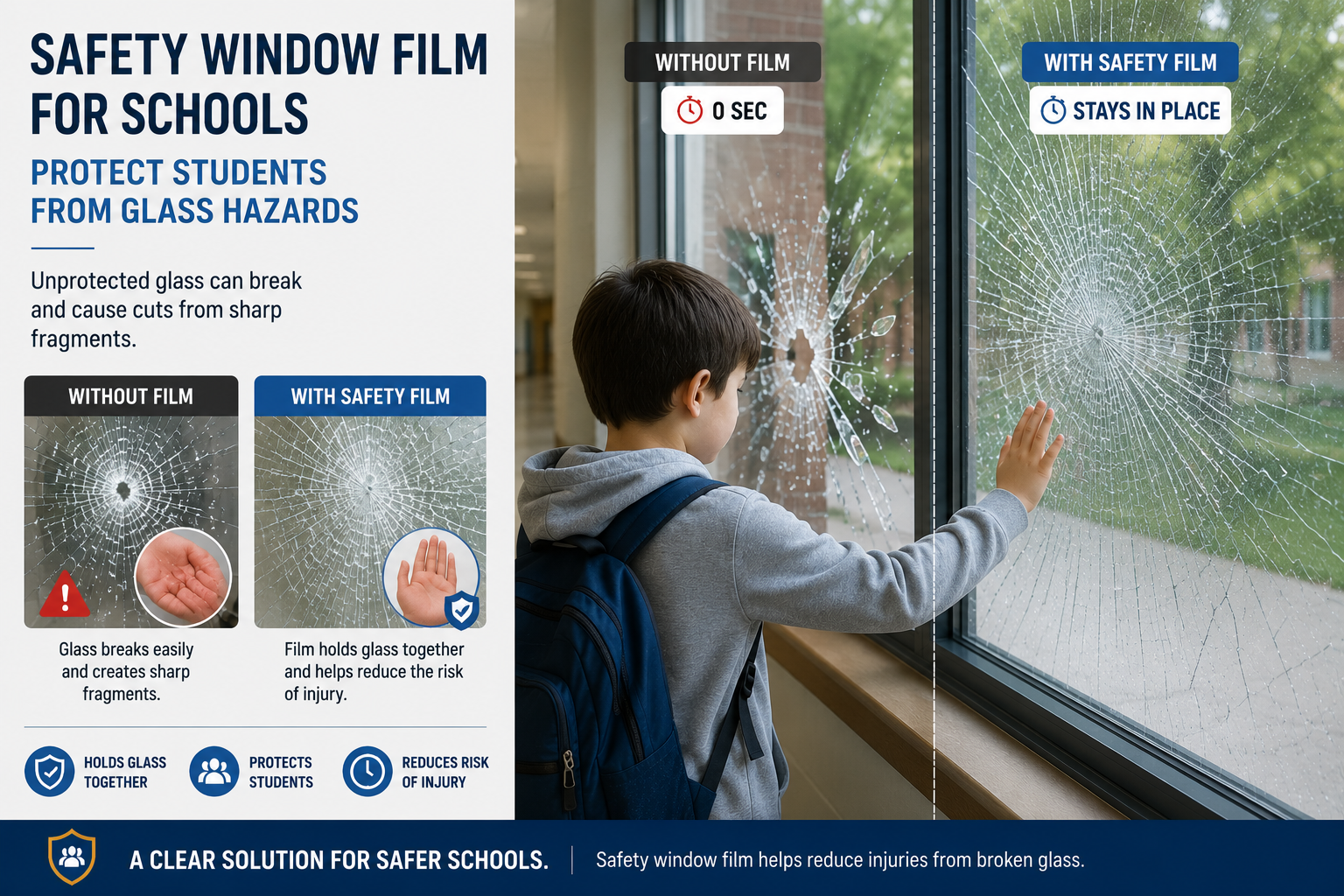
Safety window film helps schools reduce glass-related injuries by holding shattered glass together and protecting students from sharp fragments.
Schools present a specific window film brief that differs from most commercial applications. The combination of occupant vulnerability (children), high foot traffic near glass surfaces, code compliance requirements for existing non-compliant glazing, and an increased focus on building security has created growing demand for safety film in educational settings — and a corresponding need for clear guidance on what to specify and why.
The Glass Hazard Landscape in Schools
Accidental injury: The most common glass-related hazard in schools is accidental breakage — children running into glass doors, balls or sporting equipment striking windows, falls against glass surfaces during physical activity. Most glass injury incidents in schools are accidents, not deliberate acts.
Standard annealed glass shatters into large, sharp fragments. Standard tempered glass breaks into small cubes but immediately creates an opening. Both present injury risk in school environments. Safety film on existing annealed glass provides fragment retention that substantially reduces laceration injuries in accidental breakage.
Code compliance: Many older school buildings have glazing that predates current safety codes. UK Building Regulations, US CPSC guidelines, and equivalent standards in most countries specify safe glazing requirements for glass in critical locations — doors, sidelites, low-level panels, glass near sporting areas. Safety film is a recognised compliance pathway for upgrading non-compliant existing glass without full replacement.
Security: School security has received increased attention over the past decade. Ground-floor windows and glass entry doors are primary access points for forced entry. Security film delays forced entry, providing time for lockdown procedures to be enacted and first responders to arrive.
Priority Locations in School Buildings
Not all glass in a school carries equal risk. Prioritising by risk profile ensures budget is applied where it has the most impact.
Highest priority:
Glass doors and sidelites — primary accidental injury risk and primary forced entry access point
Glazing adjacent to corridors used for physical activity or where running children regularly pass
Low-level windows (below 800mm from floor) — accessible to children, high fall-through risk
Gymnasium windows, sports hall glazing — impact from sporting equipment
Second priority: 5. Ground-floor classroom windows — security and accidental protection 6. Internal glazed partitions at low level 7. Library and computer room glazing (occupant density, valuable equipment)
Third priority: 8. Upper-floor classroom windows (lower direct hazard, but storm and seismic value) 9. Administrative areas not directly student-accessible
Product Specification for Schools
For Accidental Safety and Code Compliance
4–6 mil safety film on all identified non-compliant and high-risk glazing locations. This provides:
Fragment retention for glass injuries from accidental breakage
EN 12600 Class B2/B3 compliance (verify against your specific jurisdiction’s requirement)
UV protection as a secondary benefit
Clear film is invisible — installation doesn’t change the school’s visual character and doesn’t create institutional-looking tinted windows.
For Security (Ground-Floor Entry Points)
8 mil security film with frame attachment on ground-floor entry glass doors and windows identified as primary forced entry vectors.
This provides:
Fragment retention
Forced entry delay: 60–120+ seconds under sustained hand tool attack
EN 12600 B1 compliance
Time for lockdown procedures and alarm response
The security specification for schools should be developed in conjunction with the school’s broader security plan — film is one layer of a security strategy that includes access control, alarm systems, CCTV, and staff procedures.
Dual-Function Products
Safety films combining fragment retention performance (EN 12600 B2) with modest solar control (TSER 40–50%) are available and useful for schools where both safety compliance and classroom overheating are problems on the same glazing. Addressing both requirements in a single product installation is cost-effective compared to separate treatments.
The Lockdown Scenario: What Safety Film Does and Doesn’t Do
Safety film has been marketed in the US market in particular around school safety and active shooter scenarios. The honest assessment:
What safety film realistically provides in an intruder scenario:
Ground-floor security film (8 mil with frame attachment) delays forced entry through a window by 60–120+ seconds
This delay is meaningful for lockdown procedures — many school lockdown protocols require 2–3 minutes to implement
The visual and audible profile of defeating security film (sustained pounding, noise, visible effort) is a deterrent to opportunistic intruders and increases the likelihood of detection
What safety film does not do:
It does not stop a determined attacker with adequate time and tools
It does not substitute for door hardware, access control, or lockdown protocols
Glass door security film is not equivalent to impact-rated door replacement for the highest security threat scenarios
Schools in the US seeking to comply with increasingly specific state-level security requirements should verify that their specific film specification meets any codified standards in their state before relying on film as a compliance solution.
Procurement Considerations for School Districts
Phased Programme Management
For a school district managing multiple buildings, a phased approach based on risk is practical:
Immediate: Safety film on all glass doors and sidelites district-wide (compliance and injury prevention)
Phase 2: Security film on identified ground-floor forced entry vectors (security upgrade)
Phase 3: Upper-floor and supplementary glazing (storm, seismic, comfort)
Third-Party Framework Procurement
In the UK, schools can procure through Crown Commercial Service and Local Authority frameworks. In the US, many state procurement frameworks include glazing film. Procurement through pre-tendered frameworks typically ensures competitive pricing and simplifies the governance process.
FAQ
Does window film on classroom windows affect learning environments?
Clear safety film is invisible — it doesn’t affect classroom lighting, views, or ambiance. Lightly tinted safety/solar control film reduces incoming light slightly (VLT 60–80% for light tints) — noticeable but not significantly impactful. Darker security film (VLT 30–50%) on security-critical windows may require supplemental lighting in some classroom configurations.
Are there any insurance discounts available for schools that install security film?
In some markets, yes — particularly UK schools where LPS 1270-rated installations may support lower commercial property insurance premiums for break-in coverage. US school districts should check with their insurer about whether security improvements including window film affect their property or liability coverage terms.
How should a school communicate safety film installation to parents and community?
Framing matters. Safety film as “glass safety upgrade to reduce injury risk from accidental breakage” is accurate and broadly supported. Security framing can be appropriate for secondary communication about ground-floor entry security but may create unnecessary anxiety if over-stated. The primary message should be the genuine primary benefit: preventing glass fragment injuries in accidents.
Specify the Right Safety Film for Your School Estate
KSB Window Film supplies safety and security film for educational building projects with EN 12600 certification documentation. Our technical team can help develop a phased specification programme for school districts.