Safety Film vs Tempered Glass: Which Provides Better Protection?
Published: July 30, 2026 · 8 min read · Category: Window Film Guide
About this article: KSB Window Film produces safety and security window film alongside our solar control range, supplying glazing contractors and building project buyers. This comparison draws on our product development and market experience across architectural film categories.
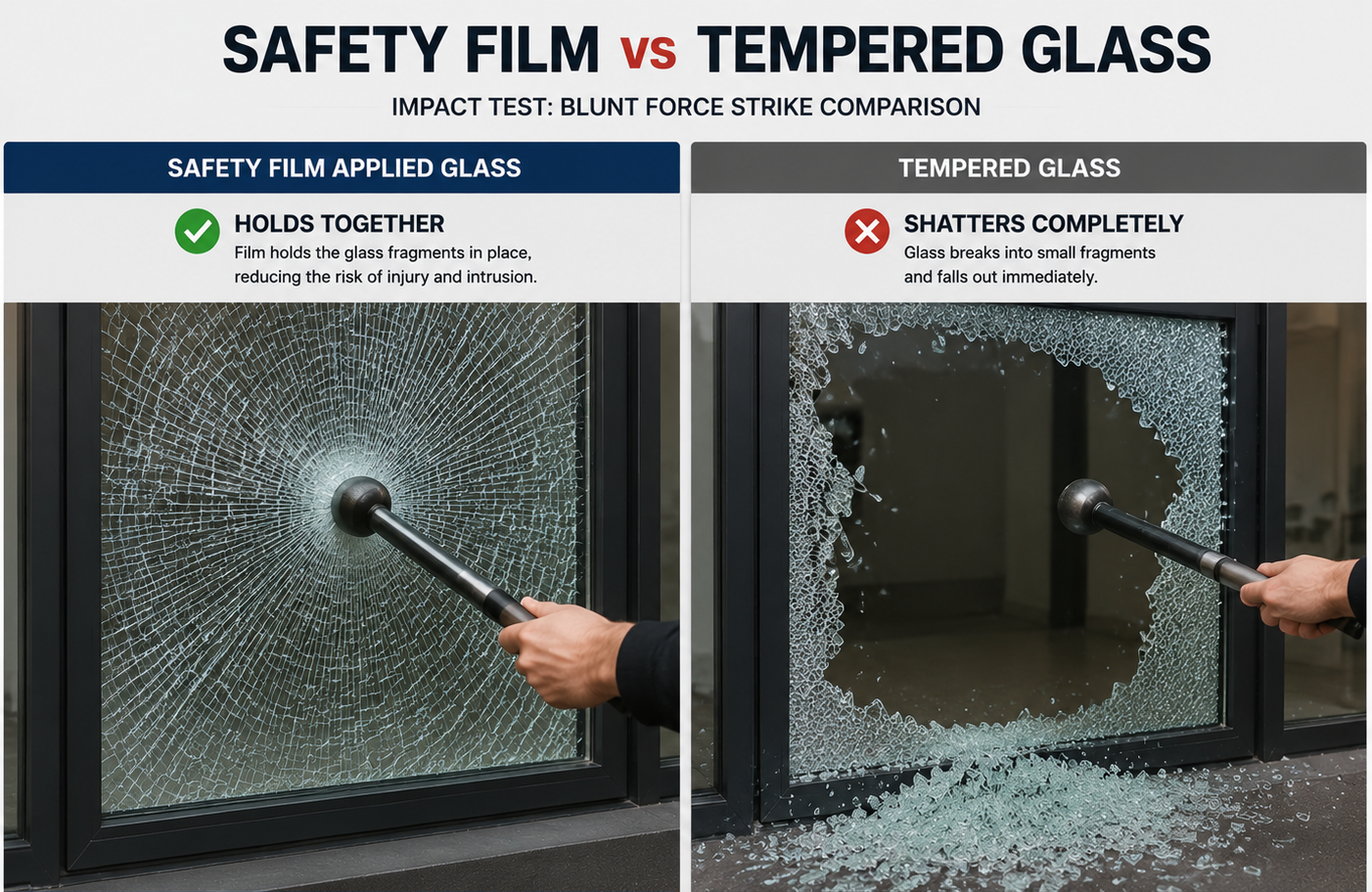
Side-by-side comparison showing how safety window film holds glass fragments after impact, while tempered glass shatters completely, highlighting safety and security differences.
This comparison comes up most often in one of three contexts: a specifier deciding whether to use safety film on a building’s existing annealed glass, a procurement team weighing the cost of glass replacement against film installation, or a security consultant evaluating options for a building that needs improved forced entry resistance.
In each case, the question sounds straightforward but isn’t — because “better protection” depends entirely on what you’re protecting against. Safety film and tempered glass are not direct substitutes. They protect against different threats, fail differently, and have different installation implications.
This guide lays out an honest comparison.
What Each Product Is
Safety window filmis a thick, multi-layer polyester film applied to the inside surface of existing glass. It’s designed to hold glass fragments together when the glass breaks — preventing the scatter of glass shards that causes most glass-breakage injuries. Safety film doesn’t prevent glass from breaking; it manages what happens when it does.
Thickness typically ranges from 4 mil (100 microns) for basic safety film to 12+ mil for heavy-duty security applications. The film is bonded to glass using a strong pressure-sensitive adhesive, and in professional security installations, may be “wet-glazed” or “mechanically attached” to the frame to prevent the glass-film unit from being pushed inward after breaking.
Tempered glass (also called toughened glass) is glass that has been thermally processed — heated to around 650°C then rapidly cooled — creating compressive stress at the surface and tensile stress in the core. When tempered glass breaks, it shatters into small, blunt fragments rather than sharp shards. It’s significantly stronger than standard annealed glass — approximately 4–5 times the surface hardness — and is code-required in many building applications (entry doors, shower enclosures, glass near floor level).
How They Fail Differently
When safety-filmed glass is broken: The glass cracks but the film holds the fragments together in the frame. The visual result is a cracked panel — still in place, still providing some barrier. The glass may bow inward under continued force, but the fragment retention prevents shards from flying and slows penetration. For a smash-and-grab attack, this delay is the primary protective value — by the time the glass has been broken enough to allow entry, enough time has elapsed for an alarm to activate or security to respond.
When tempered glass breaks: It shatters immediately into small cubes or pebbles — safer than annealed glass shards in terms of injury risk, but no longer a barrier at all. Tempered glass, once broken, provides zero resistance. A single impact breaks the entire pane completely, creating an immediate opening.
This failure mode difference is critical for security applications: tempered glass is arguably worse than safety-filmed annealed glass for forced entry resistance, because a single blow provides complete, immediate access.
Protection Against Specific Threats
Blunt Force / Smash-and-Grab
Safety film: Effective — specifically designed for this scenario. The fragment retention slows penetration and the continued presence of a cracked but intact panel delays entry. High-quality safety film (8+ mil) on glass that has been mechanically attached to the frame can withstand sustained attack with hand tools for 60–120+ seconds.
Tempered glass: Poor to no resistance after initial breakage. The glass breaks completely from a single focused impact.
Verdict: Safety film is significantly better for smash-and-grab resistance.
Flying Glass Injury (Breakage from Any Cause)
Safety film: Excellent. Fragment retention is the core design function. Whether the glass breaks from impact, seismic event, or accident, the film holds fragments in place. Studies show safety film substantially reduces glass-related injuries in building collapses, explosions, and storm damage.
Tempered glass: Good but not equivalent. Small blunt fragments from tempered glass breakage are safer than annealed glass shards, but still present at the breakage site and can be dispersed by blast overpressure. Tempered glass provides no protection against secondary fragment scatter in a blast event.
Verdict: Safety film is better for fragment retention; tempered glass improves on annealed glass for fragment safety.
Blast Resistance
Safety film: High-performance blast film (certified to GSA or DoD standards) is specifically designed for bomb blast mitigation. The film holds large glass fragments together during the positive pressure phase and prevents secondary fragment impact injuries — the most common blast-related injury mechanism. Safety film is standard in US government building blast protection specifications.
Tempered glass: Not blast-resistant. Tempered glass shatters into small particles under blast overpressure — the particles are less sharp than annealed shards but still accelerate to dangerous velocities in a blast wave. No blast mitigation value.
Verdict: Safety film wins decisively for blast resistance.
UV and Solar Control
Safety film: Safety film is primarily a structural product — solar control and UV blocking are secondary properties. Some safety film products incorporate UV blocking (typically 99%+ UV rejection) and modest IR rejection, but they’re not optimized for thermal performance.
Tempered glass: Provides no UV or solar control benefit over standard glass unless combined with a low-E coating (separate process).
Verdict: Neither is specifically designed for solar control. For combined safety and solar control, look for products specifically engineered for both.
Code Compliance
Tempered glass: Required by building code in many applications — glass in doors, sidelites, shower enclosures, glass near floor level, glass accessible to children. In these applications, tempered glass is a code requirement, not an option.
Safety film: Safety film is not a code substitute for tempered glass in code-required locations. You cannot install safety film on annealed glass in a shower enclosure and claim code compliance in place of tempered glass.
Verdict: Tempered glass wins for code compliance in required applications. Safety film cannot substitute for code-required tempered glass.
Cost Comparison
Safety film installation: $15–$45 per square meter for the film itself, depending on product tier, plus installation labor. A complete safety film installation on existing annealed glass is a fraction of the cost of glass replacement.
Tempered glass replacement: $80–$200+ per square meter for fabricated tempered glass, plus replacement installation which typically requires a glazier and potentially structural support depending on the application.
For large areas of existing glass where the primary concern is fragment safety or forced entry resistance, safety film delivers substantial protection at a small fraction of glass replacement cost.
The Right Answer for Common Scenarios
Retail store concerned about smash-and-grab: Safety film on existing glass, mechanically attached at the frame perimeter.
Building in a seismic zone concerned about glass injury in earthquake: Safety film — holds fragments in the frame during shaking.
Shower enclosure compliance: Tempered glass — safety film is not a code substitute.
Ground-floor office concerned about blast threat: Blast-rated safety film to GSA specifications — this is what government buildings use.
School or hospital replacing old annealed glass: If the primary goal is fragment safety, safety film is cost-effective. If glass is at a code-required location, tempered glass replacement is required regardless.
New construction specification: Specify tempered glass in all code-required locations (doors, sidelites, accessible glazing). Consider safety film or laminated glass in above-code locations where forced entry or blast resistance is a concern.
FAQ
Can safety film be applied over tempered glass?
Yes, safety film can be applied to tempered glass. The film adds fragment retention for the case where the tempered glass does break. The combined result — tempered glass (blunt fragments) plus safety film (fragment retention) — is better than either alone for fragment safety. For blast applications, this combination is often specified.
Does safety film make glass impossible to break?
No. Safety film holds fragments together after breakage; it doesn’t make glass unbreakable. High-performance security film significantly delays forced entry (measured in sustained effort rather than a single blow), but a determined attacker with adequate tools will eventually penetrate any glass-film combination.
Is there a product that combines solar control with safety film?
Yes. Multi-functional window films combining safety (fragment retention), solar control (TSER, UV blocking), and security (forced entry resistance) are manufactured by several companies including 3M, Eastman, KSB Window Film, and other Chinese manufacturers with certified safety film capability. These are marketed as “safety and solar” or “security and solar” films and are specified in commercial buildings where both performance requirements apply.
What certifications should safety film have?
For architectural safety applications: EN 12600 (European impact test standard) certification. For blast applications: GSA/Department of State (US government) blast resistance certification. For general fragment retention: ANSI Z97.1 or equivalent. See What Certifications Should a Window Film Manufacturer Have? for the full certification evaluation framework.
Can I install safety film myself?
For basic fragment retention on residential glass, DIY installation is possible with appropriate tools and care. For security-focused installations where frame attachment (wet glaze or mechanical) is required, professional installation is necessary — the frame attachment component requires glazing expertise to execute correctly.
Source Certified Safety Film for Your Project
KSB Window Film manufactures safety and security window film for architectural applications — including EN 12600-rated fragment retention products and multi-functional safety/solar control combinations. We can provide product-specific test documentation and connect you with the right specification for your project requirements.