Security Window Film for Banks and Financial Institutions
Published: August 29, 2026 · 8 min read · Category: Safety & Security Film
About this article: KSB Window Film manufactures high-security window film for institutional applications. Banks and financial institutions represent the most specification-intensive commercial security film application — this guide addresses the specific brief.
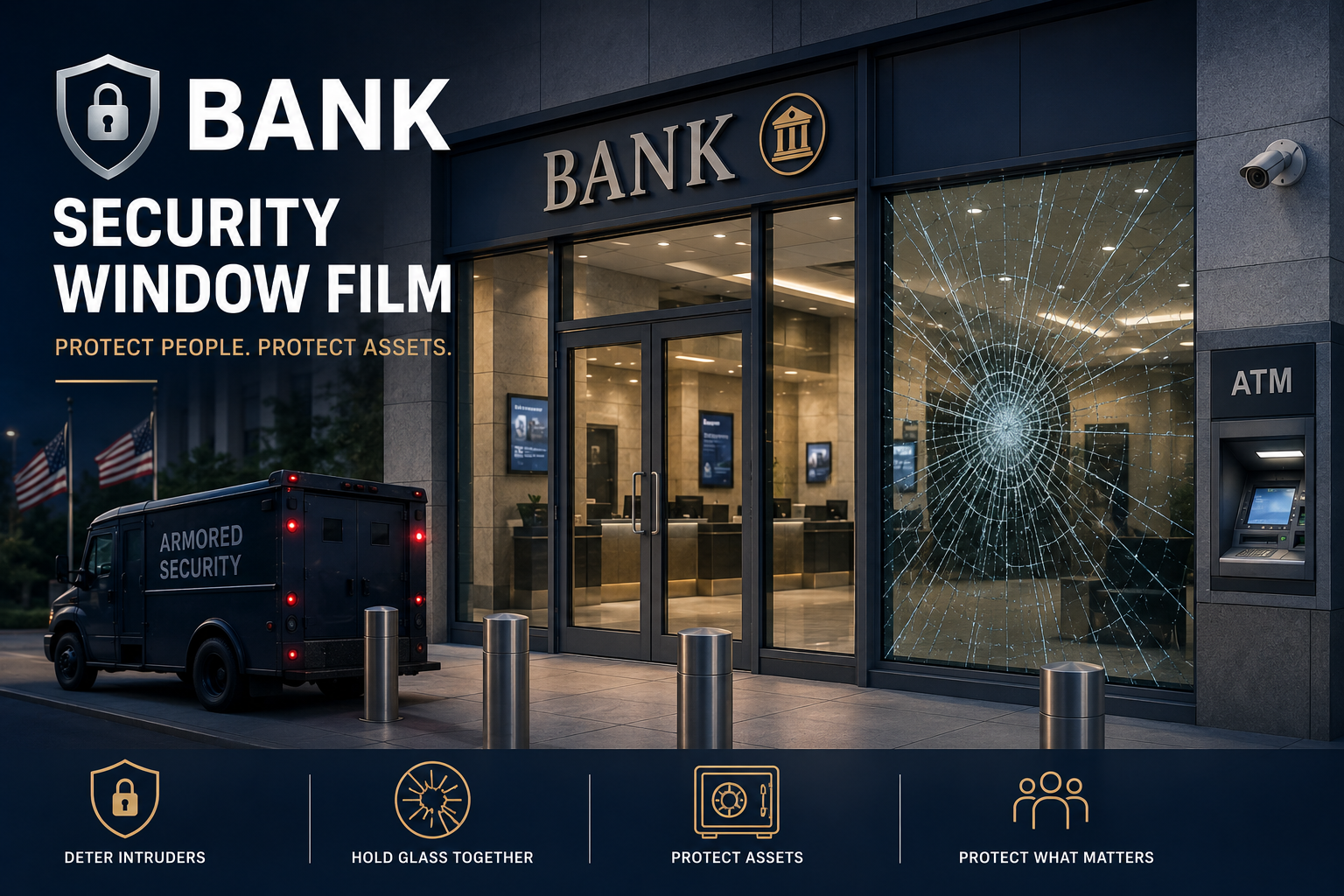
Security window film helps delay forced entry, retains broken glass, and protects banks, ATMs, and financial institutions.
Banks and financial institutions occupy the top tier of security window film specification requirements. The combination of high-value targets, professional criminal threat profiles, regulatory oversight of security measures, and insurance requirements that specify performance standards creates a brief that requires more than standard commercial security film.
The Bank Security Brief
Banks face a different threat profile from retail smash-and-grab:
Professional cash-in-transit and branch attacks: Targeting cash, safety deposit contents, or specific items — using planning, tools, and sometimes force against staff. The time-to-penetrate requirement is longer than for opportunistic retail smash-and-grab.
ATM and lobby attacks: Often using vehicles to ram through glass lobby walls or ATM enclosures. Requires film and frame systems capable of resisting vehicle impact forces.
Robbery under duress: While not directly addressed by window film (this involves in-branch dynamics), ground-floor security film is part of the overall perimeter hardening that discourages certain attack methodologies.
Counter staff visibility vs. security: Banks balance the need for customer visibility and approachability (open, transparent design) against the need for physical security barriers. Security film that provides fragment retention and forced entry delay without changing the branch’s visual character is the typical solution.
Specification Standards for Financial Institutions
UK/Europe: UK banking security specifications typically reference LPS 1270 at Class A2 or A3 minimum for external glazing at branch level. Many institutions have their own security standards that reference or exceed LPS 1270. Insurance requirements (from specialist financial institution insurers) typically specify minimum attack resistance standards.
US: No single mandatory federal standard for bank branch glazing security, but major banking institutions have corporate security standards that specify performance levels. UL 972 Class 2 or higher is commonly referenced.
Key certification difference from retail: Financial institutions typically require LPS 1270 or UL 972 certification documentation — not just EN 12600. The difference: EN 12600 is an impact standard; LPS 1270 and UL 972 are attack resistance standards that test sustained tool assault over time.
Security Film Specification for Banks
External Glazing (Street-Facing)
Minimum specification: 10–12 mil security film with wet-glazed or mechanical frame attachment.
Performance target: LPS 1270 Class A2 minimum (3-minute attack resistance with basic hand tools). Class A3 (5-minute) for branches with elevated threat profiles.
Appearance consideration: Banks typically want security film that doesn’t signal heightened security in a way that affects customer perception. Clear 10–12 mil film provides this — invisible at normal viewing distance.
For branches where exterior signage or display windows are part of the design: confirm that the film specification doesn’t affect the display quality for any signage or promotional materials.
Lobby and Entrance Glazing
Standard specification: 8–10 mil security film with frame attachment on all lobby glass panels not already specified as laminated glazing.
Many modern bank branches use laminated glass in the lobby — safety film is still valuable on any annealed or standard tempered glass in the space.
Counter Glazing and Transaction Areas
Counter glazing (the glass between teller and customer) is typically specified as polycarbonate or laminated glass in new construction — this provides ballistic resistance that security film does not. For older branches with standard counter glazing, security film improves fragment retention but does not provide ballistic protection.
Ballistic-grade glazing (polycarbonate, glass-clad-polycarbonate) is separate from safety film and addresses a different threat profile. Don’t substitute security film for ballistic glazing where ballistic protection is the requirement.
ATM Enclosure Glazing
ATM enclosures are targeted for both access to the machine and smash-and-grab on cash in transit. Security film on ATM enclosure glass provides:
Fragment retention from vehicle ram or tool attack
Extended forced entry delay
Deterrent effect against less-determined attacks
For ATM installations where vehicle ramming is a credible threat, the frame and structural attachment must be engineered to handle vehicle impact forces — significantly beyond what standard window film frame attachment addresses.
Insurance and Compliance Documentation
Banks operating under financial institution insurance policies typically need to document their physical security measures. Security film certification documentation required:
LPS 1270 or UL 972 test certificate for the specific film product
Installer certification confirming the installation matches the certified specification
Frame attachment detail documentation
Photo record of the completed installation
Important: The certification must cover the specific film-glass-frame assembly as installed. A film certified to LPS 1270 Class A2 in a certified test configuration doesn’t automatically provide Class A2 performance in a different installation. The installation specification must match the certified configuration.
KSB Window Film provides product-specific LPS 1270-referenced documentation and installation guidance that meets the documentation requirements for financial institution security compliance.
Integration with Broader Bank Security
Security film is one layer in a bank’s physical security strategy. For maximum effectiveness, it should be integrated with:
Alarm systems: Glass break detectors and vibration sensors that activate immediately on the first impact — before any attempt to penetrate the film.
CCTV: Coverage of all external glazing, with footage retention that supports police investigation of any attempted attack.
Intercom and remote access: Lobby access control that doesn’t rely solely on the physical security of the glazing.
Dye pack and smoke systems: For branches where cash attack scenarios are the primary threat — delays attacker post-penetration while activating response.
Staff procedures: Training on lockdown, silent alarm activation, and communication with security response.
FAQ
Can security film substitute for laminated glass in bank specifications?
For most fragment retention and forced entry delay requirements: yes, with appropriate specification. For ballistic protection (protection against firearms): no — ballistic-grade laminated glass or polycarbonate systems are the appropriate solution. Security film does not provide meaningful ballistic resistance.
What’s the difference between LPS 1270 and the bank’s own security specification?
Many large financial institutions maintain proprietary security standards that reference LPS 1270 as a minimum while specifying additional requirements. The film supplier and installer need to be familiar with the institution’s specific standard, which may require additional documentation, testing, or installation details beyond the LPS 1270 certificate.
How often should security film at bank branches be inspected?
Annual inspection is recommended, with immediate inspection after any incident (attempted break-in, significant impact event, flood or temperature extreme). Signs of deterioration (edge lifting, adhesion reduction, top coat cracking) indicate the film needs replacement to maintain performance. Post-incident replacement is required if the film sustained significant stress even if breakage didn’t occur.
High-Security Film for Financial Institution Specifications
KSB Window Film manufactures 10 mil and 12 mil security film with LPS 1270-referenced performance documentation. Our technical team provides full specification support for financial institution security requirements including installer guidance and certification documentation.