Published: October 29 2026 · 7 min read · Category: Sunroof Film
About this article: KSB Window Film provides TSER and IR rejection data for our sunroof film range. This guide gives specific, quantified heat rejection data — not marketing ranges — with the methodology to interpret it correctly.
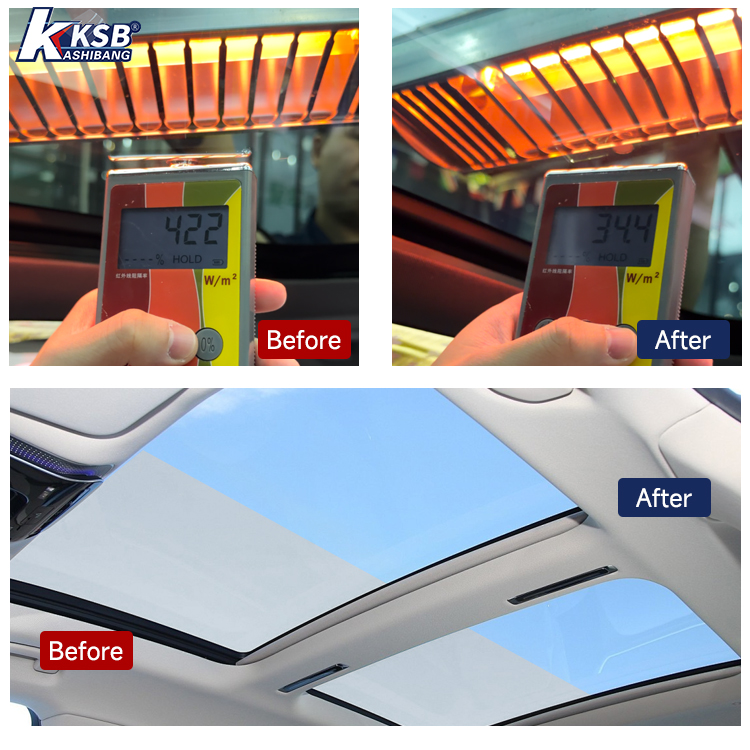
Before and after test showing reduced solar heat after installing sunroof film.
The most useful answer to “how much heat can sunroof film block?” is a number. TSER — Total Solar Energy Rejected — is that number, and it ranges from approximately 35% for entry-level film to 70%+ for premium ceramic film. But the number needs context to be meaningful. This guide provides both.
The Solar Energy Split
Sunlight arriving at your panoramic glass carries roughly:
44% visible light (380–780nm) — what your eyes see, contributes to heat
51% near-infrared (780–2,500nm) — the primary heat carrier, invisible
TSER is the percentage of all three components combined that the film prevents from entering the cabin. A film with TSER 60% blocks 60% of the total solar energy — meaning 60% less solar heat enters through that glass panel compared to unfilmed glass.
Heat Blocked by Film Technology Tier
Entry-Level Dyed Film: TSER 35–45%
Dyed film achieves heat rejection primarily through absorption. The dye absorbs solar radiation, converting it to heat in the film itself. Some of this heat re-radiates inward; some dissipates through the glass outward.
What 40% TSER means: 40 units of heat blocked for every 100 units arriving. The remaining 60 units enter the cabin. Improvement over unfilmed glass, but less than half blocked.
IR rejection: Typically 30–50% in the near-IR range.
Carbon Film: TSER 45–55%
Carbon film uses carbon particles rather than dyes, with better IR absorption properties. Less fading and colour stability than dyed film over time. Better heat rejection per VLT level.
What 50% TSER means: Exactly half the arriving solar energy blocked. Noticeable improvement in heat comfort, particularly on the radiant heat sensation.
IR rejection: Typically 45–60% in the near-IR range.
Ceramic / Nano-Ceramic Film: TSER 55–70%
Ceramic nanoparticles (typically titanium nitride or tungsten compounds) selectively target infrared wavelengths for absorption and rejection. Because the rejection is concentrated on the infrared (heat) component rather than distributed equally across all wavelengths, ceramic film achieves higher TSER at higher VLT than other technologies.
What 60% TSER means: 60 units of heat blocked per 100 arriving. The remaining 40 units enter the cabin. Combined with high VLT (70–80%), this is the most practical choice for panoramic roofs.
IR rejection: Typically 70–90%+ in the near-IR range (780–1,800nm).
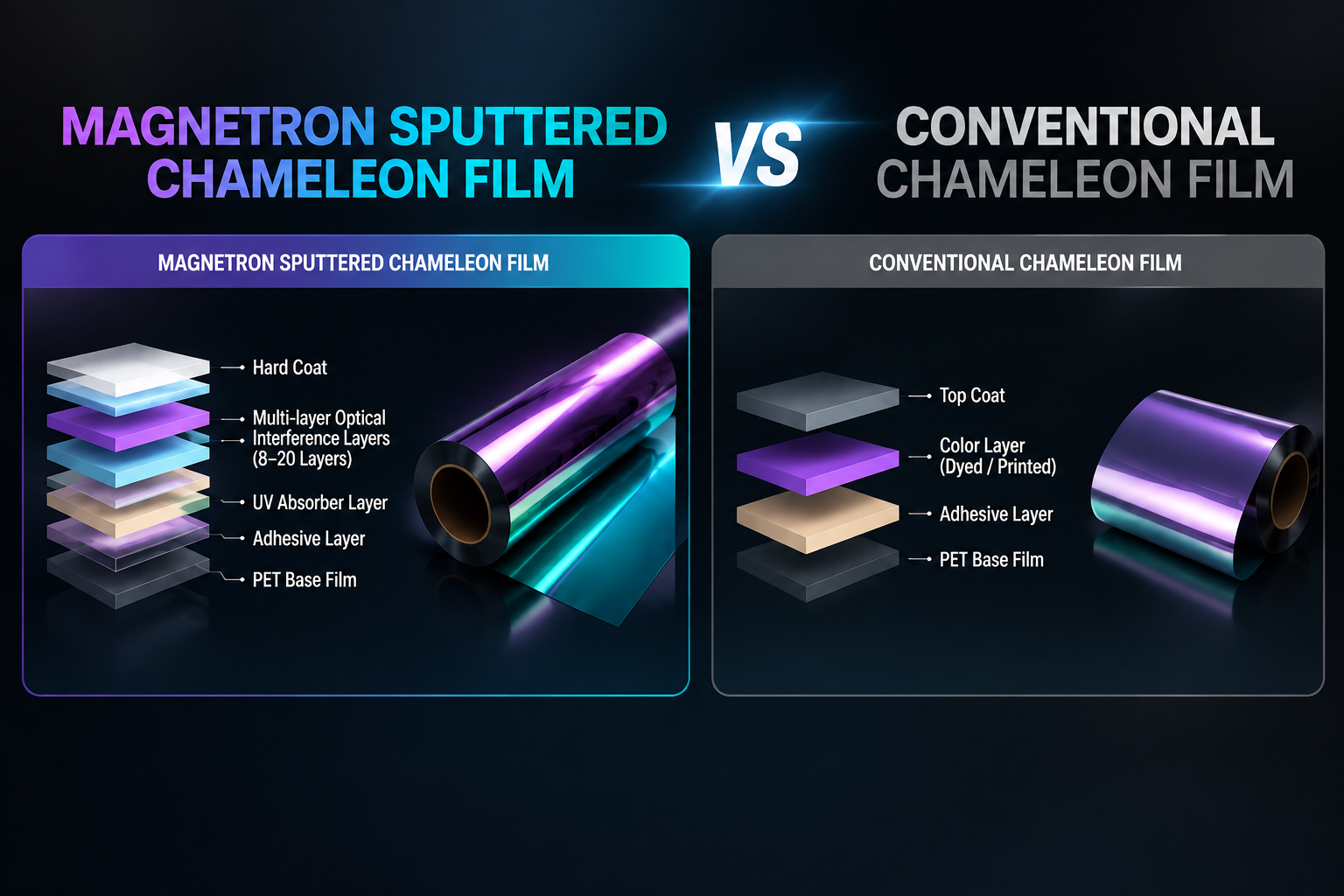
Magnetron Sputtered Metallic Film: TSER 60–75%
High-performance metallic film deposited using magnetron sputtering achieves heat rejection through both reflection and absorption. Very high TSER at lower VLT (30–60%).
What 65% TSER means: Among the best heat blocking available in a film product. Trade-offs: darker appearance, potential RF signal interference.
IR rejection: 75–95% in the near-IR range.
Real-World Temperature Difference
To translate TSER percentages into practical experience, here’s a reference scenario:
Test conditions: 38°C ambient, peak solar radiation (1,000 W/m²), 90-minute parked vehicle, panoramic roof area approximately 1.2m².
Total solar energy arriving at roof glass: ~72,000 joules/hour.
Film
TSER
Heat entering cabin/hour
Cabin temp delta vs unfilmed
None
0%
72,000 J/hr
—
Dyed (40% TSER)
40%
43,200 J/hr
−5 to −8°C
Carbon (50% TSER)
50%
36,000 J/hr
−7 to −12°C
Ceramic (60% TSER)
60%
28,800 J/hr
−10 to −16°C
Magnetron metal (70% TSER)
70%
21,600 J/hr
−13 to −20°C
The temperature differences are peak estimates for parked-vehicle scenarios. In driving conditions with A/C active, the effect on cabin comfort is different (the A/C is managing temperature actively) but the radiant heat sensation through the glass is directly reduced proportional to TSER.
What TSER Doesn’t Tell You
It doesn’t tell you VLT. A 70% TSER metallic film might be 30% VLT (dark) while a 60% TSER ceramic film is 75% VLT (nearly clear). For sunroof applications where maintaining visible light is important, comparing TSER and VLT together is essential.
It doesn’t tell you infrared rejection specifically. TSER is a total figure — some film with high TSER achieves it by blocking a lot of visible light rather than targeting IR specifically. If you want to know how much of the invisible heat component is blocked, ask for IR rejection data separately.
It doesn’t guarantee the measurement methodology. TSER must be measured to a defined standard (ASTM E891, ISO 9050, or equivalent). Films tested at a single wavelength or at cherry-picked conditions produce misleading TSER claims. Request the test standard alongside the TSER number.
FAQ
What’s the minimum TSER I should look for in a sunroof film?
For meaningful heat reduction in a warm climate: 50% TSER minimum. Below this, the improvement is modest enough that many drivers don’t find the investment worthwhile. For best results: 60%+ TSER, achievable with quality ceramic film at maintained high VLT.
My installer quoted 99% infrared rejection. Is that different from TSER?
Yes — and this distinction matters. A 99% IR rejection claim is typically measured at a single wavelength (usually 900nm or 1,000nm) where ceramic particles have peak absorption. TSER covers the full solar spectrum with appropriate weighting. A film can have very high single-wavelength IR rejection while having a lower TSER. Request both numbers and the methodology for each.
Verified TSER Data With Every KSB Sunroof Film Sample
KSB Window Film provides current ISO 9050-referenced TSER and IR rejection data for our full sunroof film range. No single-wavelength claims — full-spectrum verified data.