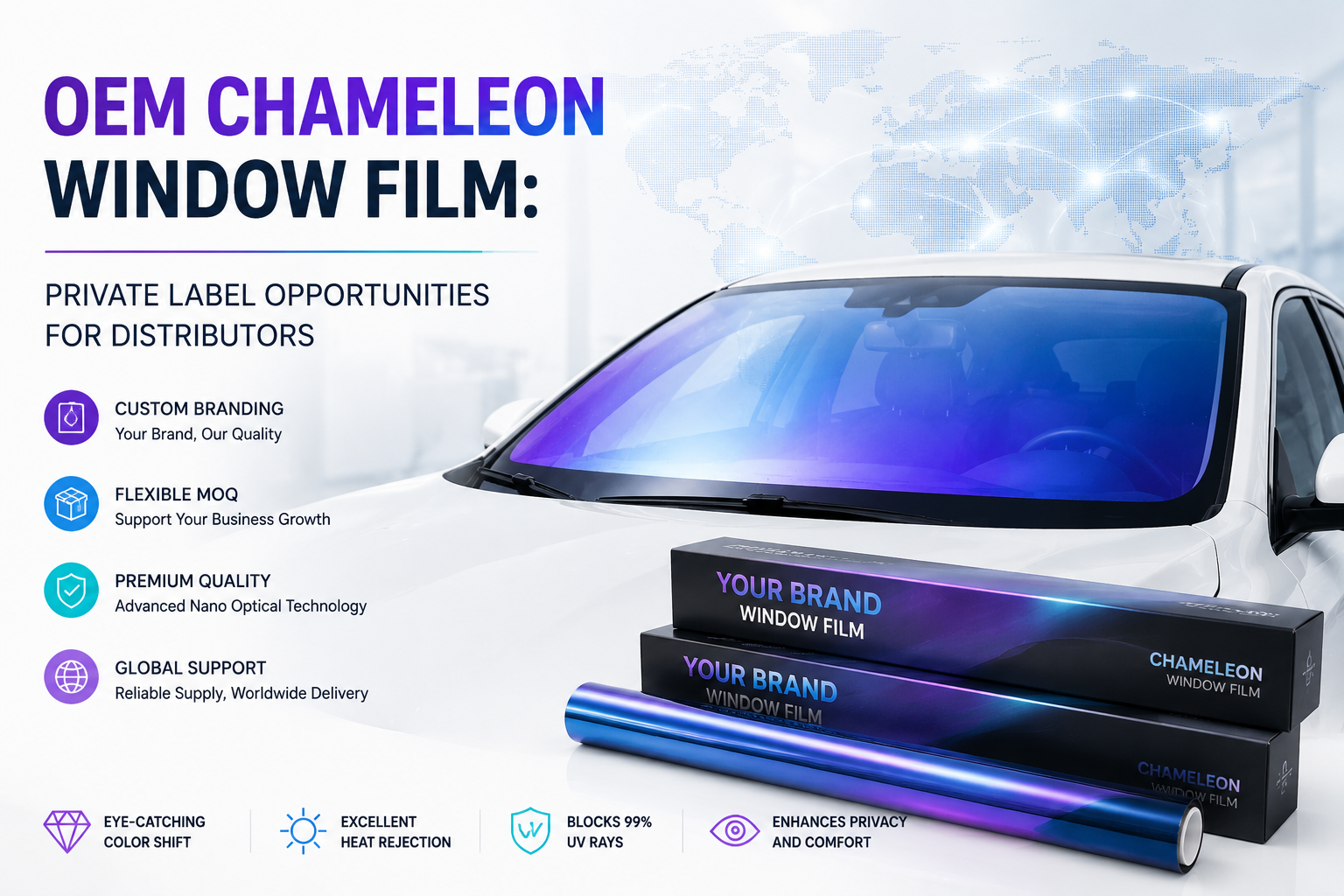
OEM Chameleon Window Film: Private Label Opportunities for Distributors
Published: October 23, 2026 · 8 min read · Category: Chameleon Window Film
About this article: KSB Window Film operates an OEM and private label programme for chameleon window film. This guide addresses the specific opportunity for distributors in a fast-growing, premium-priced aesthetic film category.
OEM chameleon window film private label program featuring custom packaging, color shifting technology, flexible MOQ, and global distribution support.
Chameleon window film occupies a specific and commercially attractive market position: it’s a premium-priced, fast-growing category with strong visual impact and growing consumer awareness, where brand differentiation matters and where private label creates meaningful commercial advantage.
Distributors who establish a credible branded chameleon film range in their market now are entering ahead of the field. This guide covers the private label opportunity, the programme structure, and the specific considerations for chameleon film that differ from standard automotive film branding.
The Chameleon Film Market Opportunity
Growing Demand, Limited Established Brands
In most Western markets, chameleon window film is in early mainstream adoption — well-known in enthusiast communities, increasingly requested by general consumers, but without the established brand hierarchy that exists in standard window tint. This is the ideal moment for a distributor to establish a branded position.
In Southeast Asian, Middle Eastern, and Eastern European markets, chameleon film is already mainstream. Understanding which stage your market is at determines how quickly you need to move to establish position before competitors do.
Premium Pricing Environment
Chameleon film commands a 40–80% premium over standard solar control film at comparable VLT. Consumers pay this premium for the aesthetic effect — there’s genuine willingness to pay for distinctiveness. This premium pricing environment rewards branded products more than commodity ones.
Installer Loyalty
Installers who recommend a branded chameleon product and build expertise in installing and discussing it create a loyalty dynamic that standard film purchasing doesn’t create. A customer who asks specifically for “your brand” of chameleon film is not price-shopping across distributor catalogues.
Private Label vs OEM for Chameleon Film
Private Label (Fastest Path to Market)
Your brand on KSB’s existing chameleon film specifications. Fast (6–8 weeks to branded product). Known colour performance from existing production experience. The underlying product is KSB’s.
Appropriate for: Distributors entering the chameleon category for the first time, testing market demand before deeper investment.
Private label scope for chameleon film:
Select from available colour combinations (purple-to-green, blue-to-purple, green-to-gold, others)
Select VLT range for each colour
Brand name, logo, and product naming on roll labels and outer packaging
Product specification sheet under your brand
OEM (Custom Colour Development)
You brief KSB on a specific colour combination or colour shift characteristic that isn’t in the current standard range. KSB develops the layer stack to achieve it.
Custom development scenarios:
Exclusive colour combination that competitors can’t match by simply ordering the same stock product
Specific VLT target at a colour combination not in current range
Custom intensity of colour shift (more subtle or more dramatic than standard)
Additional functional layers (higher TSER alongside specific colour combination)
Development timeline: 8–14 weeks for optical design, sample production, and colour validation. Development cost: $3,000–$8,000 depending on novelty of the specification.
Appropriate for: Distributors with established volume who want a genuinely proprietary product.
The Chameleon Film Product Range Architecture
When building a private label chameleon film range, consider:
By colour combination (2–3 colours at launch): Start with the most popular combinations in your market. Purple-to-green is globally the most popular. Blue-to-purple is popular in cooler-preference markets. Green-to-gold performs well in Middle Eastern and Southeast Asian markets.
By VLT tier within each colour:
Light (55–65% VLT): for front windows in markets with permissive regulations, or rear windows where lighter appearance is preferred
Dark (35–50% VLT): for rear windows, maximum colour intensity
By application category:
“Street” line: accessible pricing, standard performance
Chameleon film naming has a distinctive vernacular that resonates in the market. Effective approaches:
Colour-led naming: Name after the colour effect — “Aurora Purple,” “Neptune Shift,” “Ember Gold.” This communicates the product character immediately.
Effect-led naming: Name the intensity of the effect — “Prism,” “Spectrum,” “Mirage,” “Eclipse.” Creates a premium aesthetic language.
Avoid: Generic “premium solar control film” language for chameleon products. The visual effect is the story; the name should reinforce it.
Packaging for Chameleon Film
Chameleon film packaging has unique requirements:
Colour swatch on the label: Unlike solar control film where VLT and TSER are the selling specs, chameleon film’s key spec is the colour shift. The roll label should show both the base colour and the shift colour — either as a split colour graphic or as photographs of the film in different conditions.
“Signal-compatible” clarification: If your product uses metallic layers (standard for chameleon film), it’s important to set expectations. Consider “note: contains metallic layers, may affect some electronic signals” as a label statement to prevent customer complaints about GPS signal after installation.
Regulation note: “Check local window tinting regulations before installation” is standard practice but particularly important for chameleon film, where the colour-shifting properties sometimes lead consumers to misunderstand that it’s subject to VLT regulations like standard tint.
Documentation Package for Private Label
Technical documents (under your brand):
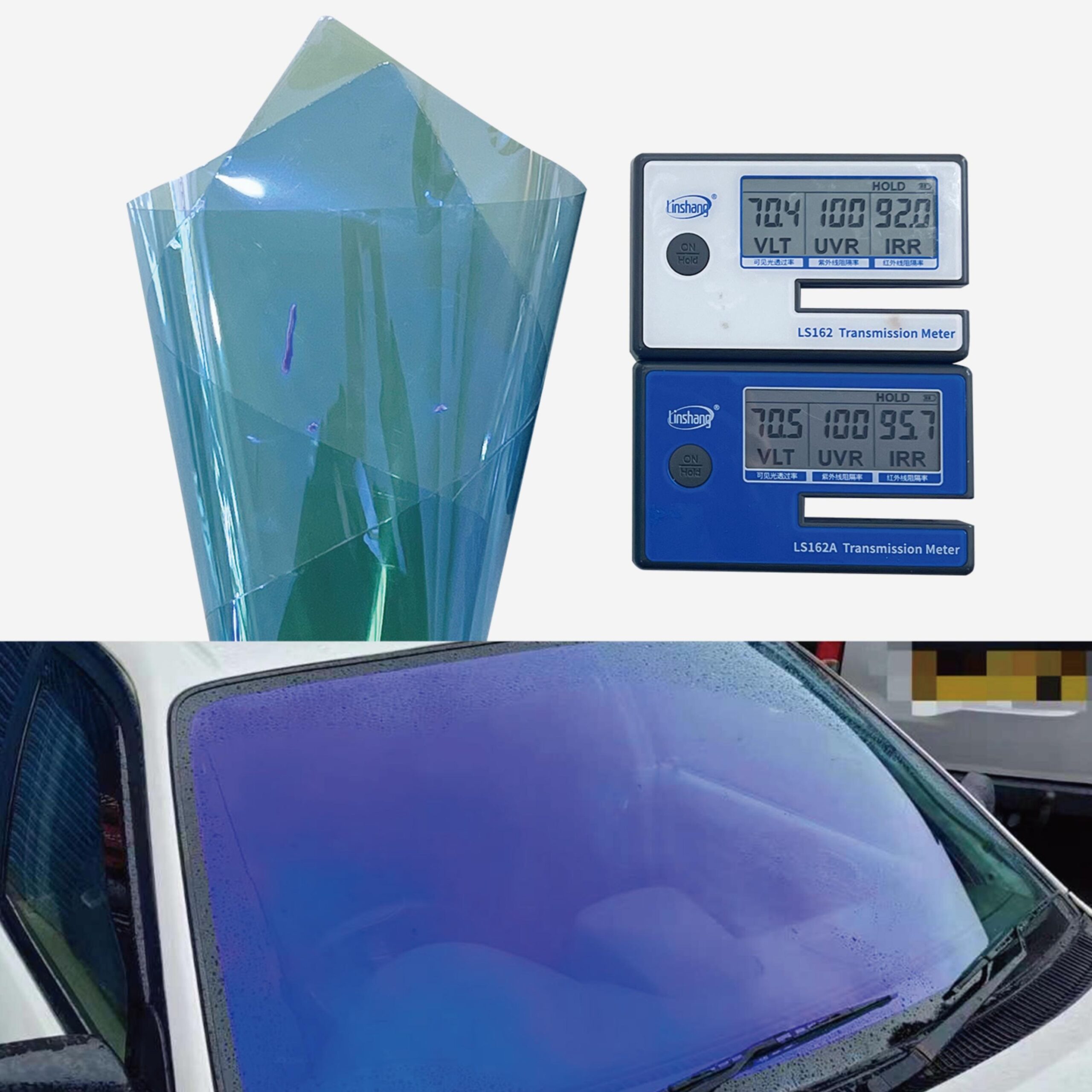
Product data sheet: colour combination description, VLT, TSER, UV rejection, IR rejection
Installation guide: specific handling notes for chameleon film (temperature sensitivity during installation, squeegee technique for multilayer stacks)
Regulation reference: overview of window tinting regulations in your market by window position
Performance evidence:
SGS or Intertek test report for VLT, UV, and solar performance (under your brand name)
Distributor to installer pricing: 2.5–4× landed cost (higher margin than standard tint, justified by premium positioning).
FAQ
Can I get exclusivity on a colour combination?
For private label on stock colour combinations: limited exclusivity — we may supply similar colours to other distributors. For OEM custom development: strong exclusivity on the specific specification. If standing out from other distributors is the goal, OEM development of a custom colour is the route to genuine exclusivity.
How quickly is the chameleon film market growing?
Chameleon film has been growing at 15–25% annually in the automotive aftermarket in most major markets. Growth is fastest in markets where car culture and aftermarket personalisation are strong (Middle East, Southeast Asia, Eastern Europe) and accelerating in Western markets as consumer awareness builds.
KSB Window Film provides a structured private label programme for chameleon window film — colour range selection, custom packaging development, first-order flexibility, and full technical documentation.