Hydrophobic Windshield Film: Rain Repellency, Visibility, and What to Expect
Published: October 23, 2026 · 7 min read · Category: Windshield Film
About this article: KSB Window Film manufactures windshield protection film with hydrophobic top coat options. Hydrophobic claims are among the most enthusiastically marketed — and most frequently misunderstood — in the windshield film category. This guide gives honest, measurable expectations.
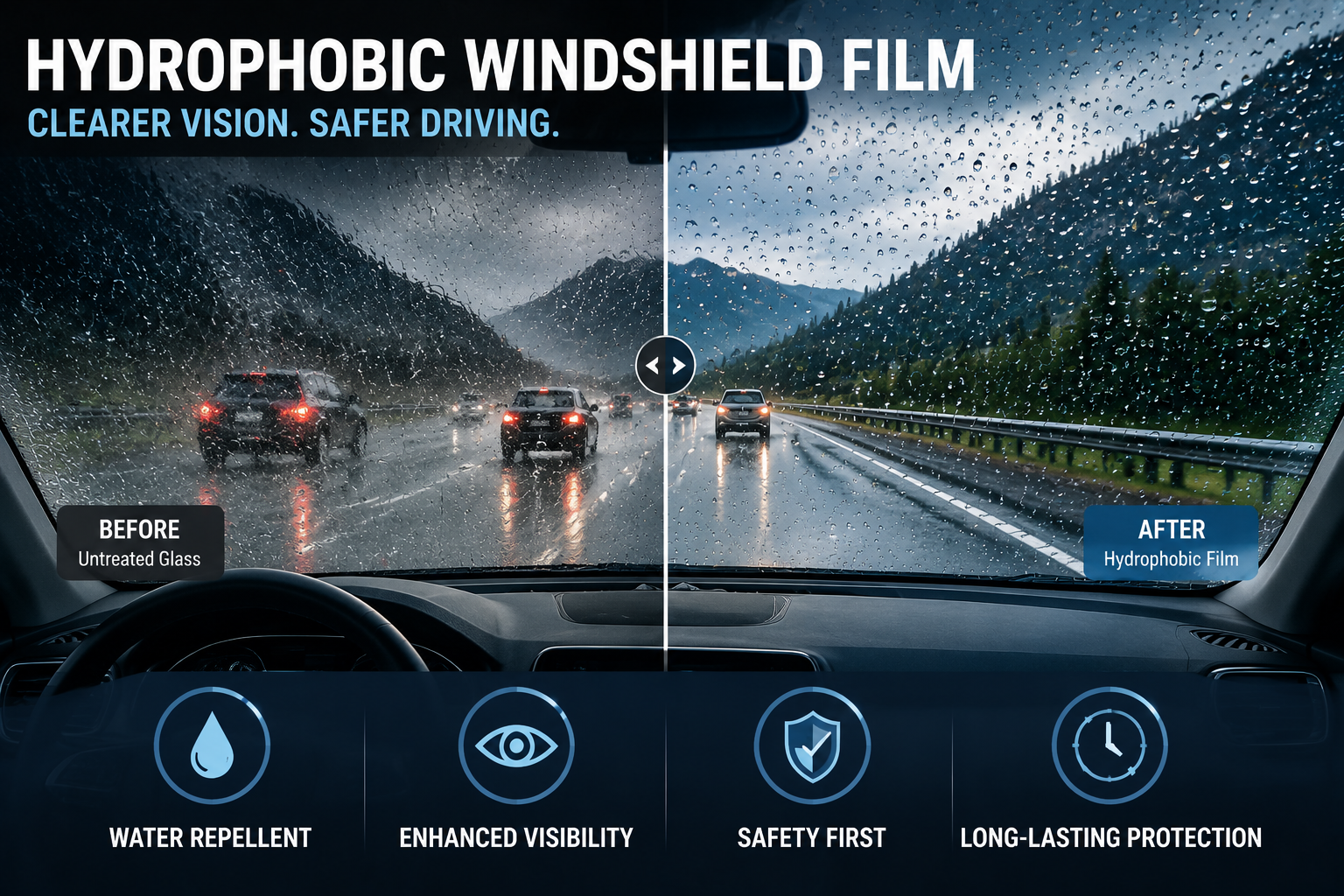
Hydrophobic windshield film helps repel rainwater, improve wet-weather visibility, and provide a clearer driving experience during highway conditions.
The marketing imagery for hydrophobic windshield film consistently shows perfect spherical water droplets rolling off glass at dramatic angles. The reality is more conditional — hydrophobic windshield film genuinely improves wet-weather driving visibility in specific conditions, performs less dramatically in others, and requires maintenance that most buyers aren’t told about upfront.
Understanding what hydrophobic film does and doesn’t do in real driving conditions sets expectations correctly and produces satisfied customers rather than disappointed ones.
How Hydrophobic Coatings Work
A hydrophobic surface resists wetting — water forms high-contact-angle droplets (above 90°) rather than spreading into a sheet. The surface chemistry reduces the adhesion energy between water molecules and the surface, causing water to bead and roll rather than sheet.
In automotive film, hydrophobic properties come from:
Fluoropolymer top coat treatments: Fluorine-containing surface coatings that have extremely low surface energy, producing contact angles of 100–120°
Silicone-based coatings: Lower surface energy than standard polymer surfaces, producing contact angles of 90–110°
Nano-structured surfaces: Micro or nano-scale surface texture (inspired by the lotus effect) that creates a composite surface energy much lower than the flat material alone
Premium hydrophobic windshield film uses fluoropolymer or nano-structured top coat chemistry to achieve water contact angles above 100°. At these angles, water droplets bead well and roll off under gravity and airflow.
What Hydrophobic Film Actually Delivers on a Windshield
At Speed (Above 70 km/h)
This is where hydrophobic windshield film performs best. At highway speed, the airflow across the windshield provides the driving force to roll water beads off the surface. A well-beaded surface with contact angle above 110° clears rapidly under these airflow conditions, dramatically reducing the amount of water on the glass at any time.
Real-world effect: At 90–100 km/h in rain, hydrophobic windshield film can make wiper operation unnecessary or significantly reduceable. The windshield surface is almost self-clearing. This is the scenario the marketing imagery is based on — and it’s genuine.
For highway drivers in wet climates, this is a meaningful safety improvement: less wiper-created visual disturbance, clearer sightlines in the between-wipe intervals, and in some cases a completely clear field of view without wipers.
At Low Speed and Stationary
At low speed (below 40 km/h), there’s insufficient airflow to roll water beads off the surface. The beads sit on the glass surface, creating a different visual problem — the large beads themselves scatter light and create visual interference, particularly with oncoming headlights at night.
The beading paradox: Water beading is optically better than sheeting at highway speed (beads move off quickly, sheeting persists). At low speed, large beads sitting stationary on the glass scatter light from different angles simultaneously — creating a visual diffusion effect that can be worse than sheeted water managed by wipers.
The honest expectation: Hydrophobic windshield film improves visibility significantly at highway speed. At low speed and in urban driving, its contribution is more modest and the visual character of water on the glass is different from non-hydrophobic film — not necessarily worse in all conditions, but different.
At Night
Wet night driving is the most visually demanding condition. Oncoming headlights scatter through water on the windshield, creating glare and reduced contrast.
Hydrophobic film’s contribution to night wet driving visibility depends on speed: at highway speed, the reduced water presence on the glass reduces headlight scatter significantly. In urban night conditions with slow-moving wet traffic, the large beads create their own light-scattering effect.
Hydrophobic Film vs. Applied Hydrophobic Treatments (Rain-X, etc.)
Many drivers are familiar with applied hydrophobic treatments — products like Rain-X applied directly to the glass surface. How does hydrophobic windshield film compare?
Durability: integrated into the film top coat — service life matches the film (2–4 years)
Maintenance: reduced (film top coat doesn’t degrade as rapidly as applied treatment)
Cost: significantly higher upfront, but lower ongoing maintenance
For drivers who consistently maintain an applied hydrophobic treatment, the comparison is close on performance with different maintenance commitments. For drivers who apply Rain-X once and forget about it (the vast majority), hydrophobic film provides significantly more consistent long-term performance.
The Maintenance Reality
Hydrophobic film top coats lose performance over time through:
Contamination: Wax, silicone-based car care products, and road film can fill the nano-scale surface texture that creates the hydrophobic effect. The contact angle drops and beading becomes less pronounced.
Wiper abrasion: Wiper blades sweeping across the film surface gradually wear the top coat. Premium fluoropolymer coatings are durable, but not permanent. The hydrophobic performance of the film gradually degrades over its service life.
Insect residue and hard water spots: Both can chemically bond to the hydrophobic surface and create areas where the surface energy is locally higher — spots where beading fails.
Maintenance to preserve hydrophobic performance:
Clean with pH-neutral, silicone-free car shampoo
Avoid wax-based products on the windshield
Remove insect residue and water spots promptly with appropriate cleaning solution
Periodic application of a hydrophobic refresh spray (compatible with film top coat) can restore performance between film replacement cycles
ADAS Interaction Consideration
Rain sensors detect water using IR reflection through the glass. Hydrophobic film changes how water sits on the glass surface — beads rather than sheets. This changes the effective surface area of water on the glass at any moment, which can affect the rain sensor’s detection pattern.
Most rain sensors calibrate automatically to the current wiper response pattern. However, the relationship between water on the glass and the sensor’s output may be different with hydrophobic film than with standard glass. See the detailed analysis in Windshield Film and Rain Sensors: Will It Interfere?.
In practice: most modern rain sensors adapt without issue to hydrophobic surfaces. Some older or less-sophisticated automatic wiper systems may behave differently. Testing automatic wiper response after film installation is the appropriate check.
Who Benefits Most From Hydrophobic Windshield Film
Highway-primary drivers in wet climates: The ideal use case. Regular motorway driving in markets with significant rainfall — UK, Northern Europe, Pacific Northwest US, Southeast Asia wet season. The combination of speed and frequent wet conditions produces consistent hydrophobic performance gains.
Drivers who dislike frequent wiper use: Some drivers find wiper-cleared sightlines distracting. Hydrophobic film reduces the need for wipers at speed — a meaningful quality-of-life improvement.
Drivers who currently maintain chemical hydrophobic treatments: Hydrophobic film provides equivalent or superior performance with significantly less maintenance overhead.
Less compelling for: Urban-primarily drivers with minimal highway exposure. Drivers in dry climates where wet-weather visibility isn’t a frequent concern.
FAQ
Can I apply a chemical hydrophobic treatment (Rain-X) over hydrophobic windshield film?
Not recommended. Applying chemical hydrophobic products over hydrophobic film can chemically interact with the film’s top coat, potentially degrading both the film’s performance and its self-healing properties. Use products specifically recommended for film maintenance, not general glass treatments.
Does hydrophobic film work when it’s very cold?
In cold conditions (below 5°C), water beading is less pronounced — the reduced surface mobility of cold water reduces the effectiveness of hydrophobic surfaces. In near-freezing conditions, hydrophobic film still provides better water clearing than non-hydrophobic glass but performs less dramatically than at warmer temperatures.
How do I test if the hydrophobic performance is still active on my existing film?
Spray a small amount of water on the windshield when stopped. If the water beads into high-contact-angle droplets (nearly spherical, sitting proud of the surface), the hydrophobic performance is active. If the water sheets or forms low-profile puddles, the hydrophobic top coat has degraded and may benefit from a compatible hydrophobic refresh treatment or film replacement.
Hydrophobic Windshield Film That Performs at Speed
KSB Window Film manufactures windshield protection film with fluoropolymer hydrophobic top coat — tested for water contact angle above 105° and validated through real-world driving assessment. Sample panels available with water contact angle data.