Magnetron Sputtered Chameleon Film vs Conventional Chameleon Film
Published: June 2026 · 7 min read · Category: Chameleon Window Film
About this article: KSB Window Film manufactures chameleon film using magnetron sputtering. This comparison addresses the quality difference between sputtered and non-sputtered chameleon products — a distinction that matters significantly for this specific film category.
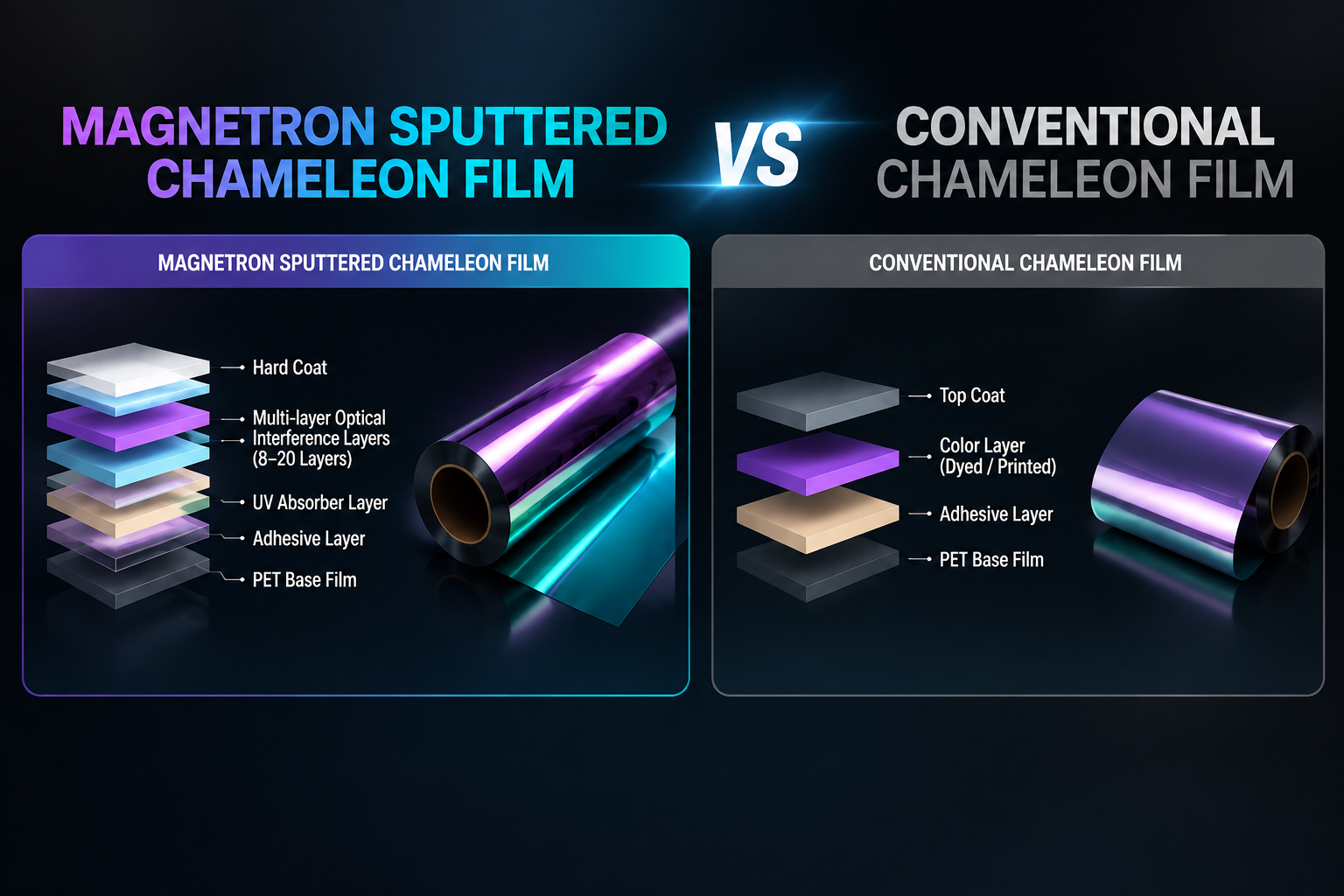
Comparison of magnetron sputtered chameleon film and conventional chameleon film, highlighting optical layer precision, color shift quality, and manufacturing differences.
Unlike standard solar control film where the difference between magnetron sputtered and conventionally manufactured film is meaningful but incremental, for chameleon film the manufacturing method is close to determinative of product quality. The colour-shifting effect that defines chameleon film is only achievable with the nanometre-level precision that sputtering provides. “Conventional” chameleon film — if it exists at all as true thin-film interference film — represents a severely limited capability.
Why Magnetron Sputtering Is Non-Negotiable for True Chameleon Film
The colour-shifting effect of chameleon film is produced by optical interference from a multilayer thin-film stack. For this to work:
Individual layers must be 20–100nm thick (0.02–0.1 microns)
Thickness must be controlled to ±2–5nm tolerance
Multiple different materials must be deposited in precise sequence
Each layer must have excellent adhesion to adjacent layers
Only magnetron sputtering can achieve all four requirements at commercial production scale.
Conventional evaporative deposition can deposit thin metallic layers but cannot:
Achieve the layer thickness consistency needed for interference effects (evaporation produces ±10–20% thickness variation, vs ±2–5% for sputtering)
Deposit dielectric materials (TiO₂, SiO₂) — evaporation of these materials produces stoichiometrically impure films with wrong optical properties
Maintain the vacuum stability needed for multi-stack deposition with multiple material switches
In practice, “conventional chameleon film” typically means one of two things:
A lower-quality sputtered film with less process control (not truly “conventional deposition”)
A wet-coated film with pearlescent pigments that creates a surface shimmer effect — not true optical interference
What “Conventional” Actually Means in the Market
When the market references “conventional chameleon film,” it typically means lower-tier products produced by one of:
Poorly controlled sputtering: The same process (magnetron sputtering) but with less precise control of deposition parameters — larger thickness variations, less precise layer count, inconsistent vacuum conditions between runs. These produce chameleon effects but with lower colour saturation, worse batch consistency, and shorter durability.
Pearlescent wet-coating: A wet coating containing mica-based or aluminium-flake pearlescent pigments. These produce an iridescent shimmer effect, particularly in reflected light. The effect is visible and attractive but is fundamentally different from true thin-film interference — it doesn’t produce the distinct, direction-dependent colour shift of sputtered chameleon film.
Performance Comparison
Characteristic
Premium sputtered chameleon
Lower-tier / inconsistent sputtering
Pearlescent wet coat
Colour shift mechanism
True thin-film interference
Thin-film interference (lower quality)
Surface scattering / pearlescence
Colour shift intensity
High saturation, vivid
Moderate, less saturated
Subtle shimmer, not colour shift
Batch colour consistency
ΔE < 2 (controlled)
ΔE variable (uncontrolled)
More consistent (uniform pigment)
Layer count
8–20+ layers
3–8 layers
N/A (single coating)
Colour stability over time
Excellent (dielectric protection)
Moderate
Good (pigment-based)
Delamination risk
Low (strong inter-layer adhesion)
Higher (adhesion quality varies)
Low (monolithic coating)
TSER contribution
Moderate (metallic/dielectric stack)
Lower
Minimal
Price
Premium
Mid
Low
How to Tell the Difference
The Angle Test
True thin-film interference chameleon film shows a directional colour shift — the colour depends on the angle between the light source, the film, and your eye. If you hold a sample up and move your position while keeping the light source fixed, the colour changes.
Pearlescent pigment film shows a diffuse shimmer — light reflects in many directions simultaneously, producing a general iridescence visible from a wide range of angles without a sharp directional shift.
Test: In a room with a single directional light source (a desk lamp, or direct sun through a window), hold the film sample up at arm’s length and tilt it slowly.
True interference film: As you tilt, the colour shifts distinctly — you’ll see it go from one clear colour to another clear different colour.
Pearlescent film: You’ll see a general shimmer in the light but the dominant “colour” changes less distinctly.
The Transmission Test
Hold the film up to the light (transmittance view, not reflection view):
True sputtered chameleon film typically has a distinctive transmitted colour that’s complementary to the reflected colour
Pearlescent coating may look more like ordinary dark tint in transmission
The Consistency Test (Between Rolls)
Order two rolls from different batches:
Premium sputtered film: colour appears consistent between batches
Lower-quality sputtered: visible colour difference between batches
This test requires actual rolls, not samples from one batch
Why Buyers Should Care
For distributors and installers, the distinction matters because:
Customer expectations: A consumer who saw chameleon film on social media (which typically shows vibrant, high-saturation interference colour) expects that effect. Pearlescent pigment film or low-quality sputtered film doesn’t deliver the same visual impact. The installation creates a disappointed customer.
Reputation: Installers who recommend chameleon film that loses its colour vibrancy within 12 months, or where batch colour differences are visible on the same vehicle, get complaints. The installer’s reputation is tied to the product quality.
Price justification: Chameleon film commands a premium. That premium is justified by the genuine optical engineering of proper thin-film interference film. Selling pearlescent pigment shimmer film at chameleon film prices is a value mismatch.
FAQ
How do I verify a supplier uses magnetron sputtering for their chameleon film?
Ask for: (1) a description of their coating equipment for this product, (2) the target materials they use (TiO₂ and SiO₂ or metallic targets), and (3) a video walkthrough showing the sputtering equipment. A genuine sputtered manufacturer can describe this clearly. A supplier using wet coating or an extremely basic sputtering process will be evasive about equipment details.
KSB’s Chameleon Film: Verified Sputtered, Not Simulated
KSB Window Film’s chameleon range is produced by magnetron sputtering with optical design via thin-film simulation. We can describe our equipment, show you the process, and demonstrate the colour shift under controlled conditions.