PPF Cost Analysis: Factory-Direct Sourcing vs. Trading Companies
Published: August 10, 2026 · 7 min read · Category: PPF Sourcing
About this article: KSB Window Film is a manufacturer, not a trading company. This cost analysis is written honestly — including where trading companies provide genuine value for smaller buyers.
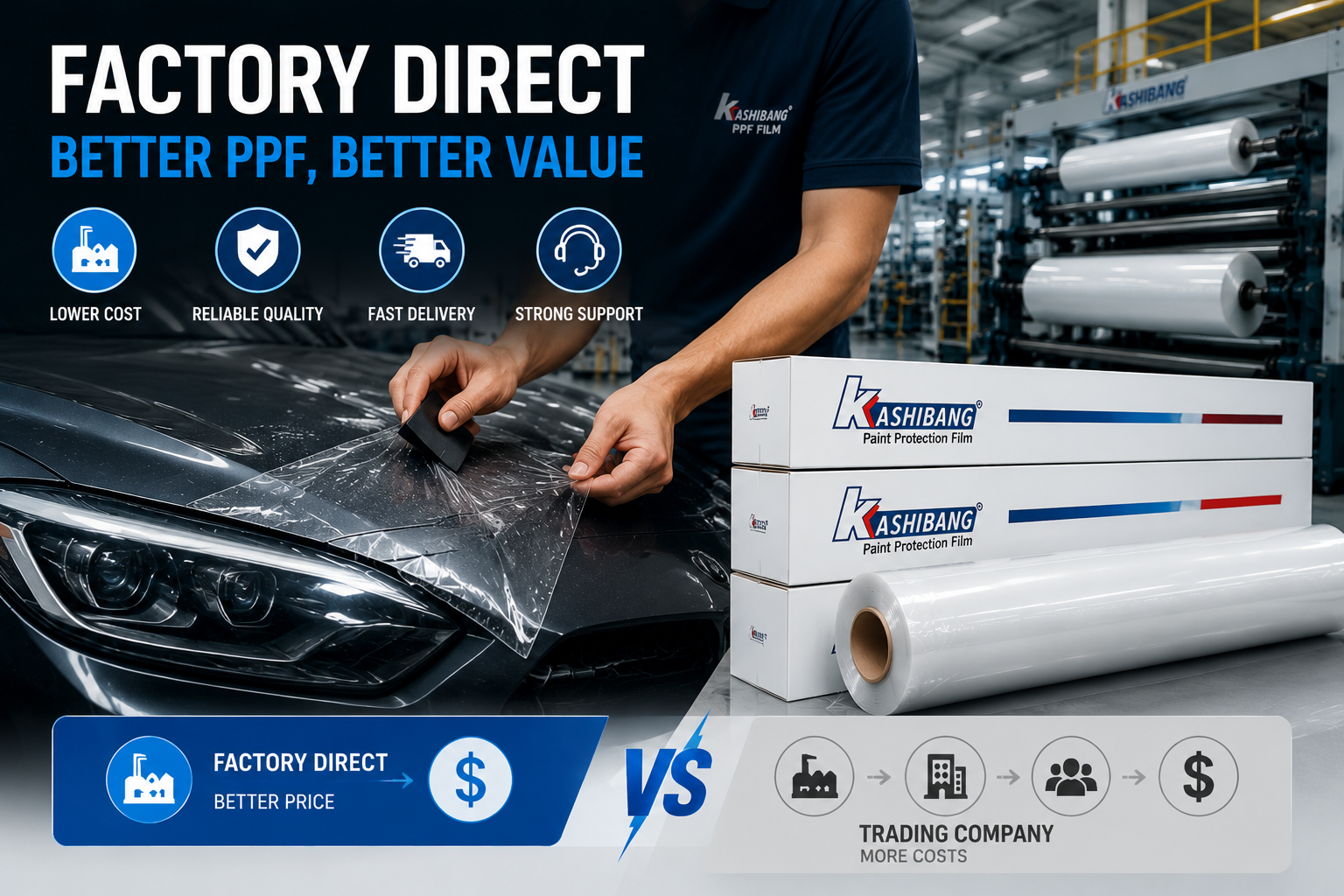
factory direct ppf manufacturing delivers lower cost, stable quality, and faster supply compared to trading company sourcing.
The choice between buying PPF from a Chinese manufacturer directly or through a trading company is framed as a price question, but it’s actually a volume and service question. Trading companies exist because they provide genuine services at smaller volumes. At larger volumes, those services are worth less than the margin being paid for them.
Maintains relationships with 5–15 manufacturers across different products
Consolidates small orders from multiple buyers into factory-minimum quantities
Handles import/export documentation, customs, and logistics
Provides single-supplier contact for multiple products
Buffers the buyer from the manufacturer’s MOQ requirements
These services have genuine value for buyers who:
Need small quantities (below factory MOQ)
Want multiple products (window tint, PPF, vinyl wrap) from one supplier
Don’t have the volume or capability to manage a direct factory relationship
Are in early market development and need flexibility
The Trading Company Margin
Trading companies typically add 20–40% to factory ex-works pricing, depending on their operation model and the value they add.
Example: 7.5mil PPF, 200 rolls per order
Cost element
Factory direct (KSB)
Trading company
Film ex-works price
$3.80/sqm
$4.90–$5.30/sqm
Trading company margin
—
$1.10–$1.50/sqm
Per roll (1.52m × 20m = 30.4sqm)
$115.50
$149–$161
Per 200-roll order
$23,100
$29,800–$32,200
Saving per 200-roll order (factory direct)
$6,700–$9,100
At 200 rolls/order, factory-direct saves approximately $7,000–$9,000. If you order quarterly, that’s $28,000–$36,000 per year in margin that stays with you rather than the trading company.
What Factory-Direct Access Adds Beyond Price
Quality visibility: A trading company doesn’t have access to batch QC records, clean room monitoring data, or material specification documentation in the way KSB provides directly. When a quality issue arises, the trading company asks the factory — adding time and losing information fidelity.
Custom specification access: Private label, regional formulation adaptation (Middle East high-Tg adhesive, tropical hydrophobic), and OEM development are only available from the manufacturer. Trading companies can request standard products; they can’t develop or modify specifications.
Relationship depth: Over time, a direct manufacturer relationship enables: preferential production scheduling, early access to new product developments, joint specification work for your specific market. These are not available through a trading company.
Fewer intermediary communication errors: Technical questions about product specifications, compatibility, installation behaviour — these are answered correctly and quickly by the manufacturer’s technical team. A trading company passes the question along and loses nuance in translation.
When Trading Companies Make Sense (Honestly)
Volume below 50 rolls/month: At this volume, the freight cost per roll and MOQ management overhead may make the trading company premium worthwhile for the service of consolidated ordering.
Multi-product sourcing: A trading company can supply window film, PPF, vinyl wrap, and related products from multiple factories in one shipment. The logistics saving from consolidation may offset the product margin cost.
Very early market entry: Testing a market with 10–20 rolls before committing to a direct factory relationship. The flexibility of a trading company is worth the premium at this stage.
Making the Transition From Trading Company to Factory-Direct
If you’re currently buying through a trading company and your volume justifies moving direct:
Identify which products are your core volume (the 2–3 SKUs making up 80% of your PPF sales)
Contact manufacturers directly for those specific products
Request samples and compare to your current trading company supply
Use the mixed sample programme to test with low initial commitment
Transition gradually — run factory-direct alongside trading company for one cycle before fully switching
FAQ
My trading company says they source directly from the manufacturer. Is that true?
Some trading companies have exclusive arrangements with specific manufacturers. Others buy from the open market at whatever price is available. Ask your trading company to identify the manufacturer of your specific PPF product and confirm by cross-referencing with the manufacturer. If they’re reluctant to disclose, that tells you something.
KSB Window Film provides factory-direct pricing for distributors at qualifying volumes. Request a price comparison for your current volume and product range.
The 20–40% margin that trading companies add is the visible cost. There are also hidden costs that make the real premium higher:
Communication delays: A technical question about your PPF — adhesion compatibility with a specific paint system, formulation adjustment for your climate, documentation request for a regional certification — goes from you to the trading company to the factory and back. Each leg adds 1–3 days. A question that a factory can answer in 4 hours takes a week through a trader. For time-sensitive market situations, this delay has real commercial cost.
No access to OEM/custom development: The most significant hidden cost is what you can’t do through a trading company. Private label under your own brand, regional formulation adaptation (Middle East high-temperature adhesive, tropical hydrophobic coating), custom thickness combinations — none of these are available through a trading company. If you ever want to own a product differentiated from what your competitors can also order, you need a factory relationship.
Quality investigation friction: When a batch issue arises — yellowing on a customer’s vehicle, edge lifting complaints — the trading company’s investigation is limited to “asking the factory.” They can’t pull batch production records, review coating parameters, or expedite a resolution. The factory can do all of this directly. Resolution time through a trader: 2–4 weeks. Direct factory resolution: 3–5 business days for a clear diagnosis.
No long-term price stability: Trading companies buy from multiple factories based on price. Your pricing depends on their current sourcing arrangement. A direct factory contract with KSB provides multi-year price stability with defined escalation terms.
When Does Factory-Direct Become Economically Compelling?
The crossover point where factory-direct savings clearly outweigh the convenience of trading company supply:
Volume: Consistently above 50 rolls/month. At this volume, the freight cost per roll becomes efficient, the MOQ barrier is manageable, and the annual savings ($40,000–$80,000 at this volume) justify the investment in managing a direct relationship.
Product complexity: If you need private label or custom formulation, the factory-direct decision is mandatory regardless of volume.
Market position: If you’re positioning as a premium brand with documented product quality, you need factory access to the documentation that supports those claims. Trading companies can’t provide batch QC records and QUV test data with the same credibility as a manufacturer.
Building the Business Case Internally
For a distributor organisation where the sourcing decision involves multiple stakeholders:
Present to finance: The annual saving from factory-direct at your current volume ($40,000–$80,000+ at 100 rolls/month vs trading company pricing). Compare to the investment in: MOQ pre-financing, freight coordination, and relationship management time.
Present to operations: The quality documentation improvement — batch certificates, traceable QC records, direct technical support. These reduce the time and cost of managing quality issues.
Present to sales/marketing: The private label opportunity — owning a brand rather than reselling someone else’s. The competitive differentiation that comes from documented aliphatic TPU, QUV-verified anti-yellowing, and regional-specific formulation.
The case for factory-direct is rarely just price. It’s the combination of price, quality access, customisation capability, and long-term strategic positioning.
FAQ
Can I test factory-direct supply without fully committing to switching from my trading company?
Yes — and this is the recommended approach. KSB’s mixed sample programme and small first-order structure allow you to test factory-direct supply in parallel with your current trading company supply, without committing to a full transition. Prove the performance difference in your market before making it your primary supply.
My trading company says they have a factory agreement and the price difference to factory-direct is small. Is that true?
Some trading companies do have preferred supplier agreements that narrow the margin gap. Verify by cross-referencing with the factory directly — ask KSB whether that trading company is a registered distribution partner and at what pricing tier. If the trading company’s pricing is within 10–15% of factory-direct and they’re providing consolidation services you genuinely value, staying with them may be the right short-term decision. Above 15% premium to factory price: the math usually favours going direct.
Get a Free Sample or Quote
Looking for a reliable window film supplier? Contact us today for fast response and professional support.
✔ OEM / ODM Customization✔ Fast Global Shipping✔ Professional Technical Support