The Ultimate Checklist for Evaluating a New PPF Manufacturer in 2026
Published: August 1,2026 · 8 min read · Category: PPF Sourcing
About this article: KSB Window Film has been manufacturing PPF for over 20 years and regularly helps prospective distributors structure their supplier evaluation. This checklist reflects the criteria that distinguish manufacturers capable of long-term partnership from those who aren’t.
A structured B2B framework for evaluating PPF manufacturers in 2026, covering production, materials, certifications, OEM services, and after-sales support
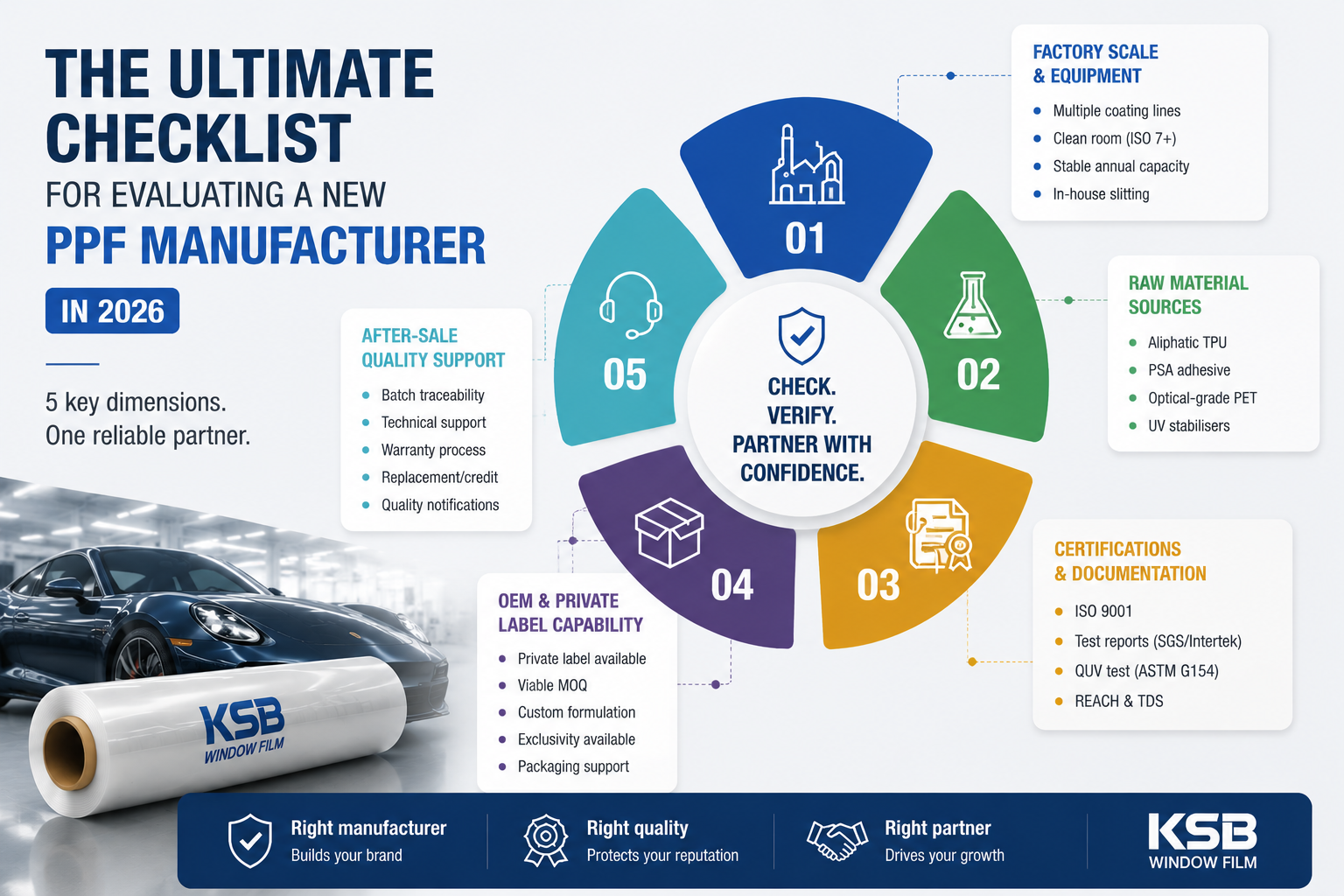
Switching PPF manufacturers is a significant business decision. Getting it right means systematic evaluation across five dimensions. This checklist guides that process.
[ ] Minimum 20,000sqm annual production capacity per coating line
[ ] Clean room coating environment (ISO 7 or better for premium grade)
[ ] Magnetron sputtering capability (if metallic film is in scope)
[ ] In-house slitting capability with precision tolerance
KSB status: 4 coating lines, ISO 7 clean room, magnetron sputtering for chameleon/metallic range.
Red flags: Factory tour reveals only slitting and packaging operations (trader, not manufacturer). Single coating line (supply disruption risk). No clean room (defect rate concern).
Dimension 2: Raw Material Sources
Questions to verify:
[ ] TPU compound: aliphatic (HDI/IPDI-based)? Document supplier name and grade.
[ ] PET base film: optical grade? Haze specification?
[ ] UV stabilisers: HALS + UVA included in specification?
KSB status: Aliphatic TPU from documented-grade compound suppliers. Ashland PSA system. Optical-grade PET with haze specification.
Red flags: Inability to name TPU compound supplier. “Premium materials” without specifics. Reluctance to provide material SDS.
Dimension 3: Certifications and Documentation
Minimum required documentation:
[ ] ISO 9001 certificate (manufacturing scope, current, accredited CB)
[ ] Current SGS or Intertek product performance test reports (UV, TSER, adhesion)
[ ] QUV accelerated weathering test to ASTM G154 (1,000 hours minimum)
[ ] REACH compliance declaration
[ ] Product TDS (technical data sheet) with all key parameters
For premium/government market buyers:
[ ] ASTM G154 to 3,000 hours
[ ] FTIR polymer identification confirmation
[ ] Low-temperature brittleness test (if cold climate supply)
KSB status: ISO 9001 (manufacturing scope), annual SGS test reports, 3,000-hour QUV data, REACH declaration, regional TDS variants.
Dimension 4: OEM and Private Label Capability
[ ] Private label packaging available (custom roll label, outer box)?
[ ] MOQ for private label is commercially viable?
[ ] Custom formulation development capability?
[ ] Geographic exclusivity available on OEM specifications?
[ ] Packaging development support (artwork, dieline provision)?
[ ] Long-term supply commitment documentation?
KSB status: Full private label from 100 rolls per SKU. Custom formulation development. Geographic exclusivity on OEM specs. Full packaging development support.
Dimension 5: After-Sale Quality Support
[ ] Batch traceability system (can trace a defective roll to specific production batch)?
[ ] Technical support for installer complaints?
[ ] Warranty claim process documented?
[ ] Replacement/credit process for confirmed production defects?
[ ] Proactive quality notification if batch issues identified post-shipment?
Any 0 score in Dimension 2 (raw materials): disqualifying
Any 0 score in Dimension 1 (no clean room for premium grade): significant concern
Dimension 3 total < 60%: insufficient documentation for commercial commitment
Dimension 5 total < 50%: warranty risk
FAQ
Is a factory visit required before placing an order?
For initial orders below $10,000: not required, but a live video factory tour is strongly recommended. For programme commitments above $50,000: in-person visit justified by the investment scale. For government or critical applications: visit required.
Expanding on Dimension 3: How to Read Certification Documents
ISO 9001 certificates contain a scope statement — this is the critical field. A certificate issued for “sales and trading of automotive film” covers zero manufacturing activity. The scope must include “manufacturing,” “production,” or “coating” of film products. Certificates without manufacturing in scope are irrelevant to production quality.
Verify the certifying body: ISO 9001 can be issued by any certification body — including non-accredited ones. The IAF (International Accreditation Forum) maintains a registry of national accreditation bodies. A certificate from a CB accredited by UKAS, DAkkS, ANAB, or equivalent has independent oversight. A certificate from an unknown CB has no such assurance.
Check the surveillance cycle: ISO 9001 requires annual surveillance audits and 3-year recertification. A certificate more than 3 years old without renewal is expired — the QMS may no longer reflect actual practice.
For SGS/Intertek product reports: The report should name the specific product tested, not a range. “KSB 7.5mil Aliphatic TPU PPF” is a named product. “Automotive paint protection film” is not. The product must be identifiable as what you’re buying.
Dimension 3 Extended: What to Request for Chemical Compliance
Modern automotive film supply chains into EU and many other markets require chemical compliance documentation beyond ISO 9001 and product test reports.
REACH (EU Regulation EC 1907/2006): All chemical substances in the PPF must be registered. Ask for the REACH declaration of compliance — specifically confirming that no SVHC (Substances of Very High Concern) from the SVHC candidate list are present above 0.1% by weight.
RoHS (where applicable): Typically for electronic equipment but sometimes applied to automotive accessories in certain markets. Confirm applicability for your specific market.
Prop 65 (California): If selling into California, any product containing chemicals on the Prop 65 list above threshold levels requires labelling. Request Prop 65 compliance confirmation for California-destined product.
Evaluating New vs. Established Manufacturers
A manufacturer who has been operating for 5+ years has documented production consistency across multiple years — something a startup cannot provide. Ask:
“When was your first PPF coating production run?”
“Can you provide customer references from buyers who’ve been sourcing from you for 3+ years?”
“What has your annual production volume been over the last three years?”
Consistent growth (not flat or declining volume) indicates a manufacturer whose product the market is accepting at increasing scale. Flat or declining volume may indicate quality or service issues driving customer attrition.
KSB status: Over 20 years of PPF manufacturing. Active distribution partnerships in 60+ countries. Production volume has grown consistently year over year.
FAQ
How often should I re-evaluate my existing PPF manufacturer?
Annual review is appropriate for significant programme commitments. Request updated test reports annually — product formulations can change (positively or negatively) over time. Ask about any changes to raw material suppliers, coating equipment, or facility since your last evaluation.
What’s the most important single criterion if I can only evaluate one?
QUV test data at 1,000 hours. This single test result tells you more about likely field performance than any other single document. A film maintaining YI below 2.0 through 1,000 hours is almost certainly aliphatic TPU with adequate HALS stabilisation. A film that can’t provide this data is either not testing or not passing.