Smash-and-Grab Protection Film: How to Stop Retail Window Break-Ins
Published: August 26 ,2026 · 8 min read · Category: Safety & Security Film
About this article: KSB Window Film supplies security film to retail and commercial building security projects. Smash-and-grab prevention is the most common commercial security film application — this guide reflects our direct project experience with retail security specifications.
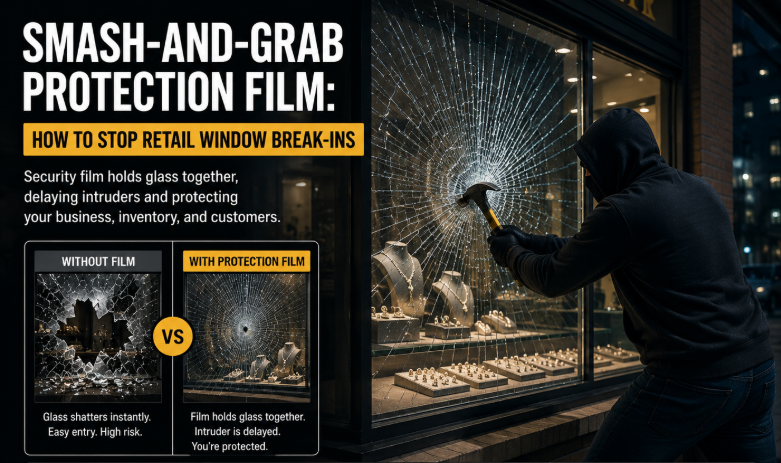
Security window film helps delay smash-and-grab attacks by holding shattered glass together and protecting jewelry store displays.
Smash-and-grab is the simplest criminal methodology in retail crime: break the glass, reach in and grab, run. The whole event takes 5–15 seconds. The damage — shattered display glass, stolen merchandise, clean-up costs, insurance claims, and the psychological impact on staff — can be disproportionate to the duration.
Security window film doesn’t eliminate smash-and-grab risk. What it does is transform the economics of the attack — from a 5-second snatch to a 60–120+ second sustained effort — in a way that deters most opportunistic criminals and significantly reduces successful outcomes for the rest.
The Smash-and-Grab Economics
Understanding why smash-and-grab happens helps understand why security film works as a deterrent.
Most retail smash-and-grab attacks are:
Opportunistic: Triggered by visible high-value merchandise and low perceived risk
Time-limited: The attacker has a threshold (typically 15–30 seconds) beyond which the risk of being caught exceeds the expected value of the theft
Non-specialist: The tools are typically a hammer, brick, or bolt cutters — not specialist glass-defeating equipment
Unprotected shopfront glass fails in 2–5 seconds under a hard impact. The opening is immediately accessible. The attack proceeds.
8 mil security film with proper frame attachment transforms the same attack:
The glass breaks, but the film holds the fragments in place
The opening is not immediately accessible — the film-glass unit blocks passage
Defeating the film-glass unit to access the opening requires sustained cutting, tearing, or hammering — each taking additional seconds
The alarm has activated
The visual and noise profile of a sustained attack is dramatically higher than a quick smash
For most opportunistic attackers, 60+ seconds of sustained effort against an actively alarmed building is not acceptable risk. The attack is abandoned.
What Security Film Actually Does to Shopfront Glass
When an attacker strikes a security-filmed shopfront window:
The glass breaks. Film doesn’t prevent this. The initial impact shatters the glass.
The fragments stay in the film. The fractured glass remains embedded in the film matrix — the film’s tensile strength holds the pieces together. The window looks cracked but remains in the frame.
The opening is not immediately accessible. The intact film-glass unit physically blocks the opening. To reach through, the attacker must defeat the film by cutting, tearing, or continued impact.
Film tearing is time-consuming. Cutting or tearing 8 mil security film is physically demanding. The film stretches under force rather than tearing cleanly. Each section that’s torn creates edges that must be folded back — a sustained, visible, audible process.
Frame attachment prevents push-through. Without frame attachment, an attacker can push the intact glass-film unit inward after breaking the glass, clearing the opening in a few seconds. With frame attachment (perimeter attachment tape or mechanical channels), the unit is anchored and cannot be pushed through — the attacker must defeat the film by cutting.
The Critical Role of Frame Attachment
This is the most commonly omitted specification element in retail security film installations — and its omission transforms a security installation into a slightly more difficult smash-and-grab.
Without frame attachment: The film holds glass fragments together. But the attacker simply pushes the intact glass-film unit inward — it’s not bonded to the frame. The opening is cleared. Total time: 10–20 seconds. Marginally better than unprotected glass.
With frame attachment: The glass-film unit is structurally bonded to the frame. The attacker cannot push through — they must cut or tear the film to create an accessible opening. Total time: 60–120+ seconds. Deters most opportunistic attacks. Activates alarms. Creates visible, audible evidence.
Specification requirement: Always specify “security film with perimeter frame attachment” — not just “security film.” The method of frame attachment (tape vs. mechanical channel) should also be specified for the security level required.
Product Specification for Retail Smash-and-Grab
For standard retail security (fashion, electronics, general merchandise): 8 mil clear security film with perimeter attachment tape.
Appearance: invisible (clear film, no tint)
Does not affect display visibility or shopfront appearance
Frame attachment via structural perimeter tape bonded to frame
For high-value retail (jewellers, luxury goods, high-end electronics): 10–12 mil security film with wet-glazed or mechanical frame attachment.
Meets LPS 1270 Class A1 or A2 with appropriate installation
May require a security consultant specification for insurance compliance
Combined solar/safety films: Tinted security film (typically medium-VLT reflective) combines security performance with daytime privacy and solar control. Useful for retail premises with sensitive merchandise storage areas behind the shopfront.
Alarm Integration: The Essential Partner
Security film without an alarm system is significantly less effective. The film provides the time delay — the alarm provides the response.
A monitored alarm that activates within 30 seconds of glass breakage changes the risk calculation for the attacker: the film requires 60–120+ seconds to defeat, while the alarm has already initiated a response. The deterrent effect is substantially higher than either element alone.
Glass break detectors and vibration sensors are the most common alarm integration for security film applications. They activate on the acoustic signature of glass breakage, providing immediate alarm activation when the first impact occurs — not when the opening is penetrated.
Installation Requirements
Professional installation is essential for security film at retail level. Specific requirements:
Glass preparation: The glass must be clean of all contamination before film application. Adhesive bond quality on contaminated glass is significantly reduced — adhesion failure at the frame edge allows the film to separate and negates the security benefit.
Edge trim: Film edges should terminate within 3mm of the frame, with no gaps. Edge lifting (even minor) provides a starting point for an attacker to begin tearing.
Frame attachment application: Perimeter attachment tape must be applied after film installation, on the exterior face of the film edge, bonded firmly to both the film and the frame surface. The frame surface must be clean and primed if specified by the tape manufacturer.
Cure time: Allow 48–72 hours before the security installation is relied upon. The adhesive continues to cure and improve bond strength during this period.
Cost vs. Risk Calculation
The most direct way to evaluate security film for a retail location:
Installation cost: 8 mil security film with frame attachment on a 20sqm shopfront: approximately $1,500–$3,000 professionally installed.
Typical smash-and-grab loss: Direct merchandise theft + glass replacement + clean-up + insurance excess + lost trading time during repair: $8,000–$50,000 depending on the merchandise and the severity.
Expected value of prevention: If security film reduces successful attacks at a location from an expected frequency (say, 1 in 5 years = 20% annual probability) to near zero, the expected annual value of prevention exceeds the film installation cost several times over before year two.
For high-value retail in areas with documented smash-and-grab activity, the ROI calculation is unambiguous.
FAQ
Will security film stop a determined professional burglary?
Security film is designed and tested against opportunistic attacks using common tools. A professional burglar with specialist glass-cutting equipment and planning can defeat most commercial security film given sufficient time. Security film is part of a layered security approach — not a complete solution. For the highest-value assets, it should be combined with laminated glass replacement, alarm monitoring, CCTV, and physical security procedures.
Can security film be installed without disrupting trading hours?
Yes. Professional installation on a 20sqm shopfront typically takes 3–4 hours for an experienced crew. It can be done overnight, early morning, or during a brief trading closure. The film is applied from the interior — no external scaffolding or shopfront closure required.
How long does security film installation last?
Quality security film: 10–12 years interior service life. At end of life, the adhesive degrades and the film should be replaced. Annual inspection of frame attachment condition is recommended.
Stop the Smash-and-Grab With Properly Specified Security Film
KSB Window Film supplies 8 mil and 12 mil security film with frame attachment specifications for retail security applications. Our technical team can advise on the correct product and installation specification for your shopfront.