Windshield Film and Rain Sensors: Will It Interfere?
Published: October 14, 2026 · 6 min read · Category: Windshield Film
About this article: KSB Window Film includes rain sensor compatibility in our windshield film application guidance. This article addresses one of the most common pre-installation questions from automotive installers.
Properly installed windshield protection film does not affect rain sensor performance when the sensor area is correctly treated or excluded.
Rain sensor interference is one of the most consistently asked questions before windshield film installation on modern vehicles — and one of the most inconsistently answered. Some installers report no issues; others report wipers running continuously or not activating in rain. The variability in experience reflects genuine technical nuance: the outcome depends on the specific sensor design, the specific film product, and where the film edge is placed relative to the sensor.
How Rain Sensors Work
The most common automotive rain sensor technology is the internal reflectance principle (also called optical rain sensing):
An infrared LED inside the sensor module projects IR light (typically 850–940nm wavelength) into the windshield at an angle beyond the critical angle for total internal reflection. The light travels through the glass to the outer surface. When the outer surface is dry, almost all the light is totally internally reflected back to the sensor’s photodetector. When water is present on the outer surface, some of the IR light is refracted out of the glass and scattered rather than reflected back. The sensor detects the reduced reflection and interprets it as rain — activating the wipers proportionally to the signal reduction.
The key physics: The sensor measures total internal reflection. Anything that changes the optical properties at the inner windshield surface — including a film applied there — can alter the sensor’s baseline measurement.
How Film Can Affect Rain Sensor Function
The adhesive-glass interface: When film is applied to the inner windshield surface in the rain sensor area, the adhesive layer creates a new optical interface. Instead of glass-air, the inner surface sees glass-adhesive. Because adhesive has a refractive index different from air (adhesive RI ≈ 1.45–1.55 vs air RI ≈ 1.0), the total internal reflection condition changes.
Specifically: the critical angle for TIR at the glass-adhesive interface is different from glass-air. The change in TIR condition can make the sensor “see” a different baseline signal, which it may interpret as constant partial rain — causing continuous wiper activation.
The outer surface effect: Additionally, the hydrophobic properties of some windshield film top coats affect how water sheets or beads on the glass outside the film edge. If the rain sensor detects water shedding differently at the film edge than on unfilmed glass, this boundary can create signal anomalies.
Which Film Applications Cause Problems (and Which Don’t)
High risk of interference:
Film applied directly over the rain sensor module
Film applied with the edge running through the rain sensor measurement zone
High-index adhesive systems that significantly change the glass-surface optical properties
Lower risk of interference:
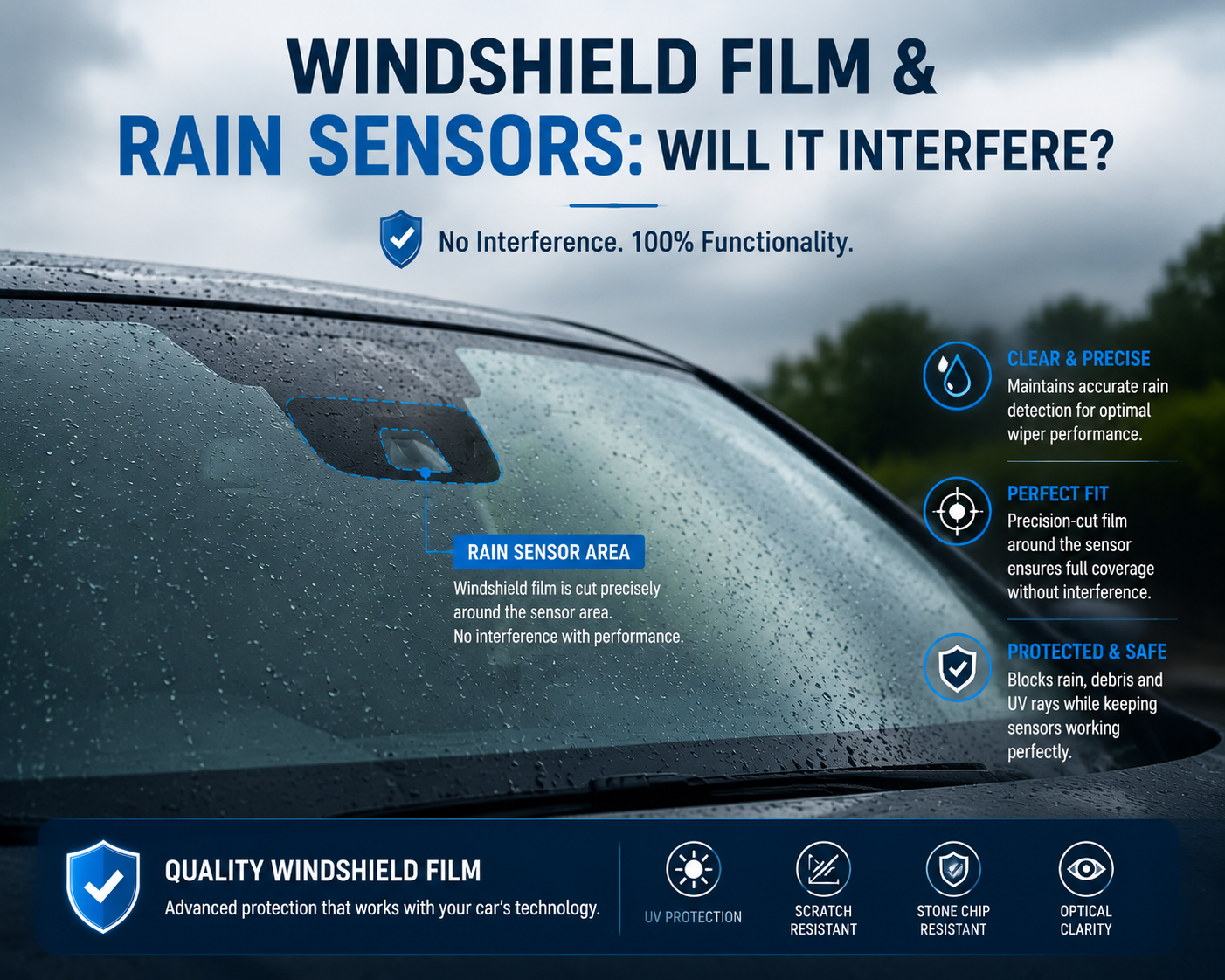
Clear film applied around the rain sensor (with a cutout or gap at the sensor location)
Very low-index adhesive systems specifically formulated for sensor-adjacent applications
Film applied well outside the rain sensor’s field
Practical finding from installer experience: The most common cause of rain sensor problems from windshield film is not the film itself but the application — specifically the film edge running through the sensor detection zone. The transition from filmed glass to unfilmed glass at the sensor edge creates a sharp optical discontinuity that the sensor may misread.
Best Practice for Sensor-Compatible Installation
Option 1: Film with a sensor cutout Apply film with a precise cutout around the rain sensor module, leaving approximately 30–50mm clear radius around the sensor. This is the cleanest approach — the sensor operates on unfilmed glass exactly as designed. Requires precise cutting, either by hand or digital cutting system.
Option 2: Film stopping short of the sensor zone For partial windshield coverage (lower impact zone only), ensure the film terminates well below the rain sensor location. Most rain sensors are in the upper windshield behind the rear-view mirror — film on the lower third of the windshield doesn’t reach this area.
Option 3: Full coverage with appropriate film If full-windshield coverage is required including the sensor area: use windshield film with a very low adhesive refractive index (specifically matched to minimise TIR change) and a clear top coat. Test on the specific vehicle before customer delivery.
Always advise the customer: Before any full-windshield installation, advise the customer that rain sensor recalibration may be needed after film installation and that they should test automatic wiper function before relying on it in poor visibility conditions.
If the Rain Sensor Malfunctions After Film Installation
Troubleshooting sequence:
Inspect the film application around the sensor — is the edge running through the sensor zone? Reposition or trim if possible.
If the film completely covers the sensor, remove film from the sensor area and test. If function restores, the sensor area needs a cutout.
If function still abnormal after removing film from sensor area, the vehicle may need dealer sensor recalibration.
Cost implication: Dealer recalibration of rain sensor / wiper control is typically $100–$200. For customers who paid for full-windshield film expecting no issues, this is a warranty situation for the installer to manage.
FAQ
Do all vehicles with automatic wipers have optical rain sensors?
Most do, but some older or budget vehicles use acoustic sensors (detecting rain droplet impact vibration) or simple timer-based automatic wipers that don’t use optical sensing. For acoustic sensors, film has no effect. Confirm the sensor type if uncertain.
Can I test rain sensor compatibility on a sample before installing on a customer vehicle?
Yes. Apply a sample of the film (including a section with a sensor-area-sized piece) to a piece of glass and place it in front of the rain sensor on a test vehicle. Run the sensor in automatic mode. This gives you an indication of whether the film will cause issues before the full installation.
KSB Provides Application Guidance for Sensor-Adjacent Areas
KSB Window Film provides specific application guidance for sensor zones, including cutout recommendations for major vehicle platforms. Our technical team can advise on rain sensor compatibility for your specific vehicle and film selection.