Window Film Payback Period Calculator: How Fast Does It Pay for Itself?
Published: August 24, 2026 · 8 min read · Category: Architectural Window Film
About this article: KSB Window Film supplies architectural solar control film to commercial building projects globally. The payback calculations here are based on our project data, LBNL research benchmarks, and real-world energy savings assessments across multiple markets.
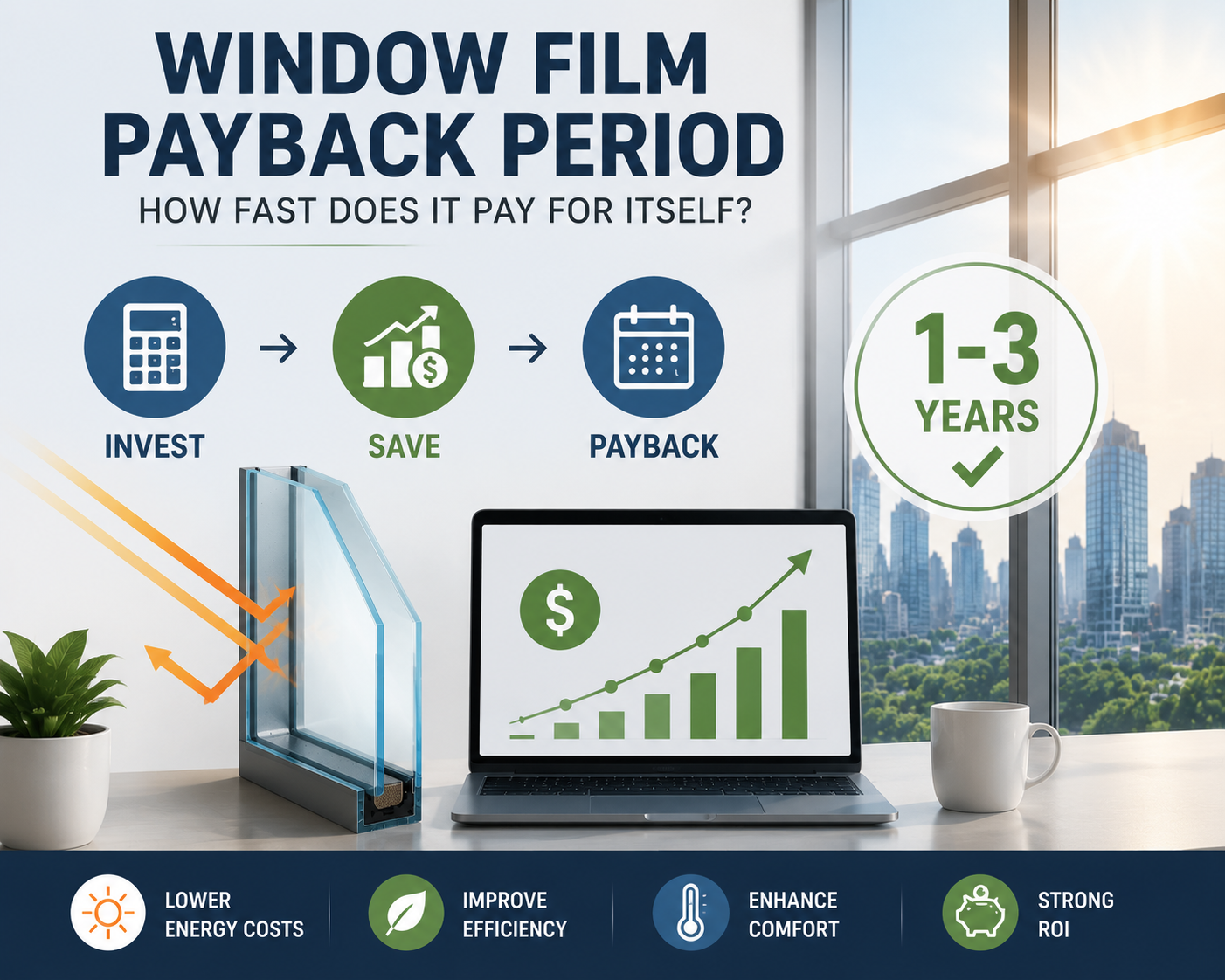
Window film investment delivers energy savings and fast ROI, typically paying back within 1 to 3 years in commercial buildings.
The payback period question is the first thing most building owners ask after they see the installation cost. Fair question. The answer is rarely “it doesn’t pay back” — quality solar control film in the right application almost always generates positive ROI — but the timeline varies from 18 months (hot climate, highly glazed building, expensive energy) to 8+ years (mild climate, small window area, cheap energy).
This guide gives you a structured way to calculate the payback for your specific situation — not a generic industry average, but a number grounded in your building’s characteristics.
The installation cost is what you pay the contractor. The annual energy savings requires a calculation that depends on your building, climate, and film specification.
Step-by-Step Calculation
Step 1: Measure Your Glazed Area on Solar-Exposed Facades (sqm)
Focus on south-facing and west-facing glass in the Northern Hemisphere (north and west in the Southern Hemisphere). East-facing glass gets morning sun — include it if mornings are a thermal problem. North-facing (Southern Hemisphere: south-facing) glass receives minimal direct solar radiation and contributes little to solar heat gain.
Tip: Don’t guess. Walk the building with a measuring tape or pull the glazing schedule from your building documentation. Overestimating or underestimating by 20% materially affects the savings calculation.
Step 2: Find Your Existing Glass SHGC
The Solar Heat Gain Coefficient of your current glass tells you how much solar energy is currently entering. If you have the glazing specification:
Single-pane clear glass: ~0.87
Double-pane clear glass: ~0.76
Bronze/grey tinted double-pane: ~0.55–0.65
Standard Low-E double-pane: ~0.25–0.45
High-performance Low-E: ~0.18–0.30
If you don’t have specs, assume the worst-case for your glass type — this gives a conservative savings estimate.
Step 3: Find the Film System SHGC
Request this from your film supplier or installer — it should be on the film’s NFRC certification data or technical data sheet. This is the SHGC of the glass-plus-film system, not just the film alone.
Example: single-pane clear glass (SHGC 0.87) with quality nano ceramic film → system SHGC approximately 0.30–0.40.
Step 4: Calculate Solar Heat Gain Reduction (W/sqm)
SHGC reduction = Existing SHGC − System SHGCExample: 0.87 − 0.35 = 0.52 (52% reduction in solar heat gain)
Peak solar irradiance at typical window angles: 500–800 W/sqm depending on location. Average effective irradiance during cooling season: 200–400 W/sqm (accounting for cloud cover, sun angle variation).
Peak load reduction per sqm = SHGC reduction × peak irradianceExample: 0.52 × 700 W/sqm = 364 W/sqm reduction in peak solar heat input
Step 5: Estimate Annual Cooling Energy Saved (kWh/year)
This step requires your local cooling degree days (CDD) — available from ASHRAE data or local meteorological services.
Simplified annual energy savings per sqm (kWh/year) = SHGC reduction × Average irradiance during cooling hours × Cooling hours per year ÷ COP of HVAC system ÷ 1000
Example calculation for Phoenix, AZ:
SHGC reduction: 0.52
Average irradiance during cooling hours: 300 W/sqm
For 500 sqm of filmed facade: 44,500 kWh/year saved.
Step 6: Convert to Dollar Savings
Annual dollar savings = Energy saved (kWh) × Local electricity cost ($/kWh)
Example: 44,500 kWh × $0.14/kWh = $6,230/year
Step 7: Calculate Simple Payback
Installation cost ÷ Annual savings = Payback period
Example: $25,000 installation cost ÷ $6,230/year = 4.0 years
Reference Calculations for Common Scenarios
Scenario
Film Area
SHGC Reduction
Annual Savings
Install Cost
Payback
Phoenix office, single-pane
500 sqm
0.52
$8,900/yr
$27,000
3.0 yr
Dubai commercial, single-pane
300 sqm
0.55
$7,200/yr
$18,000
2.5 yr
London office, double-pane
400 sqm
0.30
$2,800/yr
$22,000
7.9 yr
Sydney office, double-pane
350 sqm
0.35
$4,900/yr
$20,000
4.1 yr
Singapore hotel, single-pane
1,000 sqm
0.50
$22,000/yr
$55,000
2.5 yr
Beyond Simple Payback: Total Return on Investment
Simple payback understates the full financial return, which includes:
Lifetime energy savings: Film lasts 10–15 years. At 4-year payback, the remaining 6–11 years of service life generate $37,000–$68,000 in additional savings on a $27,000 investment.
HVAC maintenance cost reduction: Less cooling demand means HVAC equipment runs less hard and lasts longer. This is harder to quantify but real.
UV protection of interior assets: Furniture, flooring, merchandise, and equipment degraded by UV — and replaced more frequently as a result — represent a real cost that solar control film reduces. Retailers and hotels with valuable interior assets can add this to the ROI calculation.
Occupant productivity: Less-cited but validated by research: thermally comfortable workers are more productive and less likely to seek alternative spaces. Quantifying this is difficult but the effect is measurable in occupant satisfaction surveys.
Green building certification value: LEED or BREEAM points attributable to improved glazing SHGC can contribute to certification uplift that has direct building value and tenant attraction implications.
FAQ
What if my payback period comes out at 8–10 years — is film still worth it?
Possibly. If the film’s service life is 12–15 years and the payback is 8 years, you still generate 4–7 years of net-positive savings after payback. The decision depends on your building’s ownership horizon and discount rate. For buildings with long-term ownership, even longer paybacks can produce positive NPV.
Can I claim tax deductions or incentives on window film installation?
In many jurisdictions, yes. In the US, energy efficiency improvements to commercial buildings may qualify for Section 179D deductions. In the UK, energy efficiency capex may qualify for enhanced capital allowances. Australia has various state and federal energy efficiency incentive programs. Check with your tax advisor for your specific jurisdiction — the incentives, if applicable, can significantly shorten the effective payback period.
How accurate is this calculation?
For planning purposes, ±25% accuracy is realistic using the simplified method above. Formal accuracy requires a building energy model (EnergyPlus or similar) that accounts for building thermal mass, HVAC control logic, occupancy patterns, and detailed local weather data. For projects where the ROI calculation is being used for investment approval or financing, a qualified energy consultant should run the formal model.
Does the calculation change for double-glazed buildings?
Yes — the starting SHGC is lower for double-glazed glass, so the SHGC reduction and energy savings are proportionally smaller. Double-glazed buildings typically have longer payback periods than equivalent single-glazed buildings. This doesn’t mean film isn’t worthwhile — it means the economics need to be evaluated specifically for the existing glass specification.
KSB Window Film can provide performance data inputs — SHGC, TSER, and system performance at your glass type — to feed into a payback calculation for your specific building. For larger projects, we can connect you with energy consultants who provide formal energy model assessments.