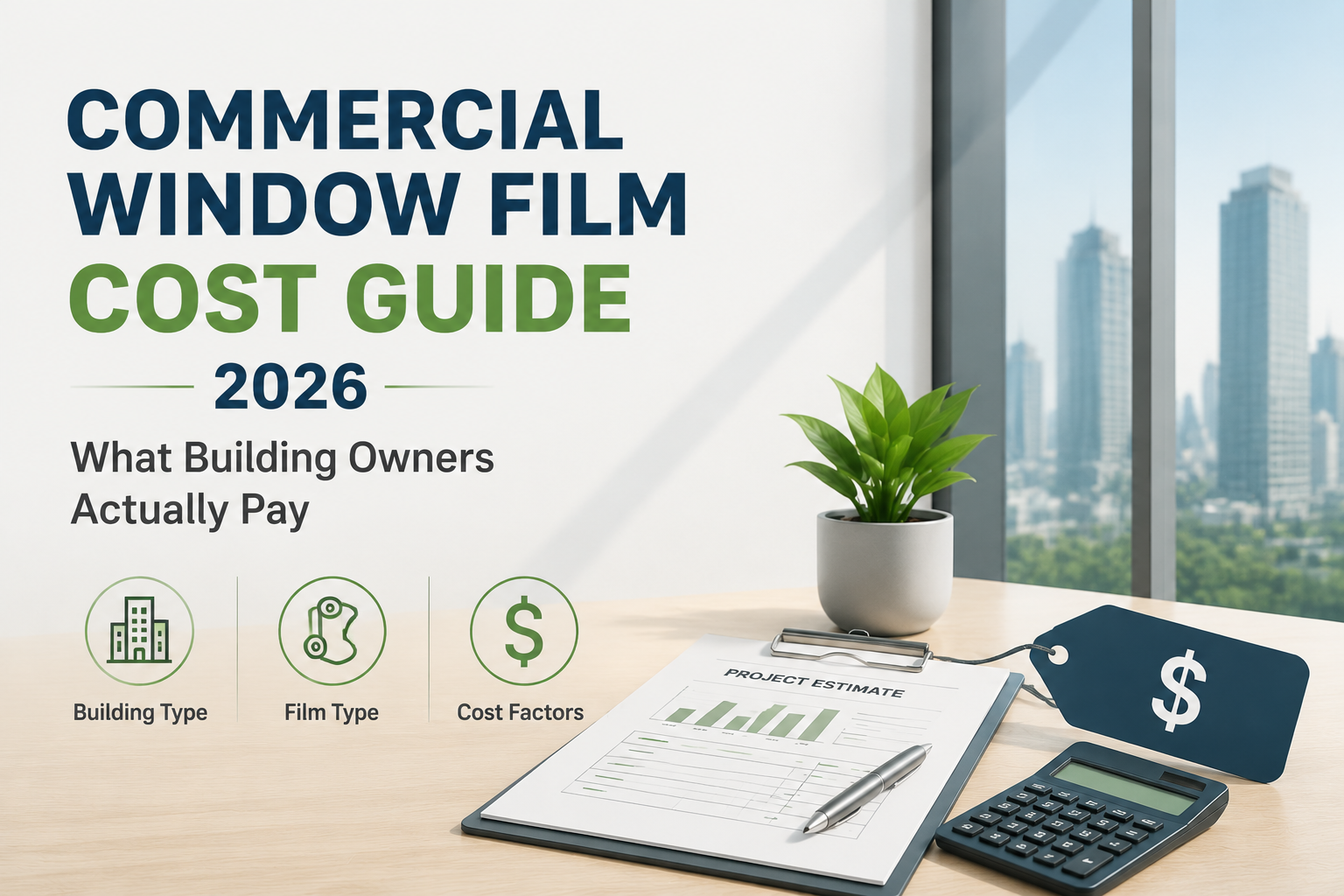
Commercial Window Film Cost Guide: What Building Owners Actually Pay in 2026
Published: August 20, 2026 · 9 min read · Category: Architectural Window Film
About this article: KSB Window Film manufactures architectural window film exported to commercial building projects globally. The cost ranges in this article reflect real project quotes and installed cost data from our distribution partners across North America, Europe, the Middle East, and Australia.
Commercial Window Film Cost Guide: What Building Owners Actually Pay in 2026
The number that comes back from the first installer quote is usually surprising — either higher than expected (“I thought this was just sticky film”) or lower than expected (“this seems too cheap for a 3,000sqm facade”). Both reactions are common, and both are often justified, because commercial window film project costs vary significantly based on factors that aren’t visible in a per-square-meter rate.
This guide breaks down what building owners actually pay in 2026, what drives variation, and how to build a realistic budget before you start requesting quotes.
The Short Answer: Reference Ranges by Project Type
These are installed cost ranges including film, consumables, and labor for professional commercial installation in Western markets (US, UK, Australia). Prices in other regions vary — see regional notes below.
Application
Cost Range (installed, per sqm)
Basic solar control / tinted film
$25–$45
Mid-range solar control (neutral)
$40–$65
Premium nano ceramic solar control
$65–$120
Reflective solar control
$35–$60
Basic safety film (4–6 mil)
$30–$55
Security film (8–12 mil)
$55–$95
Blast film (with frame attachment)
$120–$250+
Frosted / privacy film
$35–$75
Decorative / printed film
$55–$150+
Exterior film
$65–$130
Important: These are installed per-sqm ranges, not film material cost. The material itself (film only, ex-works from manufacturer) typically represents 30–50% of the installed cost. The remainder is installer margin, consumables, and labor.
What Drives Cost Variation
1. Film Product Tier
The single largest variable in project cost is the film specification itself. The difference between basic tinted film ($25/sqm installed) and premium nano ceramic ($100/sqm installed) on the same glass area is entirely the product — installation labor and overhead are comparable.
For a 500sqm office facade:
Basic tinted film: ~$12,500–$22,500
Premium nano ceramic: ~$32,500–$60,000
The premium ceramic delivers better heat rejection (TSER 65%+ vs 45–50%), better optical clarity, longer service life, and better long-term color stability. Whether that additional performance justifies the cost premium depends on the energy modelling and occupant requirements for the specific building.
2. Glass Access and Building Complexity
Film is priced per sqm of glass area, but the labor component varies with access difficulty:
Ground floor, easy internal access: Standard labor rate
Atrium / internal high-level glass: Elevated work platform or mobile scaffolding — add 20–40% to labor
External film application: Requires rope access or external scaffolding — add 30–60% to total project cost
Curved glass or complex shapes: Higher waste factor and longer application time — add 10–30%
A facade that looks like a simple area measurement in a survey can cost significantly more per sqm than the standard rate if access is difficult.
3. Preparation Requirements
Glass that hasn’t been properly cleaned or has existing film, adhesive residue, or contamination requires preparation before new film can be applied. Old film removal adds cost:
Standard film removal: $8–$20/sqm
Film with heavy adhesive residue: $15–$35/sqm
Film on damaged glass (requires care to avoid breakage): project-specific pricing
Building owners who’ve had film previously installed need to factor in removal cost for re-filming projects.
4. Project Size
Per-sqm costs decrease on larger projects. Installers allocate fixed project overheads (mobilization, site management, waste disposal) across the total area. A 50sqm project pays more per sqm than a 500sqm project at the same product specification.
Reference scale effect:
Under 100sqm: Often 15–30% above the mid-range per-sqm rate
100–500sqm: Standard rate range
500–2,000sqm: 5–15% below standard rate
2,000sqm+: Negotiated pricing, often 15–25% below standard rate
5. Market and Location
Labor costs vary significantly by geography. The per-sqm ranges above reflect Western market labor rates. In the Middle East, Southeast Asia, and Eastern Europe, installed costs are typically 30–50% lower due to lower labor costs, even with equivalent film product.
Film material cost (what distributors and installers pay for the film itself) is more globally consistent — Chinese-manufactured architectural film represents the dominant global supply source at consistent quality-adjusted pricing.
Building-Type Cost Examples (2026)
Office Building — 800sqm South and West Facade
Specification: mid-range neutral solar control, internal application Film specification: TSER 55%, VLT 40%, 5-year warranty
Breakdown:
Film material: $18,000
Installation labor: $12,000
Consumables and project management: $2,500
Total: ~$32,500 (~$41/sqm)
Expected annual energy saving: $6,000–$10,000 (varies by climate and HVAC efficiency) Indicative payback: 3–5 years
Hotel — 1,500sqm Guest Room Windows (Solar + Privacy)
Specification: premium solar control with integrated privacy tint, external facing Film specification: TSER 60%, VLT 25%
Breakdown:
Film material: $52,500
Installation labor: $28,000
Access equipment (internal corridors, some rope access): $8,000
Total: ~$88,500 (~$59/sqm)
School — 600sqm Classroom Windows (Safety + Solar)
Specification: dual-function safety and solar control, 6 mil Film specification: TSER 45%, impact certified to EN 12600
Breakdown:
Film material: $19,800
Installation labor: $14,000
Total: ~$33,800 (~$56/sqm)
How to Get Accurate Quotes
What to Provide to Installers
A precise brief produces comparable quotes. Include:
Glass area by elevation (north, south, east, west) — solar film performs differently by orientation
Glass type (clear single, tinted single, clear double, Low-E double, etc.)
Access conditions (floor levels, internal/external, any restricted areas)
Always get at least three quotes for commercial projects. The spread between high and low quotes on a 500sqm project is often $15,000–$30,000 — entirely justified if one quote uses premium ceramic and another uses budget tinted film at the same per-sqm rate. This is why product specification must be standardized across quotes for them to be comparable.
FAQ
Why is the quote I received much higher than your reference ranges?
Possible reasons: very difficult access (external application, rope access required), existing film removal included, premium product specification, small project area with high fixed overhead allocation, or high-cost market (London, New York, Sydney city center premium). Ask the installer to itemize labor, materials, and access separately — the breakdown will show you where the premium is coming from.
Can I reduce costs by using cheaper film?
Yes, but the payback period extends proportionally. Cheaper film with lower TSER delivers less energy saving per year — the cost reduction on film may not produce better ROI than spending more on better film. Run the energy savings calculation for both options before deciding on specification.
Is VAT or tax included in these estimates?
No — the ranges above are net of applicable taxes and duties. Add applicable sales tax, VAT, or GST for your jurisdiction.
What are film costs in the Middle East vs. the US?
Film material costs are broadly similar globally (Chinese-manufactured film at consistent quality-adjusted pricing). Labor costs in the UAE or Saudi Arabia are 40–60% lower than the US for equivalent installation quality. A project that costs $65/sqm installed in Houston might be $35–$45/sqm installed in Dubai at the same film specification.
Does the building owner or the tenant pay for window film in a leased building?
Typically negotiated. In most commercial leases, improvements that benefit the building (solar control film that reduces HVAC load) are either building-owner funded or shared cost. In fit-out scenarios, tenants often fund interior decorative and privacy film as part of their fit-out budget. Lease terms vary — check your specific agreement.
KSB Window Film can provide indicative material cost for architectural film projects based on your building area, glass type, and performance specification — before you go to installer quotes. This gives you an independent reference point for evaluating proposals.