How to Choose Architectural Window Film: VLT, TSER, SHGC and What They Mean
Published: September 3, 2026 · 9 min read · Category: Architectural Window Film
About this article: KSB Window Film provides specification support to commercial building owners, facilities managers, and glazing contractors across our global distribution network. This guide reflects the specification decisions we help buyers navigate most frequently.
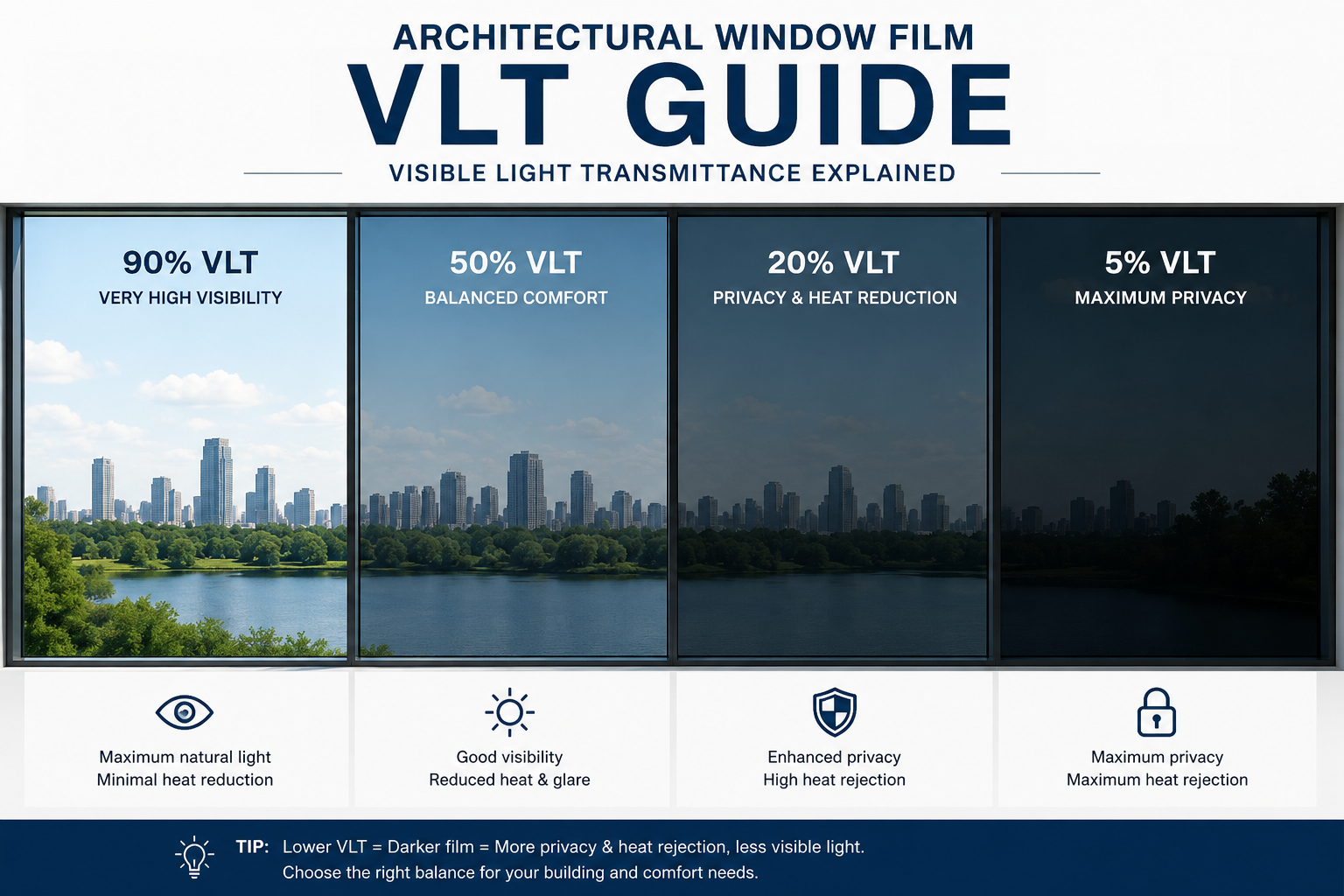
5%–90% VLT window film comparison for commercial glazing selection.
The performance specifications for architectural window film — VLT, TSER, SHGC, U-factor, UV rejection — describe real and distinct aspects of film performance, and understanding what each measures is what separates a specification that solves the problem from one that looks right on paper but doesn’t deliver.
This guide explains each metric, how they interact, and how to use them to choose the right film for your specific building requirement.
VLT — Visible Light Transmittance
What it measures: The percentage of visible light (380–780nm wavelength) that passes through the film-glass system. A 40% VLT film transmits 40% of visible light.
What it affects:
Interior brightness and natural light quality
Glare reduction (lower VLT = more glare reduction, but also less natural light)
Exterior appearance (lower VLT = darker appearance from outside)
Common misconception: VLT and heat rejection are not the same thing. A 50% VLT nano ceramic film can reject more total solar heat than a 20% VLT dyed film, because nano ceramic technology selectively targets infrared radiation (the heat component) rather than blocking all wavelengths uniformly.
How to choose:
Primary objective is daylight preservation: VLT 50–70%
Balancing daylight with solar control: VLT 35–50%
Aggressive solar control or privacy with some daylight: VLT 20–35%
Maximum solar control, daylight secondary: VLT 10–20%
Note: Going below VLT 35% typically requires supplemental artificial lighting in deep-plan office floors. Below 20%, artificial light is generally necessary throughout the day.
TSER — Total Solar Energy Rejected
What it measures: The percentage of total incoming solar energy (UV + visible light + infrared, combined) that the film prevents from entering the building. This is the most comprehensive indicator of a film’s heat rejection performance.
Why it matters: Solar energy arriving at a window comprises approximately 5% UV, 44% visible light, and 51% infrared. A film that blocks only infrared has a theoretical ceiling of 51% TSER. A film that blocks all three components can approach 100% TSER (at zero VLT). The engineering challenge — and the achievement of good solar control film — is achieving high TSER at high VLT by selectively targeting infrared rather than blocking everything equally.
Reference values:
Basic dyed film at 35% VLT: TSER approximately 40–45%
Carbon film at 35% VLT: TSER approximately 50–57%
Nano ceramic film at 35% VLT: TSER approximately 60–72%
Reflective film at 20% VLT: TSER approximately 70–80%
How to choose:
Minimum TSER for meaningful solar control: 50%
Good solar control: 55–65%
Excellent solar control for warm climates: 65–75%+
For energy code compliance and LEED certification projects, TSER drives the energy model input. Specify the highest TSER achievable at your target VLT.
SHGC — Solar Heat Gain Coefficient
What it measures: The fraction of solar energy transmitted through the glazing system (glass + film) that enters the building as heat. Expressed as a decimal from 0 to 1. Lower SHGC = less solar heat gain.
The relationship to TSER: SHGC and TSER are related but measure slightly different things. TSER measures what the film rejects. SHGC measures what the glass-film system transmits as heat (accounting for both direct transmission and the portion that’s absorbed in the glass and re-radiated inward). SHGC is the building energy code metric — ASHRAE 90.1 specifies maximum SHGC by climate zone.
Conversion reference: SHGC ≈ 1 − (TSER/100) is a rough approximation, but not exact because SHGC also accounts for secondary heat transmission from glass absorption.
How to use it: In building energy code compliance projects, the target SHGC is specified. The film must deliver a glass-film system SHGC at or below the target. Request this data — SHGC of the glass-film system, not just the film alone — from your supplier.
Reference values for common glass types with film:
Glass Type
Unfilmed SHGC
With Quality Ceramic Film
Single-pane clear
0.87
0.25–0.40
Double-pane clear
0.76
0.28–0.45
Bronze tinted double
0.55
0.22–0.38
Existing Low-E double
0.35
0.18–0.28
UV Rejection
What it measures: The percentage of ultraviolet radiation (280–380nm) blocked by the film.
Why it matters: UV is responsible for:
Fading and degradation of interior materials (textiles, flooring, furniture, artwork, merchandise)
Skin UV exposure for building occupants
Reference values: Quality films across all technology tiers achieve 99%+ UV rejection regardless of VLT. UV blocking is not a differentiator between technology tiers — a 50% VLT ceramic film blocks as much UV as a 10% VLT dyed film. UV protection is a baseline feature, not a premium one.
VLR — Visible Light Reflectance
What it measures: The percentage of visible light reflected by the film surface. Higher VLR = more mirror-like appearance from outside.
Why it matters for specification:
Reflective film (high VLR): provides better solar rejection per VLT level, but produces a mirror appearance from outside and creates evening internal reflections
Non-reflective film (low VLR): subtle exterior appearance, better view quality from inside, less glare from internal reflections at night
How to choose:
Exterior appearance management is important: specify VLR below 12–15% (non-reflective)
Maximum solar rejection, appearance secondary: higher VLR reflective film acceptable
Putting the Metrics Together: Specification Matrix
Building Type
Priority Metric
Target Values
Office — energy compliance
SHGC
Below target set by local energy code
Office — glare management
VLT
30–45%; lower end for direct sun
Retail — display preservation
VLT
50–65% (high VLT)
Hotel guest rooms
TSER + VLT
TSER 60%+; VLT 25–40%
Healthcare
UV rejection + TSER
UV 99%+; TSER 55%+
LEED / green certification
SHGC + NFRC rating
SHGC per ASHRAE zone
What the Test Report Should Show
A credible supplier provides a test report (SGS, Intertek, or NFRC simulation) showing:
VLT (visible light transmittance)
TSER (or total solar transmittance, from which TSER is derived)
SHGC for the glass-film system at the relevant glass type
UV rejection
VLR (interior and exterior reflectance)
Test standard referenced (ISO 9050, NFRC, EN 410, or equivalent)
If a supplier provides only marketing claims without a referenced test standard and specific glass-film system data, the numbers are not reliably comparable to competing products tested to different methodologies.
FAQ
Which metric should I lead with in a supplier brief?
For energy performance projects: SHGC of the glass-film system at your glass type. For comfort and glare: VLT range. For climate-focused solar control: TSER. If you’re not sure, ask potential suppliers to provide SHGC, TSER, and VLT together for their recommended product — a complete picture requires all three.
Can a film with higher VLT also have higher TSER?
Yes — this is the achievement of spectrally selective and nano ceramic film. By targeting infrared specifically, they achieve higher TSER at higher VLT than older film technologies. A 50% VLT nano ceramic can have TSER 60%; a 50% VLT dyed film might only achieve TSER 40–45%. The improvement comes from the technology, not the VLT.
Is there a minimum TSER I should always specify?
For any meaningful solar control benefit: above 50% TSER. Below 50%, the energy and comfort benefit is modest. Above 60%, it’s substantial. For hot climates or high-solar-load applications, 65%+ TSER is the appropriate minimum.
KSB Window Film provides NFRC-referenced SHGC, TSER, VLT, and UV data for our full architectural range — at the specific glass types relevant to your building. If you’re building a specification brief, we can provide the performance data inputs you need.