Window Film for Office Buildings: Energy Savings, Glare, and Privacy Guide
Published: August 29, 2026 · 8 min read · Category: Architectural Window Film
About this article: Office buildings are the dominant commercial application for KSB Window Film’s architectural range. This guide consolidates our experience across hundreds of office building specifications across multiple markets and climates.
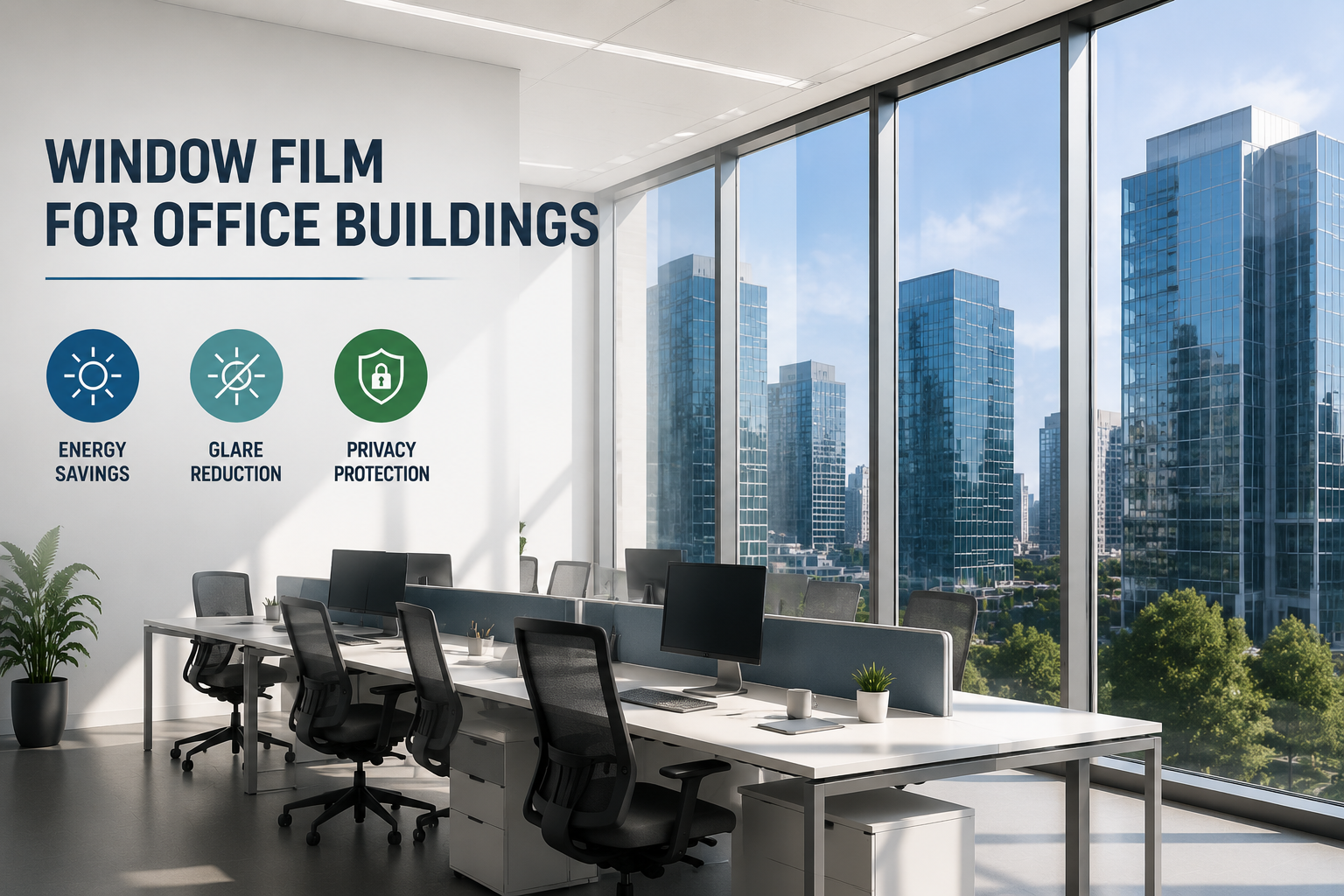
Window film improves comfort by reducing glare, heat, and privacy issues in office buildings.
Office buildings generate the most consistent demand for architectural window film, and for good reason — the combination of glazed facades, occupant density, screen-based workstations, and energy intensity makes window film one of the most straightforward building improvement investments available to a facilities manager.
But “office building window film” is not a single product or specification. The right film for a three-storey professional services office in London is different from the right film for a thirty-storey commercial tower in Dubai. This guide gives you the framework for an office-specific specification, organised around the three problems window film most commonly solves in office buildings.
Problem 1: Energy and Cooling Cost
The Scale of the Opportunity
Commercial offices are typically cooled for 8–12 hours per day, 250+ days per year. In buildings with significant glazing, solar heat gain through windows is consistently identified as the largest single driver of cooling energy consumption — accounting for 20–40% of total building HVAC energy in highly glazed buildings in warm climates.
A quality solar control film with TSER of 60–70% on south and west-facing glazing can reduce cooling energy attributable to those facades by 50–65%. For a 5,000sqm office in a warm climate, this translates to annual energy savings of $15,000–$50,000 depending on local energy costs and HVAC efficiency.
Specification Approach for Energy
Target the highest TSER achievable at a VLT that maintains acceptable daylighting quality. The energy saving scales directly with TSER — a film at TSER 65% saves roughly 30% more cooling energy than one at TSER 50%. The incremental cost of higher-performance film is typically modest relative to the incremental energy saving.
Priority facades: South and west first (Northern Hemisphere). East second. North typically requires no solar control film.
Glass type check: Verify glass specification before selecting film. Double-glazed and Low-E glass require specific film compatibility verification — see Window Film for Double-Glazed and Low-E Glass.
Payback calculation: With energy savings and installation cost modelled for your building, a simple payback of 3–6 years is typical for well-specified office installations in temperate to warm climates. See Window Film Payback Period Calculator to run the numbers for your building.
Problem 2: Glare on Workstations
Why Office Glare Is Worse Than It Used to Be
Screen glare has gotten harder to manage as monitors have become larger and moved to matte surfaces (which are glare-sensitive in ways that older glossy screens weren’t). Simultaneously, the post-pandemic redesign of many offices has favoured open-plan layouts with high windows — creating beautiful spaces at 9am that become unusable workstations at 3pm on the west elevation.
Specification Approach for Glare
The right film for glare depends on which type of glare is the primary problem:
Direct sun glare (west/south afternoon sun): Requires VLT reduction to 30–40% to meaningfully reduce direct beam intensity. Higher VLT films (50%+) typically don’t solve direct sun glare. Premium nano ceramic at VLT 35% on west-facing glass resolves most direct sun glare problems while maintaining a naturally lit character.
Diffuse sky glare (veiling reflections on screens): More persistent, lower intensity. VLT 35–45% neutral film reduces the diffuse sky brightness that causes veiling reflections. Reflective film is more effective per VLT level but produces an exterior mirror appearance.
Combined approach: A single specification at VLT 35% neutral solar control handles both types effectively on most office facades.
Avoid specifying film that’s too light (VLT 60%+) for glare management — many building managers try 50% VLT because they want to preserve daylight, find the glare reduction insufficient, and end up installing darker film anyway. Get the VLT right the first time.
Problem 3: Conference Room and Office Privacy
The Modern Office Privacy Challenge
The post-pandemic office redesign has favoured transparency and visual connection — glass partitions everywhere, visible culture, connected teams. This creates persistent privacy problems for the spaces that actually need to be private: conference rooms during sensitive discussions, HR and legal offices, executive suites.
Specification Approach for Privacy
Conference rooms: Frosted or etched-effect diffusion film at VLT 40–60% on the lower portion of glass walls (750mm to 1,800mm from floor) is the standard specification. This provides genuine privacy for seated and standing occupants while preserving the visual openness of the space above eye level. Alternatively, full-height frosted film at VLT 50–60% provides privacy while maintaining substantial light transfer.
HR and legal offices: Full-height frosted film at VLT 30–50%. These rooms require consistent privacy regardless of lighting conditions — reflective one-way film is not appropriate.
Executive suite perimeter: Lightly frosted at VLT 60–80% — enough to reduce sightlines while maintaining the prestigious, well-lit character of premium office space.
For offices with higher budgets considering on-demand switchable privacy, see Smart Film for Office Applications. Smart film at current pricing is viable for conference rooms and executive suites where the value justifies the premium.
Combining All Three: A Full Office Specification
A well-specified office building typically uses multiple film products in different zones:
Zone
Film Type
VLT
Primary Function
West/south facade, general offices
Nano ceramic solar control
30–40%
Energy + glare
East facade, general offices
Neutral solar control
40–50%
Energy + mild glare
Conference rooms (glass walls)
Frosted privacy
40–60%
Privacy
HR / legal offices
Frosted privacy
30–50%
Privacy
Reception area
Decorative / branded
Variable
Aesthetics + privacy
Ground floor, street-facing
Reflective or frosted
20–35%
Privacy + security
North facade
None or light tint
60–80%
Uniformity
FAQ
How long does office window film installation take?
A typical office building installation — 1,000sqm of facade — takes 3–7 working days with a professional crew. Work can be done floor by floor during business hours with minimal disruption. Tenants can remain in occupation throughout.
Do I need landlord permission for window film?
For interior-applied non-reflective film, most commercial leases allow tenant improvements of this type without landlord consent, though checking the specific lease terms is advisable. Reflective film that changes the building’s exterior appearance may require landlord approval and in some cases planning consent.
Can the same film be used throughout the building?
A single film specification is operationally simpler but may not be optimal — different facades and different space types have different requirements. A zoned specification with 2–3 products typically produces better performance and occupant satisfaction than a single compromise specification.
What certifications should the film have for a commercial office specification?
KSB Window Film supplies solar control, privacy, and decorative film for office building projects. Our technical team provides facade-by-facade specifications based on your building’s orientation, glass type, and occupant requirements — not a one-size-fits-all recommendation.