PDLC Smart Film: Applications, Technical Realities, and Regulations by Region
Published: July 3, 2026 · 11 min read · Category: Smart Film
About this article: KSB Window Film manufactures and exports PDLC smart film. Smart film gets significantly more enthusiasm in sales conversations than it does successful deployments — this guide tries to give an honest picture of both the technology’s genuine strengths and the parts of the pitch that don’t survive contact with reality.
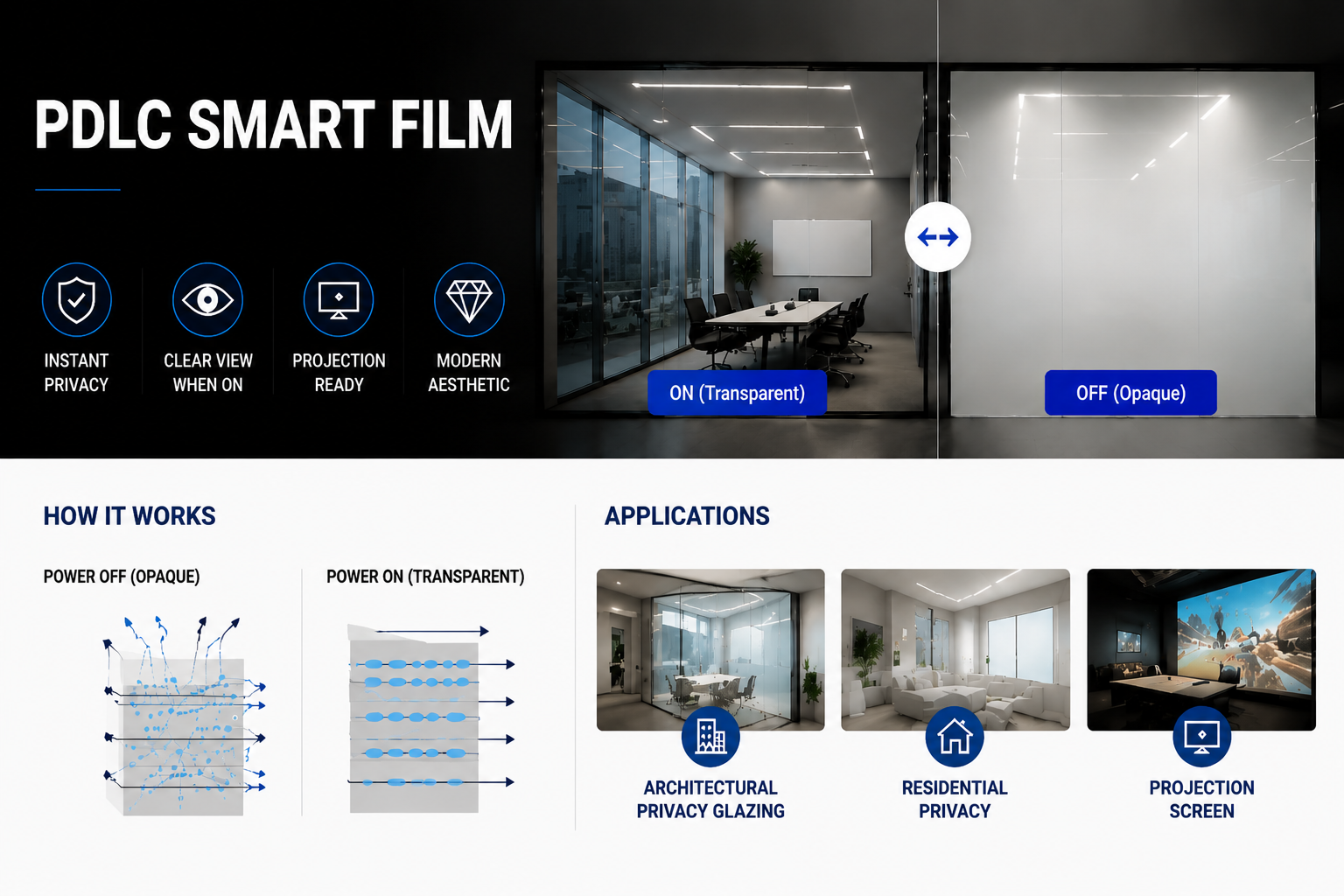
PDLC smart film switches between clear and opaque states for privacy, projection, and modern glass design applications
Smart film attracts a particular kind of buyer: someone who saw it in a hotel lobby or at a trade show, was genuinely impressed, and immediately started imagining applications for it. That enthusiasm is understandable — switchable glass privacy is a compelling idea. But between the trade show demonstration and the installed project, there are engineering constraints, building code questions, and power infrastructure requirements that the enthusiastic sales brochure tends to gloss over.
PDLC stands for Polymer Dispersed Liquid Crystal. The active layer is a film containing microdroplets of liquid crystals dispersed in a polymer matrix, sandwiched between two layers of ITO (Indium Tin Oxide) conductive coating on transparent substrates.
The switching mechanism:
Power off (opaque state): Without electrical field, liquid crystal droplets orient randomly. Incident light scatters in multiple directions — the glass appears white/milky and opaque.
Power on (transparent state): AC voltage applied across the ITO layers creates an electrical field that aligns the liquid crystal droplets. Light passes through without scattering — the glass appears clear.
The transition happens in milliseconds when the electrical field is applied or removed. To human perception, it’s instant.
What this is not: It’s not a darkening glass (like electrochromic). In both states, the film transmits a similar amount of light — it just scatters it differently. Opaque PDLC still transmits a significant fraction of total light (typically 50–70%); it just renders that light diffuse rather than directional, preventing clear visibility through the glass. If you need blackout, PDLC isn’t the right product.
The Three Real Applications (and Two That Don’t Work Well)
It Works Well: Architectural Privacy Glazing
Conference rooms, executive offices, medical consultation rooms, legal client meeting areas — spaces that need instant privacy on demand without permanent opacity. PDLC delivers exactly this: clear glass when the room is not in use (visually open, welcoming), opaque with a switch when privacy is needed.
The economic case here is strongest when the alternative is a permanent privacy treatment. Frosted film costs less than smart film, but it’s always frosted. If the space functions better being sometimes clear and sometimes opaque, PDLC’s cost premium is justified by the functionality.
It Works Well: High-End Residential (With Realistic Expectations)
Master bedroom windows, bathroom screens, home office privacy walls — applications where the homeowner wants architectural interest alongside functionality. PDLC works here, but the expectation needs to be managed: it’s a privacy product, not a blackout product. A master bedroom with PDLC windows at night will still show illuminated-room silhouettes from outside when the film is clear; when opaque, it glows white from outside if interior lights are on.
It Works Well: Retail and Hospitality Projection Screens
PDLC glass makes an effective rear-projection screen. In transparent state it’s clear; switched to opaque, it becomes a diffuse white surface that receives projected images excellently. This application is growing in retail (interactive store windows) and hospitality (restaurants, hotel lobbies). The projection quality is genuinely impressive and the “glass that becomes a screen” effect has real commercial value in brand experience contexts.
It Doesn’t Work Well: Automotive Applications
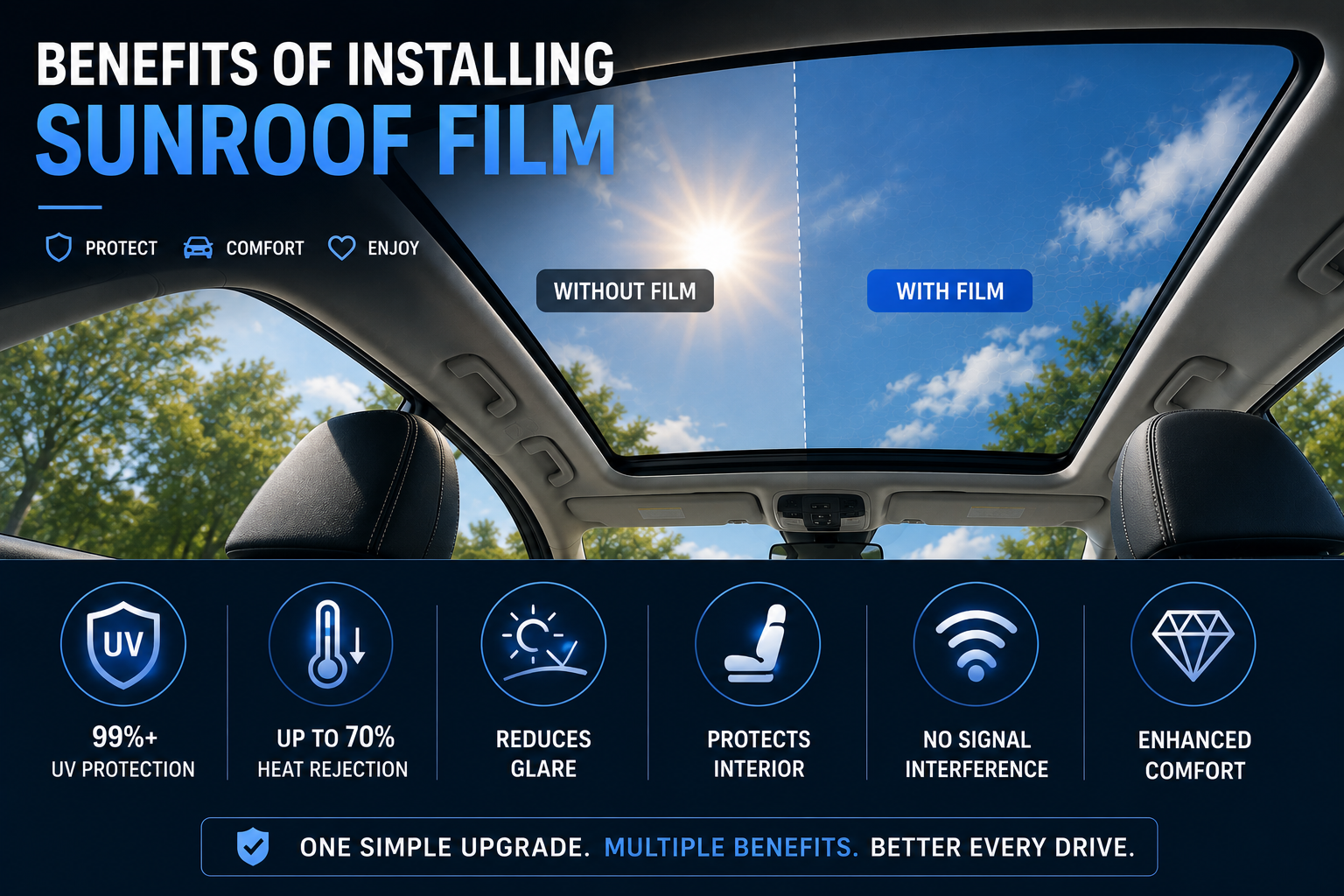
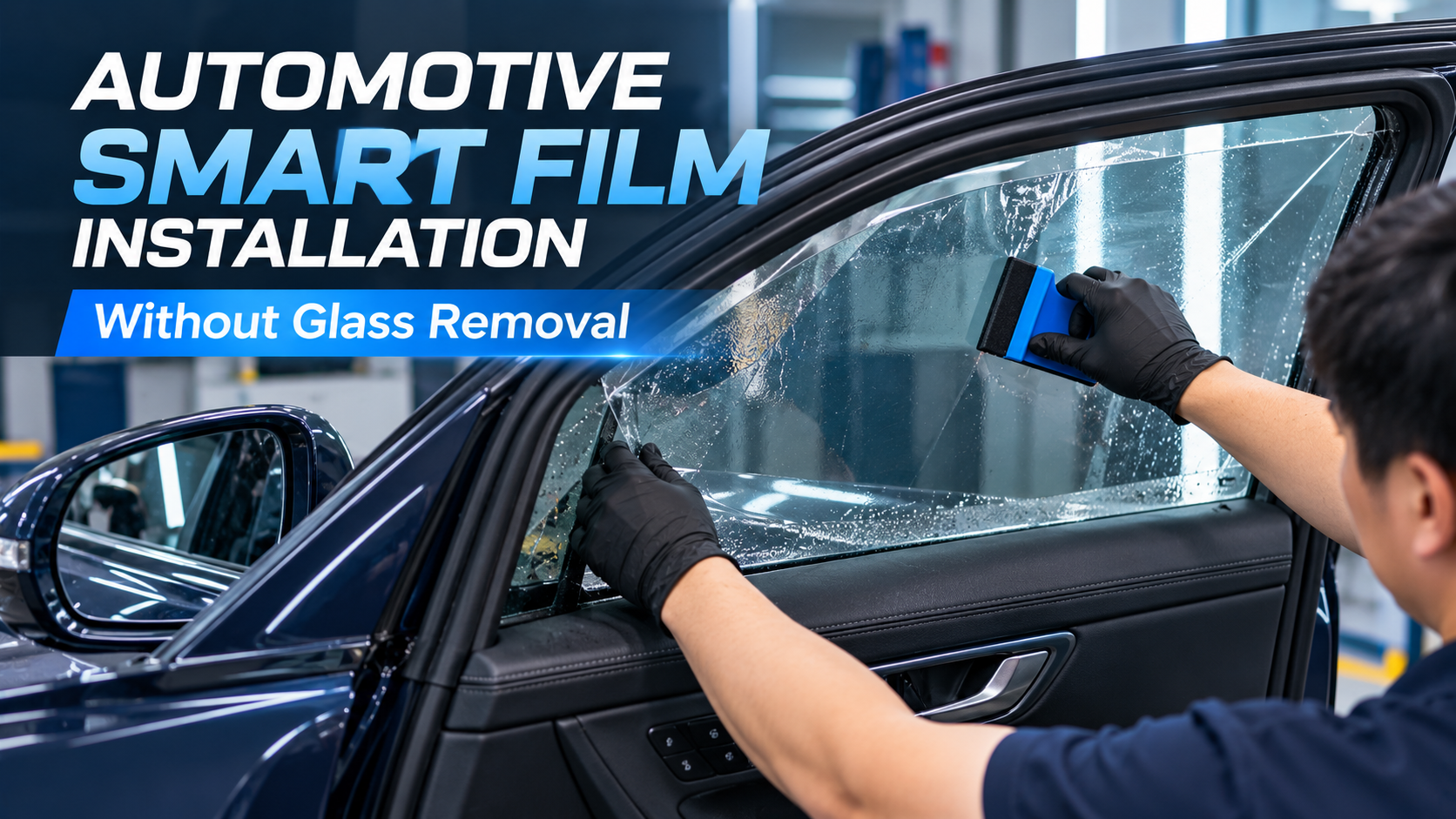
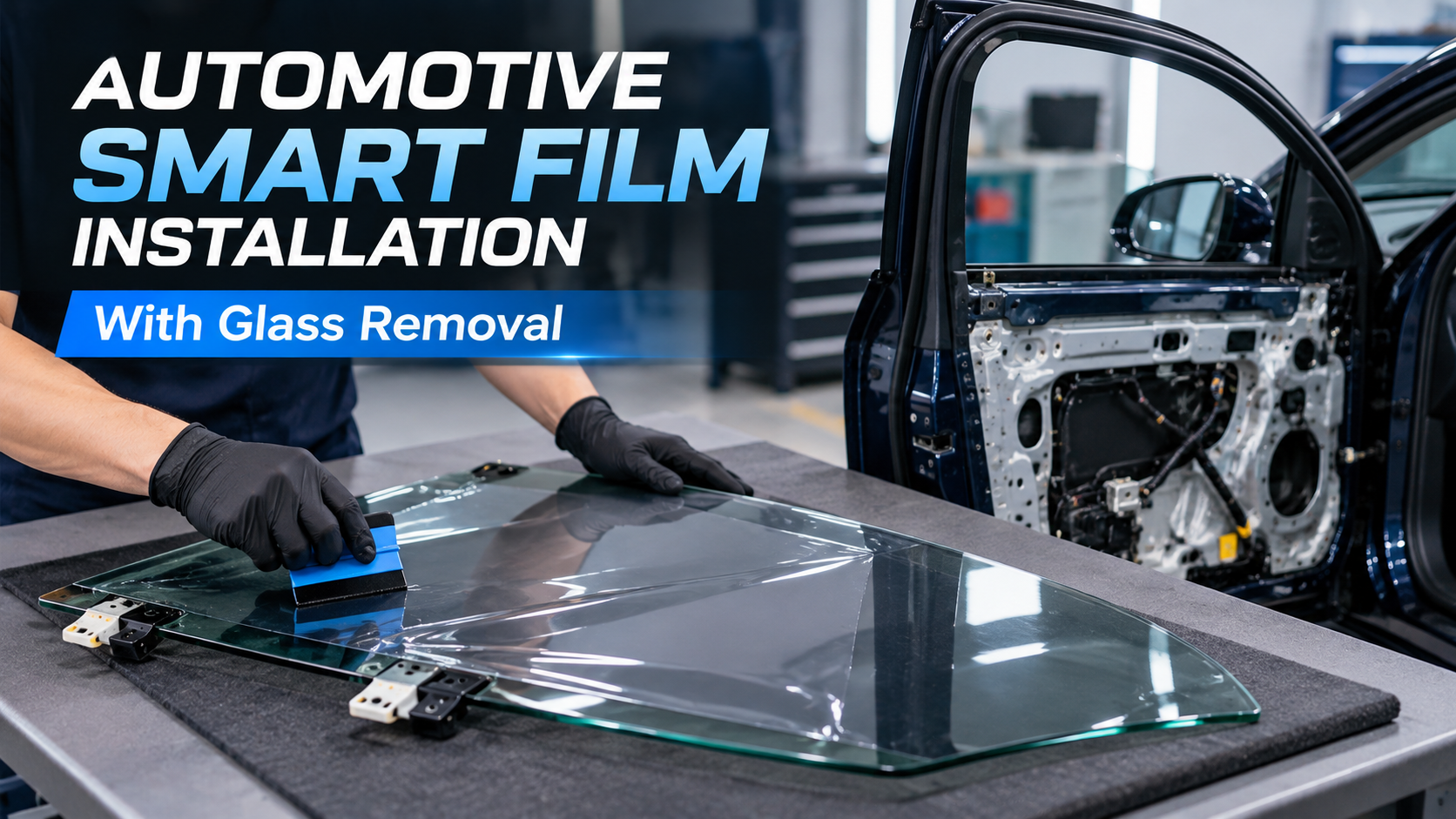
PDLC for car windows is a recurring idea that comes up in conversations periodically. The problems are substantial: the film requires AC power at 48–110V, which means electrical infrastructure in a vehicle architecture designed for 12V DC systems; the opaque-to-transparent transition requires the film to cover the full window including safety-critical driving view areas; and automotive glazing regulations in most markets don’t permit switchable opacity systems on primary vision panels. PDLC automotive applications are limited to the non-critical positions — sunroof, rear window of non-driving vehicles, partition windows in limousines.
It Doesn’t Work Well: Replacing Window Blinds Purely on Economics
A 2m × 1m PDLC glass panel costs $1,200–$2,500 installed, including film, controller, and electrical integration. A motorised blind for the same window costs $300–$600. If the decision is purely based on economics and the only function is “sometimes let light in, sometimes block it,” blinds win easily. PDLC justifies its cost premium in applications where cleanliness is critical (hospitals, clean rooms where fabric blinds collect pathogens), where aesthetics demand a flush glass solution, or where the projection or display functionality is an active requirement.
Technical Specifications You Need to Know
Opacity in off state: VLT drops to 3–6% in terms of directional (image-forming) light. Total light transmittance in the off state is still 50–75% — the light is scattered rather than blocked. This is why “opaque” needs to be understood correctly: you cannot see through it clearly, but the glass is not dark.
Transparency in on state: VLT typically 65–80% depending on film specification. Clear glass is typically 88–90% VLT. PDLC in the on state is slightly less transparent than unfilmed glass.
Haze in on state: A consistent quality issue with PDLC. Even in the clear state, ITO-coated film introduces some haze relative to unfilmed glass. Premium PDLC achieves haze below 4–5% in the on state; budget products can be 8–12%, which is perceptibly milky even when “clear.”
Operating voltage: Standard PDLC operates at 48–110V AC, 50–60Hz. Frequency and voltage affect both the opacity-to-transparency transition completeness and the power consumption. Lower voltage systems (48V) are safer and more accessible in terms of installation requirements. Higher voltage systems (110V) may achieve slightly better opacity-to-transparency transition. For integration with building management systems, 48V AC is increasingly preferred for safety and BMS compatibility.
Power consumption: 3–5W per square metre continuously when on (transparent). Zero when off (opaque). For energy management conscious projects: the film is “normally opaque” (power-off opaque) — it defaults to privacy when power is cut, and requires continuous power to remain clear. Some projects choose this configuration deliberately (privacy as the default); others want normally-clear film, which requires a different configuration.
Lifespan: Reputable PDLC film has a switching cycle life of 100,000+ cycles and a service life of 10–15 years. The ITO layer is the most vulnerable component — it can develop visible delamination or conductivity failures over time. Budget PDLC uses cheaper ITO that’s thinner and less uniform, producing visible failures within 3–5 years.
Regulations by Region
This is where smart film projects most often stall. Regulations for PDLC glazing in buildings are a patchwork — building codes in most markets were written before switchable glazing existed, and interpretations vary considerably between jurisdictions and building officials.
United States
Building codes: The International Building Code (IBC) and International Energy Conservation Code (IECC) govern glazing performance. There’s no specific PDLC provision in either. Smart film in architectural applications is evaluated under the general glazing provisions.
Safety glazing: For glazing in impact-hazard locations (within 24″ of a door, in floor-to-ceiling applications, etc.), the glass must meet safety glazing requirements per ANSI Z97.1 or CPSC 16 CFR Part 1201. Film applied to existing glass doesn’t automatically create safety glazing compliance — the film-on-glass system must be tested. Some PDLC film products have been tested as laminate systems and carry safety glazing certification; most haven’t.
Energy codes: PDLC affects SHGC only marginally — the film changes opacity, not solar heat gain to a significant degree. For LEED and energy code compliance, PDLC is essentially neutral on solar performance.
Electrical: Standard electrical installation regulations apply. 48V AC falls below the threshold requiring licensed electrician installation in most states; 110V AC requires licensed installation.
European Union
CE Marking and CPR: For PDLC applied to glass in construction applications, the Construction Products Regulation (CPR) requirements are the same as for other glazing products — Declaration of Performance and CE marking for products within harmonised standard scope. The electrical component of smart film brings in EMC Directive (2014/30/EU) and Low Voltage Directive (2014/35/EU) compliance requirements.
EN 12600 safety glass: In impact-hazard locations (as specified in building codes per country), safety glazing requirements apply. PDLC film on glass needs system-level testing rather than just film-level testing for safety glazing certification.
REACH: The ITO layer and liquid crystal materials in PDLC film must comply with REACH. Most ITO formulations are compliant, but it’s worth verifying — particularly for liquid crystal components.
UK (Post-Brexit)
UKCA marking has replaced CE marking for products sold in England, Wales, and Scotland from January 2022. The substantive technical requirements are essentially identical to EU CE requirements but require separate UK Conformity Assessment documentation.
The technical requirements for glazing performance (BS EN 12600, BS EN 410) remain the same as EU standards.
China (Domestic)
PDLC is manufactured and installed at high volume in China. Domestic regulations are less stringent than EU/US equivalents, which means that PDLC products manufactured primarily for the Chinese domestic market may not have the safety glazing certifications or electrical compliance documentation required for EU or US import.
For buyers sourcing PDLC from Chinese manufacturers for Western markets: explicitly require CE marking (EMC and LVD) for the electrical components and confirm safety glazing test status before ordering.
Australia and New Zealand
No specific standard for PDLC/smart film exists in AS/NZS standards. Projects are evaluated under general glazing and electrical regulations. Safety glazing requirements per AS 1288 (Glass in Buildings — Selection and Installation) apply in impact-hazard locations.
Installing Smart Film: The Electrical Integration Reality
The most common underestimation in PDLC projects is the electrical integration. The film needs a driver/controller, the driver needs power, and the power needs to come from somewhere.
In a fit-out or new construction project, this is manageable: the smart film positions can be planned into the electrical schematic and low-voltage cabling can be run during construction. The cost is integration into the building management system or standalone controller, plus the cabling.
In a retrofit into an existing building, it’s more complicated: cable routing to existing glass positions often requires visible conduit or invasive chasing, and the controller needs to be positioned accessibly. Projects underestimate this cost regularly.
Things to plan for:
Multiple glass panels on one controller vs. individual controllers: A single controller can typically manage multiple adjacent panels if they need to switch simultaneously. Panels that need to switch independently (different rooms on the same circuit) need either multiple controllers or a zoned controller.
Integration with building automation: BMS integration (KNX, DALI, BACnet) enables automation (privacy at certain times, occupancy-linked switching). This requires controllers with appropriate communication interfaces — not all PDLC controllers have them.
Fail-safe position: What happens when power fails? Power-off-opaque defaults to privacy (preferred for medical and legal applications). Power-off-transparent defaults to clear (preferred for security camera coverage, emergency egress visibility). This is a design decision that needs to be made before installation, not after.
FAQ
Why does PDLC look slightly milky even when switched to clear?
The ITO-coated film substrate introduces forward light scattering even in the on state. This is inherent to the technology — even premium PDLC film has 3–6% haze in the on state compared to 0.1–0.5% for standard window glass. In most applications this isn’t noticeable to occupants. In applications where optical clarity is critical (retail display windows, precision optical environments), it can be an issue. Specify haze measurement in the product data sheet and set a threshold that’s acceptable for your application before ordering.
Can I apply PDLC film to curved glass?
Limited curvature — gentle curves found in some architectural panels — is manageable with flexible PDLC film. Tight compound curves (like some automotive glass) are not suitable. The ITO coating is a rigid conductive layer that cracks under significant bending. Specify the film’s minimum bend radius and compare to your glass geometry.
KSB Window Film manufactures PDLC smart film for architectural, retail, and hospitality applications with CE marking documentation for EU/UK markets. We’ll also tell you when smart film isn’t the right solution for your project.