Hurricane and Storm Window Film: Does It Actually Protect Your Building?
Published: August 20, 2026 · 8 min read · Category: Safety & Security Film
About this article: KSB Window Film manufactures safety film for storm and blast protection applications. This guide addresses one of the most frequently misunderstood topics in the safety film category — what storm protection film can and cannot do for a building.
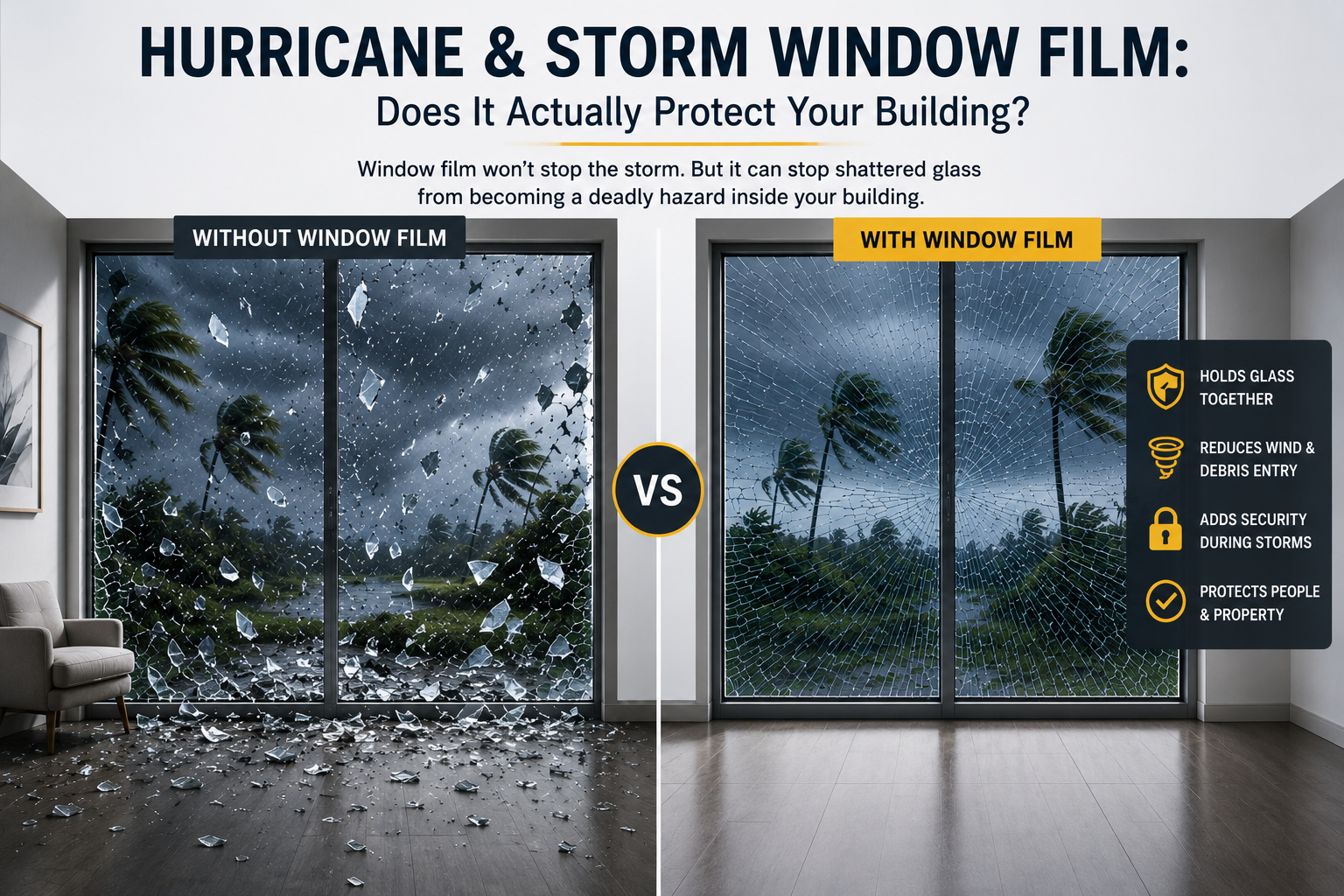
Comparison of building windows with and without hurricane safety window film during a severe storm.
The marketing around hurricane and storm window film can create unrealistic expectations. “Hurricane protection film” sounds like it makes windows hurricane-proof. It doesn’t. But that’s not the right standard to judge it against — and when evaluated correctly, storm safety film provides meaningful, cost-effective protection that building owners in hurricane and severe storm zones genuinely benefit from.
This article explains what storm film actually does, where it works, and where it doesn’t — so your specification is based on what you’re actually buying.
What Hurricanes and Severe Storms Do to Windows
Wind pressure in a major hurricane (Category 3+) can exceed 200 mph gusts. This creates dynamic pressure loads on building envelopes that standard residential and commercial windows were not designed to resist.
But the most common glass failure mechanism in hurricane events isn’t direct wind pressure — it’s wind-borne debris impact. Projectiles carried by hurricane-force winds — branches, gravel, signage, structural components from adjacent buildings — strike windows and break them at relatively modest wind speeds. Once glazing fails, two things happen:
Wind and rain enter the building, causing extensive water damage
Internal pressure increases dramatically, which can cause structural failure of the building envelope (roof uplift, wall failure)
The glass failure is the initiating event. The storm damage that follows is often far greater than the direct impact cost.
What Storm Safety Film Does
Storm safety film (typically 8 mil safety film, sometimes specifically engineered hurricane-grade products) addresses the glass failure event by changing the aftermath of impact.
When debris strikes a window protected by safety film:
The glass typically still breaks — film doesn’t make glass impact-resistant to hurricane debris
The broken glass stays in the frame — held together by the film
Wind and rain infiltration is reduced (not eliminated) because the intact film-glass unit still partially occupies the opening
The delay before the window is completely compromised is extended
The critical point: Storm film does not prevent breakage. It manages what happens after breakage. On a building where windows fail and the openings drive cascading damage, even a few minutes of delay in complete failure can reduce the total damage substantially.
The Official Position: Code Compliance
Here is where expectations need to be carefully managed.
Florida Building Code, Texas wind codes, and most US hurricane-zone standards require specifically rated impact-resistant glazing (laminated glass or polycarbonate systems) for new construction in high-wind zones. Safety film does not satisfy these code requirements as a substitute for impact-rated glazing in new construction.
For existing buildings that predate current codes and can’t practically be re-glazed, safety film provides meaningful risk reduction — it just doesn’t make the building code-compliant for wind impact resistance.
Building owners in hurricane zones should understand this distinction:
If you’re required by code to have impact-rated glazing: you need impact-rated glazing, not film
If your existing building has annealed glass that predates current codes: safety film provides genuine risk reduction for wind-borne debris and storm events
What the Evidence Shows
Studies following major hurricane events (including analysis after hurricanes Andrew, Katrina, and Harvey) have documented that:
Buildings with safety film experienced reduced glass scatter injuries
Film-treated windows that failed in storms typically maintained the film-glass unit in the frame for longer than unfilmed windows, providing extended protection during the event
Internal pressurisation (the mechanism of roof uplift) was delayed in some film-treated buildings
The film industry, including the IWFA, has published data on this. LBNL has also studied the effect of film on storm performance. The honest summary: film helps, it helps significantly in reducing injuries, but it is not equivalent to properly engineered impact-resistant glazing for the highest wind exposures.
Storm Film Specification
For existing buildings in hurricane and severe storm zones, the appropriate specification:
Minimum: 8 mil safety film with perimeter attachment tape on the most exposed windows.
Better: 8–12 mil security/safety film with wet-glazed or mechanically fastened frame attachment on all vulnerable glazing. Frame attachment substantially increases the ability of the film-glass unit to resist wind pressure loads in addition to fragment retention.
Application priority: Face the prevailing storm direction first (typically south and east elevations in the US Gulf Coast and Atlantic regions). Ground-floor glazing is more vulnerable to wind-borne debris from ground-level sources.
Product selection: Standard safety film is adequate for most residential and light commercial applications. For buildings requiring the highest available protection from film products, look for products with documented hurricane simulation testing (ASTM E1886/E1996 for wind-borne debris resistance).
Storm Film vs. Hurricane Shutters vs. Impact Glass
Solution
Protection Level
Cost
Disruption
Appearance
Safety film (8 mil)
Moderate (fragment retention, debris delay)
Low
None
Invisible
Safety film (12 mil + frame attach)
Good (fragment retention, pressure delay)
Low–medium
Minimal
Invisible
Hurricane shutters
High (direct impact)
Medium
Significant (deploy/store)
Visible when deployed
Impact-rated glass
Highest (code compliant)
High
Significant (replacement)
Normal glass appearance
For building owners who cannot afford impact glass or who prefer not to deploy shutters: safety film at 8–12 mil provides the best available protection at the lowest cost and disruption.
FAQ
Does storm film void my home or building insurance?
No — in most markets, safety film installation doesn’t void insurance. In some markets, it may qualify the building for a reduced wind risk premium (check with your insurer). It does not, however, qualify the building as “impact-rated” for insurance or code purposes unless the specific film product has been tested to applicable storm rating standards.
What’s the difference between “storm film” and regular safety film?
In most cases, the same product. “Storm film” is marketing terminology for safety film products (typically 8 mil) positioned for this application. Some manufacturers produce specifically engineered storm/hurricane products with enhanced tensile strength and wider tear resistance, tested to ASTM E1886/E1996. For the most demanding storm applications, look for products with documented hurricane simulation testing rather than generic “storm film” labeling.
Will safety film help in a tornado?
Tornado wind speeds (EF2–EF5) can exceed hurricane Category 5 intensity. Safety film provides fragment retention benefits but cannot be expected to hold windows intact at extreme tornado wind speeds. The primary safety benefit is reducing glass fragment injuries if windows fail — not maintaining window integrity.
Source Storm Safety Film With Documented Performance
KSB Window Film supplies 8 mil and 12 mil safety film for storm protection applications, with EN 12600 certification and frame attachment guidance. We can advise on product selection based on your building’s storm exposure and existing glazing specification.