What Is EN 12600? Understanding Europe’s Safety Glazing Standard for Window Film
Published: September 2, 2026 · 7 min read · Category: Safety & Security Film
About this article: KSB Window Film maintains EN 12600 certification for our safety film range and regularly provides this documentation for European and international commercial project specifications. Understanding what EN 12600 actually tests helps buyers use the standard effectively rather than just citing it.
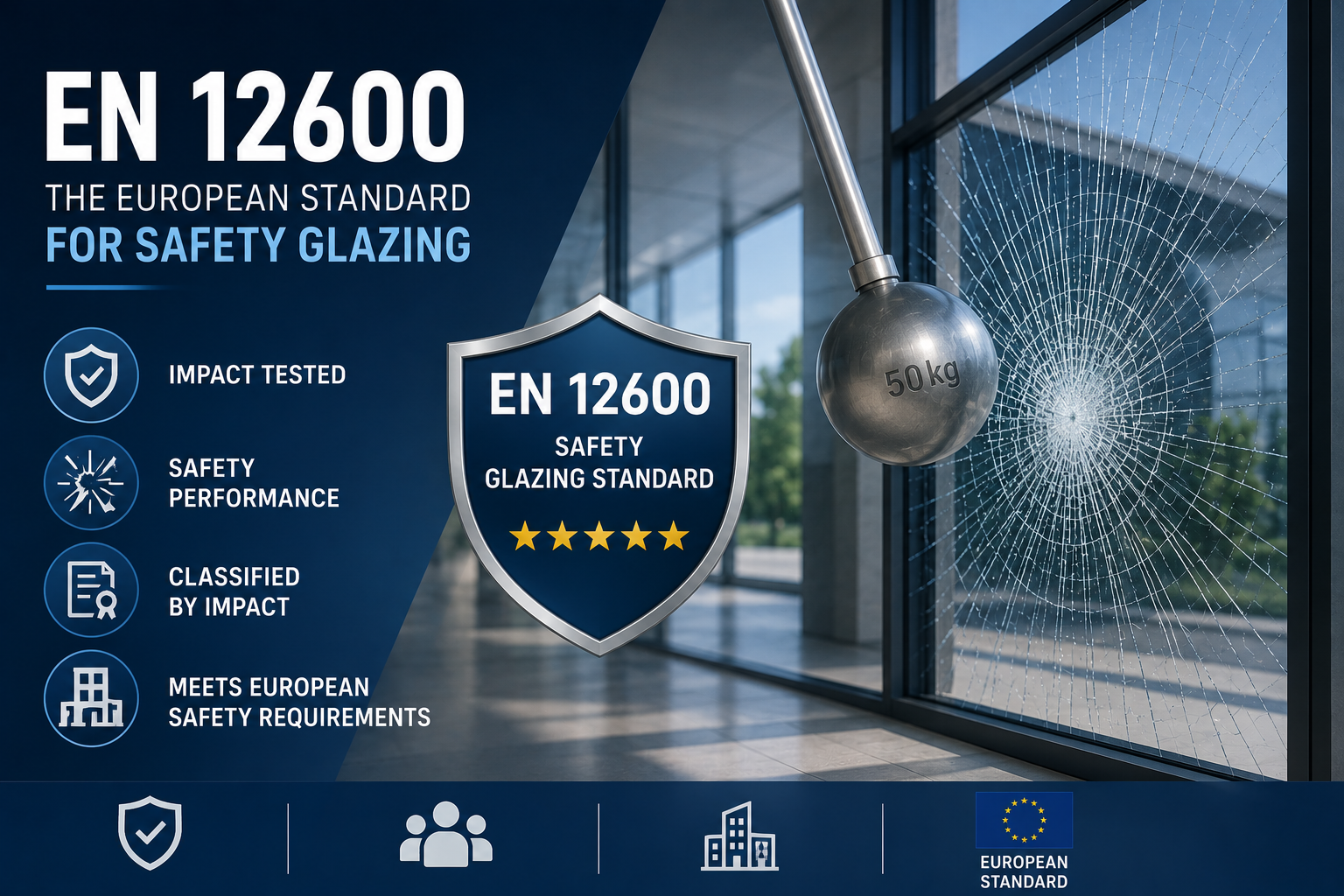
EN 12600 certified safety window film tested with a 50kg pendulum impact for glass fragment retention and building safety compliance.
EN 12600 is the standard that appears most frequently in European safety window film specifications — referenced in building regulations, insurance requirements, and procurement documents across the UK, EU, and many international markets that follow European standards. It’s also one of the most frequently misread standards in the industry, because the three-component classification system produces a label that looks simple but requires interpretation to use correctly.
What EN 12600 Is (and Isn’t)
EN 12600 is formally titled: “Glass in building — Pendulum test — Impact test method and classification for flat glass.”
What it is: A single-impact test that simulates a human body falling against glass. It measures whether a glass assembly (glass + any applied film) breaks through under the impact, and if it does, whether fragments are retained or scatter.
What it isn’t:
A blast resistance test (that’s ISO 16933 and related standards)
A sustained forced entry test (that’s LPS 1270)
A test of long-term performance under UV or thermal ageing
A complete measure of building security
EN 12600 answers one specific question: if a person falls against this glass at a defined impact energy, does the glass fail safely (fragments retained) or dangerously (break-through or scattering shards)?
The Test Methodology
The Pendulum Impactor
The test apparatus is a pendulum — a defined mass (a spherical body of 50kg) suspended on a pivot arm. The pendulum is raised to a defined height and released to strike the test specimen at a controlled energy level.
Why a pendulum rather than a direct impact tool? Because the pendulum’s mass and swing path replicate the biomechanics of a human body falling against glass more accurately than a simple drop test or projectile impact. The standard was specifically developed for the most common glass injury scenario in buildings: a person falling or stumbling against a glass surface.
The Test Specimen
The glass-film assembly is mounted in a standard test frame. The frame configuration (how the glass is supported and constrained) affects the result — which is why test results specify the glass type and mounting configuration alongside the performance class.
The Energy Levels
EN 12600 tests at three “impact classes”:
Class 1: 450mm drop height — highest energy (equivalent to a hard fall)
Class 2: 190mm drop height — medium energy
Class 3: 70mm drop height — lowest energy
The test starts at the lowest energy and progresses to higher levels to determine at which point, if any, the assembly fails.
The Classification System: Reading the Label
EN 12600 classifications are written as: [failure mode][impact class](glass type)
Failure Mode
A: No break-through — the impactor does not pass through the assembly at the test energy level. The glass may crack or deform, but the impactor doesn’t create a passable opening.
B: Break-through occurs, BUT fragments are retained — the impactor passes through the assembly, but the broken glass fragments remain in the film matrix rather than scattering. This is still a meaningful safety improvement over unprotected glass, which scatters sharp fragments on both sides of the break.
C: Break-through with large fragments — the glass breaks through AND produces large, potentially dangerous fragments. Essentially a “failure” in safety terms — this classification indicates the product doesn’t provide safe glazing performance.
(1): The outer lite of a double-glazed unit (IGU) (2): The inner lite of a double-glazed unit, or a single-glazed panel
Reading Common Classifications
B1(2): Fragment retention (B) at the highest impact energy (1) on single glazing or inner lite (2). This is the most commonly specified class for safety film on commercial glazing — fragments are held in place even at maximum test energy.
A1(2): No break-through (A) at maximum impact energy on single/inner glazing. A higher performance level than B1 — the impactor doesn’t pass through at all. Required for some security applications.
B2(2): Fragment retention at medium impact energy. Lower performance than B1 — adequate for some building code requirements but not the maximum available.
B1(1): Fragment retention at maximum energy on the outer lite of an IGU. Relevant for double-glazed unit applications.
Building Code Application
EU/European Markets
EN 12600 is the recognised European standard for safety glazing. National building regulations in EU countries and the UK reference EN 12600 for defining compliant safety glazing in required locations:
Glazing in and adjacent to doors
Glass within 800mm of the floor
Glass in areas accessible to children
Glazing adjacent to staircases and circulation areas
The minimum class required varies by application and by national regulation. In the UK, for example, Building Regulations Part N specifies compliant safety glazing at critical locations — EN 12600 Class B1 is typically the minimum for these applications.
Middle East and International Markets
Many Middle Eastern and Asian markets have adopted European standards, including EN 12600, either directly or as the basis for national standards. ESMA (UAE) and equivalent bodies in Saudi Arabia and other GCC markets reference European safety glazing standards.
EN 12600 vs. Other Standards: Which Do You Need?
Standard
What It Measures
When You Need It
EN 12600
Impact safety (human body fall)
Code compliance, general safety
ANSI Z97.1
Impact safety (US equivalent)
US market code compliance
LPS 1270
Forced entry resistance
Security and insurance requirements
UL 972
Burglary resistance
US security specifications
GSA/UFC
Blast resistance
US government buildings
ISO 16933
Blast testing
International blast certification
For most European commercial projects: EN 12600 B1 is the baseline safety certification requirement. Add LPS 1270 for security applications.
FAQ
Does EN 12600 certification mean the film is “blast rated”?
No. EN 12600 is a single-impact pendulum test simulating a human body fall. It has no relevance to blast loading, which involves much higher energy, much faster loading rates, and a different failure mechanism. A film certified to EN 12600 B1 is not blast rated. Blast certification requires testing under ISO 16933, ASTM F1642, or equivalent standards.
If film already has EN 12600 certification, does it also automatically comply with ANSI Z97.1?
Not automatically — the two standards are similar but have different test procedures and classification systems. A film should be independently tested to each standard to carry each certification. Many manufacturers test to both for international market compliance.
My building specification says “EN 12600 Class B.” Is that sufficient to specify?
“Class B” alone is incomplete — it doesn’t specify the impact energy class (1, 2, or 3). A complete specification should state the full classification, e.g., “EN 12600 Class B1(2).” Ask the specifier to clarify which class is required.
KSB Window Film provides EN 12600 certification documentation for our safety film range — specifying the class achieved for the specific product on the specific glass configuration relevant to your project.