Window Film for Retail Stores: Protecting Merchandise and Shopfront Display
Published: September 2, 2026 · 7 min read · Category: Architectural Window Film
About this article: KSB Window Film supplies solar control, security, and decorative film to retail projects. Retail has a distinctive window film brief — the shopfront is both a marketing asset and a vulnerability — and this guide addresses the specific tradeoffs involved.
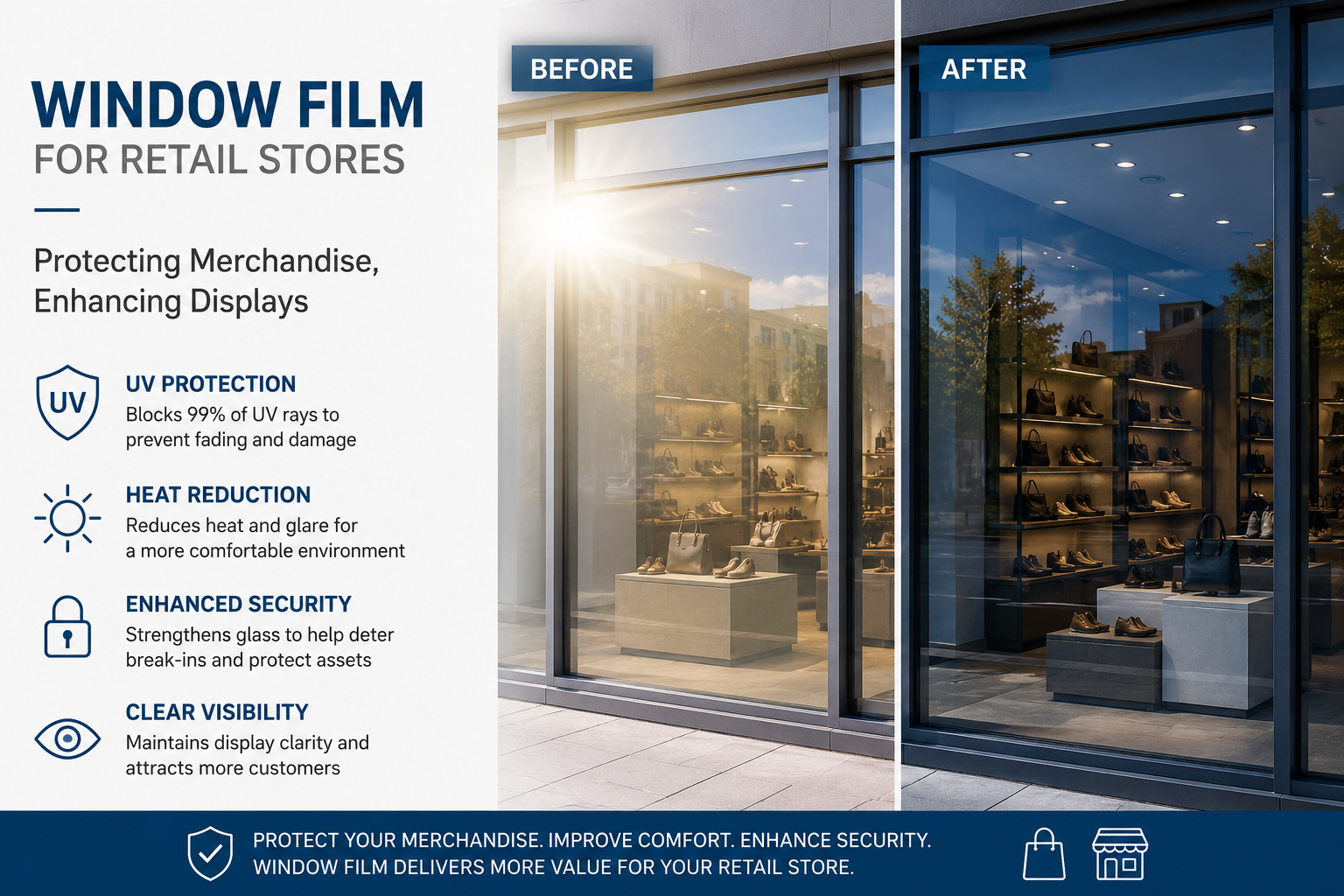
Retail window film helps protect merchandise from UV damage, improves customer comfort, and enhances storefront security while maintaining display visibility.
Retail window film decisions involve tensions that other building types don’t face as acutely. The shopfront is a marketing asset — it needs to display merchandise attractively and draw customers in. At the same time, UV radiation is destroying the same merchandise, heat through the glass is creating uncomfortable shopping environments, and the glass itself is the most vulnerable point in the building’s security perimeter.
Getting window film right in a retail environment means resolving these tensions, not just choosing between them.
The Merchandise Protection Case
UV radiation is responsible for the majority of colour fading in retail merchandise — textiles, apparel, flooring samples, furniture, food products, artworks, and virtually anything displayed near windows. The UV bleaching effect is cumulative and irreversible.
Quality solar control film blocks 99%+ UV regardless of VLT level. This single fact is often the most compelling case for retail window film — the film pays for itself in reduced merchandise replacement and writedown costs before the energy and comfort savings are even counted.
Reference data: UV exposure through unfilmed glass fades many textiles to 50% of original colour saturation within 500–800 hours of direct exposure. With quality UV-blocking film, this rate reduces by 99%+ — the same fading that occurs in weeks without film takes years with it.
For fashion retailers, furniture showrooms, art galleries, wine merchants, and any retailer with sun-exposed merchandise, UV protection alone justifies window film.
Solar Heat: Customer Comfort and Food Safety
Retail spaces with large south- and west-facing shopfronts frequently overheat in summer — creating uncomfortable shopping environments and, in food retail, creating temperature compliance challenges for chilled product adjacent to windows.
Customer dwell time is documented to drop significantly in thermally uncomfortable retail environments. A customer who enters a hot, glary shopfront is less likely to browse and more likely to leave quickly.
Solar control film at TSER 55–65% on shopfront glazing reduces the thermal discomfort that drives customers away from display-adjacent areas — improving dwell time and the shopping experience.
The Shopfront Display Dilemma
Here’s the genuine tension in retail film specification: any film that reduces visible light transmission (VLT) also reduces the visibility of merchandise from outside.
A 20% VLT film provides excellent solar control and privacy but significantly reduces the visibility of window displays — customers looking in from outside see a dark, reflective surface rather than the merchandise behind it.
The resolution: reflective film for privacy or security; spectrally selective or lightly tinted film for retail display preservation.
Reflective film at 15–20% VLT provides good solar control and daytime privacy (useful for back-office areas behind the display zone), but makes the shopfront appear dark and mirrored from outside. Not ideal for merchandise display.
Spectrally selective or neutral solar control film at VLT 50–60% provides meaningful solar and UV control while maintaining most of the display visibility. The heat rejection is moderate (TSER 45–55%), but the display remains visible and the UV blocking is complete.
Retail-optimised specification: Spectrally selective film at VLT 55–65% on primary shopfront glazing. This maximises the display visibility trade-off against solar control, with complete UV protection in both cases.
Security Film for Retail
Retail is the primary market for security window film — smash-and-grab shopfront break-ins are a persistent and increasing problem in many markets. Security film at 8–12 mil significantly delays forced entry through shopfront glass.
How much delay? An unprotected glass shopfront can be cleared in 3–5 seconds. A properly installed 8 mil security film installation on the same glass — with frame attachment — typically requires 60–120 seconds of sustained effort to penetrate. This delay is long enough for alarm systems to activate and begin a response.
Frame attachment is essential for security applications. Security film without frame attachment holds glass fragments together but the intact glass-film unit can be pushed inward as a whole. Mechanical frame attachment (perimeter attachment tape or mechanically fastened edge channels) prevents this. Specify this explicitly: “8 mil security film with frame-attached perimeter detail.”
Many retailers combine security film on lower shopfront glass with solar control film on upper glazing — addressing both requirements on the same shopfront with a single installation.
Signage and Branding: Decorative Film in Retail
Decorative window film is a mainstream retail fit-out product:
Window manifestation: Many retail shopfronts use cut vinyl or frosted band film at 900–1,800mm height to comply with building codes that require glass identification markers at pedestrian level.
Brand graphics: Digitally printed window film allows retailers to apply large-format brand graphics, campaign images, or product photography to shopfront glass — at a fraction of the cost and complexity of traditional signage structures.
Privacy for back-of-house areas: Frosted film on glass partition between sales floor and stockroom, staff areas, or checkout back-offices.
FAQ
Will security film make the shopfront look different?
Security film at 8–12 mil is typically clear (minimal tint) — it doesn’t change the appearance of the glass significantly. Some products have a very slight tint; others are genuinely optically clear. Confirm the appearance with the supplier before installation.
Does UV-blocking film affect photography in the shop?
UV-blocking film affects UV-specific lighting (UV photography, UV germicidal lamps) but does not affect visible light photography. If you use UV-active displays or UV lighting for product presentation, discuss this with your film supplier.
Can I apply graphics over existing security film?
In some cases yes, if the security film’s surface is compatible with the graphic film adhesive. More reliably: apply security film on the interior, graphics on the exterior — this allows both to be maintained and replaced independently.
How often does security film need to be replaced?
Quality interior security film: 10–12 years before noticeable performance degradation. Film that has been impacted (tested by an attempted break-in) should be replaced regardless of apparent condition — the adhesive and film structure may have been compromised.
Specify Retail Window Film That Protects Without Compromising Display
KSB Window Film supplies solar control, security, and decorative film for retail fit-outs and shopfront renovations. We understand the display visibility trade-off and can advise on specifications that maximise UV and solar protection while maintaining shopfront display effectiveness.