Optical Clarity Standards for Windshield Films: What Installers and Buyers Must Know
Published: September 24 2026 · 8 min read · Category: Windshield Film
About this article: KSB Window Film measures optical performance of our windshield film products to ASTM D1003 and equivalent standards. Optical clarity is the non-negotiable specification in windshield film — this guide explains what the standards mean and how to verify them.
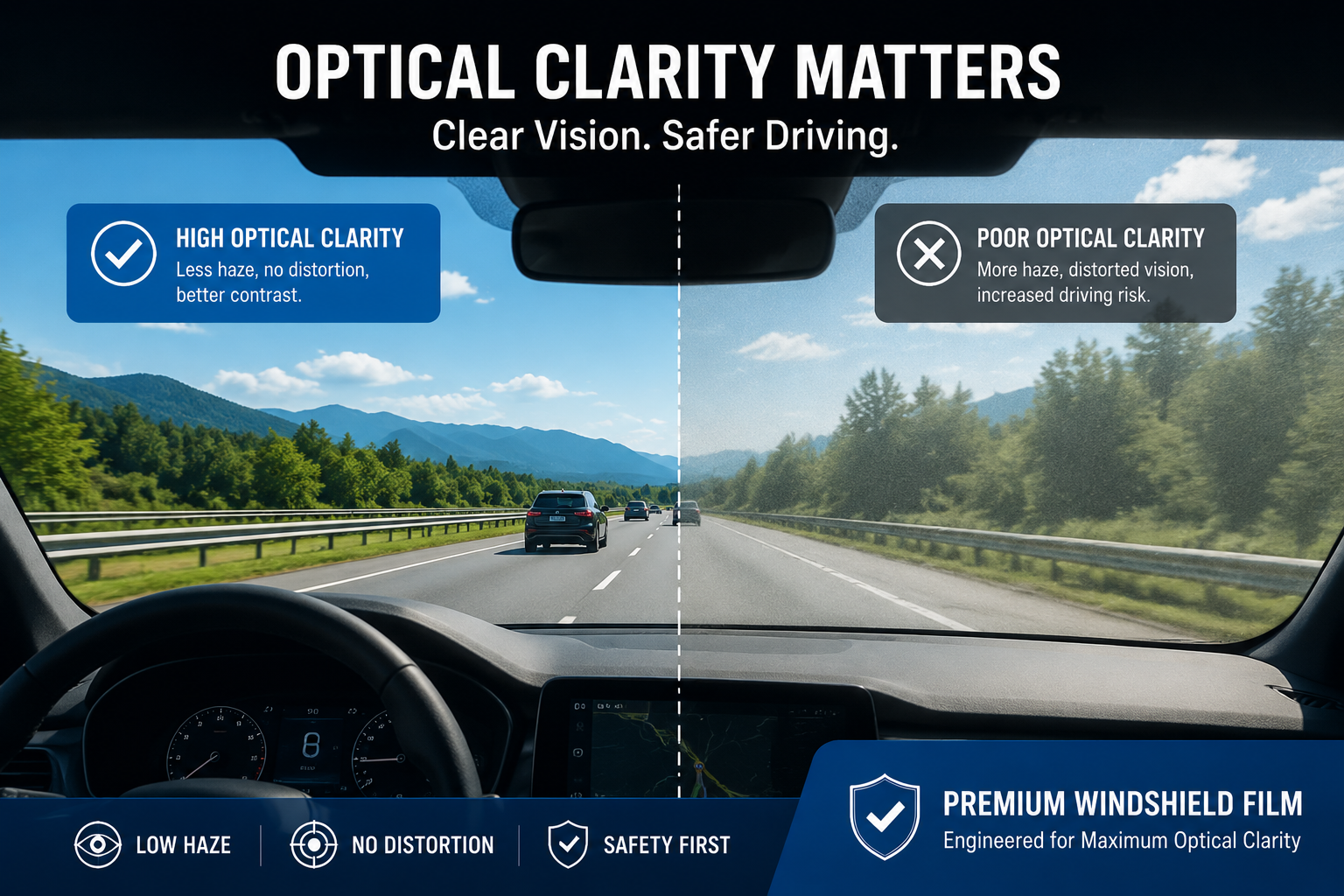
High optical clarity windshield protection film ensures clear visibility and safe driving without visual distortion.
Optical clarity in windshield film is not a soft preference — it’s a safety requirement. A film that introduces haze, distortion, or reflective anomalies on a driving glazing surface creates a visual safety hazard that can contribute to accidents. Regulatory bodies in most markets recognise this and set minimum optical standards for materials used in driving vision areas.
Most windshield film suppliers market their products with optical clarity claims. Most of these claims are accurate for the limited conditions under which they were measured. Few suppliers explain what the standards mean, how the measurements are made, or how to verify them independently.
This guide does all three.
The Applicable Standards
ECE Regulation 43 (International / Europe)
ECE R43 (“Uniform provisions concerning the approval of safety glazing materials and their installation on vehicles”) is the primary international standard for automotive glazing optical quality. It’s adopted by most countries outside the US.
Key optical requirements from ECE R43 applicable to windshield materials:
Regular light transmittance: Minimum 70% VLT in Zone A (the area directly in front of the driver). This is the minimum light transmission standard — most windshield protection film is clear and exceeds this easily.
Diffusion (haze): ECE R43 limits the scatter of light transmitted through glazing in the driving field. The standard specifies maximum permitted haze values at defined measurement conditions.
Secondary image separation: ECE R43 limits the separation between the primary image and any secondary image (reflection/refraction double image) visible when looking through the glazing. This is the optical distortion standard.
Windshield film implication: Film applied to a windshield that causes the combined glass-film assembly to fail ECE R43 optical requirements is technically non-compliant for use in driving vision areas. Premium windshield film engineered to ECE R43 compliance allows the glass-film system to remain within the standard’s limits.
FMVSS 205 (US Federal)
Federal Motor Vehicle Safety Standard 205 governs glazing materials in US-market vehicles. Like ECE R43, it specifies minimum light transmittance and optical quality requirements for driving vision areas. Films applied to windshields must not cause the glass to fail FMVSS 205 requirements.
ANSI Z26.1 (US — additional reference)
The American National Standard for Safety Glazing Materials includes optical quality requirements including maximum haze and minimum transmittance for different glazing application zones.
The Key Optical Parameters
Haze
Definition: The percentage of transmitted light that deviates from the direction of the incident beam by more than 2.5° during passage through the film.
Measurement: ASTM D1003 (Haze and Luminous Transmittance of Transparent Plastics) is the standard test method. A hazemeter measures the proportion of transmitted light that scatters.
Why it matters for driving: Haze reduces contrast sensitivity — the ability to distinguish objects against backgrounds. At night with oncoming headlights, a hazy windshield dramatically reduces the ability to see pedestrians, cyclists, and road markings in the contrast-reduced zones.
Reference values for windshield film:
Below 0.3%: Excellent — equivalent to or better than high-quality unfilmed glass
0.3–0.5%: Good — acceptable for all driving conditions
0.5–1.0%: Marginal — may be acceptable in daytime but reduces night vision quality
Above 2.5%: Unacceptable for windshield application
Optical Distortion
Definition: The apparent displacement or deformation of viewed objects caused by non-uniform refraction of light through the film.
Measurement: More complex than haze measurement. Involves imaging a test pattern through the film at defined angles and measuring the apparent deformation. Some methods use the “zebra angle” test — looking at reflected parallel lines at a shallow angle to identify prismatic distortion.
Why it matters for driving: Optical distortion causes false perception of object position, movement, and shape. At highway speeds, even subtle distortion in the driver’s field of view can create reactions to non-existent stimuli or delay recognition of real hazards.
Testing windshield film for distortion:
Hold a sample against a window and look through it at a distant straight line (power cable, roof line, horizon)
Any apparent wavering, bending, or stepping of the straight line indicates distortion
At driving distances (10–100m), any visible distortion is problematic
Visible Light Transmittance (VLT)
Definition: The percentage of visible light (380–780nm) that passes through the film.
ECE R43 / FMVSS 205 minimum: 70% VLT in the driver’s direct vision area (Zone A).
Windshield film VLT: Premium clear windshield film achieves VLT of 90%+. The film is essentially optically transparent — it doesn’t darken the windshield.
What reduces VLT: Haze (scattered rather than transmitted light), surface reflections, and any tint in the film. Clear windshield film should have minimal VLT reduction. Any significant tinting (VLT reduction below 90%) in a front windshield product is a red flag in most markets — it may take the windshield below regulatory minimum VLT.
UV Transmission
Definition: The percentage of ultraviolet radiation (280–380nm) that passes through the film.
Not directly safety-critical for driving vision: UV is outside the visible spectrum. However, UV from the sun contributes to driver fatigue and skin damage. Most windshield films block 99%+ UV as a standard feature.
How to Verify a Supplier’s Optical Claims
Step 1: Request ASTM D1003 haze measurement results. The report should specify:
The specific product tested (named product, not just the range)
The measurement conditions (the D1003 procedure, the instrument used)
The specific haze percentage result
Step 2: Conduct a visual distortion test on a sample. As described above — straight-line test through the sample at multiple distances and angles. Pass/fail assessment.
Step 3: Install a sample on a test vehicle and evaluate in real driving conditions. Night driving with oncoming traffic is the most demanding test. Any perceived haze or distortion should be compared to the unfilmed section of the same windshield.
Step 4: Request ECE R43 or FMVSS 205 compliance documentation. A manufacturer who’s tested their film for regulatory compliance has made the investment in proper optical characterisation. Compliance documentation is the highest standard of optical verification.
FAQ
Can I test haze with a standard tint meter?
No. Tint meters measure VLT (visible light transmittance), not haze. Haze measurement requires a hazemeter — a specific instrument that measures the scattered light component of transmittance separately from the direct (specular) transmittance. These are different measurements of different optical properties.
Is there a simple field test for optical quality?
The straight-line test described above is a useful field screening method. For more systematic assessment: hold the film sample at arm’s length in front of a detailed image (newspaper text, a fine grid) and assess whether the image appears distorted or hazier than through adjacent clear glass.
Does all windshield film need to meet ECE R43?
Technically, materials applied to windshields in vehicles sold in ECE R43 markets should not cause the glazing to fail the standard. In practice, the standard is applied to the original glazing specification, not to aftermarket film. However, film that would cause ECE R43 failure is clearly not appropriate for windshield application by the spirit of the standard.
KSB Window Film provides ASTM D1003 haze test data for our windshield film products, with haze below 0.4% for our premium grade. Our technical team can provide optical test documentation and advise on ECE R43 compliance considerations for your market.