PCU PPF is often promoted with long service-life claims. Some pages describe 10-year or 15-year performance, while others say polycarbonate-based polyurethane lasts several times longer than conventional TPU.
The material chemistry can support better resistance to some forms of aging. It cannot assign a universal number of years to every finished film.
In most PPF discussions, PCU refers to polycarbonate-based polyurethane, often a PCDL-based TPU. PCDL can provide strong hydrolysis and environmental-resistance properties. Real-world PPF lifespan still depends on the complete film, the vehicle’s climate and use, the installation, and maintenance.
The practical answer is therefore conditional: a well-designed PCDL-based PPF may retain performance longer under demanding exposure, but the PCU label alone does not prove how many years it will last.
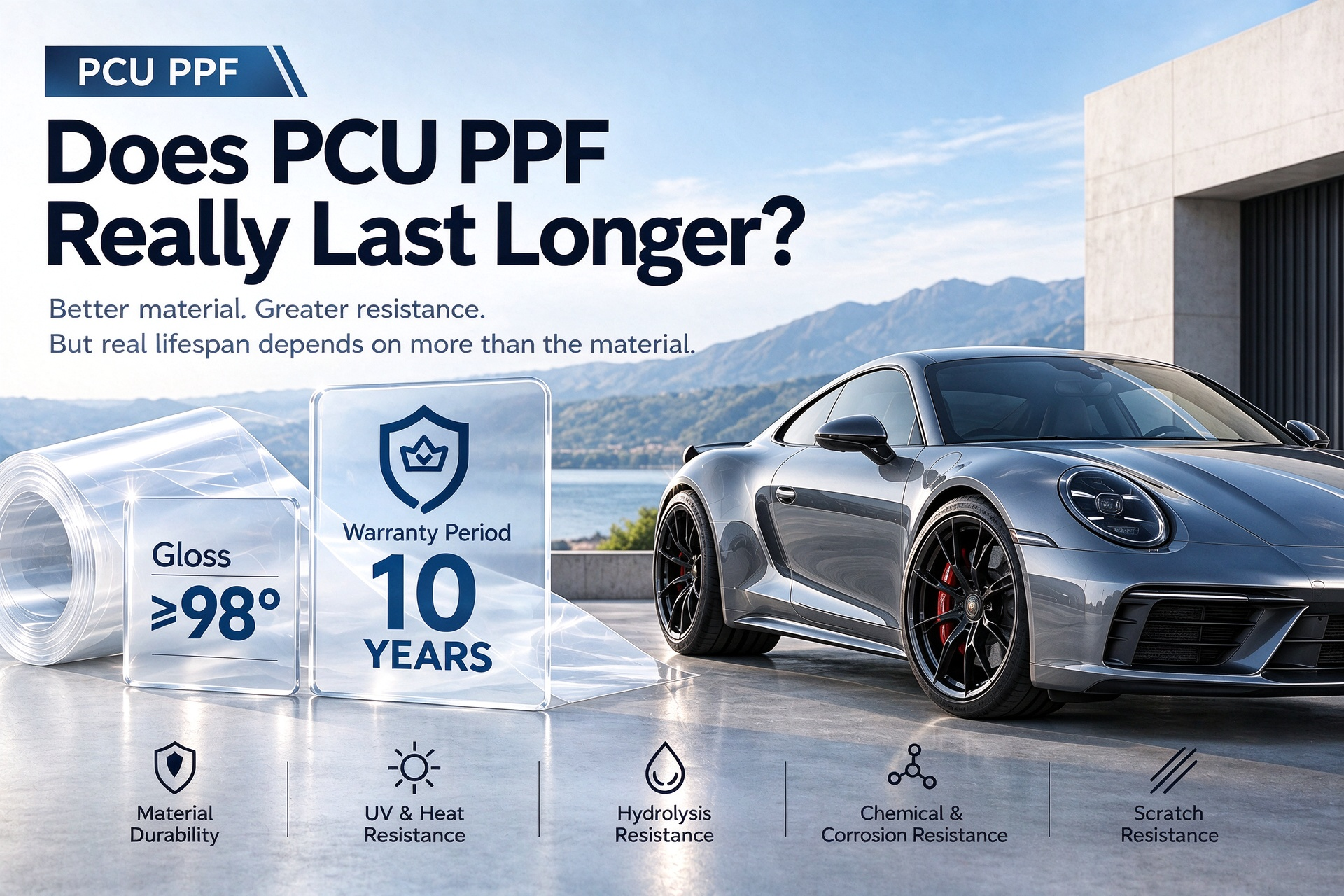
Material Durability and Film Lifespan
Material durability describes how a material resists particular degradation mechanisms under defined conditions. Finished-film lifespan describes how long a complete installed product remains acceptable in actual use.
Those are related but different.
A raw TPU may show excellent hydrolysis resistance. The installed PPF can still be limited by topcoat wear, adhesive instability, contamination, excessive stretch, edge failure, or optical change.
The service life of PPF is better understood as the combined result of:
substrate + stabilizers + topcoat + adhesive + manufacturing + climate + installation + maintenance
Each part can become the limiting factor.
Substrate Chemistry
The TPU substrate supplies much of the film’s flexibility and mechanical structure.
PCDL-based TPU can be a sensible choice for long-term durability because polycarbonate polyols are used where hydrolytic stability, wear resistance, and environmental resistance matter. This may be valuable in hot, humid, coastal, or frequently washed environments.
The exact result depends on the PCDL grade, isocyanate chemistry, hard-segment ratio, stabilizers, and film-processing conditions. A generic PCU description cannot show how well the actual substrate retains tensile strength, elongation, clarity, or adhesion after aging.
Ask for retained-property data rather than only initial specifications.
UV Stabilizers and Light Stable Chemistry
Outdoor PPF receives years of solar exposure. UV can initiate chemical changes that affect color, strength, gloss, and surface performance.
Long-term resistance normally requires more than a durable soft segment. The polyurethane chemistry should be suitable for clear outdoor use, and the formulation needs an appropriate package of UV absorbers and hindered amine light stabilizers.
The topcoat may also contribute protection, but no layer should be assumed to block all damaging radiation indefinitely.
When reviewing a weathering report, check whether the finished product was measured for color, gloss, haze, tensile, elongation, and adhesive behavior after exposure. A photograph alone is difficult to compare and may hide small but meaningful changes.
Topcoat Durability
The topcoat is exposed to washing, abrasion, chemicals, bird droppings, insects, fuel, road residue, and sunlight.
A durable topcoat should retain acceptable surface appearance and function over repeated exposure. Important questions include:
• Does scratch recovery remain after aging?
• Does hydrophobicity fall sharply after washing or abrasion?
• Does the film resist common stains without permanent discoloration?
• Does the surface become dull, cracked, sticky, or rough?
• Does gloss remain consistent across exposed and protected areas?
Initial water beading or a quick heat-healing demonstration cannot answer these long-term questions.
Adhesive Aging
Adhesive performance changes with time, heat, moisture, and stress.
The bond must become strong enough to hold edges and curves without becoming so unstable that it discolors, migrates, leaves residue, or damages the appearance of the paint.
Climate matters. High panel temperatures can accelerate adhesive changes. Moisture can affect the interface, especially when edges are poorly sealed or the installation traps contamination. Cold can change tack and flexibility during installation.
A durability program should check peel and appearance after heat, humidity, weathering, and thermal cycling. It should also include removal under the supplier’s stated conditions.
Climate and Vehicle Use
The same PPF can age differently in different markets.
High UV and Heat
Vehicles in hot, high-UV regions experience elevated panel temperatures and intense radiation. Color stability, topcoat retention, adhesive stability, and thermal cycling become important.
High Humidity and Coastal Exposure
Heat and moisture can accelerate hydrolytic degradation. Salt and frequent washing add more chemical exposure. PCDL-based TPU may offer a useful substrate advantage here, but edges, topcoat, and adhesive still need protection.
Cold Climate and Road Chemicals
Low-temperature flexibility, freeze-thaw cycling, road salt, deicers, and winter washing can stress the construction. A material selected only for heat and humidity may not have been qualified for these conditions.
Vehicle Storage and Use
A garaged weekend vehicle and a daily-driven outdoor vehicle do not receive the same exposure. Mileage, highway debris, parking location, washing frequency, and local pollution can all affect appearance and service life.
This is why a single lifespan number needs conditions.
Installation Quality
PPF can fail early even when the material is sound.
Common installation-related risks include:
• Contamination under the film
• Excessive stretch
• Poor edge preparation
• Insufficient edge wrap or unstable trimming
• Incorrect slip or tack solution
• Installation outside the recommended temperature range
• Trapped moisture or solution
• Premature washing before the adhesive has settled
Overstretching can thin the film and topcoat, distort optics, and add stress to the adhesive. Edges under constant tension are more likely to lift. A warranty may exclude these conditions as workmanship rather than material failure.
For private-label brands, installer guidance and training are part of durability control.
Maintenance
Maintenance does not stop aging, but it can reduce avoidable damage.
Owners should follow the supplier’s instructions for curing time, washing, chemical use, pressure-washer distance, stain removal, and care products.
Aggressive compounds, abrasive brushes, harsh solvents, and neglected contamination can shorten the useful appearance of the topcoat. Leaving bird droppings or insect residue on a hot surface increases staining risk.
If coatings or sealants are applied over the PPF, confirm that they are compatible with the topcoat and do not interfere with warranty terms.
What Accelerated Aging Can Tell You
Accelerated aging is valuable because it exposes materials to controlled stress in a shorter period. It can compare formulations, reveal failure modes, and measure property retention.
It does not reproduce every outdoor condition or predict an exact calendar lifespan on its own.
When comparing reports, check:
• Standard and apparatus
• Light source
• Irradiance
• Black-panel or chamber temperature
• Humidity, condensation, or water spray
• Cycle timing
• Total exposure
• Specimen construction
• Measurements before and after exposure
• Acceptance criteria
Xenon-arc testing and fluorescent-UV testing use different light sources and cycles. Results from one should not be compared with the other as if the hour counts were identical.
The strongest evidence combines accelerated testing with outdoor exposure, field history, retained samples, complaint data, and consistent production records.
Warranty Is Not the Same as Lifespan
A PPF warranty defines what the supplier promises to cover under written conditions. It does not mean every installed film will look new for that entire period.
Before using a warranty in marketing, review:
• Covered defects
• Definitions of yellowing or discoloration
• Exclusions for installation and maintenance
• Geographic or climate limits
• Commercial, fleet, racing, or off-road exclusions
• Required installer status
• Transferability to a new vehicle owner
• Labor and material coverage
• Claim documentation
• Replacement or compensation terms
A long warranty from an unknown or inaccessible issuer may provide less practical value than a shorter warranty with clear terms and reliable support.
Signs That PPF Is Aging
Durability should be evaluated through observable changes rather than a single anniversary date.
Watch for:
• Yellowing or color shift
• Increased haze
• Gloss loss
• Surface cracking or checking
• Permanent stains
• Reduced scratch recovery
• Topcoat delamination
• Edge lifting
• Adhesive lines, bubbling, or residue
• Loss of flexibility or tearing during removal
The end of useful life depends on severity and customer expectations. A small gloss change may be acceptable in one market and unacceptable in a premium detailing business.
How Buyers Should Evaluate a Lifespan Claim
When a supplier claims that PCU PPF lasts longer, ask five questions.
1. Which exact product and construction were tested?
2. Longer than which reference product or material?
3. Which degradation mechanism was measured?
4. What were the test conditions and before-and-after results?
5. How does the evidence support the stated warranty or market claim?
These questions do not reject the material advantage. They show whether the advantage has been demonstrated in the finished film.
Frequently Asked Questions
How long does PCU PPF last
There is no universal lifespan. Product construction, climate, vehicle use, installation, maintenance, and warranty conditions all affect service life. Use product-specific evidence rather than the PCU label alone.
Can PCU PPF last 15 years
A supplier may offer a long warranty or durability claim, but the basis should be reviewed. Ask whether it comes from outdoor field data, accelerated aging, raw-material literature, or commercial warranty terms.
Does PCDL make PPF more durable
PCDL-based TPU can improve resistance to hydrolysis and support environmental durability. The topcoat, adhesive, stabilizers, processing, and exposure still control the complete film’s performance.
What climate is hardest on PPF
High UV, high heat, humidity, salt, road chemicals, and large temperature cycles can all be demanding. The relevant combination varies by region and vehicle use.
Does a 10 year warranty mean the film will look new for 10 years
No. A warranty covers specified defects under defined conditions. Read the terms for appearance thresholds, exclusions, maintenance, installation requirements, and remedies.
How should distributors verify durability
Review finished-film test reports, compare retained properties after aging, conduct controlled installations, track production lots, and build field feedback from the target market.
Further Reading
On this site:
- What Is PCU PPF — Understand what PCU means and how PCDL-based polyurethane is used in PPF
- PCDL vs PCL TPU — How polyurethane chemistry affects durability
- Yellowing Test Standards: What QUV Accelerated Weathering Tells B2B Buyers — How accelerated weathering tests PPF aging
- What Makes a High Quality PPF — Key factors behind long-term film performance
- Self-Healing PPF Explained: How Does It Work? — How topcoat technology affects lasting surface performance
Get a Free Sample or Quote
Looking for a reliable window film supplier? Contact us today for fast response and professional support.