How to Source Window Film from Manufacturers: A Distributor and Importer’s Guide
Published: June 24, 2026 · 12 min read · Category: Window Film Sourcing
About this article: KSB Window Film has worked with distributors and importers from over 60 countries. Some of these relationships have lasted 15+ years; others ended badly after the first container. This guide is honest about both categories.
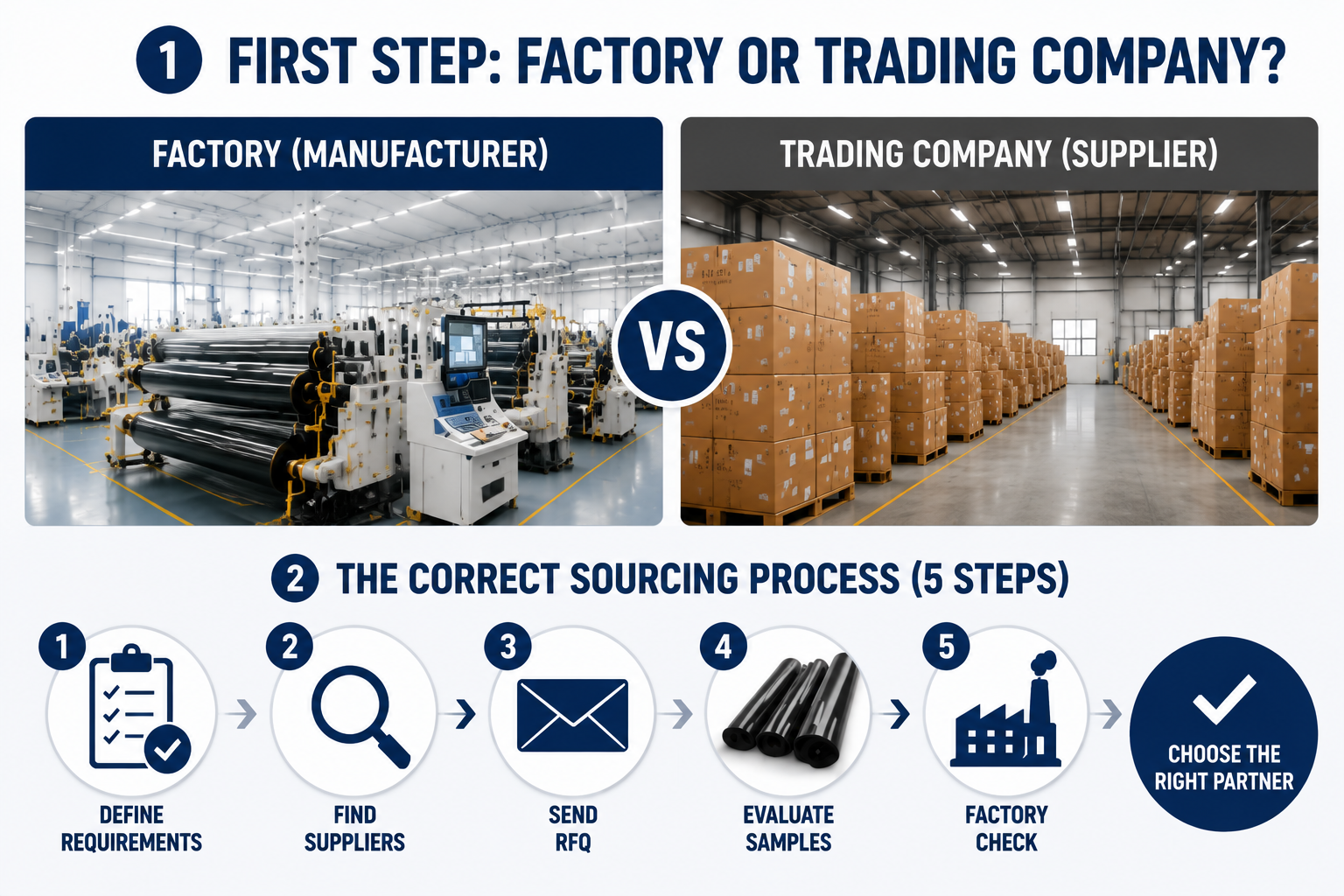
Window film sourcing decision: factory vs trading company and procurement flow
Every experienced window film distributor has a sourcing story they’d rather forget. A manufacturer who shipped beautiful samples but produced mediocre commercial product. A trading company that claimed to be a factory. A supplier who disappeared after a claim. Learning these lessons through experience is expensive. This guide tries to give you the framework to avoid the common mistakes without paying for them.
First Decision: Factory or Trading Company?
This gets framed as a price question, but it’s really a control question. What level of control do you need over product specification, quality, and supply continuity?
Trading companies (外贸公司) serve a genuine purpose. They aggregate small orders, consolidate product ranges, handle logistics, and provide English-language interface to factories that may not have strong export capability. If you’re buying 30 rolls of window film per month across five product types, a trading company probably makes sense — the administrative savings are worth the margin they take.
The problems start when you try to do things trading companies can’t do:
Private label under your brand
Custom formulation for your climate
Batch-level quality documentation for compliance purposes
Direct technical dialogue about product engineering
Any kind of long-term supply security with SLA
These require a factory.
Identifying factories from trading companies is harder than it sounds. Alibaba listings regularly present trading companies as manufacturers with “factory tours” that show someone else’s coating equipment. Some reliable signals of genuine manufacturers:
They can describe their coating process specifically. Ask: “What type of coating equipment do you use for your ceramic solar control film?” A real manufacturer can say “slot-die coating with UV cure at 800mJ/cm²” or something similarly specific. A trader says “advanced coating technology.”
They have ISO 9001 in manufacturing scope. The scope statement on the certificate matters. “Manufacturing of automotive and architectural window film” is a manufacturing scope. “Sales and trading of film products” is not.
They know their raw material suppliers by name. Ask who supplies their PET base film. A factory knows. A trader guesses or deflects.
Their production photos have no people doing nothing. Genuine factory operations have workers actively engaged with equipment. Trader photos feature clean, empty equipment borrowed from a factory visit.
The Right Sequence for Finding Suppliers
Most importers discover this sequence through trial and error. Save yourself the error:
Step 1: Define what you actually need before looking.
“Window film” describes hundreds of products. Before you open Alibaba or message a supplier, write down:
Product categories (automotive solar control? architectural? safety? PPF?)
Market and any compliance requirements (REACH for EU, Prop 65 for California, etc.)
This document becomes the brief you send to prospective manufacturers. Suppliers who respond to it seriously and specifically are in a different category from those who send a generic catalogue.
Step 2: Find candidates through multiple channels.
Alibaba/Made-in-China: Still useful for initial discovery, but apply heavy filters. Search for manufacturers, not trading companies. Look at years on platform (10+ is better), transaction history, and the specificity of their product listings. “Nano ceramic window film with TSER 65%+ at 70% VLT” is a real product specification. “Best quality car tint film factory direct price” is not.
Canton Fair and trade shows: Guangzhou Import & Export Fair (April and October) has significant window film manufacturer presence. Meeting suppliers in person at their booth tells you things a week of messaging doesn’t. Watch how they talk about their products — knowledgeable manufacturers have opinions and explain trade-offs; traders sell everything as “best quality.”
Industry referrals: Other non-competing distributors in adjacent markets are sometimes willing to share supplier information. The window film installer community (IWFA in the US, BWFA in the UK, equivalent associations in other markets) occasionally surfaces in supplier discussions.
Directly search company registries: Chinese companies are registered with the State Administration for Market Regulation (SAMR). A registered company’s registration number, business scope, and registered capital are publicly verifiable. A manufacturer claiming 20 years of history should have registration records consistent with that claim.
Step 3: Send a serious RFQ.
Your Request for Quotation should include your product brief from Step 1 plus:
Request for product samples (specific quantities)
Request for technical data sheets
Request for test reports (SGS/Intertek, citing specific standards)
Request for ISO 9001 certificate and scope
Request for REACH SVHC declaration (if EU market)
Estimated volume per quarter
The quality of the response tells you as much as the response content. Fast, specific, technically competent responses come from manufacturers who’ve done this before. Slow, generic catalogue-sends come from companies that don’t serve export buyers well.
Measure VLT with a tint meter and compare to stated specification
Measure TSER if you have a solar power meter (or commission a $200 lab test)
Apply to glass and assess: working window (time to reposition), adhesion quality, optical clarity
Test UV rejection qualitatively with a UV lamp
For automotive film: test conformability on a curved surface
For PPF: run the stretch test and self-healing test
Don’t skip the sample stage. Not ever. A manufacturer who pushes you to skip samples and go straight to a bulk order is either desperate or has something to hide.
Step 5: Factory visit or video tour.
Before any significant commercial commitment ($15,000+), visit or video-tour the facility. Specific things to look for:
Active coating lines — not clean, idle equipment. Genuine manufacturers have production running. Raw material inventory — you should see PET rolls, adhesive drums, UV stabiliser containers. The raw materials tell you what they’re actually making. Quality lab — spectrophotometer, hazemeter, tint meter, peel adhesion tester. No lab = no quality control. Clean room indicator — for premium film, look for HEPA filtration systems and positive-pressure entrance protocols.
A factory visit via scheduled WeChat video call with a live walkthrough is the minimum for remote evaluation. Screen-sharing a pre-recorded video is not.
Evaluating the Commercial Relationship
Product quality is necessary but not sufficient. The commercial relationship needs to work long-term.
Communication quality
This is more predictive of relationship success than most buyers realise. A supplier who takes 72 hours to respond to a commercial enquiry during your evaluation will take 72 hours to respond to a quality complaint after you’ve been buying for two years. Responsiveness is a character trait, not just a feature.
For English-speaking buyers: a supplier who communicates fluently and technically in English is meaningfully easier to work with than one who uses translation services for every message. Technical nuance gets lost in translation precisely when it matters most.
Payment terms evolution
Standard terms for a new factory-direct relationship: 30% deposit on purchase order, 70% before shipment (T/T). After 3–5 orders with no issues, many manufacturers will move to 20/80 or offer net-30 terms against trade credit. A manufacturer who offers generous credit terms immediately to a new customer with no track record is either under commercial pressure or is overconfident about risk management.
Warranty and claims process
Ask specifically before placing your first order: “If we receive product that doesn’t match the sample or specification, what is your claims process?”
A manufacturer with a proper claims process can tell you: what documentation they need (photos, measurements, batch number), who handles claims, typical resolution time, and whether resolution is credit or replacement. A manufacturer who hasn’t thought about this gives you a vague “we’ll handle it.”
Test the claims process with a small, legitimate quality query early in the relationship — even if it’s not worth a formal claim. How they respond to that interaction tells you what a real claim will look like.
Exclusivity
Territory exclusivity from a manufacturer means they won’t knowingly supply the same product (including under their own brand) to another distributor in your territory. This is negotiable and worth asking for on volume-committed programmes.
What to ask for: category exclusivity on specific products at defined minimum volume, with a cure period if volume falls below threshold. What manufacturers resist: broad, open-ended exclusivity with no volume commitment. The negotiation usually lands somewhere with a defined product list, volume floor, and annual review.
China-Specific Sourcing Realities in 2026
A few things that are specifically relevant to sourcing from China right now:
Trade terms have shifted costs. Section 301 tariffs for the US market mean that the calculation of China vs. alternative sourcing for US importers has changed. Some categories of window film are now more competitively priced from South Korean or Indian manufacturers for US import specifically. Run the landed cost comparison including current tariffs before assuming China is cheapest.
Payment friction has increased. US dollar wire transfers to Chinese companies face more compliance screening than five years ago. Payments through Alibaba Trade Assurance or established trade finance channels face less friction than direct T/T for new relationships. Work with a bank or payment provider familiar with China trade.
Quality has bifurcated. The gap between top-tier Chinese manufacturers (ISO 9001, clean room, magnetron sputtering, full QUV testing) and budget-tier Chinese manufacturers has widened, not narrowed. The competition for export buyers has improved quality at the top end. The race to the bottom at the low end has also continued. Sourcing well requires distinguishing between these tiers, not treating “Chinese manufacturer” as a single category.
What a Good Long-Term Supplier Relationship Looks Like
The distributors who’ve been buying from KSB for 10–15 years share some common practices:
They visit the factory every 2–3 years. Not because anything has gone wrong — to maintain the relationship and stay current with product developments.
They tell us their market. We know which regions and vehicle types their customers work with, which regulations are relevant, and what complaints their installers encounter. This information flows into product development and specification discussions that benefit both sides.
They raise small issues quickly. A distributor who flags a minor quality observation (slight VLT variation in one batch, adhesion slightly harder than usual in cold weather) gives us the chance to investigate and correct before it becomes a pattern. Distributors who only report problems after they’ve accumulated enough for a formal claim create worse outcomes for everyone.
They don’t shop us on every order. Long-term relationships get access to new product developments before they’re public, better payment terms, and flexibility on minimum orders around slow seasons. These aren’t formally documented advantages — they accrue to partners who’ve earned trust.
FAQ
How much sample should I request before a first commercial order?
Enough to install on 3–5 actual vehicles or window applications under real conditions. For automotive film, that’s typically 2–4 rolls. For architectural film, a 1m × 1m sample panel is the minimum for meaningful evaluation. Don’t try to save money on samples — it’s the cheapest insurance available.
Should I work with one manufacturer or multiple?
For volume buyers: a primary manufacturer with at least one qualified backup. Supply concentration in a single source creates vulnerability to production disruptions, price increases, and quality changes. But fragmented sourcing across 5 suppliers creates its own problems — no one supplier has enough of your volume to prioritise you. One primary, one backup is usually the right structure.
Panjiva — Verify any supplier’s actual export history by name
A Manufacturer That’s Done This Before
KSB Window Film has been working with distributors and importers across 60+ countries since 2004. We know what documentation you need, what questions you should be asking, and what good long-term sourcing looks like from both sides of the table.