Published: June 3, 2026 · 8 min read · Category: Sourcing Guide
At some point in almost every window film sourcing conversation, the same question surfaces:
“Are you a factory or a trading company?”
It sounds simple. The answer, apparently, should tell you everything you need to know — where to buy, who to trust, and how much you should be paying.
Except it’s not that simple. And buyers who treat it as a binary choice often end up either overpaying for convenience they didn’t need, or getting burned by a factory visit that revealed the “manufacturer” was operating two coating machines and a labeling table in a rented warehouse.
This guide is for anyone who wants to understand what the distinction actually means, when it matters, and when it genuinely doesn’t.
What Is a Window Film Factory?
A factory — or manufacturer — handles production in-house. In the window film industry, that means owning (or long-term leasing) the physical equipment to coat, laminate, cut, and roll film: PET base film unwinders, magnetron sputtering lines or dye-coating systems, adhesive lamination equipment, slitting machines, and quality control stations.
Real manufacturers have R&D capabilities. They can adjust formulations, develop new SKUs, and produce to custom specifications. They have production managers, QC teams, and (usually) ISO-certified processes.
They also carry inventory risk, manage raw material procurement, and — critically — they’re the people who actually know why a batch went wrong if something fails in the field.
A legitimate window film factory is a capital-intensive operation. Sputtering lines alone can run into the millions of dollars. This isn’t a business you set up overnight.
What Is a Trading Company?
A trading company doesn’t manufacture anything. It buys finished or semi-finished products from factories and resells them — often with branding, packaging, and documentation services layered on top.
Trading companies exist because they solve a real problem: factories are often bad at sales, bad at export documentation, bad at dealing with international buyers who ask twenty questions before placing a $5,000 order. Trading companies fill that gap. They speak English (or your language), understand import compliance, handle freight coordination, and take on the complexity of working across multiple suppliers.
The best trading companies have long-standing relationships with specific factories, know the production schedules, and can offer genuine product knowledge. The worst ones are pure middlemen with a Alibaba storefront and a phone number — one step removed from the factory, and sometimes two or three steps.
The Real Differences That Matter to Buyers
Forget the abstract definitions. Here’s where the gap shows up when you’re actually placing orders.
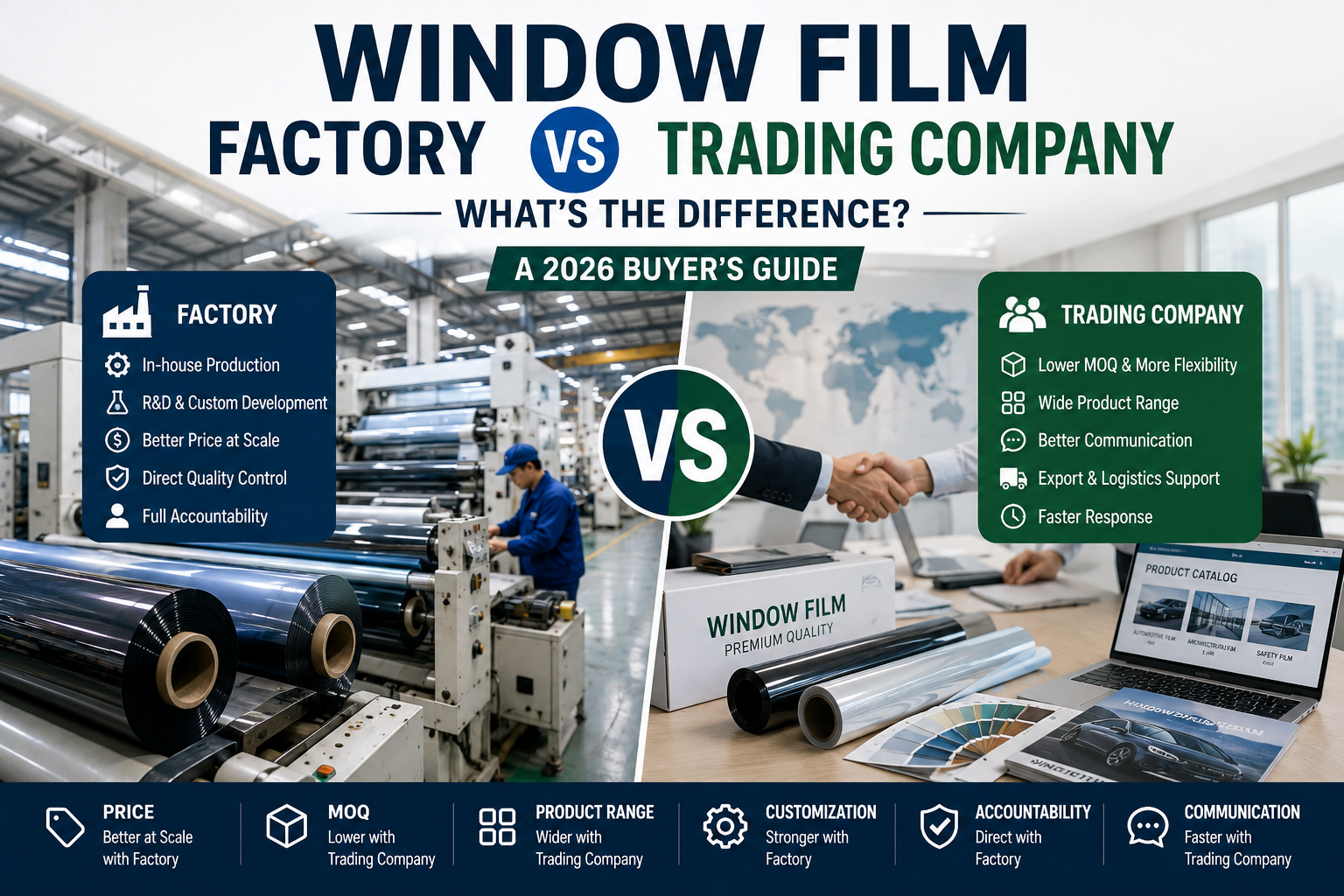
Price
Factories don’t automatically mean cheaper. Yes, removing the middleman margin sounds logical — but trading companies with high volume relationships often negotiate better per-unit pricing than a small distributor could get directly from the same factory. They’re buying 10,000 rolls a month. You’re buying 200.
That said, at scale — consistent orders above 500–1,000 rolls per SKU per month — a direct factory relationship almost always wins on price. The math eventually tips.
Minimum Order Quantities
Factories are set up for production runs. Their MOQs reflect the minimum that makes a run economically viable. Trading companies aggregate demand from multiple buyers, which means they can often offer lower MOQs on standard SKUs — because they’re topping up a larger factory order, not running a new one for you.
For buyers who need flexibility and variety without committing to large volumes per SKU, a trading company often makes more practical sense.
Product Range
A single factory, by definition, makes what it makes. Its capabilities are defined by its equipment. A trading company can offer window film from five different factories — automotive tint from one supplier, nano-ceramic architectural film from another, safety film from a third — presenting a unified product catalog that no single manufacturer can match.
If your customers expect you to have a full range, sourcing from a single factory limits what you can offer.
OEM and Custom Development
This is where factories have a decisive edge. If you want a custom formulation — a specific VLT, a proprietary nano-ceramic blend, a unique adhesive chemistry — only the factory can build it. Trading companies can facilitate conversations with factories, but they don’t control the R&D process. For serious OEM window film development, go direct.
Accountability and Traceability
When something goes wrong — and at some point, something always does — the factory is the party who can actually diagnose and fix the problem. They have the batch records, the raw material certifications, the production logs. A trading company is a relay point. They can escalate, but they can’t solve.
For buyers who need deep traceability (government contracts, high-liability commercial applications, safety film), direct factory relationships provide cleaner accountability.
Communication and Responsiveness
Trading companies win here, consistently. They’re sales-oriented businesses. Someone will answer your WhatsApp at 9pm. Someone will send you a revised quote within two hours. Someone will track your shipment without being asked.
Factories — especially large ones — can be slow, hierarchical, and occasionally indifferent to small buyers. Your account manager may be one of 50 they’re managing. Response times of 24–48 hours are common, and export documentation experience varies wildly.
How to Tell Which One You’re Actually Dealing With
This matters because plenty of trading companies present themselves as factories — sometimes genuinely believing it, sometimes not.
Here’s how to verify:
Ask for the factory address and look it up. Cross-reference the address on Google Maps or Baidu Maps. Does it look like a manufacturing facility? Industrial zones, loading docks, large floor space — or a commercial office building in a city center? The second one is a trading company.
Ask for a factory audit or video walkthrough. A real manufacturer will show you the floor. They’ll show you the sputtering line, the slitting machines, the QC lab. A trading company will offer to “arrange a factory visit” — which means they’ll take you to their supplier’s facility, not their own.
Check the business license. In China, the business scope listed on a company’s营业执照 (business license) distinguishes between manufacturing (制造/生产) and trading (贸易/销售). You can request this document. Reputable suppliers will provide it without hesitation.
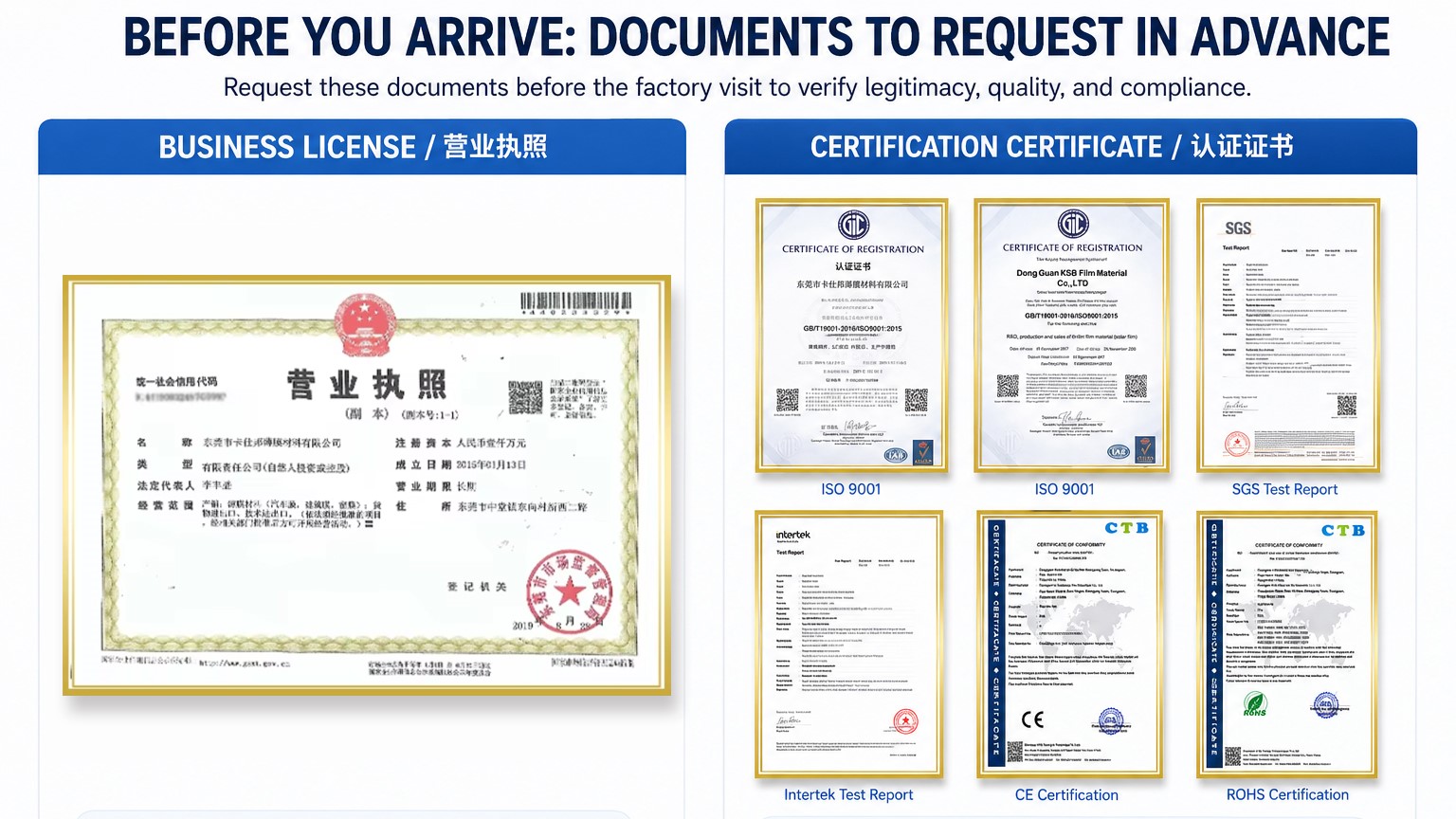
Look at the ISO certificate. ISO 9001 certificates issued to manufacturing companies will reference production processes in the scope statement. Trading company certificates have different scope language. The difference is visible if you read the document rather than just checking the logo.
Run a Panjiva or ImportGenius search. These platforms track US import records. Search the company name or their shipping address — you can see what’s actually been exported, in what volumes, and to which buyers. If a self-described factory has never shipped a container from their listed address, that’s information.
When a Trading Company Is the Better Choice
Let’s be clear: trading companies aren’t inherently inferior. For many buyers, they’re the smarter option.
You’re new to the market. Trading companies handle complexity that new importers aren’t equipped to manage — freight, customs documentation, labeling compliance, payment terms. The premium you pay covers real services.
You need a broad product range at low volumes per SKU. No single factory covers everything well. A trading company with a curated supplier network can source automotive film, nano-ceramic film, decorative film, and safety film — all under one relationship.
Speed matters more than cost. Trading companies often hold inventory, or have faster turnaround arrangements with factories. Direct factory orders require production scheduling.
You want a relationship that manages exceptions. Returns, replacement shipments, quality disputes — a good trading company is incentivized to resolve these quickly because their business depends on your repeat orders. A factory dealing directly with small importers may be less motivated.
When Going Direct to the Factory Is Worth It
You have volume. Once you’re consistently moving 500+ rolls per SKU per month, the economics of direct relationships become compelling. Even a 10–15% price difference compounds significantly at scale.
You need custom development. OEM formulations, proprietary blends, custom packaging — these conversations can only happen with the manufacturer. See our guide on OEM vs Private Label Window Film for more detail on what this process actually looks like.
Traceability is non-negotiable. Certain markets and applications — blast-resistant film for government buildings, marine applications, hospital installations — require documentation chains that only a direct factory relationship can fully provide.
You’ve already validated the market. If you know what sells, you know what to order, and you’re not experimenting — direct factory relationships reward that certainty with better pricing and terms.
The Hybrid Approach Most Buyers Eventually Land On
Here’s what the sourcing lifecycle looks like for most successful window film distributors:
- Start with a trading company to learn the market, test products, and build customer relationships without overcommitting capital.
- Identify the 2–3 SKUs that drive the majority of your revenue.
- Go direct to the factory for those SKUs — negotiate pricing, lock in specs, and consider OEM development if volume justifies it.
- Keep the trading company relationship for tail SKUs — products you need to offer but don’t sell in enough volume to justify factory minimums.
This isn’t a compromise. It’s just a sensible allocation of your sourcing resources.
Questions Worth Asking Either Type of Supplier
Whether you’re talking to a factory rep or a trading company account manager, these questions will tell you a lot:
- Where exactly is the film produced? (Factory name, address, city)
- Can you provide the manufacturer’s ISO certificate — not just your company’s?
- Who is your PET base film supplier?
- Can you provide SGS or Intertek test reports dated within the last 12 months?
- What happens if a batch fails incoming inspection at my end?
- What are your payment terms for first-time buyers versus established accounts?
- Can I visit the production facility — and if so, who would I actually be visiting?
The confidence and specificity of the answers will tell you as much as the answers themselves.
FAQ
1.Is buying directly from a window film factory always cheaper than using a trading company?
Not always. Trading companies with large purchasing volume can sometimes negotiate better pricing than smaller direct buyers, especially for standard products and lower order quantities.
2.How can I verify whether a supplier is a real window film factory?
Ask for the factory address, business license, ISO certificates, and a factory video or audit. You can also check export records through platforms like Panjiva or ImportGenius.
3.When is a trading company the better choice for window film sourcing?
Trading companies are often better for buyers who need lower MOQ, faster communication, broader product ranges, or support with export and logistics management.
4.When should distributors work directly with a window film factory?
Direct factory sourcing becomes more beneficial when order volume is stable, OEM customization is required, or lower long-term pricing and stronger production traceability are important.
The Bottom Line
Factory vs trading company isn’t really a question of one being better than the other. It’s a question of fit — your volume, your product mix, your risk tolerance, and where you are in the lifecycle of your business.
What matters more than the label is the substance behind it: Can they deliver consistent quality? Do they understand your market’s compliance requirements? Are they transparent about how the product is made and where it comes from? Will they stand behind it if something goes wrong?
If you’re trying to figure out which type of supplier — or which specific supplier — makes sense for your situation, we can help. We work with window film buyers across North America, Europe, Australia, and the Middle East, and we know which factories and trading companies actually perform when orders are on the line.
→ Send us a sourcing inquiry and we’ll get back to you within one business day.
Further Reading
On this site:
- Top 7 Window Film Manufacturers in China (2026 Verified List) — How to evaluate and shortlist Chinese suppliers, whether factory or trading company
- OEM vs Private Label Window Film: Which Is Better? — The sourcing model question that comes right after you’ve found the right supplier
- How to Source OEM Window Film from China: A Step-by-Step Guide — How to Source OEM Window Film from China: A Step-by-Step Guide
Industry and verification resources:
- Alibaba Supplier Verification — Alibaba’s own framework for distinguishing manufacturers from trading companies (useful starting point, not a substitute for due diligence)
- SGS Factory Audits — Third-party audit services used by serious buyers to verify manufacturing claims
- Panjiva / S&P Global Trade Intelligence — US import record database; search any Chinese exporter’s actual shipment history
- IWFA Industry Standards — The International Window Film Association’s resource library for product standards and installer certification
Related topics: Window Film Sourcing, China Window Film Factory, Window Film Trading Company, Verified Window Film Supplier, Automotive Window Tint Wholesale, Architectural Film Distributor
Get a Free Sample or Quote
Looking for a reliable window film supplier? Contact us today for fast response and professional support.