Window Film Import Regulations: US, EU, and Australia Compared
Published: June 23, 2026 · 11 min read · Category: Window Film Sourcing
About this article:KSB Window Film (卡仕邦) has been exporting window film and PPF to North America, Europe, and Australia for over 20 years. Import regulations change, and what cleared customs smoothly three years ago may face scrutiny today. This guide reflects our current experience shipping into these three markets.
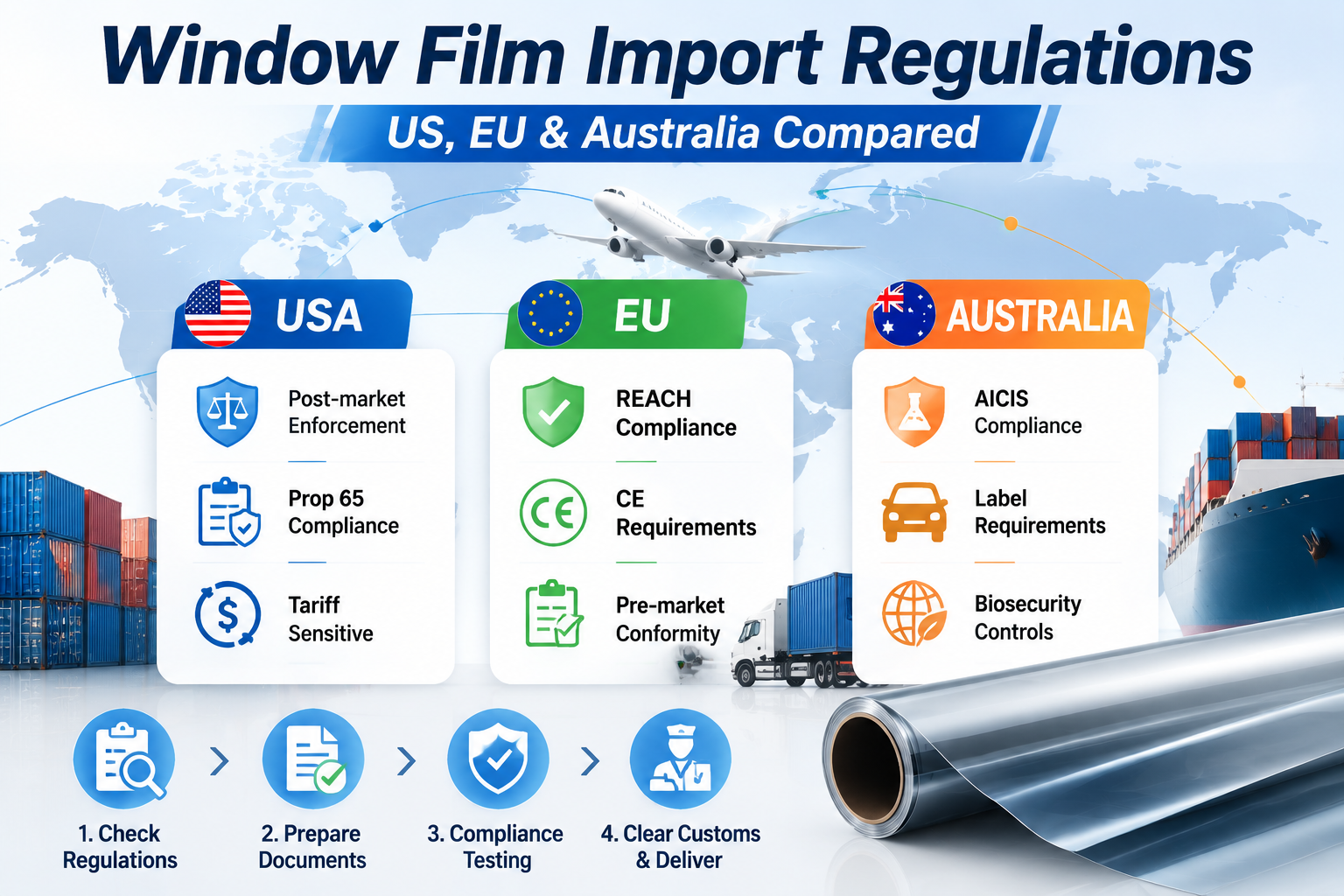
US EU and Australia window film import regulations comparison infographic
Importing window film sounds straightforward until your first shipment gets held at port. Then you discover there are actually several distinct regulatory layers — product safety testing, chemical compliance, customs classification, and in some markets, energy efficiency labelling — and failing any one of them costs time and money that eats directly into your margins.
This isn’t a guide to circumvent regulations. It’s a practical breakdown of what’s required in each market, where importers typically run into problems, and how to prepare documentation properly so your film clears without incident.
The Regulatory Framework: Three Distinct Systems
The US, EU, and Australia each approach product regulation differently at a structural level, which shapes everything downstream.
The US operates on a largely post-market enforcement model. There’s no mandatory pre-market approval for window film — you can import and sell, but if your product doesn’t meet applicable standards and something goes wrong, the enforcement consequences are serious. The practical result: customs clearance is relatively smooth if your HS code and documentation are correct, but chemical compliance (particularly CPSC and California Prop 65) can create liability that surfaces months after you’ve already sold inventory.
The EU uses a pre-market conformity assessment model. The CE framework (and specifically the Construction Products Regulation for architectural film, and various chemical directives for automotive) means products should have compliance documentation before they hit shelves. The REACH framework is not negotiable — if substances in your film are on the SVHC list above threshold concentrations, you have a problem that will catch up with you.
Australia sits between these approaches. The mandatory standards that apply to window film are relatively limited, but chemical compliance (particularly AICIS, formerly NICNAS) and import documentation requirements for Chinese-origin goods have tightened significantly since 2020.
United States
Customs Classification
Window film for most automotive and architectural applications falls under HS 3921.90 (other plates, sheets, film, foil and strip, of plastics). The specific 10-digit HTS code matters because it determines the applicable duty rate and any Section 301 tariff exposure.
For Chinese-origin window film, Section 301 tariffs have been the most significant import cost variable of the last several years. The current tariff situation (as of mid-2026): most window film imports from China remain subject to additional Section 301 duties. The applicable rate and product list have changed multiple times. Check the current USTR Section 301 list and the applicable HTS subheading before finalising your landed cost calculation — importing with an incorrect tariff estimate is a very expensive mistake.
Key HTS subheadings for window film:
3919.10.2060: Self-adhesive plastic film in rolls ≤20cm wide
3919.90.5060: Self-adhesive plastic film, other (most common for automotive film)
3921.90.4000: Other film/sheet of plastics, not cellular, combined with textile
3920.62: Non-cellular PET film (sometimes applicable for bare film without adhesive)
Classification isn’t always obvious and customs brokers sometimes get it wrong. If your film is being classified differently to what you expect, the classification is worth challenging — the duty rate difference between HTS subheadings can be several percentage points.
CPSC and Consumer Product Safety
The Consumer Product Safety Commission regulates products sold to US consumers. Window film marketed for residential or consumer automotive application is within CPSC’s general jurisdiction. The applicable concern: certain heavy metals and phthalates in film plasticisers.
For window film specifically:
Lead content: Products containing lead above CPSC thresholds (100ppm for children’s products) face recall risk
Phthalates in PVC-based products: Six phthalates are banned in children’s products; if your film is PVC-based and could end up in consumer contexts, phthalate compliance matters
General safety: No specific CPSC standard mandates pre-market testing for most window film categories, but documented compliance with applicable chemical standards is prudent for liability management
California Proposition 65
This is the compliance issue that catches more importers than any other. Prop 65 requires businesses to provide “clear and reasonable warnings” before knowingly and intentionally exposing anyone to a listed chemical. The list contains over 900 substances.
For window film, the relevant Prop 65 chemicals are those that might be present in adhesives, stabilisers, or pigments:
Lead compounds (in some older film formulations)
DEHP and other phthalates (in PVC-based products)
Toluene and benzene (residual solvents in some adhesive systems)
Titanium dioxide (listed for inhalation exposure — relevant if film is cut or sanded in installation)
The practical implication: if you’re selling into California, get a Prop 65 compliance review done before your first shipment. The cost is $500–$2,000 for a laboratory testing programme. The cost of a private plaintiff Prop 65 lawsuit starts at $2,500 per violation day.
Energy Policy Act and Labelling
There’s no federal mandatory labelling requirement for window film performance claims, but the National Fenestration Rating Council (NFRC) provides a voluntary rating system that commercial buyers increasingly expect. Architectural film sold to commercial glazing contractors will be specified to NFRC metrics (SHGC, VLT, U-factor). While not legally mandated, NFRC-referenced test data is essentially market-required for commercial architectural sales.
European Union
REACH — The Most Important Requirement
The Registration, Evaluation, Authorisation and Restriction of Chemicals regulation (REACH, EC 1907/2006) is non-negotiable for any product sold in the EU. Every substance in your film must be evaluated:
SVHC (Substances of Very High Concern): The SVHC candidate list is updated twice yearly. Any SVHC present above 0.1% by weight in any article (a “complex article” like window film counts) requires notification to your supply chain customers. SVHC concentrations above 0.1% don’t automatically ban the product, but require specific disclosure.
Restricted substances (Annex XVII): Certain substances are restricted or banned entirely. The restrictions relevant to window film include restrictions on certain phthalates in PVC plasticisers, restrictions on certain azo colourants, and restrictions on certain heavy metals.
What this means in practice: You need an SVHC declaration from your manufacturer for every product. A declaration that says “we confirm our product complies with REACH” is not sufficient — you need a statement that specifically addresses the SVHC list, with the list version referenced. KSB provides current REACH SVHC declarations with each product’s technical documentation.
RoHS
The Restriction of Hazardous Substances directive (2011/65/EU) restricts certain hazardous substances in electrical and electronic equipment. Window film isn’t EEE, so RoHS doesn’t directly apply. However, smart film (PDLC) with electrical components does have EEE classification — if you’re importing smart film with integrated controllers, RoHS compliance is required.
Construction Products Regulation (CPR)
For window film sold for architectural use in EU construction projects, the Construction Products Regulation (EU 305/2011) may apply. CPR requires a Declaration of Performance (DoP) and CE marking for products covered by harmonised standards.
The harmonised standard relevant to window film is EN 16613 (glass in building — laminated glass and laminated safety glass — test methods for interlayer properties). However, CPR applicability depends on how the product is marketed and the specific use case. Window film sold as a “treatment” rather than a structural glazing component occupies an ambiguous space in CPR.
For most importers selling architectural solar control film to installers: CPR compliance is not commonly required. For film sold as part of a glazing system or specified in construction projects by architects: DoP documentation becomes more relevant.
Chemical Safety — EN Standards
The applicable European test standards for window film solar performance:
EN 410:2011 — Glass in building: determination of luminous and solar characteristics (the European equivalent of ISO 9050 for VLT, TSER, and related metrics)
EN 12600:2002 — Glass in building: pendulum test, impact test method for safety classification (for safety/security film)
Test reports to EN 410 are the equivalent of ISO 9050 reports for EU market specifications.
Customs — CN Code
EU customs uses the Combined Nomenclature (CN). Window film typically classifies under:
3919 90 — Self-adhesive plates, sheets, film, foil, tape, strip of plastics, other
3921 90 — Other plates, sheets, film, foil, strip of plastics
Anti-dumping duties on certain Chinese-origin plastic products have been applied in the EU. Check the current EU anti-dumping measures relevant to your specific CN classification before finalising import cost estimates.
AICIS replaced NICNAS (National Industrial Chemicals Notification and Assessment Scheme) in 2020 and represents the most significant compliance change affecting Australian window film importers in recent years.
Under AICIS, industrial chemicals introduced into Australia must be assessed. Most window film components (PET, polyurethane, standard PSA adhesives) are either listed on the Inventory of Chemical Substances (ICS) or qualify for simplified assessment pathways. However:
New or novel chemicals (certain ceramic nanoparticles, newer HALS formulations) may require assessment notification
Importers are responsible for AICIS compliance — not just the manufacturer
Annual reporting may be required for certain chemicals above threshold import volumes
The practical implication: get your manufacturer’s material safety data sheets and composition information, run them against the AICIS inventory, and confirm whether any components require assessment or reporting.
Australian Consumer Law and Standards Australia
Window film for automotive use is subject to the Australian Consumer Law (ACL) requirements for acceptable quality and truthful representation. There are no specific mandatory product standards for automotive window film in Australia.
Window tinting regulations are state-based for road vehicles and vary:
NSW, VIC, QLD, WA: Minimum 35% VLT on front side windows (post-factory); variable requirements on rear
SA, ACT: Similar but check current state rules
Importing film that’s intended for installation on front windows but only achieves 20% VLT creates compliance exposure for the installer — but the importer should be aware of the downstream regulatory context for their product.
Biosecurity — Timber Packaging
This isn’t specific to window film but catches importers frequently: ISPM 15 (International Standards for Phytosanitary Measures No. 15) requires that all wood packaging (pallets, crates, dunnage) used in shipments to Australia be heat-treated or fumigated and marked with the ISPM 15 mark.
Australian Border Force enforces this rigorously. Non-compliant wooden pallets are either treated at the importer’s cost at the border or destroyed. KSB ships on ISPM 15 compliant pallets as standard for Australian shipments — confirm this with any new supplier before your first order.
Anti-Dumping Measures
Australia has applied anti-dumping measures to a range of Chinese-manufactured goods. Check the Anti-Dumping Commission’s measures register for the specific HS codes applicable to your window film category before finalising landed cost calculations.
Documentation Checklist: What to Prepare Before Every Import
For all three markets, having these documents organised before shipment avoids the majority of customs delays:
Document
US
EU
Australia
Commercial invoice (accurate value, complete description)
✓
✓
✓
Packing list
✓
✓
✓
Bill of lading / airway bill
✓
✓
✓
Certificate of Origin
For tariff preference
✓
✓
REACH SVHC declaration
Advisory
Required
Advisory
AICIS compliance confirmation
N/A
N/A
✓
Material Safety Data Sheet
Prop 65 review
REACH support
AICIS support
SGS/Intertek product test report
Prop 65, CPSC
EN 410
ACL
ISPM 15 compliant packaging
Advised
Required
Required
FAQ
Do I need an import licence to import window film into Australia?
Generally no, for standard commercial quantities. Some chemical components may require notification under AICIS, but window film itself isn’t a controlled or licensed import category.
My shipment to the EU was held because of SVHC concerns. What should I do?
Request a current, dated REACH SVHC declaration from your manufacturer that specifically references the current SVHC candidate list version. The declaration should be product-specific, not generic. This usually resolves the issue within a few days.
Are Section 301 tariffs on Chinese window film permanent?
No. Section 301 tariffs have been modified multiple times and are subject to ongoing review. Check USTR guidance and your specific HTS code before each import cycle. Your customs broker should maintain current information.
KSB Window Film provides complete export documentation for US, EU, and Australian customs requirements as standard: REACH SVHC declarations, ISPM 15 compliant pallets, SGS product test reports, and accurate HTS/CN classification references.