Night driving can reveal optical problems that are barely noticeable during the day.
Headlights appear brighter against a dark background. Dashboard displays become more visible on the windshield. Streetlights, signs and other point-light sources can make the view feel less comfortable.
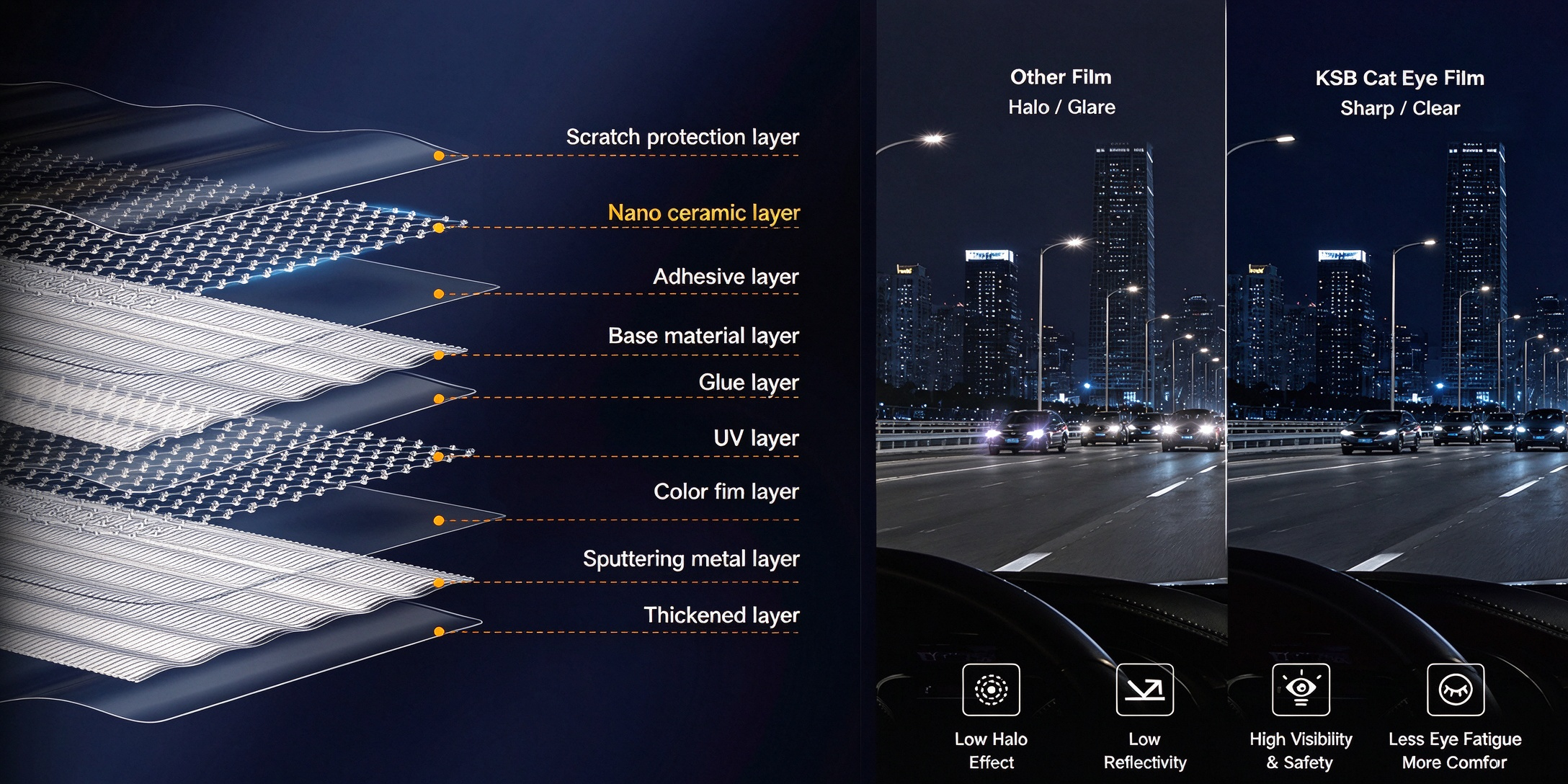
During the day, the problem changes.
Strong sunlight, reflections from surrounding vehicles and bright surfaces can all interfere with the driver’s view.
This is why automotive films are sometimes marketed as “anti-glare window film.”
But glare is not one simple problem.
When evaluating an automotive window film, it helps to separate three different optical effects:
Glare
Haze
Internal Reflection
They can all influence perceived visibility, but they are not the same—and they should not be measured or discussed as if they were.
What Is Anti-Glare Window Film for Cars?
Anti-glare window film generally refers to automotive film designed to help create a more comfortable viewing environment under bright or high-contrast conditions.
Depending on the product, this may involve controlling:
visible light transmission
light scattering
internal reflection
and solar energy entering through the glass.
The important point is that there is no single specification called “anti-glare performance” that tells the whole story.
A film may be darker and reduce the amount of visible light entering the vehicle.
Another film may focus on low haze.
A high-clarity windshield film may instead place greater emphasis on controlling internal visible-light reflection.
So when comparing anti-glare automotive films, professional buyers should look beyond the marketing term and ask:
What optical property is actually being controlled?
Glare, Haze and Internal Reflection Are Different
These terms are often mixed together.
A simple way to separate them is:
| Optical Issue | What Happens | What You May Notice |
|---|---|---|
| Glare | Bright light creates visual discomfort or interferes with viewing | Sunlight, headlights or bright reflections feel distracting |
| Haze | Transmitted light scatters as it passes through the film | The view may look slightly cloudy or less crisp |
| Internal Reflection | Light from inside the vehicle reflects from the glazing system | Dashboard or screen reflections appear on the glass |
This distinction becomes especially important for windshield films.
A film can have low haze but still show noticeable internal reflection.
Likewise, reducing internal reflection does not automatically mean that the film has lower haze.
They need to be evaluated separately.
1. What Is Haze in Automotive Window Film?
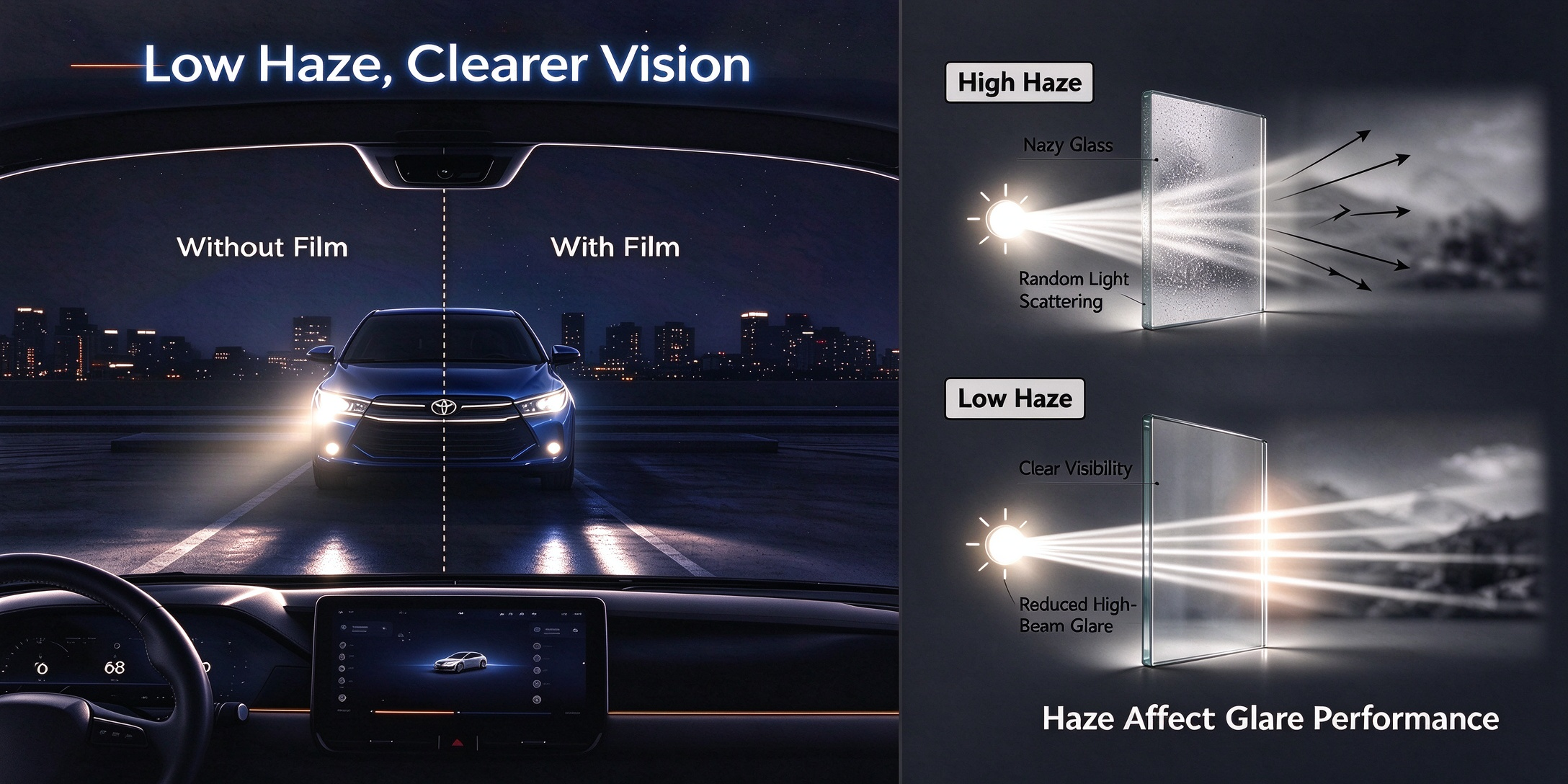
Haze describes the scattering of transmitted light.
Ideally, when you look through automotive glass, transmitted visible light maintains a clear optical path.
If more transmitted light is scattered, the view can appear softer or slightly cloudy.
This effect may become easier to notice when looking at:
distant road signs
small details
headlights
streetlights
or other high-contrast objects.
For high-clarity automotive applications, lower haze generally means less transmitted-light scattering.
Selected ultra-clear automotive films can achieve finished-film haze around:
≤0.5%
But this should not be treated as a universal pass/fail threshold.
Haze depends on the complete film construction and should be considered together with VLT, reflection and the intended application.
→ Related: What Is Haze in Window Film? Why It Matters for Driving Clarity
→ Related: Low Haze Window Film: What Does ≤0.5% Haze Actually Mean?
2. What Is Internal Reflection?
Internal reflection is a different optical effect.
Imagine driving at night.
Inside the vehicle, you have light coming from:
the instrument cluster
center display
navigation screen
ambient lighting
and sometimes mobile devices.
Some of that light can reach the windshield and reflect back toward the driver.
The result may look like:
Dashboard / Display Light
↓
Windshield
↓
Internal Reflection
↓
Visible Image on the Glass
This is why drivers may sometimes see a faint reflection of the dashboard or infotainment display in the windshield.
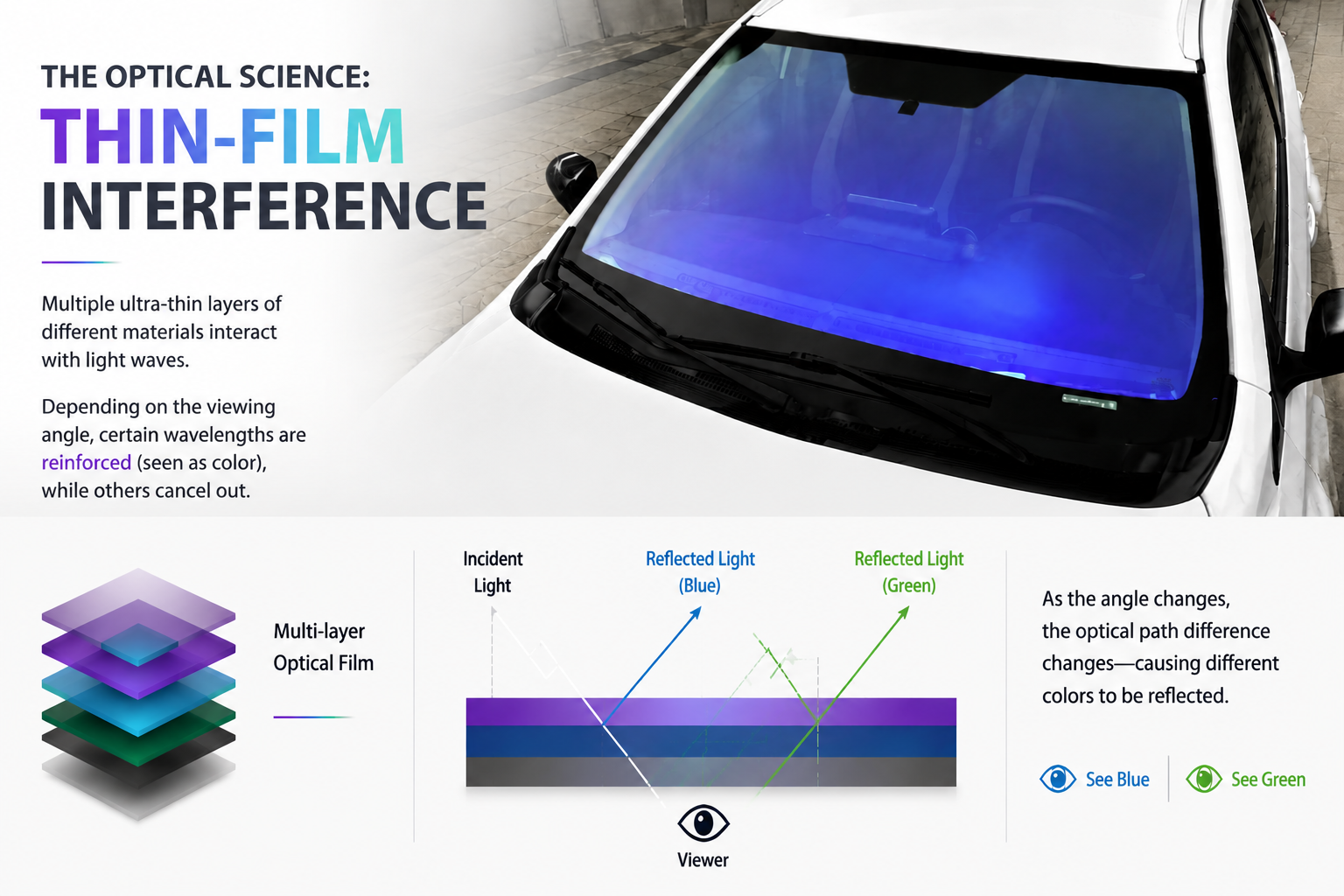
Adding window film changes the optical system of the glass.
Depending on the film construction, visible-light reflection can increase or remain relatively controlled.
For high-clarity windshield applications, this is an important specification to evaluate.
3. What Is Visible Light Internal Reflectance?
If you’re sourcing premium automotive window film, this is a specification worth knowing.
It may appear on a technical data sheet as:
Visible Light Reflectance – Interior
VLR Interior
or a similar term.
It describes the proportion of visible light reflected from the interior-facing side of the glazing or film system under the specified measurement conditions.
In simplified terms:
Lower internal visible-light reflectance
can help reduce the prominence of reflections from interior light sources on the glass.
This is particularly relevant for:
windshields
high-VLT front glass
and vehicles with large digital displays.
Selected KSB high-clarity film constructions can achieve visible-light internal reflectance as low as:
6%
The exact value depends on the film construction and VLT.
That qualification matters.
“6%” should not be presented as the internal reflectance of every KSB automotive film.
4. Why Internal Reflection Matters More at Night
During daytime driving, the outside environment is usually much brighter than the interior of the vehicle.
That brightness difference can make interior reflections less noticeable.
At night, the situation changes.
Outside:
Dark road
Inside:
Bright dashboard and displays
Now the reflected interior light has much more contrast against the dark scene outside.
This is why a windshield film that appears perfectly acceptable during the day may feel different at night.
The issue is not necessarily haze.
It may be internal reflection.
This distinction is important when testing high-clarity windshield films.
5. Why Haze Can Also Be More Noticeable at Night
Haze creates a different nighttime problem.
Bright point-light sources such as:
oncoming headlights
streetlights
traffic signals
can make transmitted-light scattering easier to notice.
Instead of a crisp point of light, the light may appear more spread out.
This is why two films with similar VLT can produce different visual impressions at night.
One may maintain a relatively crisp view.
Another may look slightly softer around bright light sources.
Again:
This is transmitted-light scattering—not internal reflection.
That is why simply calling both effects “glare” makes it harder to evaluate the film correctly.
6. What About Direct Sunlight?
Daytime glare introduces another issue.
Strong sunlight can create visual discomfort regardless of whether window film is installed.
Window film can control how much visible and solar energy enters through the glass, but the result depends heavily on the film’s VLT and optical construction.
A darker film generally transmits less visible light.
But lower VLT is not automatically the best answer for every automotive application.
This is particularly true for windshields.
For windshield film, manufacturers often need to balance:
high visible-light transmission
with:
heat rejection
low haze
and controlled internal reflection.
The objective is not simply to make the windshield darker.
It is to achieve the required solar-control performance while maintaining appropriate visibility for the intended application.
7. Does Lower VLT Mean Better Anti-Glare Performance?
Not necessarily.
A lower-VLT film allows less visible light to pass through, which can reduce overall brightness.
But that does not tell you:
how much transmitted light is scattered
or
how much interior light is reflected back toward the driver.
Consider two films with similar VLT.
Film A
Low haze
Controlled internal reflection
Film B
Higher haze
Higher internal reflection
Even though their VLT numbers are similar, they may look very different from inside the vehicle.
That is why VLT alone is not enough to evaluate optical quality.
8. Low Haze Does Not Automatically Mean Low Reflection
This is one of the most important points for professional buyers.
A manufacturer may advertise:
Haze ≤0.5%
That can be useful information about transmitted-light scattering.
But it does not automatically tell you anything about internal reflection.
Likewise:
Internal Reflectance 6%
does not tell you the haze value.
Think of them as two different optical paths:
Haze
Outside Light → Film → Scattered Transmitted Light → Driver
Internal Reflection
Interior Light → Glass / Film → Reflected Light → Driver
Different mechanism.
Different measurement.
Different specification.
For a high-clarity automotive film, both deserve attention.
9. What Makes an Automotive Film Low-Haze?
For nano ceramic constructions, optical clarity begins long before the finished film reaches the installer.
Several manufacturing factors can influence haze:
Optical-grade PET
↓
Nano-scale functional materials
↓
Controlled particle dispersion
↓
Precision coating
↓
Reduced visible-light scattering
↓
Low finished-film haze
For selected KSB constructions, optical-grade PET with substrate haze below 0.25% is used as the starting material.
Selected nano ceramic constructions can also use functional materials with particle sizes below 20 nm.
But neither number guarantees the finished result by itself.
Particle dispersion, coating uniformity, adhesive and the complete film construction also matter.
→ Related: What Makes a Window Film Ultra Clear? PET, Nanoparticles and Coating Explained
10. Can Nano Ceramic Film Reduce Glare?
Nano ceramic films are often used in premium automotive applications because they can combine:
solar control
non-metallic construction
neutral appearance
and high optical clarity.
However, the term “nano ceramic” alone does not guarantee low glare, low haze or low internal reflection.
Different ceramic films use different:
PET substrates
functional materials
coating formulations
adhesives
and optical constructions.
A professional buyer should therefore compare finished-film specifications rather than relying on the technology label.
The same principle applies to sputtered films.
Both technologies can be engineered for high-clarity automotive applications.
11. Anti-Glare Film vs. Ultra-Clear Film
These two terms sometimes appear together, but they describe different priorities.
Anti-glare focuses on managing visual interference from bright light and reflections.
Ultra-clear focuses on maintaining a clear view through the film with low unwanted scattering and controlled optical effects.
For premium automotive applications, the two goals often overlap.
An effective high-clarity windshield film may need to combine:
Low Haze
for reduced transmitted-light scattering
Controlled Internal Reflection
for fewer distracting interior reflections
Appropriate VLT
for the intended glass position and market
Solar Control
for heat and UV performance
The product should be evaluated as a complete optical system.
12. How to Test Anti-Glare Window Film Samples
Specification sheets are useful.
Installed samples are better.
If you are a distributor, wholesaler or private-label buyer evaluating automotive window film, test samples under more than one lighting condition.
Daylight
Look through the film toward distant objects, text and road signs.
Check whether fine details remain crisp.
Strong Sunlight
Evaluate overall brightness, reflections and viewing comfort.
Night Driving Conditions
Look toward headlights, streetlights and other bright point-light sources.
Check whether light appears excessively scattered.
Interior Display Test
Turn on the dashboard and infotainment display in a dark environment.
Look for reflections on the windshield.
Side-by-Side Comparison
Install competing samples on identical or comparable glass.
Side-by-side testing makes subtle optical differences much easier to identify.
For wet-installed automotive films, allow an appropriate curing period before making a final optical judgment.
13. What Should B2B Buyers Ask Their Window Film Supplier?
If your target market values optical clarity, don’t simply ask:
“Do you have anti-glare film?”
Ask for measurable information.
| Specification | What to Check |
|---|---|
| VLT | How much visible light passes through |
| Haze | Transmitted-light scattering |
| VLR Interior | Interior-facing visible-light reflection |
| VLR Exterior | Exterior-facing reflection / appearance |
| IRR | Infrared rejection under specified test conditions |
| TSER | Overall solar-energy rejection |
| UVR | UV rejection |
| PET Haze | Optical quality of the base substrate |
| Finished-Film Haze | Optical result of the complete film |
For wholesale or private-label programs, also ask about:
batch consistency
available VLT levels
warranty
roll dimensions
MOQ
and OEM packaging.
For distributors, a film that performs well once is not enough.
The specification needs to remain reasonably consistent from batch to batch.
14. Cat Eye Film and High-Clarity Driving Visibility
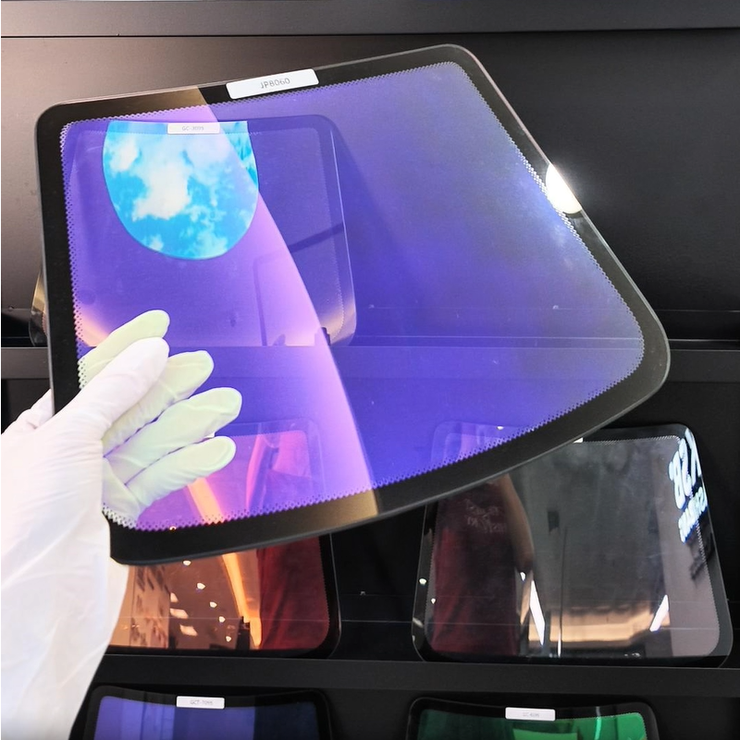
This is also the idea behind KSB’s Cat Eye Window Film range.
Rather than treating “Cat Eye” as one manufacturing technology, it is more useful to think of it as an optical-performance positioning.
Depending on the construction, Cat Eye Film can use:
nano ceramic
or
sputtered technology.
Selected constructions are designed around characteristics such as:
low haze
high optical clarity
controlled internal reflection
and solar-control performance.
Both technologies can therefore be engineered for low-haze, high-clarity automotive applications.
→ Read: What Is Cat Eye Window Film? A Guide to Ultra-Clear Automotive Window Film
FAQ
Does anti-glare window film eliminate glare completely?
No. Glare can come from direct sunlight, headlights, reflections and other sources. Automotive film can help manage some of the optical factors involved, but “anti-glare” should not be interpreted as complete elimination of glare.
What is the difference between haze and glare?
Haze refers to transmitted-light scattering through the film. Glare is a broader visual effect caused by excessive brightness or high-contrast light sources. They are related in some viewing conditions but are not the same thing.
What is internal reflection in automotive window film?
Internal reflection occurs when light from inside the vehicle—such as dashboard or display light—is reflected from the glazing system back toward the driver.
Is lower internal reflectance better for windshield film?
Lower internal visible-light reflectance can help reduce the prominence of interior reflections, particularly at night. It should still be considered together with VLT, haze and the complete optical performance of the film.
Is 6% internal reflectance good?
The significance of a 6% value depends on the film construction, VLT, measurement method and intended application. Selected KSB high-clarity constructions can achieve internal visible-light reflectance as low as 6%.
Does low haze mean less glare?
Not necessarily. Lower haze means less transmitted-light scattering. Glare can also be affected by direct brightness, internal reflection, VLT and other factors.
Which window film is best for night driving?
Rather than selecting by one marketing label, compare appropriate VLT, finished-film haze, internal reflection and overall optical quality for the intended application. Local automotive glazing regulations should also be considered.
Further Reading
On this site:
- What Is Haze in Window Film? — How haze affects automotive visibility and driving clarity
- Low Haze Window Film: What Does Haze ≤0.5% Actually Mean?— Understanding low-haze specifications and optical clarity
- What Makes a Window Film Ultra Clear? — Key materials and coating factors behind ultra-clear film
- What Is Cat Eye Window Film? — Understanding Cat Eye film and high-clarity automotive performance
- How to Choose an Ultra-Clear Windshield Film: 7 Specifications to Check— Key specifications for evaluating high-clarity windshield films
Looking for High-Clarity Automotive Window Film?
For distributors and private-label brands, “anti-glare” should be more than a marketing claim.
Ask what happens to the light.
How much is transmitted?
How much is scattered?
How much is reflected back toward the driver?
KSB offers nano ceramic and sputtered automotive film constructions for different optical and solar-control requirements, including selected low-haze products with internal visible-light reflectance as low as 6%.
If you’re developing a premium automotive window film line, windshield film range or private-label Cat Eye Film series, we can provide specifications and samples for comparison.
Get a Free Sample or Quote
Looking for a reliable window film supplier? Contact us today for fast response and professional support.