If you compare premium automotive window films, you may come across specifications such as:
Haze ≤0.5%
Ultra-low haze
Optical-grade PET
HD clarity
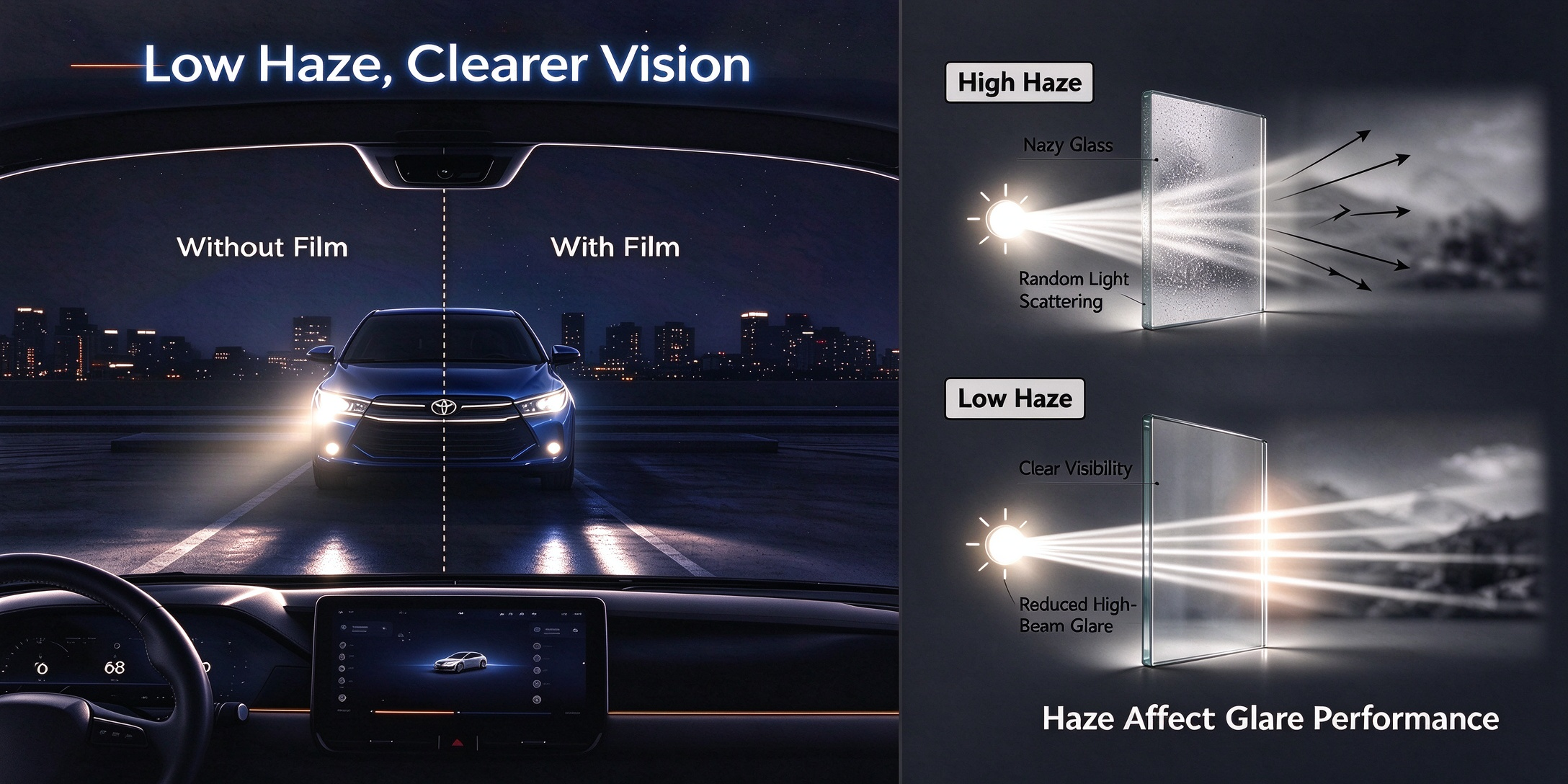
These numbers and terms sound impressive—but what do they actually mean?
Does 0.5% haze mean the film blocks 0.5% of visible light?
Is a film made with 0.25% haze PET automatically a 0.25% haze window film?
And is a lower haze number always better?
For distributors, window film brands and professional installers, understanding these differences is useful when comparing high-clarity automotive films—especially products intended for windshields and other applications where optical quality matters.
Let’s start with the most important point:
0.5% haze is not 0.5% VLT.
They measure completely different optical properties.
What Does 0.5% Haze Mean?
Haze is a measurement of light scattering through a transparent material.
When light passes through window film, most transmitted light continues through the material in a relatively direct path. A small portion can be scattered.
Haze expresses this scattering as a percentage under defined measurement conditions.
So when a finished window film has a measured haze of:
≤0.5%
it indicates a relatively low level of transmitted-light scattering under the applicable test method.
In practical terms, lower haze is generally associated with a cleaner, clearer view through the film.
But there is an important distinction:
Haze measures light scattering. It does not measure how much visible light passes through the film.
That’s where VLT comes in.
0.5% Haze Does Not Mean 0.5% VLT
This is one of the easiest window film specifications to misunderstand.
Consider a film with:
VLT: 70%
Haze: 0.5%
The 70% VLT tells you approximately how much visible light is transmitted through the film under the specified test method.
The 0.5% haze tells you about the proportion of transmitted light that is measured as scattered.
These numbers are not interchangeable.
A simple way to think about it is:
| Specification | What It Measures |
|---|---|
| VLT | Amount of visible light transmitted |
| Haze | Scattering of transmitted light |
| VLR | Visible light reflected |
| IRR | Infrared rejection |
| UVR | Ultraviolet rejection |
| TSER | Total solar energy rejected |
This means a 70% VLT film can have 0.5% haze, while another 70% VLT film may have a higher haze value.
They transmit a similar amount of visible light, but they may not provide exactly the same optical experience.
High VLT does not automatically mean low haze.
And low VLT does not automatically mean poor clarity.
Is 0.5% Haze Considered Low for Window Film?
For automotive films specifically developed around optical clarity, a finished-film haze around 0.5% or lower can be considered a low-haze construction.
But this number should not be treated as a universal pass/fail line for every type of automotive film.
Film construction matters.
Application matters.
The measurement method matters.
And most importantly, buyers should make sure they are comparing the same type of haze measurement.
A supplier advertising “0.25% haze,” for example, may be referring to the raw PET substrate rather than the finished automotive window film.
Those are two different specifications.
Optical-Grade PET <0.25% vs. Finished Film ≤0.5%
This distinction is particularly important when sourcing ultra-clear window film.
A finished automotive film contains more than PET.
A simplified film construction may include:
PET substrate
↓
Functional coating
↓
Solar-control materials
↓
Adhesive
↓
Hard coat / protective layers
↓
Finished Window Film
Each component and interface can affect how light travels through the finished product.
For selected ultra-clear constructions, KSB uses optical-grade PET with substrate haze below 0.25%.
That gives the film a low-haze optical foundation.
But once nano materials, functional coatings, adhesive and other layers are introduced, the finished film has to be measured again.
For selected low-haze constructions, the final target can be:
Finished Film Haze ≤0.5%
So:
PET haze <0.25% does not mean finished-film haze <0.25%.
This is a small distinction on a technical data sheet, but an important one for professional buyers.
Why Start With Optical-Grade PET?
If the goal is to produce a low-haze automotive film, the optical quality of the substrate matters from the beginning.
Think of PET as the optical foundation of the film.
If the base material already produces relatively high light scattering, adding additional functional layers does not make the optical challenge easier.
A low-haze optical-grade PET substrate provides a cleaner starting point.
But PET alone does not determine the final result.
The finished film also depends on:
functional material
particle dispersion
coating uniformity
adhesive quality
layer consistency
and manufacturing control.
That’s why a supplier saying:
“We use ultra-clear PET.”
is useful information, but not enough to evaluate the finished product.
For sourcing purposes, ask for the haze value of the finished window film as well.
How Can Nano Ceramic Materials Affect Haze?
Nano ceramic window films use functional materials to control infrared energy while maintaining visible-light transmission.
For high-clarity products, these materials need to be incorporated without creating excessive visible-light scattering.
Particle characteristics therefore matter.
In selected KSB ultra-clear ceramic constructions, nano-scale functional materials with particle sizes below 20 nm are used.
However, particle size should never be viewed in isolation.
Imagine thousands of extremely small particles gathering together into larger clusters.
The individual particles may be tiny, but the clusters can interact with light differently.
This is why particle dispersion is just as important as nominal particle size.
A well-controlled nano dispersion process helps distribute the functional material more uniformly throughout the coating.
The objective is not simply:
smaller particles.
It is:
small particles + controlled dispersion + uniform coating.
That combination is more meaningful when discussing low-haze film construction.
Why Coating Uniformity Matters
Automotive window film is not manufactured as a tiny laboratory sample.
A commercial roll may be 1.52 meters wide and 30 meters long.
For a distributor or private-label brand, the challenge is therefore not only achieving a low haze measurement once.
The product also needs consistency.
That means controlling optical properties:
across the width of the roll
and
from one production batch to another.
If coating thickness or functional-material distribution varies, optical performance can also vary.
For professional buyers, this raises an important question:
How consistent is the haze performance across production batches?
That question can be more useful than asking only for the lowest haze number a supplier has ever achieved.
Can You See the Difference Between 0.5% and Higher Haze?
Not necessarily in every situation.
If two small samples are placed on a table under normal indoor lighting, the difference may be difficult to judge.
Automotive glass creates a much larger viewing area.
Once the film is installed, differences in optical quality can become easier to notice under demanding viewing conditions.
For example:
Strong sunlight
Looking toward a bright sky or low-angle sunlight creates strong contrast. Additional light scattering can reduce perceived crispness.
Night driving
Headlights, streetlights and illuminated signs create bright points against a dark background. Optical imperfections can become more noticeable around these light sources.
Rainy conditions
Water on the windshield, wet-road reflections and external light sources already create a challenging visual environment.
Long-distance viewing
Looking through a windshield toward distant road signs, lane markings and vehicles can make differences in optical quality more apparent than viewing a sample at close range.
This is why haze data is useful—but physical sample evaluation still matters.
Does ≤0.5% Haze Mean Zero Glare?
No.
Low haze and glare are related to visual performance, but they are not the same measurement.
A low-haze film reduces transmitted-light scattering.
Glare, however, can be influenced by many factors, including:
brightness
contrast
external light sources
glass angle
and reflection.
Internal reflection is another separate optical characteristic.
For example, dashboard displays or interior lighting can reflect from automotive glass at night.
A high-clarity film should therefore not be evaluated by haze alone.
For premium automotive applications, buyers may want to consider:
Haze + VLT + Internal Reflectance + Optical Distortion
together.
This provides a more complete picture of visual performance.
Does ≤0.5% Haze Mean Better Heat Rejection?
No.
This is another important distinction.
Haze is an optical-clarity specification.
It does not directly tell you how much solar energy the film rejects.
A low-haze film can have strong heat rejection.
Another low-haze film may have lower heat rejection.
Likewise, a film with very high IR rejection does not automatically have very low haze.
For solar-control performance, buyers should separately evaluate specifications such as:
IRR
TSER
VLT
and, where applicable, SHGC.
For optical performance, evaluate:
Haze
VLR
Internal Reflectance
and overall visual quality.
The best way to read a technical data sheet is not to look for one “best” number.
Look at the combination of specifications required for the application.
Why ≤0.5% Haze Matters More for Windshield Film
Optical clarity matters across automotive glazing, but the windshield deserves particular attention.
The driver looks continuously through the windshield.
This makes optical imperfections more relevant than they may be on rear or decorative glazing.
High-VLT windshield films are also often chosen specifically because customers want:
heat control without noticeably darkening the windshield.
That creates an important product-design challenge.
The film needs to provide solar-control functionality while maintaining a natural view through the glass.
This is where specifications such as low haze and low internal reflection become particularly useful.
For professional buyers sourcing windshield film, don’t evaluate only:
“How light is it?”
and:
“How much IR does it reject?”
Also ask:
“What is the finished-film haze?”
Low Haze vs. “Ultra Clear”: What’s the Difference?
“Ultra clear,” “HD,” “crystal clear” and similar terms are commonly used in window film marketing.
They are descriptions.
Haze is a measurable specification.
This does not mean haze tells you everything about optical quality.
It doesn’t.
But when comparing products from different suppliers, measurable specifications give you a better starting point than marketing terminology alone.
If two suppliers both describe their products as:
Ultra-Clear Nano Ceramic Window Film
ask each supplier for:
Finished-film haze
VLT
Visible-light reflectance
IRR
TSER
and the relevant test method or report.
Then test physical samples.
That makes the comparison much more meaningful.
What Should B2B Buyers Ask Their Window Film Supplier?
If you are sourcing low-haze automotive window film for wholesale, distribution or private labeling, a good technical conversation should go beyond:
“Do you have 99% IR rejection?”
Ask:
What is the haze of the finished film?
What is the haze of the PET substrate?
Are these two numbers clearly distinguished?
What test method is used?
What is the VLT of the model being tested?
What are the internal and external visible-light reflectance values?
What is the TSER?
Is haze consistent across different production batches?
Can I test a production sample before placing a bulk order?
These questions help separate measurable product performance from marketing claims.
For private-label brands, they also make it easier to decide which specifications should actually appear on your product packaging and technical data sheet.
How to Evaluate a Low-Haze Film Sample
A specification sheet is useful, but it should not replace physical testing.
When evaluating samples, don’t only hold two pieces of film in your hand.
Install them on comparable glass.
Then look through them under several conditions:
Daylight:
Look at distant buildings, road signs or other high-detail objects.
Direct sunlight:
Check whether the view remains clean under strong illumination.
Night:
Look toward headlights or other bright point sources.
Interior reflection:
Check whether dashboard or interior-light reflections become distracting.
Side-by-side comparison:
Whenever possible, compare samples on the same type of glass under the same conditions.
And remember that freshly installed film may temporarily show moisture-related appearance changes during the curing process.
Allow the installation to cure appropriately before making a final optical comparison.
Low-Haze Cat Eye Window Film
Low haze is also one of the key optical characteristics behind KSB’s Cat Eye Window Film concept.
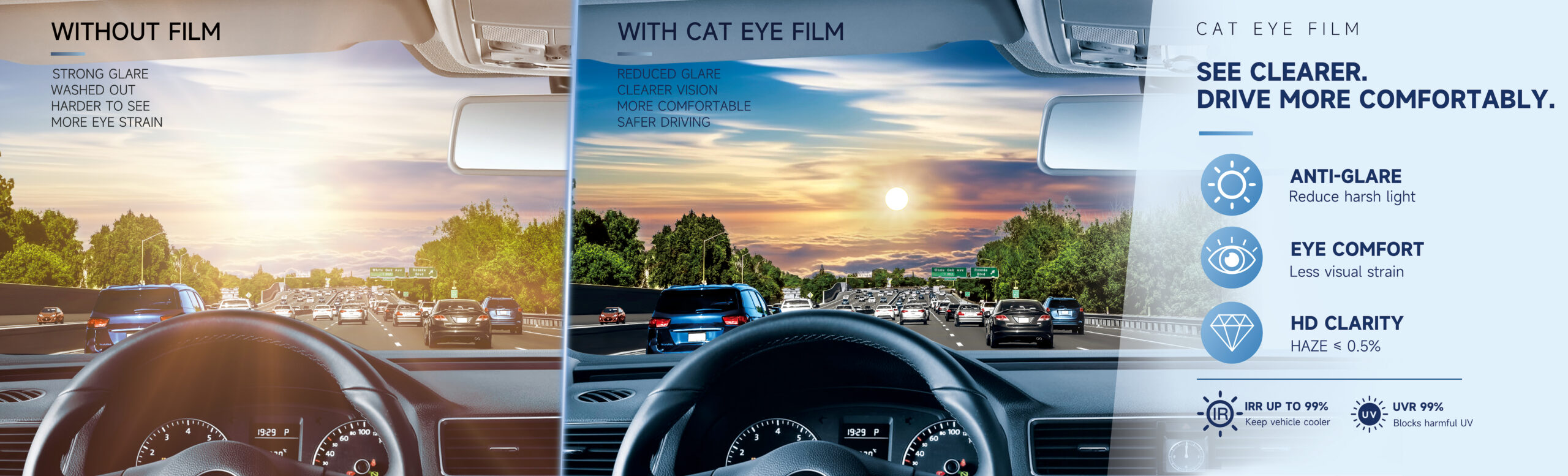
Rather than describing one specific material technology, Cat Eye Film focuses on optical performance such as:
high clarity
low haze
reduced internal reflection
and solar-control performance.
Depending on the construction, Cat Eye Film can use either nano ceramic or sputtered technology.
For selected KSB ultra-clear constructions, optical-grade PET with haze below 0.25% is used as the substrate, while selected finished-film constructions can achieve haze around 0.5% or lower.
→ Related Guide: What Is Cat Eye Window Film?
Low Haze Is One Number—Not the Whole Product
A haze value of ≤0.5% can be a useful indicator when comparing high-clarity automotive window films.
But it should not become another marketing number that buyers evaluate in isolation.
For professional sourcing, the better approach is to look at the complete performance profile:
Optical clarity
Solar control
Reflectance
Durability
Manufacturing consistency
A film with excellent laboratory specifications still needs to perform consistently across commercial production rolls.
That distinction becomes particularly important for distributors and private-label brands purchasing hundreds or thousands of square meters rather than a few sample sheets.
FAQ
What does ≤0.5% haze mean in window film?
It means the measured haze of the film is 0.5% or lower under the applicable test conditions. Haze describes transmitted-light scattering and is used as one indicator of optical clarity.
Is 0.5% haze the same as 0.5% VLT?
No. Haze measures light scattering, while VLT measures the amount of visible light transmitted through the film. A film can have 70% VLT and 0.5% haze at the same time.
Is lower haze better for windshield film?
Lower haze is generally desirable when optical clarity is a priority, particularly for high-visibility applications such as windshields. However, haze should be considered together with VLT, reflectance, optical distortion and other performance specifications.
Is PET haze the same as finished-film haze?
No. PET haze refers only to the substrate. Finished-film haze is measured after functional coatings, adhesive and other film layers have been incorporated. The finished-film value is generally more relevant when evaluating the final automotive product.
Does optical-grade PET guarantee ≤0.5% finished-film haze?
No. Low-haze PET provides a good optical foundation, but coatings, particles, adhesives, manufacturing consistency and other layers can affect the final haze.
Does nano ceramic film always have low haze?
No. Nano ceramic technology alone does not guarantee a particular haze level. Particle characteristics, dispersion, PET quality, coating uniformity and the complete film construction all influence optical performance.
Is ≤0.5% haze the same as anti-glare?
No. Haze measures transmitted-light scattering. Glare and internal reflection involve different optical effects, so they should be evaluated separately.
Looking for Low-Haze Automotive Window Film?
If you’re sourcing automotive film for distribution, wholesale or your own private-label brand, compare the finished-film haze—not only the haze of the PET substrate.
KSB offers nano ceramic and sputtered automotive film constructions for different VLT, optical and solar-control requirements.
For professional buyers, we can provide technical specifications and samples to help you compare suitable constructions before bulk purchasing.