Ask a window film supplier about windshield film, and one of the first numbers you may hear is:
“99% IR rejection.”
It sounds impressive.
But for a distributor, tint brand or professional installer, that number alone is not enough to select a windshield film.
A film can have high infrared rejection and still have:
higher haze
unwanted internal reflection
insufficient visible light transmission
or lower overall solar-energy rejection than expected.
For windshield applications, optical quality matters just as much as solar-control performance.
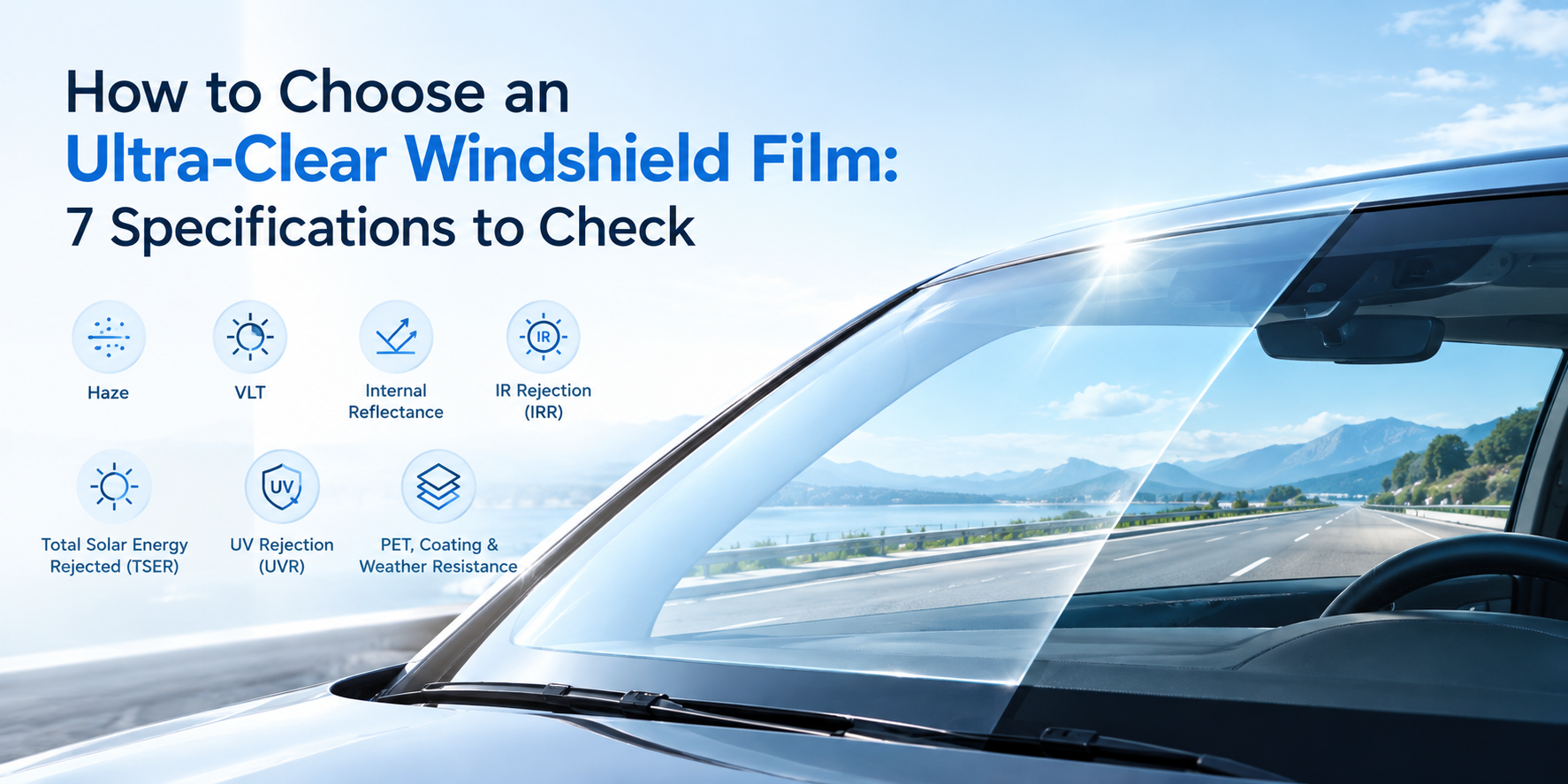
Before comparing suppliers, check these seven areas:
- Haze
- Visible Light Transmission (VLT)
- Internal Visible Light Reflectance
- Infrared Rejection (IRR)
- Total Solar Energy Rejected (TSER)
- Ultraviolet Rejection (UVR)
- PET, Coating and Weather Resistance
Here is what each specification actually tells you—and what it doesn’t.
Why Windshield Film Needs a Different Evaluation
A dark side-window tint and a high-clarity windshield film do not have the same job.
For side and rear windows, buyers may prioritize:
privacy
appearance
heat rejection
or a particular VLT.
For a windshield, the driver is constantly looking through the film.
That makes optical properties much more important.
A windshield film needs to balance several competing requirements:
Clarity + Visible Light Transmission + Solar Control + Low Reflection + Durability
Maximizing one specification while ignoring the others can result in a poorly balanced product.
This is why professional buyers should compare the complete technical data—not one headline number.
1. Haze: Check the Finished Film, Not Just the PET
If clarity is your priority, haze should be one of the first specifications you ask for.
Haze describes the scattering of transmitted light.
In practical terms, higher haze can make the view through the film appear slightly softer or less crisp.
The difference can become easier to notice around:
road signs
distant objects
oncoming headlights
streetlights
and other high-contrast details.
For an ultra-clear windshield film, lower haze is generally preferred.
Selected high-clarity constructions can achieve finished-film haze around:
≤0.5%
But there is an important detail when comparing suppliers.
Ask:
Is this the haze of the PET substrate or the haze of the finished film?
They are not the same.
For example, selected KSB constructions use optical-grade PET with substrate haze below 0.25%.
Once functional coatings, adhesive and other layers are added, the haze of the complete film changes.
For procurement, the finished-film haze is the more relevant number.
→ Related: Low Haze Window Film: What Does ≤0.5% Haze Actually Mean?
2. VLT: How Much Visible Light Passes Through?
VLT stands for Visible Light Transmission.
A film with:
70% VLT
transmits much more visible light than a film with:
20% VLT.
For windshield applications, high-VLT constructions are commonly considered when the goal is to maintain a relatively clear appearance while adding solar-control properties.
But VLT and clarity should not be confused.
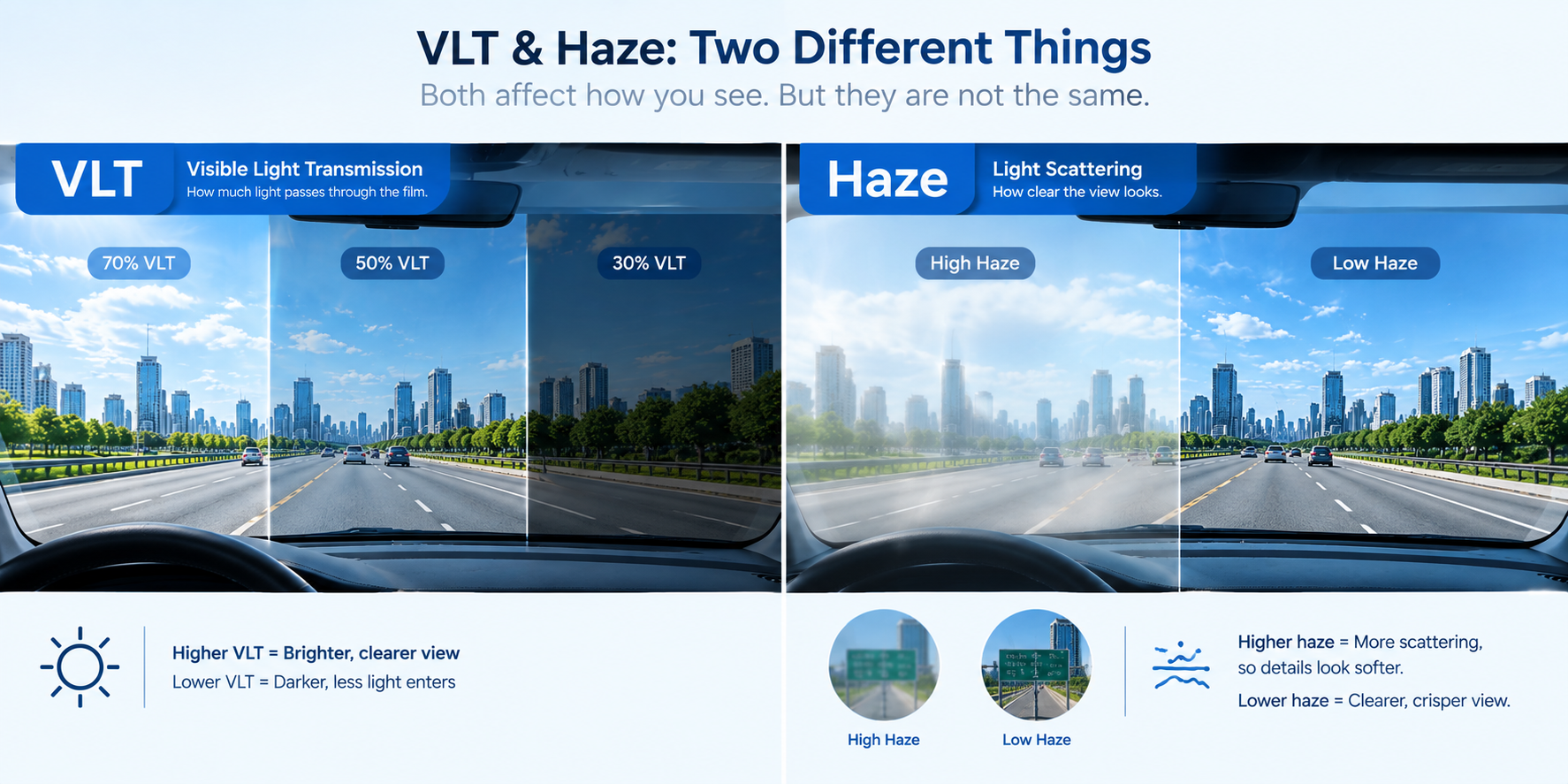
High VLT ≠ Low Haze
A film may transmit a large amount of visible light while still scattering more of that transmitted light.
Likewise:
Low VLT ≠ Better Heat Rejection
Darkness alone does not tell you how effectively the film manages solar energy.
This is why professional buyers should evaluate VLT together with haze, IRR and TSER.
Another consideration is regulation.
Permitted windshield VLT and film use vary by country and region, so distributors should match their product range to the regulations of the markets they serve.
3. Internal Reflectance: An Overlooked Windshield Specification
This is one specification many buyers forget to ask about.
During daytime driving, reflections from inside the vehicle may be relatively difficult to notice because the outside environment is bright.
At night, the contrast changes.
Light from:
instrument panels
infotainment displays
navigation screens
and ambient lighting
can reflect from the windshield toward the driver.
This is internal reflection.
On a technical data sheet, look for:
Visible Light Reflectance – Interior
or:
VLR Interior
For selected KSB high-clarity film constructions, internal visible-light reflectance can be as low as:
6%
depending on VLT and film construction.
A lower internal-reflectance value can help make interior reflections less prominent, but it should not be confused with haze.
They measure different optical effects.
Haze = transmitted-light scattering
Internal reflectance = visible light reflected from the interior-facing glazing system
For premium windshield film, both are worth checking.
→ Related: Anti-Glare Window Film for Cars: How Haze and Internal Reflection Affect Visibility
4. IRR: Useful, but Don’t Stop at “99%”
IRR stands for Infrared Rejection.
It is one of the most commonly advertised specifications in automotive window film.
You may see claims such as:
IRR 95%
IRR 98%
or:
IRR 99%
IRR is useful, but there is a common purchasing mistake:
A film with 99% IRR is not automatically an ultra-clear or high-performance windshield film.
Why?
First, IRR tells you about infrared performance—not haze, visible-light transmission or reflection.
Second, an IRR percentage should be understood together with the supplier’s measurement method or wavelength range.
Two specifications labeled “IRR 99%” are not necessarily directly comparable if they were measured differently.
So when a supplier gives you an IRR value, ask:
What wavelength range or test method is used for this IRR measurement?
Then look at the other solar-control specification that buyers often overlook:
TSER.
5. TSER: Why IRR Is Not the Same as Total Heat Rejection
TSER stands for:
Total Solar Energy Rejected
This is one of the most important concepts for professional window film buyers.
Solar energy reaching automotive glass is not made up of one infrared wavelength.
Therefore:
IRR ≠ TSER
A film advertised as:
99% IR rejection
does not mean:
99% of total solar energy is rejected.
That distinction matters when comparing products from different suppliers.
IRR describes infrared rejection according to the specified measurement conditions.
TSER looks at the overall solar-energy performance of the glazing system.
For a more meaningful comparison, evaluate films at similar VLT levels and compare:
VLT
IRR
and TSER
together.
For example, comparing a very dark film against a high-VLT windshield film without considering VLT is not an apples-to-apples comparison.
IRR vs. TSER: A Simple Example
Imagine two suppliers send you technical sheets.
Film A
VLT: 70%
IRR: 99%
Film B
VLT: 70%
IRR: 95%
It might be tempting to immediately choose Film A.
But you still don’t know:
TSER
haze
internal reflectance
measurement method
or long-term stability.
Without those values, you do not yet have enough information to decide which film better matches your windshield product requirements.
This is why one headline percentage should never replace a complete specification comparison.
6. UVR: Important, but Usually Not the Main Differentiator
UVR stands for:
Ultraviolet Rejection
Many quality automotive films are designed to provide very high UV rejection.
For example:
UVR up to 99%
is common in higher-performance automotive film ranges.
UV control is important for reducing UV transmission through automotive glass and can also contribute to protecting interior materials from UV exposure.
But for B2B buyers comparing premium windshield films, UVR alone often does not differentiate products enough.
If several candidates all offer similar UV rejection, move deeper into:
haze
VLT
internal reflectance
TSER
and durability.
Those specifications may reveal much larger differences.
7. PET, Coating and Weather Resistance
The specification sheet tells you how the film performs today.
The construction tells you something about how that performance is achieved—and how consistently it may be produced.
For an ultra-clear windshield film, pay attention to three areas.
PET Substrate
Optical-grade PET provides the foundation for clarity.
Selected KSB ultra-clear constructions use PET with substrate haze below:
0.25%
But remember:
PET haze ≠ finished-film haze.
Always ask for both when optical clarity is critical.
Functional Layer and Coating
For nano ceramic constructions, functional-material characteristics, particle dispersion and coating uniformity can affect optical performance.
Selected KSB ceramic constructions use nano-scale functional materials with particle sizes below:
20 nm
But smaller particles alone do not guarantee better clarity.
They still need to be properly dispersed and applied through a controlled coating process.
For sputtered constructions, the functional layer is created through a different deposition process.
Both technologies can be engineered for high-clarity windshield applications.
→ Related: Nano Ceramic vs. Sputtered Window Film: What’s the Difference?
Weather Resistance and Stability
A windshield film is exposed to:
sunlight
high glass temperatures
temperature cycling
and long-term UV exposure.
For distributors, initial performance is only part of the evaluation.
Ask about:
warranty
weathering tests
color stability
adhesive durability
and performance stability over time.
A film that looks excellent when new but changes significantly after extended exposure creates warranty problems for both distributors and installers.
The 7 Specifications at a Glance
For procurement teams, this is the checklist worth keeping.
| Specification | What It Tells You | What to Ask the Supplier |
|---|---|---|
| Haze | Transmitted-light scattering | Is this finished-film haze? |
| VLT | Visible light transmitted | What VLT options are available? |
| VLR Interior | Internal visible-light reflection | What is the interior reflectance at this VLT? |
| IRR | Infrared rejection | What wavelength range/test method is used? |
| TSER | Overall solar-energy rejection | What is TSER at this VLT? |
| UVR | UV rejection | What is the tested UVR? |
| PET / Coating / Durability | Construction and long-term performance | What PET, coating, warranty and weathering data are available? |
A serious windshield film comparison should contain most of this information.
If the specification sheet only says:
99% IRR + 99% UVR
you still have several unanswered questions.
Don’t Compare Specifications at Different VLT Levels
This is another common sourcing mistake.
Suppose:
Product A
VLT 70%
Product B
VLT 35%
If Product B has a higher TSER, that does not automatically mean its technology is superior.
The two products transmit very different amounts of visible light.
For meaningful supplier comparison, try to compare products within similar VLT ranges.
For example:
70% vs. 70%
50% vs. 50%
35% vs. 35%
This gives you a much better picture of how each film balances clarity and solar control.
Specification Sheets Are Not Enough: Request Samples
Once you’ve narrowed the options using technical data, request physical samples.
For windshield film, evaluate the film from the driver’s side under different conditions.
Daylight
Look at distant objects, signs and fine details.
Strong Sunlight
Check overall appearance, brightness and reflections.
Night
Look toward headlights and streetlights and observe whether the view remains crisp.
Interior Reflection
Turn on the dashboard and infotainment display in a darker environment and inspect the windshield reflection.
Side-by-Side Comparison
Install two candidate films on comparable glass.
Small differences are much easier to see side by side than from technical sheets alone.
If you are planning a large wholesale order, also ask about batch-to-batch consistency.
One excellent sample does not guarantee consistent mass production.
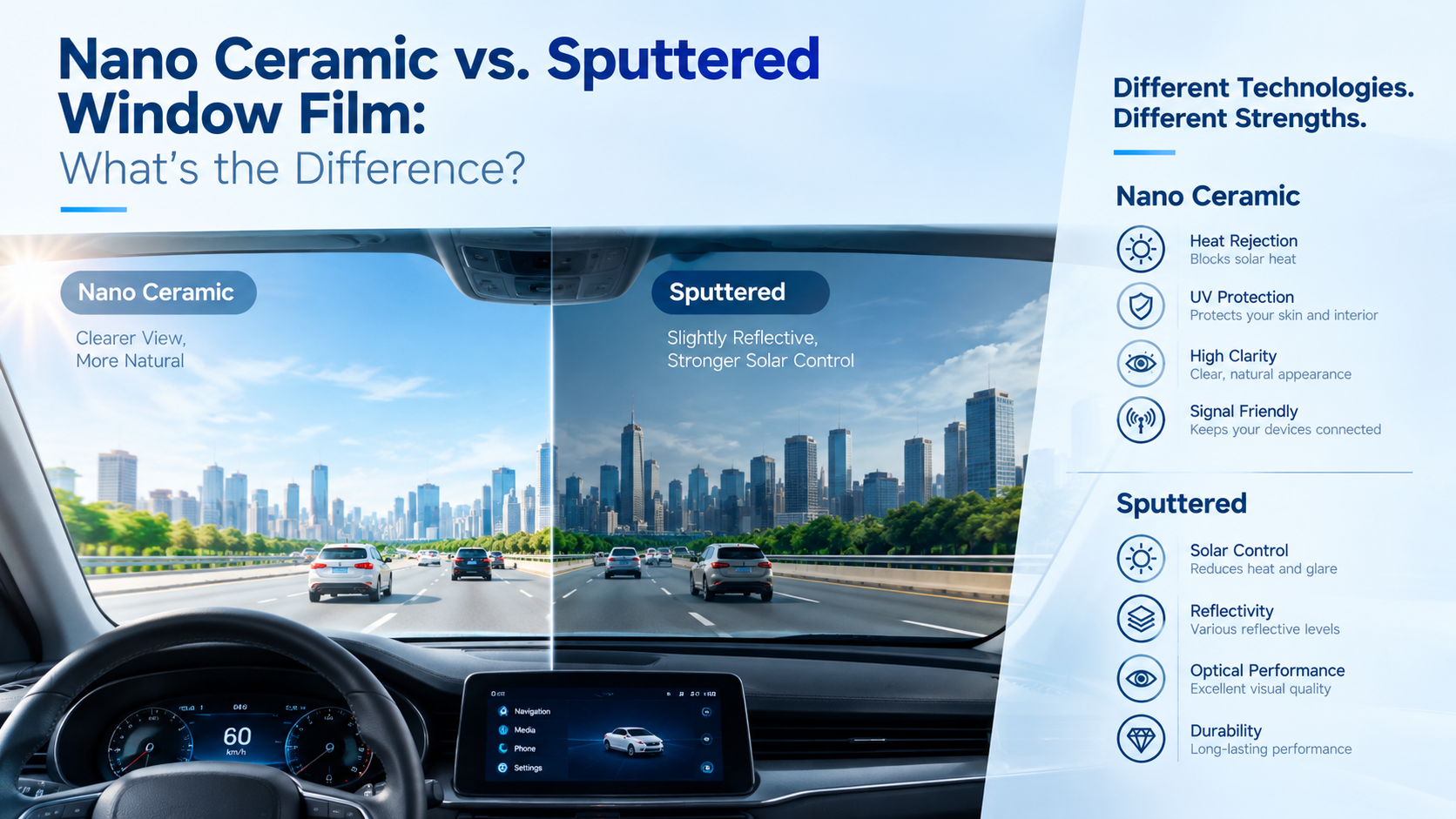
Nano Ceramic or Sputtered for Windshield Film?
Both technologies can be used for high-clarity automotive applications.
Nano ceramic film is commonly selected when buyers want a combination of:
non-metallic construction
signal compatibility
neutral appearance
and high infrared rejection.
Sputtered film uses vacuum-deposited functional layers and can be engineered for different combinations of:
solar control
reflectivity
appearance
and optical performance.
Neither technology should be selected by name alone.
For windshield film, the better approach is:
Define your target specifications first, then choose the construction.
For example:
Target VLT: 70%+
Finished Haze: ≤0.5%
Low Internal Reflectance
Required IRR / TSER
UVR: 99%
Target Warranty
Now a manufacturer can recommend a construction that actually fits your market.
How KSB’s Cat Eye Film Range Fits Different Requirements
KSB’s Cat Eye Film range includes both ceramic and sputtered constructions, allowing different optical and solar-control requirements to be addressed within the same product family.
CE-G Series — Ceramic
Nano ceramic construction for buyers looking for a combination of solar control, optical clarity and non-metallic film technology.
CE-T Series — Sputtered
Sputtered construction positioned for high solar-control performance with multiple VLT options.
CE-D Series — Sputtered
An alternative sputtered series for different combinations of VLT, appearance and solar-control requirements.
Across the range, available VLT levels extend from darker automotive tint options to high-VLT constructions.
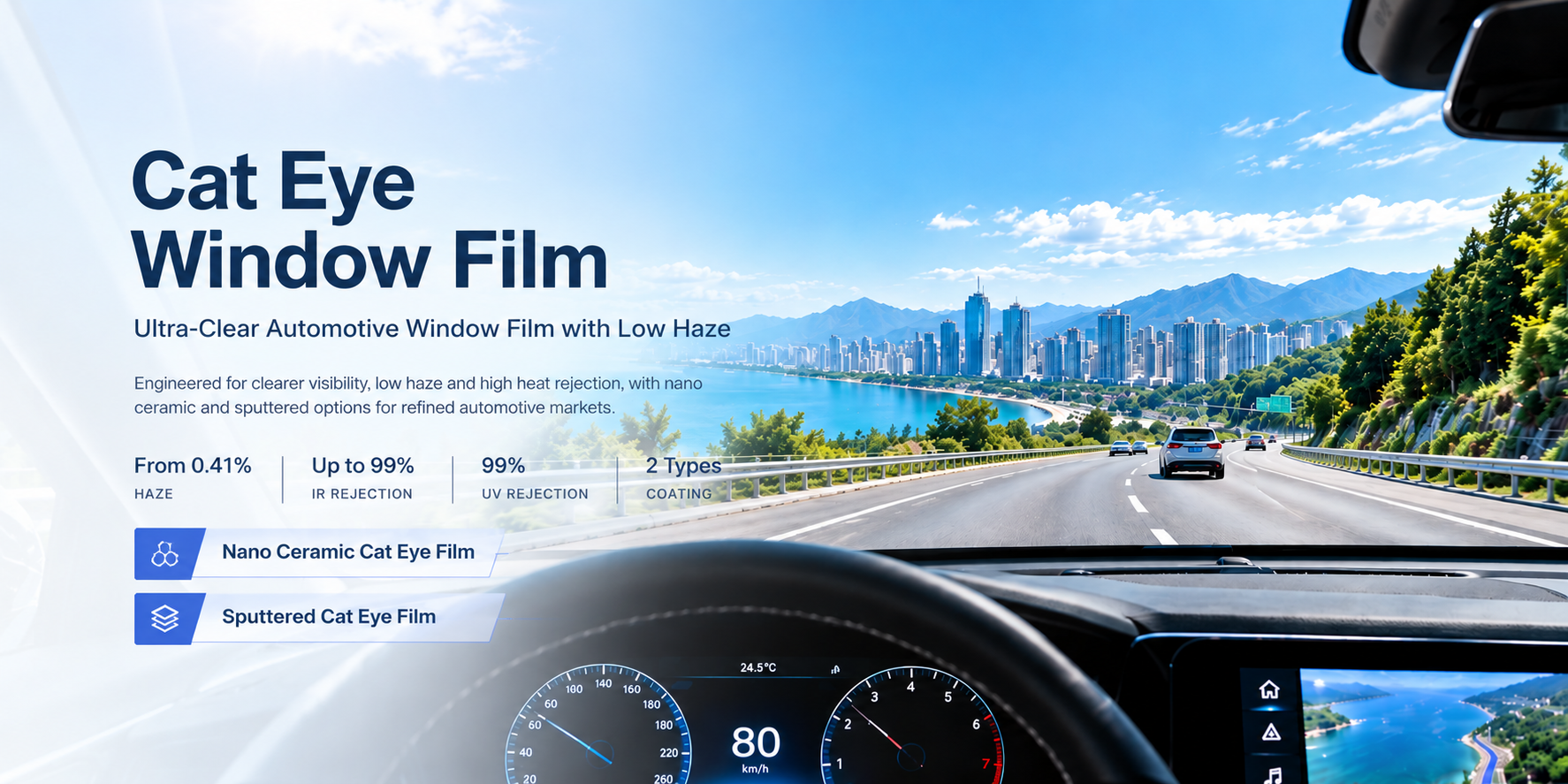
Selected products are designed around:
low haze
high optical clarity
high IR rejection
UV rejection up to 99%
and controlled visible-light reflection.
Standard roll specifications are available in:
2 mil · 1.52 × 30 m
with selected constructions offering warranties up to:
8 years
Because the exact haze, VLT, IRR and reflectance vary by model, professional buyers should compare the individual product specification rather than treating CE-G, CE-T or CE-D as one fixed performance level.
→ Read: What Is Cat Eye Window Film? A Guide to Ultra-Clear Automotive Window Film
What Distributors Should Send a Manufacturer Before Requesting a Quote
If you want a useful recommendation instead of a generic price list, give the supplier more than:
“Send me your best windshield film.”
A better inquiry would be:
We are looking for an ultra-clear windshield film for our automotive tint range. Target VLT is 70–80%, with low finished-film haze, low internal reflection and strong solar-control performance. Please send suitable ceramic and sputtered options with IRR, TSER, UVR, haze, warranty, MOQ and sample availability.
That gives the manufacturer enough information to recommend the right construction.
For private-label buyers, you can also include:
target market
annual volume
preferred roll size
packaging requirements
and warranty positioning.
This usually produces a much more meaningful quotation.
FAQ
What is the most important specification for windshield film?
There is no single specification that determines windshield film quality. For high-clarity applications, haze, VLT, internal reflectance, IRR, TSER, UVR and long-term stability should be considered together.
Is 99% IR rejection good for windshield film?
It can indicate strong infrared performance under the stated measurement conditions, but it does not tell you the film’s haze, VLT, TSER or internal reflectance. IRR should not be evaluated alone.
Is IRR the same as heat rejection?
Not exactly. IRR describes infrared rejection under specified measurement conditions, while TSER describes total solar energy rejected by the glazing system. A 99% IRR claim does not mean 99% TSER.
What haze level is good for windshield film?
Lower finished-film haze is generally desirable for high-clarity applications. Selected ultra-clear films can achieve around 0.5% haze or lower, but there is no universal threshold for every application or measurement method.
What VLT should windshield film have?
The appropriate VLT depends on the intended application and local regulations. High-VLT films are commonly considered when maintaining a relatively clear windshield appearance is important.
Why does internal reflectance matter?
Interior-facing reflection can make dashboard, infotainment and other interior light sources more noticeable on the windshield, particularly at night.
Is ceramic or sputtered film better for windshields?
Both can be engineered for high-clarity windshield applications. Buyers should compare the finished-film specifications and samples rather than selecting solely by technology name.
Should I request samples before placing a wholesale order?
Yes. Technical specifications are useful for narrowing options, while installed samples allow buyers to compare actual clarity, appearance, reflection and nighttime viewing characteristics.
Further Reading
On this site:
- Anti-Glare Window Film for Cars— How haze and internal reflection affect driving visibility
- What Is Haze in Window Film? — Understanding haze and optical clarity in automotive film
- Low Haze Window Film— What low-haze specifications mean for clear viewing
- What Is Cat Eye Window Film? — Exploring Cat Eye film and high-clarity windshield applications
Sourcing Ultra-Clear Windshield Film?
If you’re a window film distributor, automotive tint brand, wholesaler or professional installer, don’t choose your next windshield film from the IRR number alone.
Start with the complete requirement:
VLT
Haze
Internal Reflectance
IRR
TSER
UVR
Durability
KSB can provide ceramic and sputtered automotive film options based on your target market and performance requirements.
Instead of asking for our “best film,” tell us what you need.
Get a Free Sample or Quote
Looking for a reliable window film supplier? Contact us today for fast response and professional support.