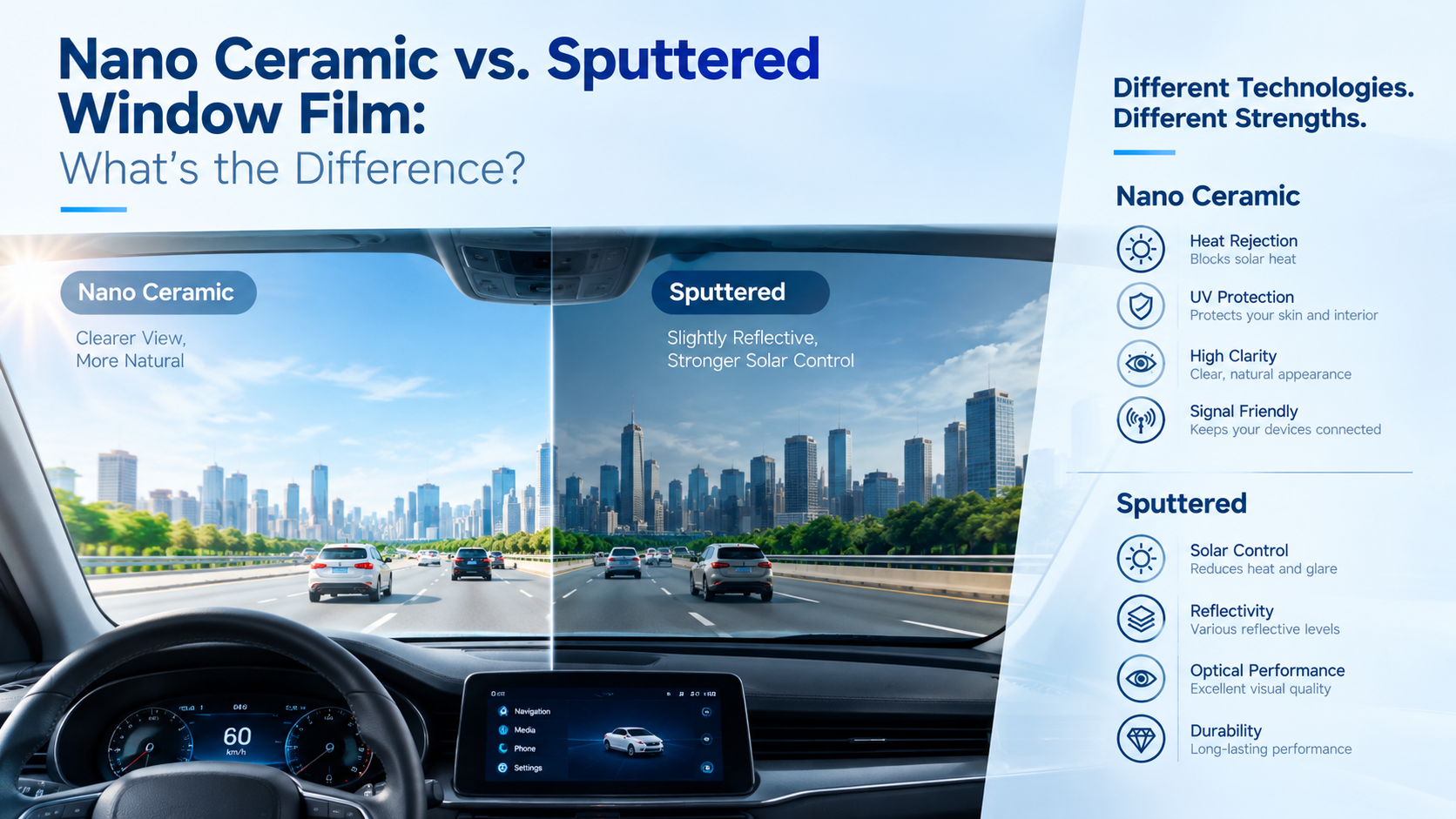
When comparing high-performance automotive window films, two technologies appear frequently:
Nano ceramic window film and sputtered window film.
Both can be designed for heat rejection, UV protection and high optical clarity. But they achieve these results in different ways.
Nano ceramic films use nano-scale ceramic functional materials within the film construction, while sputtered films use a vacuum deposition process to create extremely thin functional layers on the film substrate.
So which technology should you choose?
There isn’t one answer for every application.
For distributors, private-label brands and professional installers, the more useful question is:
Which technology provides the right balance of heat rejection, clarity, reflectivity, appearance, signal compatibility and cost for your target market?
Let’s compare them.
What Is Nano Ceramic Window Film?
Nano ceramic window film uses ceramic-based functional materials to control solar energy.
These materials are incorporated into the film construction at a very small scale. In high-quality ceramic films, careful control of particle size, dispersion and coating uniformity helps maintain optical clarity while providing infrared and UV rejection.
A simplified construction may look like:
Optical PET
↓
Nano Ceramic Functional Layer
↓
Adhesive System
↓
Protective / Hard-Coat Layers
The technology is non-metallic, which is one of its most recognizable characteristics.
Nano ceramic films are commonly selected when buyers want a combination of:
heat rejection
low reflectivity
neutral appearance
signal compatibility
and optical clarity.
However, “nano ceramic” itself does not guarantee a particular level of performance.
Two ceramic films can have very different VLT, IRR, TSER, haze and durability depending on their formulation and construction.
What Is Sputtered Window Film?
Sputtered window film is produced using a vacuum deposition process.
During manufacturing, selected functional materials are deposited onto a film substrate in extremely thin, controlled layers.
Rather than relying on ceramic particles dispersed in a coating, sputtering creates functional layers directly on the substrate.
This gives manufacturers considerable control over solar performance and optical characteristics.
Sputtered films are commonly used when the product design calls for a particular balance of:
solar control
reflectivity
visible light transmission
appearance
and optical performance.
Depending on the materials and layer structure used, sputtered films can range from relatively neutral automotive films to more reflective solar-control products.
So it is important not to assume that:
Sputtered = highly reflective
Every sputtered film is different.
Nano Ceramic vs. Sputtered Window Film: Quick Comparison
Here is a practical overview.
| Feature | Nano Ceramic Film | Sputtered Film |
|---|---|---|
| Technology | Nano-scale ceramic functional materials | Vacuum-deposited functional layers |
| Metal Content | Typically non-metallic | Depends on deposited materials |
| Heat Control | Can be high | Can be high |
| Optical Clarity | Can be very high | Can be very high |
| Haze | Depends strongly on particle dispersion and coating | Depends on film/layer construction |
| Reflectivity | Usually designed for relatively low reflection | Can range from low to more reflective |
| Appearance | Often neutral / natural | Depends strongly on deposited layers |
| Signal Compatibility | Generally strong because it is non-metallic | Depends on the film construction |
| Durability | High-quality constructions can be very stable | High-quality constructions can also be highly durable |
| Typical Applications | Automotive tint, windshield, premium low-reflection films | Automotive and architectural solar-control films |
The important word in this table is “can.”
Technology alone does not tell you the final performance.
A well-engineered ceramic film can outperform a basic sputtered film in some specifications, while a well-designed sputtered film can outperform a ceramic construction in others.
Always compare the actual technical data.
1. Heat Rejection: Which Technology Performs Better?
This is usually the first question buyers ask.
But comparing heat rejection is more complicated than comparing a single IRR number.
Nano ceramic films can achieve strong infrared rejection through ceramic functional materials designed to interact with infrared wavelengths.
Sputtered films use deposited functional layers to control different parts of the solar spectrum.
Both technologies can therefore achieve strong solar-control performance.
When comparing products, look at:
IRR — Infrared Rejection
IRR describes infrared rejection under the specified measurement method or wavelength range.
TSER — Total Solar Energy Rejected
TSER considers the overall solar-energy performance of the glazing system.
This distinction matters.
A product advertised as:
99% IR Rejection
does not necessarily reject 99% of total solar energy.
For professional buyers, TSER is an important companion specification to IRR.
So instead of asking:
Which technology has better IR rejection?
ask:
At the VLT I need, what are the IRR and TSER values for each construction?
That produces a much more useful comparison.
2. Optical Clarity: Ceramic vs. Sputtered
Both technologies can provide excellent optical clarity.
But they reach that result differently.
With nano ceramic film, factors such as:
PET quality
ceramic particle size
particle dispersion
coating uniformity
and adhesive quality
can affect haze and clarity.
If nano materials agglomerate into larger clusters or are distributed unevenly, visible-light scattering may increase.
Sputtered films do not depend on nano-particle dispersion in the same way. Their optical quality depends more on the deposited layer system, substrate quality and overall film construction.
However, that does not automatically make sputtered film clearer.
The correct comparison is finished film vs. finished film.
For high-clarity automotive applications, check measurable specifications such as:
Haze
VLT
Visible Light Reflectance
and, where available, other optical-quality data.
This is particularly important for windshield applications.
3. Which Has Lower Haze?
There is no universal answer.
A high-quality nano ceramic film can achieve very low haze when optical-grade PET, fine functional materials, controlled nano dispersion and precision coating are used.
A properly engineered sputtered film can also provide excellent optical clarity.
Therefore:
Low haze is a property of the finished film—not a property guaranteed by the technology name.
For example, simply seeing:
Nano Ceramic
on a product specification does not tell you whether its haze is:
0.4%
0.8%
or higher.
The same principle applies to sputtered films.
If clarity is important, request the finished-film haze value.
→ Related: What Is Haze in Window Film? Why It Matters for Driving Clarity
→ Related: Low Haze Window Film: What Does ≤0.5% Haze Actually Mean?
4. Signal Interference
This is one of the most frequently discussed differences between ceramic and sputtered window films.
Nano ceramic films are generally non-metallic.
Because of this, they are commonly chosen for applications where compatibility with electronic signals is an important consideration.
This can include:
mobile communication
GPS
and other wireless systems used inside vehicles.
Sputtered film requires a more careful product-by-product evaluation.
Some sputtered constructions use materials or layer structures that may interact with radio-frequency signals more than non-metallic ceramic films.
However, it is inaccurate to say:
All sputtered films block signals.
Modern sputtered constructions vary considerably.
If signal compatibility matters for your market, request technical information or conduct practical testing on the specific film rather than making the decision based only on the word “sputtered.”
5. Reflectivity
Reflectivity is another area where the two technologies can feel different.
Nano ceramic automotive films are often designed to provide a relatively neutral, low-reflection appearance.
This is useful for markets where customers prefer a more natural OEM-style look.
Sputtered films offer more flexibility in reflectivity.
Depending on the deposited materials and layer design, they can be engineered toward:
lower reflection
or
a more reflective solar-control appearance.
That makes sputtered technology useful across a wider range of visual designs.
But higher reflectivity is not automatically better heat rejection, and lower reflectivity is not automatically better quality.
The right level depends on the application and market preference.
6. Appearance
Appearance is sometimes overlooked in technical comparisons.
For automotive distributors, it shouldn’t be.
Two films with similar VLT can still look different on the vehicle.
Nano ceramic films are often selected for relatively neutral colors such as:
charcoal
smoke
neutral black
or similar OEM-style appearances.
Sputtered films can produce different visual characteristics depending on their layer structure.
Some may have a more neutral appearance, while others can show stronger reflective or color characteristics.
For a distributor developing a product range, physical samples are essential.
Don’t select an automotive film from a specification sheet alone.
Install the film on real automotive glass and evaluate it:
from inside the vehicle
and
from outside the vehicle
under different lighting conditions.
7. Internal Reflection
External appearance is only half of the story.
For drivers, internal reflection can have a significant effect on visual comfort.
At night, light from:
dashboard displays
infotainment screens
interior lighting
can appear as reflections on automotive glass.
This is especially relevant for windshields.
Both ceramic and sputtered films can be engineered to control visible-light reflection, but the result depends on the actual construction.
For premium high-clarity films, check:
Visible Light Reflectance – Interior
rather than assuming that one technology automatically provides lower internal reflection.
Selected ultra-clear automotive films can be engineered toward internal visible-light reflectance around 6%, depending on the construction and VLT.
8. Durability and Color Stability
Both technologies can offer long service life when high-quality raw materials and manufacturing processes are used.
Nano ceramic functional materials are generally valued for their stability and resistance to fading compared with basic dyed constructions.
Sputtered functional layers can also provide strong long-term solar performance when properly manufactured and protected within the film structure.
But again, technology is only one part of durability.
Other factors include:
PET quality
adhesive
hard coating
UV stability
weather resistance
manufacturing consistency
and installation conditions.
So a claim such as:
“Ceramic lasts longer than sputtered film.”
is too broad to be useful.
Compare the actual warranty, weathering data and product construction.
9. Which Is Better for Windshield Film?
For windshield applications, the technology name should not be your first selection criterion.
Start with the required optical and solar-control performance.
A professional buyer may want to evaluate:
High VLT
Low haze
Low internal reflection
UV rejection
IR rejection
TSER
Optical distortion
and signal compatibility.
Nano ceramic technology is commonly used for high-VLT windshield films because it can combine a neutral appearance, non-metallic construction and strong infrared control.
But sputtered films can also be engineered for high-clarity windshield applications.
The final choice should be based on the actual specifications and sample performance.
And, of course, windshield tint requirements vary by market, so local regulations should always be considered.
10. Which Technology Is Better for Automotive Window Tint?
There is no single answer.
A better way to choose is to start with the product you want to build.
Nano Ceramic May Be Suitable When You Need:
- Non-metallic construction
- Strong signal compatibility
- Neutral appearance
- Low reflectivity
- High infrared rejection
- Premium automotive positioning
Sputtered Film May Be Suitable When You Need:
- Specific solar-control performance
- Greater flexibility in reflectivity
- Different optical or visual characteristics
- A particular balance of VLT and solar rejection
But these are general tendencies—not rules.
The actual product specifications should always determine the final selection.
Nano Ceramic and Sputtered Cat Eye Film
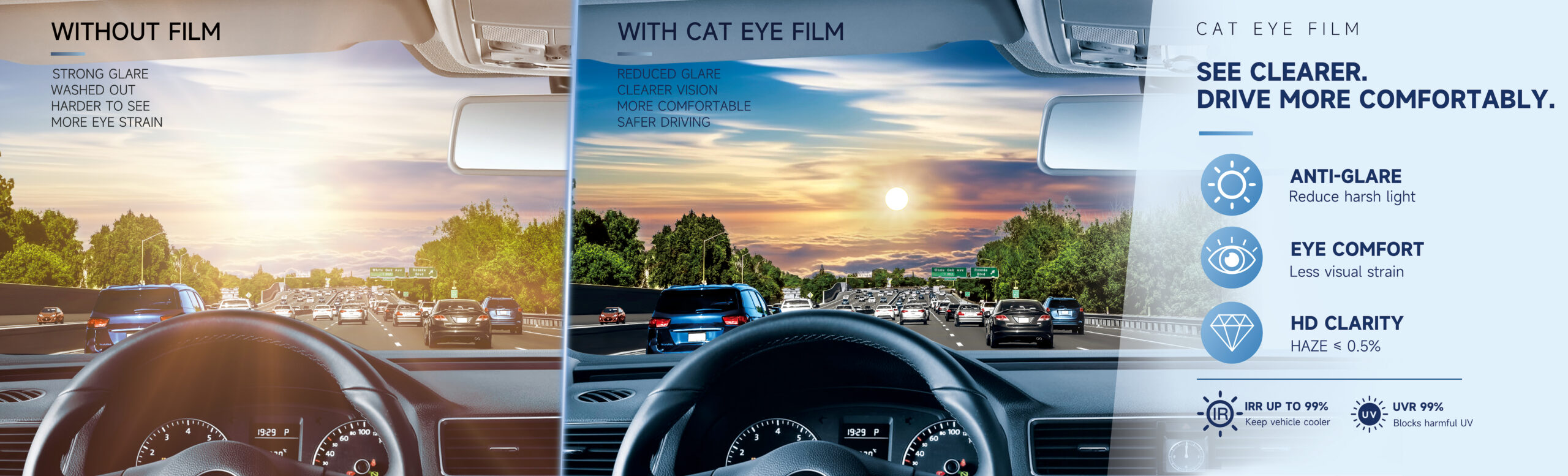
This is where Cat Eye Window Film becomes relevant.
Cat Eye Film should not be understood as a third technology competing with ceramic and sputtering.
Instead:
Ceramic and sputtering describe how the film is engineered.
Cat Eye describes the optical-performance positioning of the finished film.
That means both technologies can be engineered for:
low haze
high clarity
reduced internal reflection
and strong solar-control performance.
So you can have:
Nano Ceramic Cat Eye Film
and
Sputtered Cat Eye Film
within the same automotive film product family.
→ Read: What Is Cat Eye Window Film? A Guide to Ultra-Clear Automotive Window Film
How Should Distributors Choose Between Ceramic and Sputtered Film?
If you are sourcing automotive window film for distribution or private labeling, don’t start by asking:
“Which technology is better?”
Start with your market.
For example:
If your customers want a high-VLT windshield film with neutral appearance and low haze, define those specifications first.
If your market wants a darker film with strong solar control and a particular reflective appearance, define that requirement instead.
Then ask manufacturers to recommend suitable constructions.
When comparing samples, request:
| Specification | Why It Matters |
|---|---|
| VLT | Tint darkness / visible-light transmission |
| Haze | Optical clarity |
| VLR Interior | Internal reflection |
| VLR Exterior | Exterior appearance |
| IRR | Infrared performance |
| TSER | Overall solar-control performance |
| UVR | UV protection |
| Thickness | Product construction |
| Warranty | Expected service positioning |
For wholesale purchasing, also ask about batch consistency, available VLT range, MOQ, roll dimensions, OEM packaging and private-label options.
Those factors often matter just as much commercially as the film technology itself.
KSB Nano Ceramic and Sputtered Window Film
KSB manufactures automotive window films for distributors, wholesalers, professional tint suppliers and private-label brands.
Within our ultra-clear Cat Eye Film range, different constructions are available depending on the required optical and solar-control performance.
CE-G Series
Nano Ceramic
Designed around ceramic solar-control technology with high optical clarity.
CE-T Series
Sputtered
Sputtered construction for high solar-control performance.
CE-D Series
Sputtered
Alternative sputtered construction with different VLT and performance options.
Rather than recommending one technology for every market, we select the construction according to the buyer’s required:
VLT + haze + heat rejection + reflectivity + appearance + application.
For distributors developing a new automotive window film line, samples and technical specifications can be provided for side-by-side evaluation before bulk purchasing.
FAQ
Is nano ceramic film better than sputtered film?
Neither technology is automatically better in every application. Nano ceramic and sputtered films use different manufacturing approaches and can be optimized for different combinations of clarity, heat rejection, reflectivity, appearance and signal compatibility.
Does sputtered window film interfere with GPS or mobile signals?
It depends on the materials and construction of the specific film. Some sputtered constructions may interact with radio-frequency signals more than non-metallic ceramic films, but it is not accurate to assume that every sputtered film causes signal interference.
Is nano ceramic window film non-metallic?
Nano ceramic automotive film is generally designed using non-metallic ceramic functional materials, which is one reason it is commonly selected where signal compatibility is important.
Which has better heat rejection: ceramic or sputtered film?
Both technologies can provide strong solar-control performance. Buyers should compare actual IRR and TSER values at similar VLT levels rather than judging performance from the technology name alone.
Which window film has lower haze?
Both nano ceramic and sputtered films can be engineered for low haze. Finished-film haze depends on the complete construction, including substrate quality, functional layers, coating and manufacturing consistency.
Which technology is better for windshields?
Both can be suitable depending on the product design. For windshield applications, evaluate VLT, haze, internal reflection, optical distortion, IRR, TSER and signal compatibility rather than selecting solely by technology.
Can Cat Eye Film be ceramic or sputtered?
Yes. Cat Eye Film describes an optical-performance concept rather than a single manufacturing technology. Both ceramic and sputtered constructions can be engineered for low-haze, high-clarity automotive applications.
Further Reading
On this site:
- What Is Cat Eye Window Film? A Guide to Ultra-Clear Automotive Window Film— Understanding Cat Eye technology and ultra-clear optical performance
- What Is Haze in Window Film? Why It Matters for Driving Clarity— Understanding haze, light scattering, and driving clarity
- Low Haze Window Film: What Does Haze ≤0.5% Actually Mean?— Explaining low-haze specifications and optical clarity
- How Nano Ceramic Window Film Blocks Heat— How ceramic materials control infrared and solar energy
- What Makes a Window Film Ultra Clear? — Key materials and coating factors behind ultra-clear film
Looking for the Right Automotive Film for Your Market?
If you’re comparing nano ceramic and sputtered window film for wholesale, distribution or private labeling, start with the performance your market actually needs.
KSB can provide different automotive film constructions based on your target VLT, haze, IR rejection, TSER, reflectivity and appearance.
For professional buyers, we can provide technical specifications and samples for comparison before bulk ordering.
Get a Free Sample or Quote
Looking for a reliable window film supplier? Contact us today for fast response and professional support.