
A low roll price is only useful if the film meets your customers’ requirements—and the next shipment matches the sample you approved.
When buying security window film wholesale, distributors need to look beyond thickness and price. Clear product specifications, installation feedback, consistent supply and usable technical documentation all affect whether a product becomes a repeat order or a customer complaint.
This guide explains what to check before placing a wholesale order, how to compare supplier quotations and what information to prepare when requesting samples or pricing.
Start With the Customers You Already Serve
Before choosing a product range, identify who will buy it from you.
A distributor supplying architectural installers may need clear film that preserves the appearance of existing glazing. A business serving automotive tint shops may receive more requests for tinted options. A project supplier may need documentation for a specific glass and film combination before the product can even be considered.
These buyers need different information:
| Your customer | Questions to resolve before stocking |
|---|---|
| Architectural film installers | Which glass types are suitable? What installation guidance is available? |
| Automotive tint shops | Which thicknesses and shades are available? Is the intended use suitable for the destination market? |
| Commercial project contractors | What performance evidence does the specification require? Does it match the proposed installation? |
| Regional wholesalers | Which products deserve regular stock? How will repeat orders and mixed specifications be handled? |
| Private-label brands | What can be customized? What quantities and approvals are required? |
For an opening order, build a focused range around actual customer requests. Ask your installers which thicknesses and shades they currently buy, which products they struggle to source and what documents their customers request.
That gives you a more useful starting point than ordering every available specification.
Compare Exact Specifications, Not Just Product Names
“Security film” can describe a broad range of products. Two rolls with the same stated thickness may have different optical properties, installation requirements or supporting documentation.
Ask each supplier for a specification sheet tied to the exact model being quoted.
At a minimum, confirm:
- Film thickness and tolerance, including whether the release liner is excluded.
- Visible light transmission, or VLT.
- Roll width and length.
- Clear or tinted appearance.
- Intended application and installation side.
- Storage instructions and warranty terms.
- Available test documentation for the selected product.
If heat rejection or UV protection matters to your customers, request those figures separately. Do not assume that every clear safety film provides the same UV rejection, or that a dark film automatically delivers the thermal performance your customer expects.
Where supplier figures differ, ask how they were measured before comparing them.
KSB’s Available Safety Film Range
KSB’s published safety film range includes the following options:
| Product range | Listed thicknesses | Listed VLT | Standard roll size |
|---|---|---|---|
| Transparent safety film | 2, 4, 8, 12, 16 and 21 mil | 90% | 1.52 × 30 m |
| Black safety film | 4, 8, 12, 16 and 21 mil | Model-dependent; options across the range span 5%–50% | 1.52 × 30 m |
Not every shade is available at every thickness. Confirm the exact model before requesting a quotation.
You can review the KSB safety film specifications to shortlist products for your market.
Treat Thickness and Tested Performance as Different Questions
Thickness is an ordering specification. It is not, by itself, proof that a product meets a particular security requirement.
When a customer asks for “security film,” clarify what they expect it to do. Are they concerned about loose glass fragments after breakage? Are they supplying a project with a named test requirement? Do they need evidence for a particular installation?
Security film can help hold broken glass together, but it does not make glass unbreakable. Performance depends on the film, glass, frame and installation—not just the number of mils on the label.
Before repeating a supplier’s performance claim, ask:
- Which film model was tested?
- What glass type and thickness were used?
- How was the film installed and attached?
- What test method and result appear in the report?
- Does the report cover the product and application you plan to sell?
A demonstration video can show how a sample behaves. It does not replace a report when a project requires documented performance.
Keep a clear distinction between a product’s measured specifications, its demonstrated behavior and any independently tested classification. This makes your own sales material easier to defend when a contractor asks for evidence.
Compare Wholesale Prices on the Same Basis
A quotation that lists only a price per roll leaves too much room for misunderstanding.
Before comparing suppliers, make sure the quotations cover the same thickness, shade, roll dimensions, packaging and delivery terms. Also check whether freight is included and where the supplier’s delivery responsibility ends.
For a standard 1.52 × 30 m roll:
Nominal film area = 1.52 × 30 = 45.6 m²
Product cost per m² = quoted roll price ÷ 45.6
This calculation helps compare different quotations, but it is not your final selling cost. You still need to account for freight, import expenses, local handling and any cutting waste.
A useful internal comparison is:
Estimated landed cost per sellable m² = total landed shipment cost ÷ estimated sellable area
Use the same assumptions for every supplier. A lower product price may offer little advantage if the roll size differs, the packaging costs extra or a larger share of the shipment cannot be sold.
Also separate standard stock pricing from private-label pricing. Branded cartons, labels and custom specifications can change the order requirements.
Already have a purchasing list? Send KSB your thicknesses, quantities and destinationto request a quotation against a defined specification.
Evaluate Samples Before Building Inventory
Sample evaluation should answer a practical question: would your installers be comfortable using this product on a paying job?
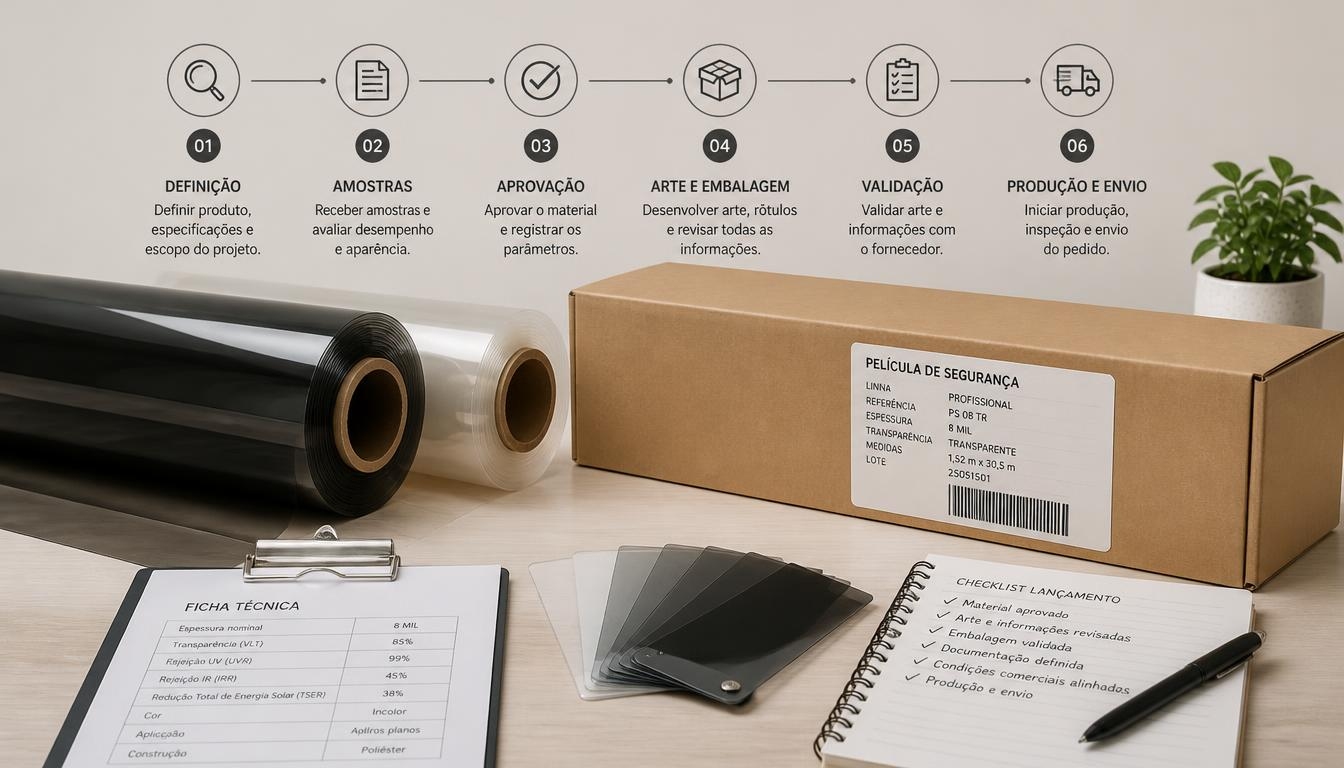
Ask for samples identified by model and thickness. Keep a record of what you receive so the approved sample can be referenced when placing the order.
Have an experienced installer assess the material on representative glass, following the supplier’s application and curing instructions. Record observations such as:
- Appearance and clarity before and after installation.
- Liner removal and handling.
- Cutting, positioning and squeegeeing.
- Adhesive appearance after the stated curing period.
- Edge condition and any visible defects.
A small swatch is useful for an initial appearance check. Ask whether a trial roll is available when you need to evaluate handling across a full installation.
If performance testing is required, agree on the method and acceptance criteria before ordering. An informal impact demonstration should not be treated as a substitute for the testing your customer specifies.
Once a sample is approved, keep a labeled reference and a written specification. Both are more useful for checking a later shipment than a message saying “same quality as before.”
Confirm MOQ, Packaging and Repeat-Order Terms
There is more than one minimum order quantity to discuss.
A supplier may have separate requirements for the total order, each thickness, each shade and custom packaging. Ask whether specifications can be mixed and whether standard products and customized products follow different production schedules.
Before paying a deposit, get written confirmation of:
| Order detail | What to confirm |
|---|---|
| Product selection | Model, thickness, shade and quantity for each item |
| Minimum quantities | Total-order and per-item requirements |
| Packaging | Standard or branded cartons, labels and roll identification |
| Timing | Production schedule and when the lead-time calculation starts |
| Inspection | What is checked before dispatch and which records are available |
| Claims | Required photos, batch details and the process for reporting a problem |
| Repeat orders | How the approved specification will be referenced |
For distributors, repeat-order clarity deserves as much attention as the first quotation. Ask how product changes will be communicated and how batches can be identified if an installer reports a problem.
Plan Private Labeling Before Finalizing the Order
If you sell under your own brand, packaging is part of the product specification.
Agree on model names, thickness labels, roll dimensions, artwork and warranty wording before production. Make sure your carton, technical sheet and sales brochure describe the same product.
KSB offers OEM and private-label support, including branded packaging, labels and specification options subject to order requirements.
When requesting an OEM quotation, explain whether you need branded packaging for an existing product or a change to the film itself. These are different requests and may involve different quantities, evaluation steps and lead times.
Avoid printing performance claims until the supporting information has been checked. Correcting a digital brochure is straightforward; replacing a shipment of printed cartons is not.
What to Include in a Wholesale Inquiry
A useful inquiry does not need to be long. It needs enough detail for the supplier to quote the right product.
Include:
- Destination: country and, if freight is required, delivery city or port.
- Business type: distributor, importer, installer network or private-label brand.
- Application: architectural, automotive or a defined project.
- Product requirements: clear or tinted, thicknesses and preferred VLT.
- Order volume: estimated rolls per specification.
- Branding: standard packaging or OEM requirements.
- Technical requirements: any documentation or testing your customer needs.
- Timing: intended purchasing or delivery date.
If you have not selected the thickness yet, describe your customers and applications. That is more helpful than choosing a specification without knowing whether it fits the intended use.
Frequently Asked Questions
What is the minimum order for wholesale security window film?
Confirm the MOQ for the exact product and packaging requested. Ask about both the total-order minimum and the minimum for each thickness or shade. Private-label packaging may have separate requirements.
Can I evaluate KSB safety film before a bulk order?
Samples can be arranged for evaluation. Provide the intended application and the specifications you want to compare so the request can be matched to suitable products. Confirm sample size and shipping arrangements with the team.
Should a distributor start with clear or tinted safety film?
Start with the needs of your existing customers. Clear film may suit buyers who want to preserve the appearance of glazing, while tinted products serve customers requesting a darker finish. Validate demand before carrying a wide range of shades.
Get a Free Sample or Quote
Looking for a reliable window film supplier? Contact us today for fast response and professional support.