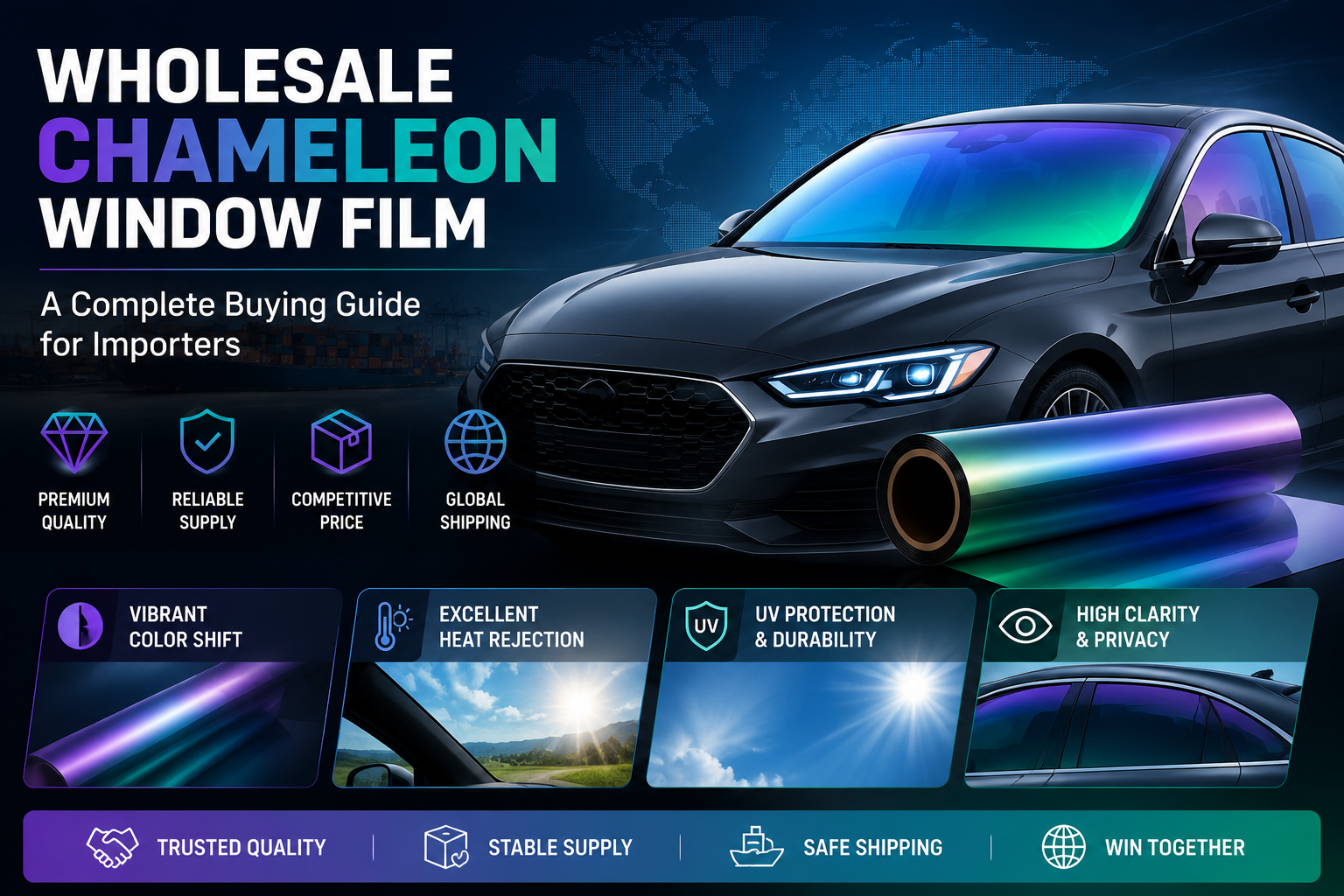
Wholesale Chameleon Window Film: A Complete Buying Guide for Importers
Published: November 5 2026 · 8 min read · Category: Chameleon Window Film
About this article: KSB Window Film supplies chameleon window film to distributors and importers globally. This guide gives specific data on wholesale structure, pricing, and logistics for chameleon film — distinct from standard automotive tint in several important ways.
This chameleon window film brings gradient color shift, strong heat insulation and full uv shielding.
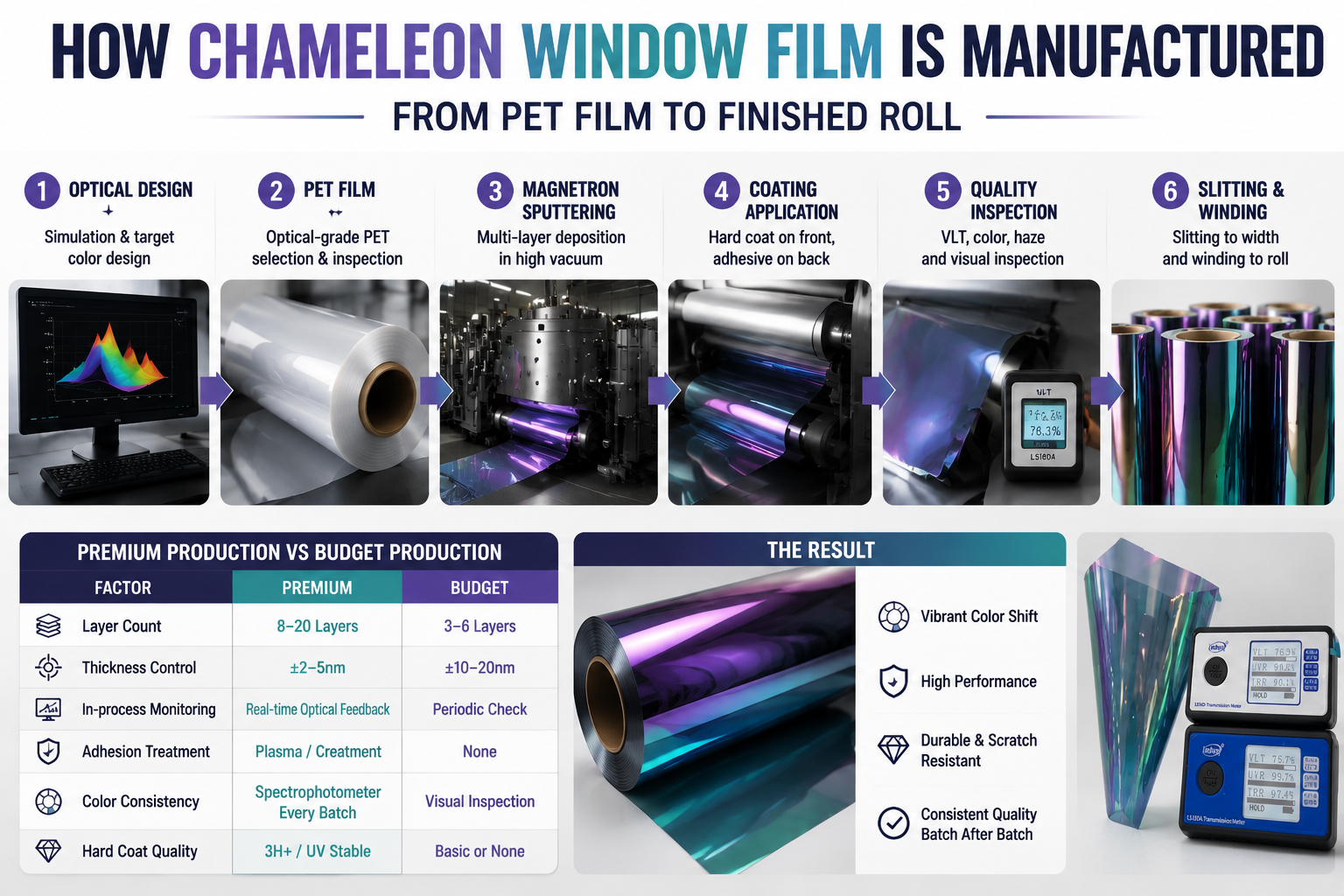
Buying chameleon window film wholesale has specific challenges that standard tint wholesale doesn’t. The colour variations, the batch consistency requirement, the premium positioning, and the smaller but growing market size all affect how to structure procurement effectively.
The Product Range Challenge: Managing Colour SKUs
The most significant difference in chameleon film wholesale vs. standard tint wholesale is the colour dimension. Standard solar control film has VLT and technology tier as the primary SKU dimensions. Chameleon film adds colour combination as a third dimension.
Typical chameleon film colour combinations in the market:
Purple-to-green (highest demand globally)
Blue-to-purple (strong in European and North American markets)
Green-to-gold (strong in Middle Eastern markets)
Blue-to-green (versatile, moderate demand)
Red-to-purple (niche, exotic vehicle market)
Custom/additional combinations (market-dependent)
And within each colour, VLT tiers:
Light (55–70% VLT): for compliance-sensitive applications, or lighter aesthetic preference
Medium (45–55% VLT): most popular for rear windows
Dark (30–45% VLT): maximum colour intensity, rear windows and markets with permissive regulations
This creates a matrix of 15–30+ SKUs if stocking all colour/VLT combinations. Most importers start with 3–5 SKUs and expand based on market response. Start with the highest-demand combinations in your market (purple-to-green at medium VLT is the safest starting SKU globally).
MOQ Structure for Chameleon Film
Single colour/VLT combination (one SKU):
Minimum for first orders: 20–50 rolls
Standard wholesale volume: 50–150 rolls
Volume discount threshold: 150+ rolls
Aggregate across the colour range:
Some manufacturers offer aggregate MOQs — e.g., 100 rolls total across any combination of their chameleon range
This allows importers to spread initial orders across multiple SKUs to test market response without committing large quantities to each
Private label addition:
Custom roll labels: minimum 500 labels (can cover multiple SKUs with one print run)
Outer boxes (if required): 200–500 units minimum
Pricing Reference (2026, Ex-Works China)
Note: Chameleon film prices are higher than standard automotive solar control film at equivalent VLT, reflecting the more complex manufacturing.
Product
VLT
Cost/sqm
Cost/roll (1.52m × 20m)
Standard chameleon (2–3 colour shift)
45–55%
$5.00–$8.00
$15–$24
Premium chameleon (vibrant, 3+ stage)
40–60%
$8.00–$14.00
$24–$43
Custom/exclusive colour
Various
$12.00–$18.00
$36–$55
Landed cost additions (adding to ex-works for major markets):
Market
Typical freight addition
Typical duty
Total landed multiplier
US
$3–$6/roll (sea)
HTS-dependent
~1.30–1.45× ex-works
EU
$3–$5/roll (sea)
~5.5–6.5%
~1.25–1.40× ex-works
Middle East (UAE)
$2–$4/roll (sea)
5%
~1.20–1.30× ex-works
Australia
$3–$6/roll (sea)
5%
~1.25–1.40× ex-works
Distributor to Installer Pricing and Margin
Chameleon film commands better margins than standard film due to premium positioning:
Recommended pricing approach: Position chameleon film 40–80% above your standard film pricing at equivalent VLT. Installers understand and accept this premium given the distinctive effect.
Margin reference:
Landed cost (mid-range chameleon): $20–$30 per roll
Distributor to installer price: $50–$80 per roll (depending on market)
Gross margin: 50–60%
This compares favourably with standard solar control film, where typical distributor margins are 35–50%.
Batch Ordering for Colour Consistency
This is the critical procurement practice unique to chameleon film. Because the colour shift must be consistent within and across orders, batch management matters:
For large orders: Request that the entire quantity of a single colour/VLT combination be produced from one production run (one batch). Mixing batches in a large order creates colour variation risk.
For ongoing supply: Maintain batch records (each order’s production batch number) so if a colour consistency issue arises, it can be traced to a specific batch.
Minimum order per colour to justify a dedicated production run: 50–80 rolls. Below this, some manufacturers incorporate your order into a larger production run — acceptable as long as the batch sampling confirms colour consistency.
Logistics Considerations
Roll dimensions: Standard chameleon film rolls are 1.52m (60″) wide and 20–30m long. This is the same as standard automotive film. A 20′ shipping container holds approximately 300–500 rolls depending on roll dimensions and packing.
Shipping stability: Chameleon film rolls should be shipped horizontal (lying on their sides) to prevent the layers from being stressed by the roll’s own weight. Vertical shipping of heavy rolls can create deformation over a long sea freight journey.
Import classification: Chameleon window film is typically classified under HS 3921.90 (other plastic sheet/film) or 3919.90 (self-adhesive plastic). Verify the correct classification for your market — the correct HS code affects duty rate.
Quality Assurance in the Import Process
Pre-shipment inspection (for first orders): Commission SGS, Intertek, or QIMA pre-shipment inspection. Inspector checks: correct quantity, roll dimensions as specified, visual colour quality (comparing against approved samples), packaging condition. Cost: $250–$450.
Incoming quality check: On receipt, check:
3–5 rolls from the shipment for colour consistency vs. the approved sample
VLT measurement on sample rolls vs. specification
Edge condition (no lifting, no delamination)
Colour rejection standard: If more than one roll in ten shows visible colour deviation from the approved sample in equivalent lighting, reject the batch for quality investigation.
FAQ
What is the shelf life of chameleon window film in storage?
Quality chameleon film stored horizontally in a controlled environment (15–25°C, 40–70% humidity, away from UV): 2–3 years from manufacture date before adhesive performance begins to degrade. Rotate stock FIFO. Do not store in direct sunlight or high-humidity environments.
Can I mix chameleon film with standard solar control film from the same manufacturer?
Yes — these are complementary range items. Most distributors stock both, with chameleon positioned as a premium upsell to customers who enquire about standard tint.
KSB’s Chameleon Film: Wholesale Programme for Importers
KSB Window Film supplies chameleon window film to importers in 60+ countries with flexible colour/VLT SKU selection, batch consistency documentation, and private label capability.