How Chameleon Window Film Is Manufactured: From PET Film to Finished Roll
Published: November 5, 2026 · 8 min read · Category: Chameleon Window Film
About this article: KSB Window Film manufactures chameleon window film using magnetron sputtering. This guide explains the complete production process — what happens at each stage and what determines the quality of the finished product.
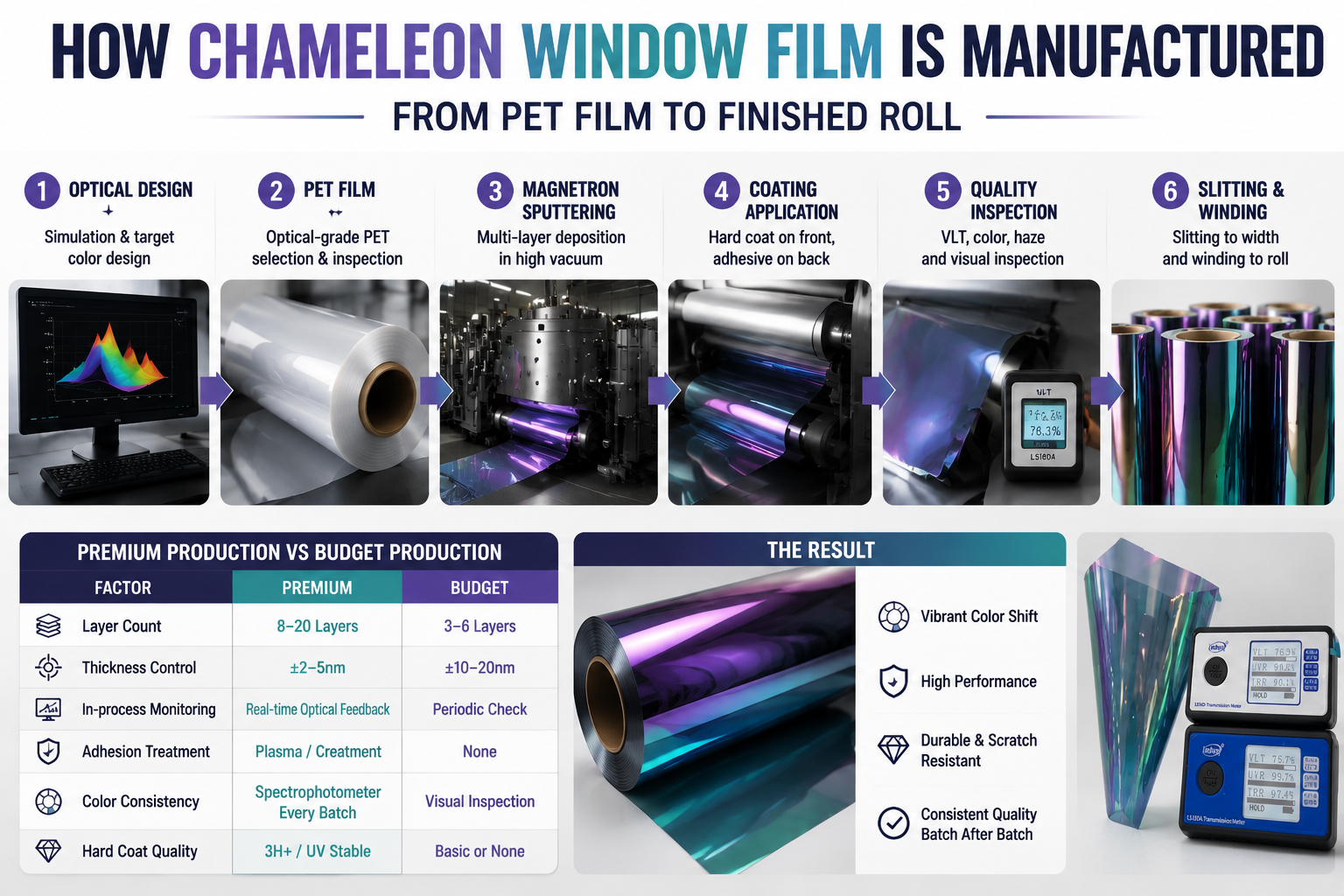
Chameleon window film with magnetron sputtering process for automotive film manufacturing
Understanding how chameleon window film is made gives buyers a practical framework for evaluating manufacturers, understanding price differences, and distinguishing genuine product quality from marketing claims. The production process is more complex than standard automotive tint — and that complexity is precisely why quality differences between manufacturers are larger in this category.
Stage 0: Optical Design — Before Manufacturing Begins
This stage separates sophisticated manufacturers from basic ones.
Thin-Film Simulation
A quality chameleon film starts on a computer, not in a coating chamber. Optical engineers use thin-film simulation software (TFCalc, Essential Macleod, or equivalent) to model the interference behaviour of proposed layer stacks.
What simulation tells the engineer:
Given a stack of N layers of materials A, B, C at thicknesses x, y, z nanometres — what colours will be reflected at what angles?
How does the colour shift depend on viewing angle?
Which layer sequence produces the sharpest, most saturated colour transition?
How does the design change if VLT needs to be 50% vs. 65%?
A manufacturer without optical simulation capability develops layer stacks by trial and error — expensive, slow, and producing less optimised designs. Premium chameleon film requires simulation to achieve the vibrant, distinct colour shifts that the market expects.
Target Colour Specification
The simulation output specifies the target colour combination (reflected CIE colour coordinates at normal and off-normal angles), the layer stack design (number of layers, materials, target thicknesses), and the VLT prediction. This becomes the engineering specification for the coating chamber.
Stage 1: PET Base Film Selection and Inspection
The polyethylene terephthalate (PET) substrate for chameleon film must be optical-grade — lower haze, better dimensional stability, and tighter thickness control than standard packaging PET.
Why PET quality matters more for chameleon than standard film: Any haze in the PET base film reduces the saturation of the interference colours — the colours appear washed out rather than vivid. Any thickness variation in the PET affects the interference layer thicknesses proportionally. Premium chameleon film uses optical-grade PET with haze below 0.3% and thickness variation below ±3%.
Incoming PET inspection: Haze meter measurement, thickness measurement at multiple cross-roll positions, and visual inspection for defects. PET that fails incoming inspection is rejected — putting non-conforming PET through sputtering wastes expensive coating time.
Stage 2: PET Surface Pre-Treatment
Before the PET enters the sputtering chamber, the surface receives pre-treatment:
Surface cleaning: Electrostatic cleaning removes dust and particulates that would create defects in the sputtered layers.
Adhesion promotion: Thin pre-coating layers or plasma/corona treatment improve the adhesion of the subsequent sputtered layers to the PET surface.
This stage is invisible in the finished film but critically important — poor adhesion at the PET-sputtered layer interface is the root cause of the delamination failures common in lower-quality chameleon film.
Stage 3: Magnetron Sputtering (The Core Process)
The PET film passes through a high-vacuum sputtering chamber on a continuous web (roll-to-roll) transport system. Inside the chamber, magnetron assemblies house the target materials.
The layer deposition sequence for a typical chameleon stack:
For a purple-to-green design using TiO₂ (high refractive index) and SiO₂ (low refractive index) with optional metallic layers:
Layer 1: SiO₂ — 30nm (adhesion / optical start layer)
Layer 2: TiO₂ — 65nm (high index layer)
Layer 3: SiO₂ — 120nm (low index spacer)
Layer 4: TiO₂ — 60nm (high index layer)
Layer 5: SiO₂ — 100nm (low index spacer)
Layer 6: Ag or Al alloy — 8nm (optional thin metallic layer for additional reflectance)
Layer 7: SiO₂ — 25nm (protective layer over metallic)
... and so on for total of 8–18 layers
(Note: The above is an illustrative example, not KSB’s actual proprietary specification.)
Process parameters controlled during sputtering:
Web speed (determines deposition time = layer thickness)
Target power (determines deposition rate)
Process gas pressure (argon for sputtering, oxygen added for oxide deposition)
Substrate temperature (affects layer density and adhesion)
In-process measurement: Optical monitors within the sputtering chamber measure the developing film’s reflectance in real-time. Control software adjusts web speed or power to correct deviations from target — maintaining layer thickness consistency across the production run.
Stage 4: Hard Coat Application
After sputtering, the front surface (the outer face that will be visible after installation) receives a scratch-resistant hard coat.
Why hard coat matters for chameleon film specifically: The interference layers are on the outer face of the film in most constructions. Without adequate hard coat protection, installation handling (squeegee contact) and service (wiper blade contact if applied to rear windscreen) would damage the interference layers and alter the colour shift appearance.
Hard coat specification for chameleon film:
Pencil hardness: 3H or above
Flexibility: must not crack when film is stretched to conform to glass curvature
Optical clarity: must not reduce VLT or introduce haze
UV stability: must not discolour or craze under UV exposure
Stage 5: UV-Absorber and Adhesive Coating
UV absorber layer: Incorporated into the adhesive or an intermediate coating. Provides 99%+ UV rejection while the interference coating layers provide the heat and colour performance.
Pressure-sensitive adhesive (PSA): Applied to the back face of the film (opposite the sputtered surface). Requirements specific to chameleon film:
Must be optically clear — any yellowing of the adhesive would visibly distort the interference colours
Must maintain adhesion across the temperature range the interference layers create (slightly elevated heat absorption at certain angles)
UV stability essential — adhesive yellowing destroys the visual quality of the installed film
Stage 6: Release Liner and Quality Inspection
A release-coated liner is laminated to the adhesive surface, protecting it until installation.
Final quality inspection:
VLT measurement (100% of production, inline)
Colour shift verification: sample from each roll compared to the reference standard under controlled lighting (spectrophotometric measurement of reflected colour)
Haze measurement
Visual inspection: no streaks, no pinholes, no coating irregularities
Slitting and winding to final roll dimensions
Batch colour record: The spectrophotometric colour measurement for each roll or batch is recorded in the quality system — providing the batch traceability that enables consistent colour matching across orders.
What Separates Premium Manufacturing From Budget Manufacturing
Factor
Premium production
Budget production
Optical design
Simulation-designed stacks
Trial and error
PET quality
Optical grade, haze < 0.3%
Standard packaging grade
Layer count
8–20 layers
3–6 layers
Thickness control
±2–5nm
±10–20nm
In-process monitoring
Real-time optical feedback
Periodic offline checks
Adhesion pre-treatment
Plasma / corona treatment
None
Colour consistency
Spectrophotometric, every batch
Visual inspection
Hard coat quality
3H+, UV stable
Basic or none
FAQ
How long does a production run take for chameleon film?
A 5,000sqm production run (approximately 160 rolls of 1.52m × 20m) takes 3–5 days end-to-end including setup, sputtering, hard coat, adhesive, and final QC. The sputtering itself may run 24 hours for this volume; setup and QC are a significant fraction of total time.
Is there a meaningful difference between a 6-layer and a 14-layer chameleon stack?
Yes. More layers enable finer control of the interference spectrum, producing a sharper, more saturated colour shift. A 6-layer stack produces a simpler colour transition; a 14-layer stack can produce a more vivid, multi-stage shift with better colour definition. The cost of sputtering time increases with layer count.
KSB Window Film’s chameleon film production process follows the six-stage framework described here. We welcome facility visits and provide production documentation to qualified buyers.