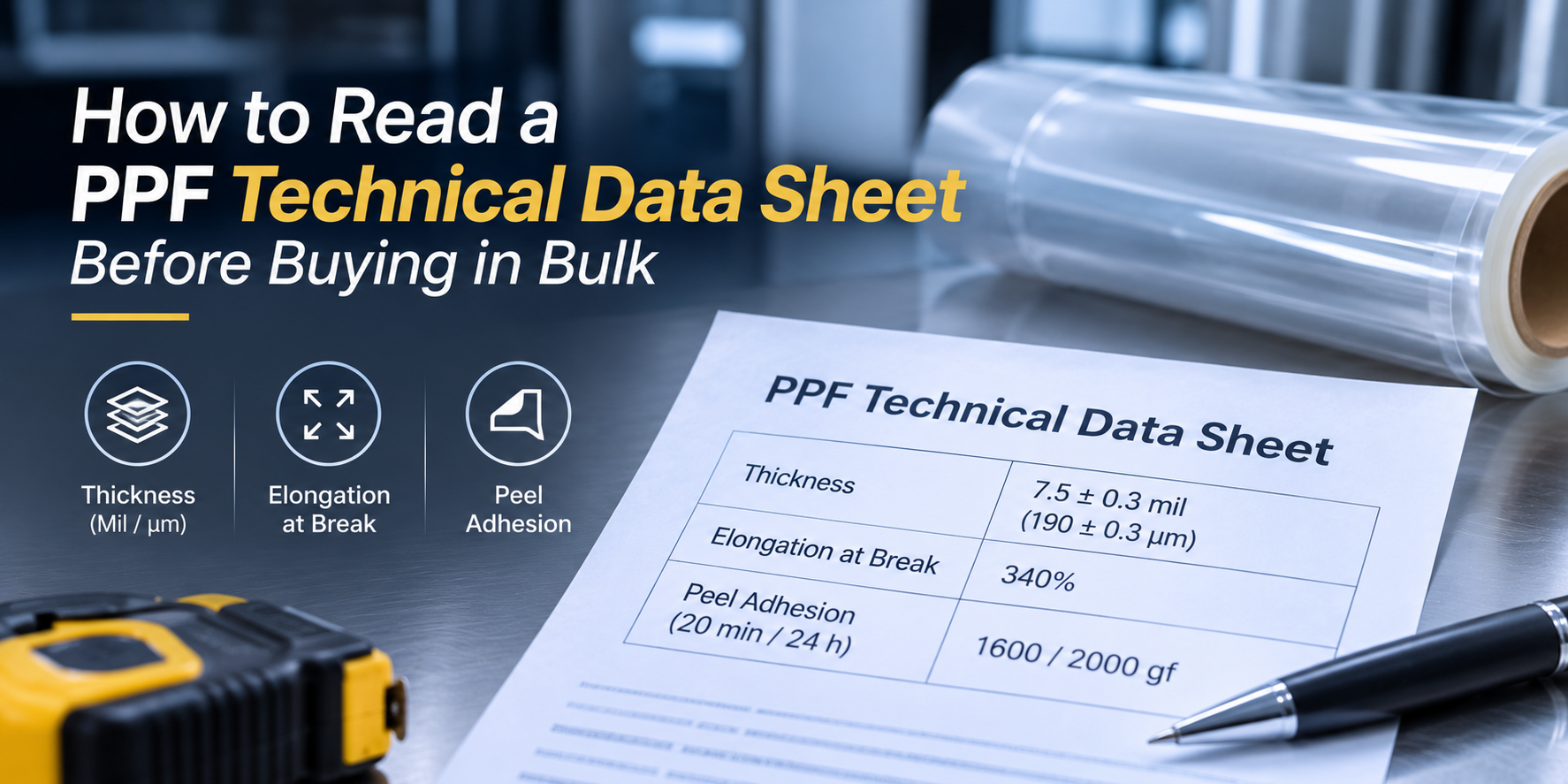
When a quote says “7.5 mil TPU,” ask for the technical data sheet for the exact roll you’re about to order. The model, finish and document revision should match the quote. A PPF technical data sheet (TDS) helps you compare films and decide what to check when the first shipment arrives. Start with three rows: thickness, elongation at break and peel adhesion.
Check what the thickness includes
One mil is 25.4 microns. A nominal 7.5 mil film is about 190.5 µm. If the sheet specifies 7.5 ± 0.3 mil, the stated range is 7.2–7.8 mil, or about 183–198 µm. The first number is the nominal thickness. The second tells you the allowed variation.
Before comparing that range with another quote, ask which layers were measured. One sheet may report the TPU base alone. Another may measure the finished film with the topcoat and adhesive. Confirm how the supplier treats the release liner and any protective cap sheet. Ask for the measurement method and sampling points if you plan to check incoming rolls against that tolerance.
Read elongation as a test result
Elongation at break is the percentage increase in a specimen’s gauge length when it breaks in a tensile test. For example, a 50 mm gauge length at 340% elongation would extend by 170 mm, reaching 220 mm at break. In the shop, check how the film behaves over a bumper corner or mirror housing and whether the finish stays clear after shaping. Use that trial to judge how far your installers can comfortably work the film.
| KSB model | Listed thickness | Listed elongation |
| TOP75 | 7.5 ± 0.3 mil | 340% |
| TOPS75 | 7.5 ± 0.3 mil | 345% |
See the KSB PPF specifications comparison for the published figures. Before using that five-point difference to choose a model, ask whether both figures cover the same test specimen (TPU base or finished film), test direction and pull speed. If results are available in both the machine and cross directions, compare matching directions. Also check the gauge length, conditioning and whether the figure is typical or a specified minimum. ASTM D882 is one reference for thin plastic sheeting tensile tests. Ask which method the supplier actually used.
Match peel adhesion test conditions
A 20-minute or 24-hour peel figure generally refers to the time the film stays on the test panel before the pull. The two readings can show how adhesion changes with dwell time when the rest of the test setup is held constant. Ask for the panel material and preparation, application procedure, dwell time, peel angle, pull speed, strip width and test temperature. Record the failure mode as well, especially if adhesive remains on the panel.
Suppose one sheet reports 1,300 gf and another reports 12 N/25 mm. The first reading is about 12.75 N of force. If that force was measured on a 25 mm strip, it can be expressed as 12.75 N/25 mm. You can compare it with the 12 N/25 mm result once you confirm the same dwell time and comparable test conditions. If the first sheet gives no strip width, ask for it before ranking the results. These figures are an example. ASTM D3330 describes several peel configurations for pressure-sensitive tape, so a standard number alone may leave the setup unclear.
On a sample roll, have installers check repositioning during application and edge behavior after the film has settled. Use their normal installation process and record the panel, solution and check-in time. For a shop trial outline, see how to test a PPF sample roll.
Ask for test data you can use to accept a shipment
A typical value gives you a reference when shortlisting. If thickness or adhesion matters to your purchase, agree on a limit or range, the test method and the evidence you’ll receive before shipment. A model-level TDS describes the product. A batch report, or a certificate of analysis if available, ties the listed measurements to a specific production lot.
| Ask for | What to check |
| Current TDS | Exact model and finish, revision date, units and whether values are typical or guaranteed |
| Supporting test report | Specimen, method, conditions, test date and reported results. For weathering or yellowing claims, check the exposure conditions, duration and measurement endpoint. |
| Sample and production roll labels | Model and lot identifiers you can trace back to the sample or report |
| Written order specification | Roll dimensions, agreed limits, sampling plan and what happens if the batch falls outside those limits |
For a first bulk order, save the approved TDS revision and sample roll label with the purchase order. Ask which measurements will appear on the shipment’s QC record. When stock arrives, match the roll labels to that record before releasing it to installers.
Request the KSB data sheet for your shortlist
Send us your company name, destination market, target finish and thickness, and estimated first-order volume in rolls. If you’re replacing a film, include the current roll label or TDS and flag any issue your installers want to solve. We can use those details to identify suitable KSB models and discuss the data sheets, sample rolls and bulk quotation for your shortlist.
Request a PPF TDS and Bulk Quote
Get a Free Sample or Quote
Looking for a reliable window film supplier? Contact us today for fast response and professional support.