Automotive window film needs to do more than reduce solar heat. Glare control, optical clarity, UV protection and signal compatibility all influence the driving experience. The KSB NK Series brings these requirements together through a combination of anti-glare technology and nano ceramic materials.
Designed for automotive applications, NK Series window film combines pure nano ceramic, tungsten oxide and nano titanium nitride with an anti-glare technology approach. Its seven models offer different visible light transmittance (VLT) levels, allowing distributors and installers to select options for different light transmission and solar control requirements.
How the NK Series Combines Nano Ceramic and Anti-Glare Technology
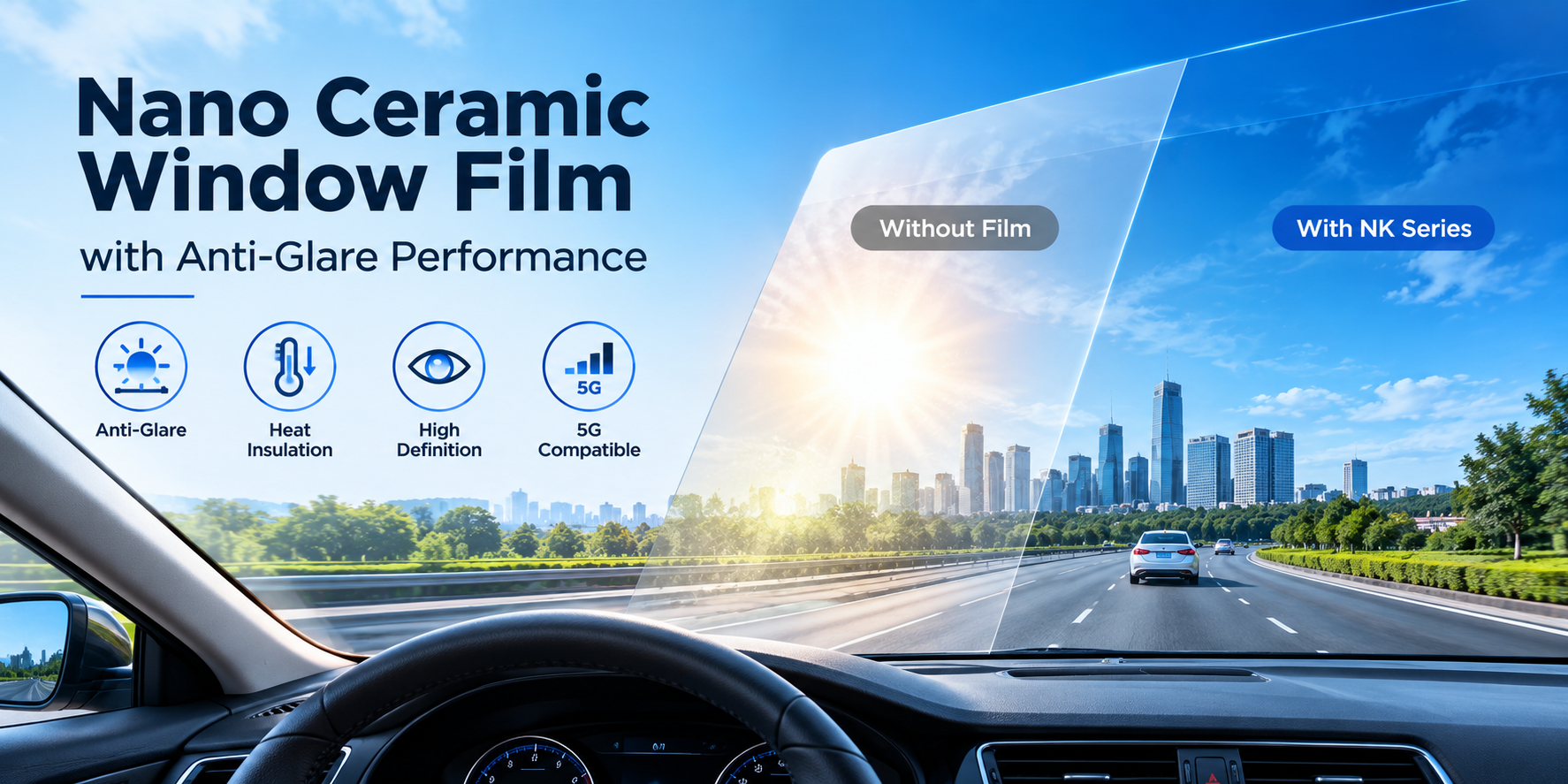
The NK Series is built around two complementary technology directions: nano ceramic materials and anti-glare performance.
Its material technology includes:
- Pure Nano Ceramic: A key material component of the film’s solar control structure.
- Tungsten Oxide: Used as part of the functional material system.
- Nano Titanium Nitride: Another component of the nano material formulation.
- Anti-Glare Technology: Designed to reduce distracting glare while maintaining a clear viewing experience.
This combination gives the NK Series a different positioning from conventional dyed films and standard ceramic products. Rather than focusing only on darker appearance or heat rejection, it brings glare management and optical clarity into the product design.
For a broader explanation of ceramic film materials, see what nano ceramic window film is and how nano ceramic window film blocks heat.
Seven VLT Options for Different Automotive Applications
The NK Series includes seven models, from NK99 to NK05. Their VLT values range from 70% to 5%, providing options for buyers who need different levels of visible light transmission.
Higher-VLT options allow more visible light through the glass, while lower-VLT options provide a darker appearance. The models also show different TSER values, giving buyers a way to compare overall solar energy rejection alongside visible light transmission.
| Parameter | NK99 | NK60 | NK40 | NK35 | NK20 | NK10 | NK05 |
|---|---|---|---|---|---|---|---|
| VLT | 70% | 60% | 40% | 35% | 20% | 10% | 5% |
| IRR 950nm | 92% | 90% | 91% | 93% | 94% | 94% | 93% |
| IRR 1400nm | 98% | 97% | 96% | 96% | 97% | 97% | 93% |
| UVR | 99% | 99% | 99% | 99% | 99% | 99% | 99% |
| TSER | 56% | 65% | 79% | 75% | 88% | 94% | 93% |
| Haze | 0.25 | 0.39 | 0.72 | 0.20 | 0.56 | 0.35 | 0.41 |
| Scratch Resistance | 3H | 3H | 3H | 3H | 3H | 3H | 3H |
| Thickness | 2mil | 2mil | 2mil | 2mil | 2mil | 2mil | 2mil |
| Color Decay Time | 8 years | 8 years | 8 years | 8 years | 8 years | 8 years | 8 years |
Performance values are based on KSB’s supplied model specifications.
The range provides several useful reference points for product selection:
- NK99: 70% VLT with 56% TSER, suitable for buyers prioritizing higher visible light transmission.
- NK60: 60% VLT and 65% TSER, offering a balance between light transmission and solar control.
- NK40 and NK35: Mid-range VLT options with 79% and 75% TSER respectively.
- NK20: 20% VLT with 88% TSER.
- NK10 and NK05: Darker options with 94% and 93% TSER respectively.
The figures also show why VLT alone should not determine product selection. For a more complete understanding of these measurements, refer to solar control window film performance metrics.
Understanding Anti-Glare Performance and Optical Clarity
Glare can make driving less comfortable, particularly when sunlight or reflected light enters the driver’s field of vision. Anti-glare technology is therefore an important consideration when selecting automotive window film.
The NK Series combines anti-glare positioning with high-definition performance. Its haze values vary by model, from 0.20 to 0.72 in the supplied specifications. Buyers should consider these model-level differences when comparing optical performance rather than assuming every VLT option has identical clarity characteristics.
For professional distributors, this distinction matters. A product range with several VLT choices should be evaluated not only by its darkest or highest-heat-rejection model, but also by the optical characteristics of each individual option.
Heat Rejection and 5G Signal Compatibility
The NK Series offers IR rejection measurements at both 950nm and 1400nm, alongside TSER values for overall solar energy rejection. These indicators describe different aspects of solar control and should be assessed together.
UVR is listed at 99% across all seven models. TSER ranges from 56% to 94%, depending on the model.
The series is also positioned as a 5G-compatible film that does not affect signal reception. This is a relevant consideration for modern vehicles, where drivers rely on mobile connectivity, navigation and wireless communication.
KSB also offers other ceramic and specialized film technologies for different market requirements. For example, pure nano ceramic window film provides a useful reference for understanding the broader ceramic film category, while the NK Series adds anti-glare technology as a defining product feature.
What Distributors Should Consider When Selecting NK Models
When evaluating the NK Series for wholesale or private-label supply, distributors should consider several points:
- VLT selection: Match the available VLT options to local market preferences and applicable automotive tint regulations.
- Solar control: Compare IRR at both specified wavelengths and TSER rather than relying on a single performance figure.
- Optical characteristics: Review haze and anti-glare requirements for the intended market.
- Signal compatibility: Confirm that the product positioning meets customer expectations for 5G-compatible automotive films.
- Product consistency: Check model specifications, production consistency and quality documentation before placing repeat orders.
KSB supports automotive window film supply for distributors and brand owners. The company operates a 50,000 m² factory with three production lines and an annual production capacity of 80 million m². Its quality management certifications include ISO 9001 and IATF 16949, with CE and RoHS product compliance.
FAQ
What makes the NK Series different from standard nano ceramic window film?
The NK Series combines nano ceramic materials with anti-glare technology. Its product positioning emphasizes glare control, high definition, solar control and 5G signal compatibility.
How many models are available in the NK Series?
There are seven models: NK99, NK60, NK40, NK35, NK20, NK10 and NK05. Their VLT values range from 70% to 5%.
Does the NK Series support 5G signals?
The series is specified as a 5G-compatible film designed not to affect signal reception.
Do all NK models have the same heat rejection performance?
No. The supplied TSER values range from 56% to 94%, while IRR also varies by wavelength and model. Buyers should compare the individual specifications before choosing a model.
Further Reading
On this site:
- Nano Ceramic vs Metalized Window Film: Pros and Cons — Understand the differences between ceramic and metalized film technologies.
- IR Rejection Explained: What Does It Really Mean? — Learn how infrared rejection figures relate to film performance.
- How to Test Nano Ceramic Window Film Performance — Review key considerations when evaluating ceramic film specifications.
Explore NK Series Supply Opportunities
The KSB NK Series brings anti-glare technology and nano ceramic materials into a seven-model automotive window film range. For distributors, importers and private-label brands, it offers multiple VLT choices and a defined set of solar control specifications.
Discuss NK Series product details and supply requirements with KSB.
Get a Free Sample or Quote
Looking for a reliable window film supplier? Contact us today for fast response and professional support.