A film can post a higher elongation figure on its data sheet and still take more effort to lay into a bumper recess. That’s because the PPF elongation rate on most comparison charts describes how far a test specimen stretches before it breaks. An installer works well before that point and cares about how much force it takes to shape the film, how it looks afterward, and whether the edges stay down.
For distributors, use elongation at break to compare like-for-like lab results. Then have your installers trial the finished film on the panels they regularly quote.
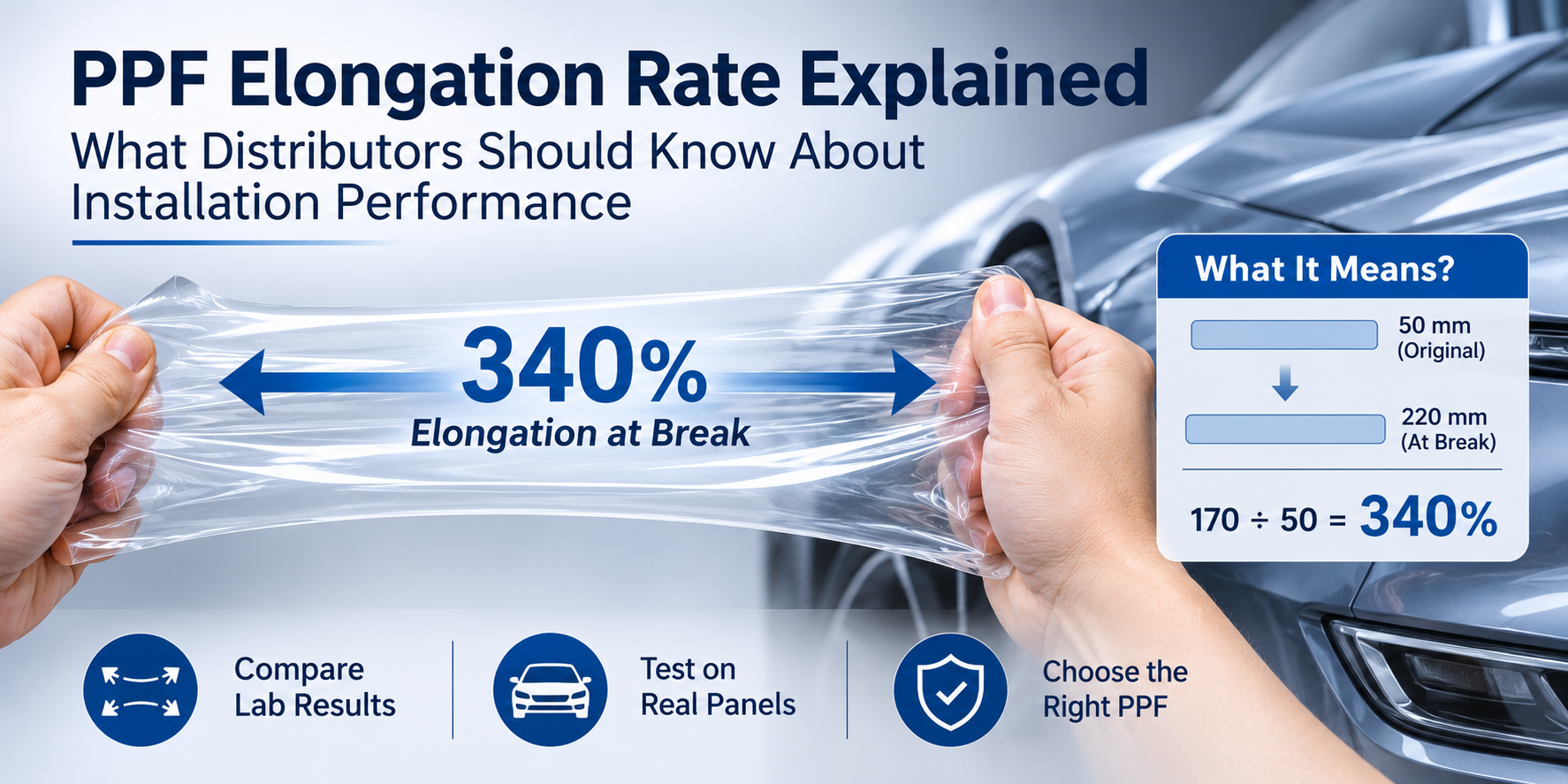
What does 340% elongation at break mean?
Elongation at break is the increase in length divided by the original gauge length, expressed as a percentage. If a specimen starts with a 50 mm gauge length and reaches 220 mm at break, it has extended by 170 mm. Dividing 170 by 50 gives 340% elongation at break. Its final gauge length is 4.4 times the original.
The figure describes the specimen at rupture. For installation, follow the film supplier’s handling guidance and judge the finished appearance on a representative panel. A film can show visible distortion, whitening or texture changes during shaping even while the material is still intact.
Check the test setup before ranking two films
KSB’s specifications list D75 at 302% and TOP75 at 340%. Both list 7.5 ± 0.3 mil thickness. The published difference is 38 percentage points. Before using that gap to pick a film, ask for the method and conditions behind each result. Compare KSB PPF model specifications.
| Ask for | What to compare |
| Specimen and thickness | TPU base film or finished PPF, and which layers were included |
| Test method and specimen setup | Method and revision, specimen dimensions, initial gauge length, and how extension was measured |
| Pull direction | Along the roll or across it. Compare the same direction. |
| Speed and conditioning | Pull speed, test temperature and humidity, and specimen conditioning |
| Reported result | Typical value or guaranteed minimum, plus sample count and spread if available |
ASTM D882 is a reference for tensile testing of thin plastic sheeting. Ask which procedure and revision were used for each model. If one supplier tests the TPU base and the other tests finished film, ask for results on equivalent specimens. For a question about how much force it takes to form the film, ask whether the supplier has a stress–strain curve or stress values at specified strains.
Trial the film on a panel your installers know
Use your current roll as the reference and trial the candidate on the same panel geometry. A mirror housing or a bumper recess will give the shop more to discuss than a flat swatch. Keep the installer, panel preparation, pattern and installation conditions as consistent as practical. Follow each film’s application guidance and record any differences in solution, temperature or technique.
| Check | What to record |
| While shaping | How much effort it takes to position the film, whether it pulls back, and how often the installer has to lift and reposition it |
| After laying the film | Visible stretch marks, whitening, gloss changes or texture differences under the same lighting |
| At a planned follow-up | Edge lift or rework around recesses and wrapped edges. Record the elapsed time and the area affected. |
If the candidate takes longer to fit or leaves visible marks on a panel you sell often, repeat the trial before placing a bulk order. An edge that lifts can also involve adhesive, prep or technique. Record where it happened and how the film was applied before attributing it to stretch. Save the roll label and photos with the notes so the next shipment can be checked against the approved sample. See KSB’s PPF sample-roll testing guide.
Request KSB data sheets and trial samples
Send us your destination market, current film or roll label, target thickness and finish, and the panels your installers find hardest to wrap. Include your estimated trial and bulk quantities so we can discuss suitable KSB models, available tensile data and sample rolls.
Request PPF Data Sheets and Trial Samples
Get a Free Sample or Quote
Looking for a reliable window film supplier? Contact us today for fast response and professional support.