Architectural Window Film Certifications: What Commercial Buyers Must Require from Suppliers
Published: September 10, 2026 · 8 min read · Category: Sourcing Guide
About this article: KSB Window Film maintains NFRC-referenced test data, EN 12600 safety certification, and SGS performance documentation for our architectural film range. Certification queries from commercial building buyers are one of the most frequent technical enquiries we handle — this guide systematises the answers.
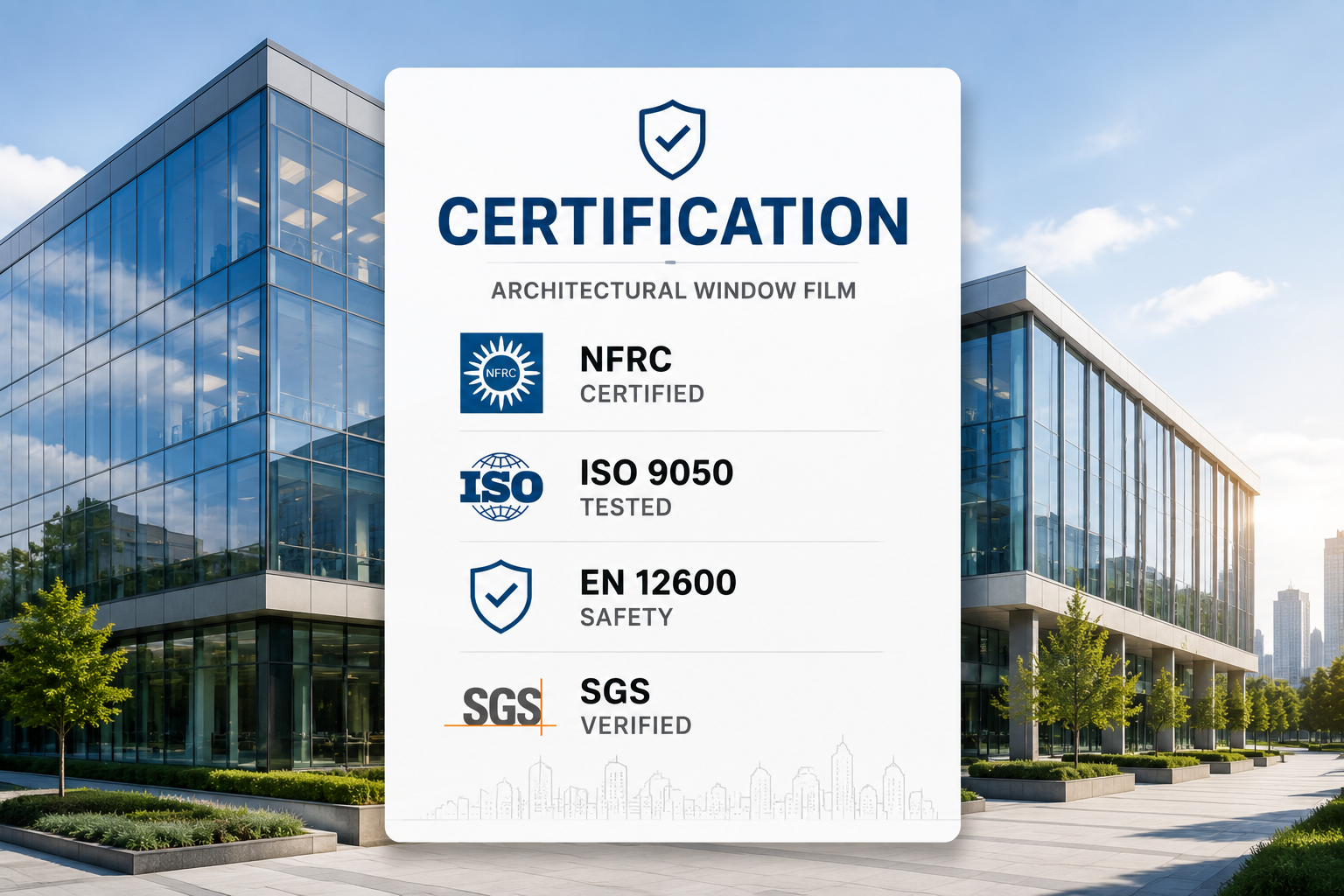
Architectural window film certification requirements.
In architectural specification, documentation is part of the product. A solar control film without verifiable performance data isn’t a specification — it’s a hope. A safety film without impact certification isn’t compliant — it’s a liability.
Commercial building owners, facilities managers, and glazing contractors who accept films without proper certification documentation are taking on risk: risk that the product doesn’t perform as claimed, risk of warranty disputes, risk of non-compliance if the installation is ever audited, and risk of liability if something goes wrong.
This guide covers every certification that matters for architectural window film, what each one proves, and how to verify it’s genuine.
NFRC (National Fenestration Rating Council) — US Market
What it certifies: The energy performance of the film-glass system — specifically SHGC (Solar Heat Gain Coefficient), VLT (Visible Light Transmittance), and U-factor. Values are independently simulated using validated optical property inputs.
Why it matters: NFRC certification is the standard required for:
Commercial building energy code compliance (ASHRAE 90.1)
LEED and green building certification documentation
US GSA (Government Services Administration) building specifications
Most institutional and government procurement specifications in the US
What to check: The product should appear in the NFRC Certified Products Directory at nfrc.org. Search by manufacturer name. The entry should show SHGC, VLT, and U-factor for the specific product on specified glass types. If the product doesn’t appear in the directory, the claimed NFRC certification is unverified.
Who provides it: Products are submitted by manufacturers for simulation by NFRC-accredited laboratories. Not all manufacturers pursue NFRC — it requires investment in optical property measurement and simulation. Manufacturers who’ve done this work have made a deliberate commitment to the US commercial specification market.
ISO 9050 — International / European Market
What it certifies: Light and solar characteristics of glass in buildings — specifically total solar energy transmittance (g-value / SHGC equivalent), visible light transmittance (VLT), and UV transmittance. The international equivalent of NFRC for non-US markets.
Why it matters: ISO 9050 data is referenced in European building energy calculations, BREEAM certification documentation, and international commercial project specifications. It provides the SHGC-equivalent data needed for energy model inputs outside the US.
What to check: Test reports to ISO 9050 should specify the test methodology, the glass type the film was tested on, the specific product name, and the testing laboratory. Reports should be dated within the last 24 months.
EN 410 — European Standard
What it certifies: Similar to ISO 9050, EN 410 is the European standard for measurement of luminous and solar characteristics of glazing. Often tested alongside ISO 9050.
Practical note: For EU-market specifications, requesting test data to EN 410 and/or ISO 9050 is the equivalent of requesting NFRC data for US projects.
SGS / Intertek / Bureau Veritas Test Reports — Global
What they certify: Third-party laboratory measurement of film performance — typically VLT, TSER, UV rejection, IR rejection, and sometimes VLR. These are product performance tests, not system-level certifications like NFRC.
Why they matter: SGS and Intertek test reports are the most widely accepted performance documentation globally, including markets where NFRC is not the standard. They provide independent verification that the product performs as the manufacturer claims.
What to check:
The report is product-specific (names the specific SKU, not just the product range)
The report is current (dated within 12–18 months)
The test standard is specified (ISO 9050, EN 410, ASTM, or similar — not an undefined internal methodology)
The laboratory is accredited (SGS, Intertek, Bureau Veritas, or an ILAC-accredited equivalent)
IR rejection methodology is specified — full-spectrum (780–2,500nm) or single-wavelength — see IR Rejection Explained
Tier 2: Safety and Security Certifications
EN 12600 — European Safety Glazing Standard
What it certifies: Impact performance of safety glass and film assemblies. Tests a simulated human impactor (pendulum) at defined energy levels against the film-glass system. Products are classified in three performance classes (1, 2, 3) based on the energy level they withstand and failure mode.
Why it matters: EN 12600 certification is required for safety film specified to comply with EU building codes at locations where safety glazing is mandated. Uncertified film claiming safety compliance is not code-compliant in the EU.
What to check: The certificate should specify the film product name, the glass type tested, and the class achieved (Class B1 is the most common commercial specification). Verify the certifying body is accredited under the EN 12600 framework.
ANSI Z97.1 — US Safety Glazing Standard
What it certifies: US equivalent of EN 12600 for safety glazing products. Required for building code compliance in US safety glazing locations.
GSA and DoS Blast Resistance Standards — US Government Buildings
What they certify: Blast mitigation performance against specific test standards developed by the US General Services Administration and Department of State. Required for safety film on US government buildings.
Who needs this: Primarily US government building owners, contractors, and security integrators specifying blast film. Most commercial buyers don’t need GSA-specific certification — EN 12600 or ANSI Z97.1 covers standard safety requirements.
Tier 3: Quality System Certifications
ISO 9001 — Quality Management System
What it certifies: The manufacturer has a documented quality management system covering process control, internal auditing, and corrective action processes.
What to check: The certificate should have a certificate number, a named certification body (CB), an expiry date, and a scope statement covering manufacturing (not just trading). Verify the CB is IAF-accredited at iaf.nu.
Limitation: ISO 9001 certifies the management system, not the product. A factory with ISO 9001 can still produce poor-quality film. It’s a necessary but not sufficient credential.
ISO 14001 — Environmental Management System
What it certifies: Environmental management practices in the manufacturing operation.
When it matters: LEED and BREEAM projects increasingly request supplier environmental management documentation. ISO 14001 provides this at the organisation level.
Tier 4: Market-Specific Requirements
CE Marking — European Market
What it covers: CE marking is required for construction products sold in the EU under the Construction Products Regulation (CPR). Safety film used in structural glazing applications may require CE marking. Solar control film used as a retrofit building product typically does not require CE marking, but the applicable product standards should be confirmed with a local regulatory advisor.
ESMA Certification — UAE / GCC Markets
The Emirates Authority for Standardization and Metrology has specific requirements for certain construction products sold in the UAE. Commercial building buyers in the GCC should confirm current ESMA requirements for architectural window film with a local compliance consultant.
The Certification Verification Checklist
When evaluating any architectural film supplier, request and verify:
For solar control products:
[ ] NFRC-certified data (US commercial specification) — verify in NFRC directory
[ ] ISO 9050 or EN 410 test report (international/EU) — verify lab accreditation
[ ] SGS or Intertek test report — verify product-specific, current, standard-referenced
[ ] IGU compatibility documentation
For safety products:
[ ] EN 12600 certificate with class rating (EU) — verify accredited certifying body
[ ] ANSI Z97.1 (US)
[ ] Installation documentation requirements (frame attachment for security film)
For all products:
[ ] ISO 9001 certificate — verify CB accreditation and scope
[ ] Product datasheets with all key performance parameters listed
Red flags:
NFRC claimed but not found in directory
Test reports with no standard referenced or no product name
ISO 9001 with scope limited to trading/sales only
IR rejection claims without methodology disclosure
Certifications that cannot be independently verified
FAQ
What’s the minimum certification I should require for a basic commercial building solar control project?
At minimum: current SGS or Intertek test reports for the specific product on the glass type installed, with VLT, TSER, and UV rejection data. ISO 9001 for the manufacturer. For US projects: NFRC-referenced data. For EU projects: ISO 9050 or EN 410. Anything less is insufficient for a commercial building specification.
Can I accept certifications that the installer provides rather than getting them direct from the manufacturer?
For simple projects, yes. For projects where certification is going into a building compliance record, contract documentation, or green building certification, obtain the certification documentation directly from the manufacturer or supply chain — not just a copy from the installer who may not have the most current versions.
What happens if I install film without the right certifications and there’s a later issue?
If safety film without EN 12600 certification is installed in a code-required location and a glass injury subsequently occurs, the building owner’s liability position is significantly worse than if certified film had been specified. For solar control film, uncertified performance claims create disputes about whether the product delivered what was specified. The certification cost is negligible compared to these risks.
KSB Window Film provides NFRC-referenced test data, EN 12600 safety certification documentation, SGS test reports, ISO 9001 certification, and IGU compatibility documentation for our architectural film range — the complete documentation package for commercial building specification.