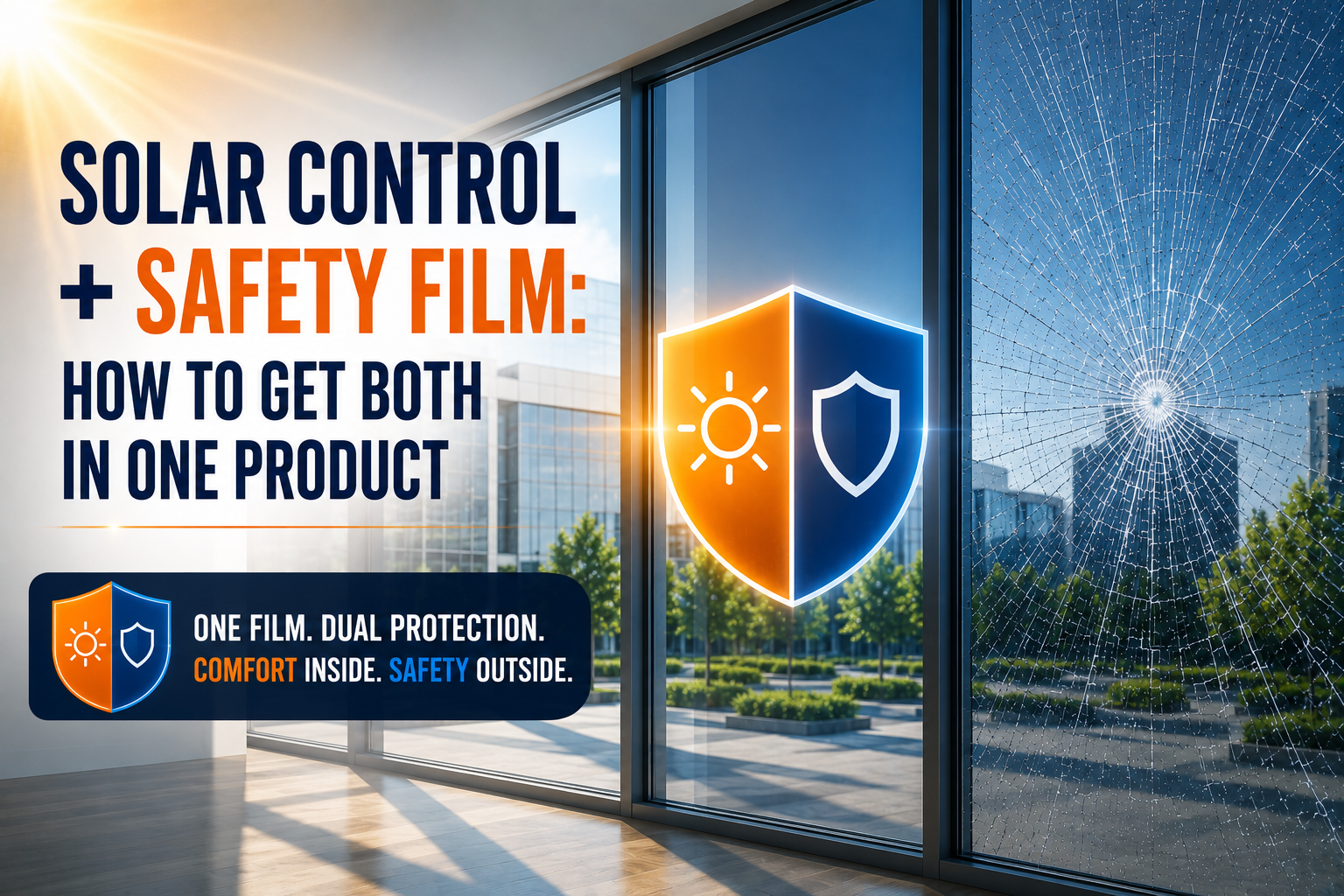
Solar Control Film + Safety Film: How to Get Both in One Product
Published: September 9, 2026 · 7 min read · Category: Safety & Security Film
About this article: KSB Window Film manufactures dual-function solar control and safety film. Multi-function film is one of our most common commercial project enquiries — this guide clarifies what’s available, what the tradeoffs are, and when a single product makes sense vs. two separate films.
Dual-function window film combines solar heat rejection with safety glass protection in one installation.
A building owner who needs both solar control and glass safety compliance faces a specification decision: use two separate films (each optimised for its function), or use a single dual-function product. The right answer depends on the performance priorities, budget, and installation context.
What Dual-Function Film Actually Is
Most “safety + solar control” products are safety film base constructions (typically 4–8 mil) with a tinted or solar-control coating applied during manufacture. The film provides fragment retention (the safety function) while the tint or coating provides solar heat rejection and UV blocking.
The integration happens at the manufacturing level — not by laminating two separate films on installation. Multi-layer film with both functions engineered in is a single product, applied in a single installation.
What this means practically:
One installation, not two
One adhesive layer on the glass (not two)
One product to specify, certify, and warranty
Usually lower total cost than two separate films installed sequentially
Performance Tradeoffs
Safety Performance
A dual-function product with an 8 mil base achieves the same EN 12600 performance as a clear 8 mil safety film. The solar control coating doesn’t affect the safety film’s structural integrity.
However, the range of safety performance available in dual-function products is narrower than clear safety film. Most dual-function products are in the 4–8 mil range — adequate for general safety compliance and moderate security, but not for heavy blast or high-class LPS 1270 applications where 12–15 mil clear film is specified.
Solar Control Performance
Dual-function safety films have solar control performance (TSER, SHGC) comparable to dedicated solar control film at similar VLT levels. The safety film base adds thickness but doesn’t materially affect the optical or solar properties of the coating.
Some dual-function products are specifically engineered for solar performance — spectrally selective coatings on safety film bases that achieve high TSER at moderate VLT. Others are simply tinted safety films that provide modest solar gain reduction.
Key check: Request TSER and SHGC data for the specific dual-function product. Solar performance varies widely within this category.
UV Protection
All quality safety film products (clear or tinted) block 99%+ UV regardless of the solar control function. UV protection is a baseline feature, not a differentiator.
When Dual-Function Makes Sense
The glazing needs both functions at similar performance levels. If the building needs fragment retention AND meaningful solar control on the same glazing, a dual-function product provides both in one installation at lower total cost than two products installed separately.
Budget is a constraint. A single dual-function product typically costs less than two separate products. The savings can be 15–30% on material cost and significant on labor (one installation rather than two).
The solar control requirement is moderate. Dual-function products are well-suited to buildings where solar control is important but not the primary design driver — a school where the classroom windows need both safety compliance and some heat reduction, for example.
Installation access is difficult or expensive. On buildings where installation access is costly (scaffolding, rope access), minimising installation visits reduces project cost. One film installation instead of two is significant when each installation costs $5,000+ in access equipment.
When Separate Films Are Better
Maximum solar performance is required. Premium spectrally selective nano ceramic solar control film achieves TSER 65–75% at high VLT. This performance level is not yet available in dual-function safety film products. If the building’s primary driver is energy performance (LEED credits, high cooling load reduction), dedicated nano ceramic solar control film outperforms any current dual-function product.
Maximum security performance is required. 12–15 mil blast and high-security film doesn’t typically come with solar control coatings. Security film at the highest threat levels is specified as clear film — the security performance requirements dominate the specification.
The two functions apply to different glazing areas. Solar control film may be required on south and west-facing glazing for energy reasons. Safety film may be required on all ground-floor glazing for security reasons. These may be different products on different glass, specified independently.
One function is significantly more important than the other. If 80% of the value is in solar control and 20% is in safety compliance, a purpose-built solar control product with a light safety compliance function may provide better overall performance.
Product Specification for Dual-Function Film
For general commercial buildings (safety compliance + moderate solar control): 6–8 mil dual-function film, VLT 35–50%, TSER 45–55%. Provides EN 12600 B1 safety compliance and meaningful solar control.
For schools and healthcare (safety compliance + comfort): 6 mil dual-function film, VLT 40–55%, TSER 40–50%. Lighter specification optimising natural light while providing compliance and comfort improvement.
For commercial buildings with strong solar control requirement: Consider whether a dedicated nano ceramic solar film (for maximum solar performance) combined with a separate clear safety film is better economics than a dual-function product — despite the two-installation cost.
FAQ
Can I apply solar control film over safety film already installed?
Film-on-film applications are not recommended — adhesion between the two films is unreliable and the combined adhesive thickness creates optical and installation problems. Remove existing film before applying a new product, or specify a dual-function product from the outset.
Is dual-function film more expensive than clear safety film?
Yes — the solar control coating adds manufacturing cost. Typically 15–30% more than equivalent clear safety film. The premium is usually justified by the avoided cost of a separate solar control film installation.
Can dual-function film contribute to LEED credits?
Yes, for the solar control component — the same SHGC and TSER data that qualifies dedicated solar control film for LEED energy credits applies to dual-function film. Request NFRC-referenced performance data from the manufacturer.
KSB Window Film manufactures dual-function solar control and safety film in the 6–8 mil range, with EN 12600 certification and NFRC-referenced solar performance data. Single-product specification for commercial projects requiring both functions.