Published: July 13 , 2026 · 8 min read · Category: Window Film Guide
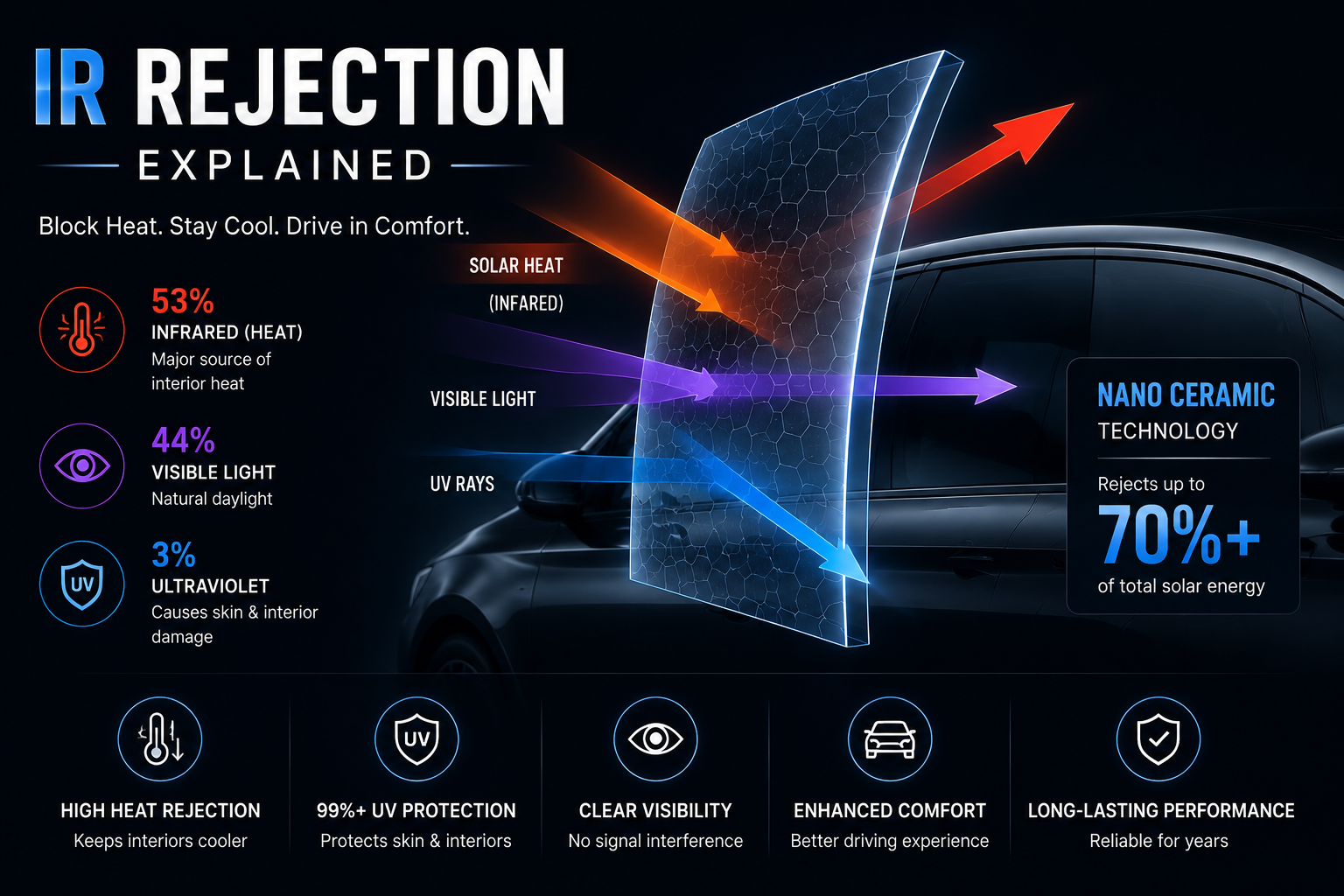
IR rejection is the number that window film manufacturers lead with in their nano ceramic marketing. “Up to 96% IR rejection.” “99% infrared blocked.” The numbers are impressive. They’re also, in many cases, technically accurate and practically misleading at the same time — because the way IR rejection is measured varies significantly, and the methodology determines the number almost as much as the product does.
This is the article for anyone who wants to actually understand what IR rejection means, how it’s measured, which measurements matter, and how to use the spec to make a real decision rather than being impressed by a headline number.
What Infrared Radiation Is
Infrared radiation (IR) is electromagnetic radiation with wavelengths longer than visible light — roughly 780nm to 1,000,000nm (1mm), though in the solar context we primarily care about 780–2,500nm, called near-infrared and shortwave infrared.
Solar IR accounts for roughly 53% of total solar energy arriving at a surface. It’s the heat portion of sunlight — the sensation of warmth you feel from the sun on your skin on a clear day is primarily near-infrared radiation being absorbed by your skin tissue.
Unlike visible light, IR doesn’t stimulate the eye’s photoreceptors. You can’t see it. But it heats whatever it hits — including car dashboards, seat fabric, interior trim, and building interiors.
Window film’s IR rejection performance determines how much of this 53% of solar energy it prevents from entering the space behind the glass.
The Measurement Problem
Here’s where things get complicated — and where buyers get misled, sometimes unintentionally.
IR rejection can be measured:
- At a single specific wavelength
- Across a defined portion of the IR spectrum
- Across the full solar IR spectrum (780–2,500nm)
These produce significantly different numbers from the same film.
Why single-wavelength measurements are misleading:
Ceramic materials have absorption peaks — wavelength ranges where they’re particularly effective at blocking IR. Titanium nitride, for example, has strong absorption in the 900–1,100nm range. A manufacturer testing at 950nm will get their best number. That number is accurate — for that specific wavelength. But the sun doesn’t only emit IR at 950nm. It emits IR across the entire 780–2,500nm range, with a distribution that peaks in the 800–1,200nm range and continues with meaningful energy levels up to 2,500nm.
A film that blocks 96% of IR at 950nm but only 35% at 1,500nm and 20% at 2,000nm is much less impressive across the full solar IR spectrum than the headline number suggests.
Full-spectrum vs. selective measurement comparison:
For a typical mid-tier nano ceramic film:
- IR rejection at 950nm: 92–96%
- IR rejection across 780–2,500nm (full solar IR): 55–65%
These numbers aren’t contradictory. They’re measuring different things. The full-spectrum number is what matters for how the film performs in actual sunlight.
The Measurement Standards That Matter
Several recognized standards exist for measuring solar film performance. The ones worth knowing:
NFRC (National Fenestration Rating Council): US-based standard that measures film performance across the full solar spectrum. NFRC-rated products provide Solar Heat Gain Coefficient (SHGC) and Visible Transmittance (VT) values that account for all solar energy bands. This is the gold standard for building applications in the US market.
ISO 9050: International standard for determining light transmittance, total solar energy transmittance, ultraviolet transmittance, and related glazing factors. Used in European and many international markets.
ANSI/IWFA S-001: The IWFA (International Window Film Association) standard specifically for automotive window film. Includes testing protocols for VLT, UV, and solar energy rejection.
EN 410: European standard for determination of luminous and solar characteristics of glazing in buildings.
Manufacturer’s own methodology: Some manufacturers define their own test conditions and wavelengths. These are the least reliable for comparison because they’re often chosen to produce favorable numbers.
When a supplier provides IR rejection data, ask which standard was used. Full-spectrum testing to NFRC, ISO 9050, or ANSI/IWFA is meaningful. Testing to “our proprietary methodology at 950nm” is a marketing number.
TSER vs. IR Rejection: Which Metric Tells You More
IR rejection is often discussed as if it’s the complete picture of a film’s heat-blocking performance. It’s not — TSER (Total Solar Energy Rejected) is a more complete metric.
IR rejection measures only what happens to the infrared portion of solar radiation. Since IR is about 53% of total solar energy, even 100% IR rejection (theoretical) would only prevent about 53% of total solar energy from entering.
TSER accounts for the full solar spectrum — UV, visible, and infrared together. A film with 70% TSER is rejecting 70% of total incoming solar energy, including all three bands. This is the number that predicts how much cooler the interior will be.
For comparing two films side by side: if both have similar VLT, the one with higher TSER will perform better in real-world heat rejection conditions, regardless of which one has the more impressive single-wavelength IR rejection number.
How to Read a Window Film Test Report
When a supplier provides a test report — ideally from SGS, Intertek, Bureau Veritas, or a similar accredited lab — here’s what to look for:
Check the test standard. Is it NFRC, ISO 9050, ANSI/IWFA, EN 410? Or something undefined? Recognized standard = meaningful data.
Find the TSER or total solar energy transmittance value. TSER = 100% minus the total solar transmittance. A film with 35% solar energy transmittance has 65% TSER.
Find the full-spectrum IR data. The report should show performance across the full 780–2,500nm range, not just at one wavelength. Some reports show IR rejection at 900nm and at the full spectrum — the difference between these numbers tells you a lot about the film’s actual performance breadth.
Check the VLT. All other performance numbers need to be read in context of the VLT. A 20% VLT film with 65% TSER is a different product from a 50% VLT film with 65% TSER — both are real and valid, but serve different applications.
Check the test date. Reports older than 18–24 months may not reflect current production. Ask for current data.
Check that the product name matches. The report should be for the specific SKU you’re evaluating, not a different product in the range.
How Buyers Get Misled (and How Not To Be)
The 950nm claim: A manufacturer advertises “96% IR rejection.” The fine print (or the test report you requested) shows this is measured at a single wavelength. Full-spectrum IR rejection: 58%. This product’s headline claim is accurate and not representative.
The comparison without methodology: Product A claims “85% IR rejection” tested at full spectrum to NFRC. Product B claims “95% IR rejection” with no methodology stated. Product A is almost certainly better on full-spectrum performance despite the lower headline number.
The certificate without the report: A supplier sends a certificate or sticker showing “SGS Approved” without an actual test report with specific numbers. The certificate doesn’t tell you anything. Request the actual test report document.
The range certificate: A test report covering “the XYZ series” rather than a specific product SKU. Performance can vary significantly within a product range. Request product-specific data.
FAQ
Is 95% IR rejection possible?
At a specific wavelength, yes — for quality ceramic films with strong absorption peaks. Across the full solar IR spectrum, 95% is essentially impossible with current technology at any VLT that allows visibility. Full-spectrum IR rejection above 80% in visible-light-transmitting film is high performance; above 90% is not credibly claimed by legitimate manufacturers.
Does higher IR rejection always mean a better film?
Not if the numbers aren’t comparable. A full-spectrum 70% IR rejection figure beats a single-wavelength 95% claim on real-world performance. Always ask for the measurement methodology and TSER data alongside IR rejection claims.
What’s a good TSER for nano ceramic film?
For a mid-range VLT (around 35%) automotive film: above 60% TSER is good, above 65% is excellent. For architectural film at higher VLTs (50–70%), above 55% TSER is competitive. These are reference points, not absolute thresholds.
Can I test IR rejection myself without lab equipment?
Not with precision, but there are practical tests. An IR thermometer pointed at the interior surface of glass in direct sun, before and after film installation, will show the surface temperature difference. An IR heat lamp pointed at a glass sample with and without film applied will show relative blocking. These won’t give you a percentage, but will confirm whether the film is performing meaningfully differently from unfilmed glass.
Should I trust the IR rejection numbers on the product packaging?
Only if they’re backed by a referenced test report to a named standard. Numbers on packaging without a verifiable source are marketing claims, not technical specifications.
Further Reading
On this site:
- What Is Nano Ceramic Window Film? — Full product overview
- What Certifications Should a Window Film Manufacturer Have? — How to evaluate the test reports that back IR claims
- How to Compare Window Film Quotes from Different Suppliers — Using IR data in supplier comparison
- Window Film Testing Standards Explained: ASTM, TSER, SHGC, VLT, and Certifications — Key testing standards and performance ratings explained
External:
- NFRC Measurement Methodology — The US standard for solar film performance measurement
- IWFA ANSI/IWFA S-001 Standard — Automotive window film test methodology
- Lawrence Berkeley National Laboratory Window Research — Independent research on solar performance of glazing and film
- ISO 9050 Glass Standards — International standard for solar and light transmission through glass
Get a Free Sample or Quote
Looking for a reliable window film supplier? Contact us today for fast response and professional support.