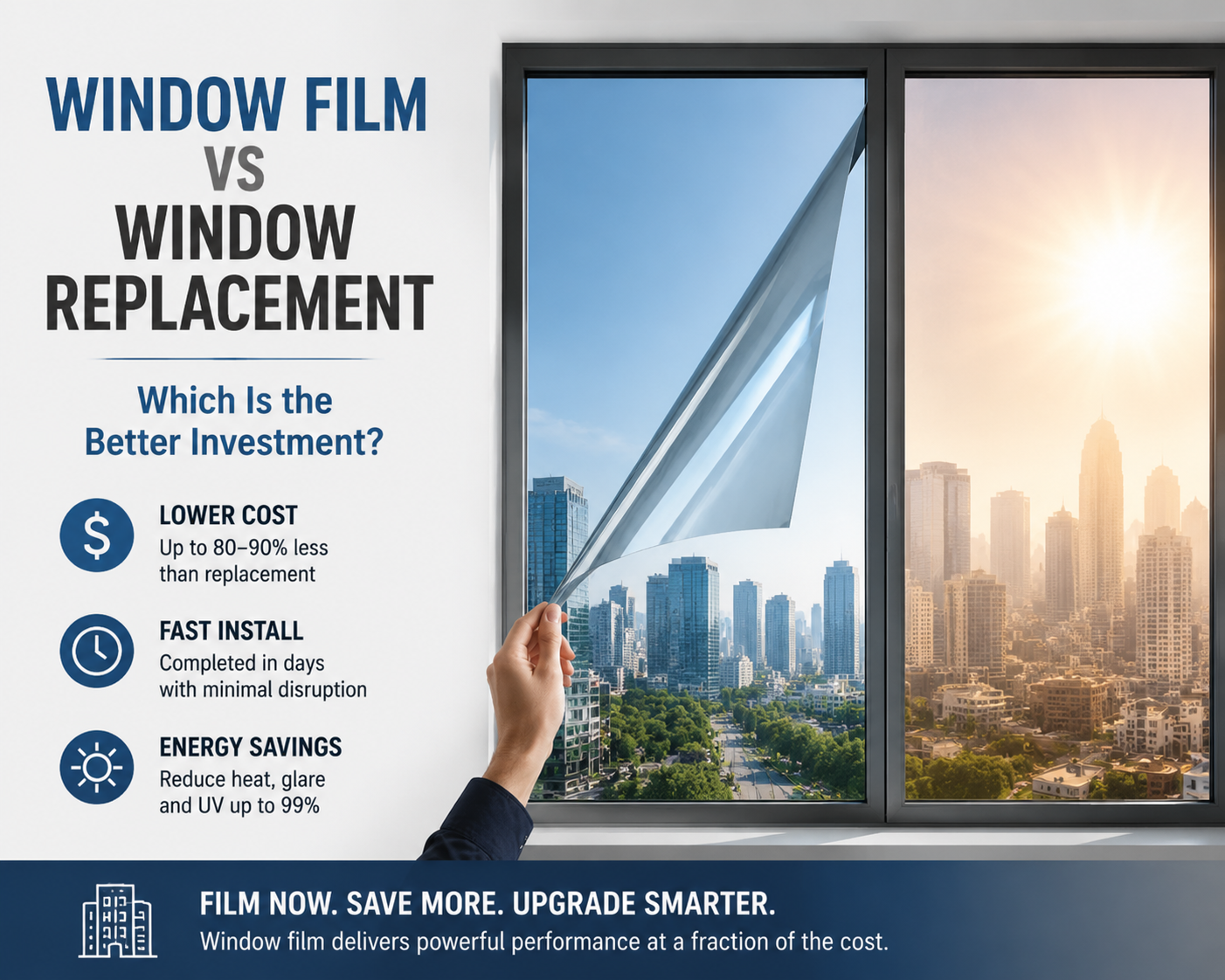
Window Film vs Window Replacement: Which Is the Better Investment?
Published: August 19, 2026 · 9 min read · Category: Architectural Window Film
About this article: KSB Window Film has supplied solar control and safety window film to commercial building projects globally since 2010. The cost and performance comparisons in this article are based on real project data, industry benchmarks, and our direct experience with building owners evaluating both options.
Window film being applied to glass for solar heat reduction and privacy improvement
The window replacement pitch sounds compelling on paper: new glazing, better performance, guaranteed results, clean slate. The window film pitch also sounds compelling: fraction of the cost, installed in days, no disruption to tenants.
Both pitches can be right or wrong depending on the specific situation. The decision isn’t about which solution is generally better — it’s about which one makes sense for your building’s glass condition, performance objectives, budget, and timeline.
This article gives you the honest framework for making that call.
Start With the Condition of the Existing Glass
Window film cannot fix glass that is structurally compromised. Before the cost comparison matters at all, assess the existing glazing honestly:
Replace the glass if:
There are visible cracks, chips, or structural damage
Seals on double-glazed units have failed (visible fogging or condensation between panes)
The glass is single-pane in a climate where thermal insulation is critical (film doesn’t meaningfully improve U-value)
The glass is non-compliant with current safety code in a way that requires replacement (some jurisdictions require laminated or tempered glass in specific locations regardless of film)
Film is appropriate if:
The glass is physically sound
The frame and seal condition are good
The primary issues are solar heat gain, glare, UV protection, or safety code fragment retention
The building is occupied and cannot support major glazing works
The Cost Reality
This is where the conversation usually starts, and the numbers are stark.
Window film installation cost: $15–$60 per square meter for the film and installation, depending on product tier and project complexity. A 500sqm commercial facade treatment might run $15,000–$30,000 all-in.
Window replacement cost: $250–$600+ per square meter for commercial glazing replacement, including new glass units, frames if needed, installation labor, and associated works (scaffolding, sealants, disposal). The same 500sqm facade: $125,000–$300,000+.
The ratio is roughly 10:1. In most situations, window film delivers 80–90% of the energy and solar performance benefit of a glass upgrade at 10% of the cost.
The remaining 10–20% of performance you “give up” with film over a premium glass replacement is real — new high-performance glass can improve thermal insulation (U-value), acoustic performance, and structural specification in ways film cannot. But for buildings where the primary driver is solar control rather than thermal insulation, that performance gap rarely justifies the cost premium.
Performance Comparison
Solar Control (Heat and UV)
Window film: Quality solar control film reduces SHGC by 30–60% on clear glass. A single-pane clear glass with SHGC of 0.87 becomes effectively 0.35–0.60 with quality solar film. Nano ceramic film achieves the highest performance: TSER of 60–75% on clear glass is realistic.
Window replacement with high-performance glass: New double-glazed units with spectrally selective Low-E coatings achieve SHGC of 0.20–0.35. This is better than film on single-pane glass, and comparable to or better than film on existing double-glazed units.
Verdict: New high-performance glass wins on SHGC — but solar control film on existing single-pane glass brings performance close enough that the 10:1 cost ratio dominates the decision for most buildings.
Thermal Insulation (U-value)
Window film: Negligible improvement in U-value. Film adds a thin layer with minimal insulating value. If cold-climate heat loss through glazing is the primary driver, film is not the solution.
Window replacement: New double or triple-glazed units with warm-edge spacers dramatically improve U-value. Single-pane to double-pane replacement reduces heat loss through glass by 40–50%.
Verdict: If thermal insulation for winter energy performance is the objective, film is not an appropriate solution. This is one clear case where replacement is justified.
Safety and Security
Window film: Safety film applied to existing annealed glass creates effective fragment retention and, at higher thicknesses, meaningful forced entry delay. This is a code-compliance and security upgrade at low cost.
Window replacement with safety glass: Laminated glass provides better long-term structural integrity and doesn’t rely on adhesive bond quality. For highest-security applications, replacement with laminated glass is superior.
Verdict: For basic safety code compliance and moderate security, film is sufficient and cost-effective. For maximum security (banks, government buildings), laminated glass replacement provides better performance.
Acoustic Performance
Window film: Minimal acoustic benefit. Some thicker safety films provide modest sound reduction (2–3 dB), but this is marginal for most noise management purposes.
Window replacement with acoustic glass: Laminated acoustic glass with PVB interlayer can reduce sound transmission by 35–45 dB. For buildings with serious noise problems (near airports, motorways), replacement is the effective solution.
Verdict: If noise is the primary driver, film is not the answer.
Disruption and Timing
Window film installation: Commercial installations are typically completed panel by panel. A large facade can be done in sections over days or weeks with minimal disruption to building occupants. No scaffolding required in most cases. Tenants can remain in occupation throughout.
Window replacement: Involves removing existing glass, installing new units, frame and seal work, scaffolding on multi-storey buildings. Significant disruption to occupied floors during works. Extended lead times for custom glass units (4–12 weeks). Temporary weather protection required.
For occupied commercial buildings, the operational disruption of window replacement is a real cost — both direct (management time, temporary relocations, scaffolding hire) and indirect (tenant satisfaction, potential lease obligations).
The Phased Approach: Film Now, Replace Later
A common and sensible approach for building owners planning longer-term upgrades:
Install window film now — addressing the immediate solar control or safety problem, improving occupant comfort and energy performance at low cost.
Plan glass replacement in phases over a longer capital programme as glass units reach end of life.
Remove film when glass is replaced — quality film can be removed cleanly from glass that’s being replaced.
This approach avoids the false choice of “film or replacement” and uses film as a bridge to a longer-term glass upgrade strategy. The film investment (typically 3–7 year payback from energy savings) produces positive ROI even if glass is replaced after 10 years.
Decision Framework Summary
Driver
Film
Replacement
Primary issue is solar heat gain
✓ Strong case
Overkill on cost
Primary issue is UV / fade protection
✓ Strong case
Overkill on cost
Primary issue is safety code compliance
✓ In most cases
Required if code mandates specific glass type
Primary issue is thermal insulation / U-value
✗ Not effective
✓ Required
Primary issue is noise
✗ Not effective
✓ Required
Budget is constrained
✓ Strong case
Difficult to justify
Building occupied, can’t vacate
✓ Strong case
Significant disruption
Glass physically damaged or failed IGU seals
✗ Not appropriate
✓ Required
Long-term building ownership
Both valid
Replacement if planned upgrade
Leased space (tenant)
✓ Lower commitment
May require landlord consent
FAQ
If I install window film now, can I still replace the windows later?
Yes. Window film can be removed from glass being replaced. Quality film removal is a standard installer service — the adhesive releases cleanly from most glass types when properly done, leaving no residue that would interfere with glazing unit disposal.
Does window film affect the warranty on my double-glazed units?
Potentially yes. Applying film to IGU (insulated glass unit) glass can affect the warranty if the film isn’t approved for that application by the glass manufacturer, or if the film isn’t specifically rated for IGU use. Thermal stress caused by increased solar absorption in the glass can crack IGU units. Specify film that is IGU-compatible and verify with your glass manufacturer. See Window Film for Double-Glazed and Low-E Glass for detail.
Will my building insurer have any concerns about window film?
Safety film and security film on ground-floor glazing typically have no insurance implications or may positively affect certain commercial property assessments. Highly reflective film that changes the building’s exterior appearance may require landlord or planning notification. Check with your broker and building manager.
Is there a hybrid product — film-enhanced replacement glass?
Yes. Some glazing systems now incorporate factory-applied film or film-like coatings within IGU construction. These provide the performance of film with the structural integrity of a factory-built glass unit. They’re more expensive than film-on-existing-glass but less than full premium glass. Worth considering in new construction or full glazing replacement projects.
ASHRAE 90.1 — Commercial building energy code reference for glazing SHGC
Get an Independent Performance Assessment
KSB Window Film can provide specification-grade performance data for both film and alternative solutions — including modelled energy savings for your building type and climate. We help building owners make the right decision, even when that means pointing them toward a glass replacement in specific cases.