Published: June 25, 2026 · 8 min read · Category: PPF Guide
About this article: KSB Window Film manufactures TPU PPF and distributes to installer networks globally. The pricing data in this article reflects our direct manufacturing costs, distribution channel observations, and real-world installed cost data from our distribution partners.
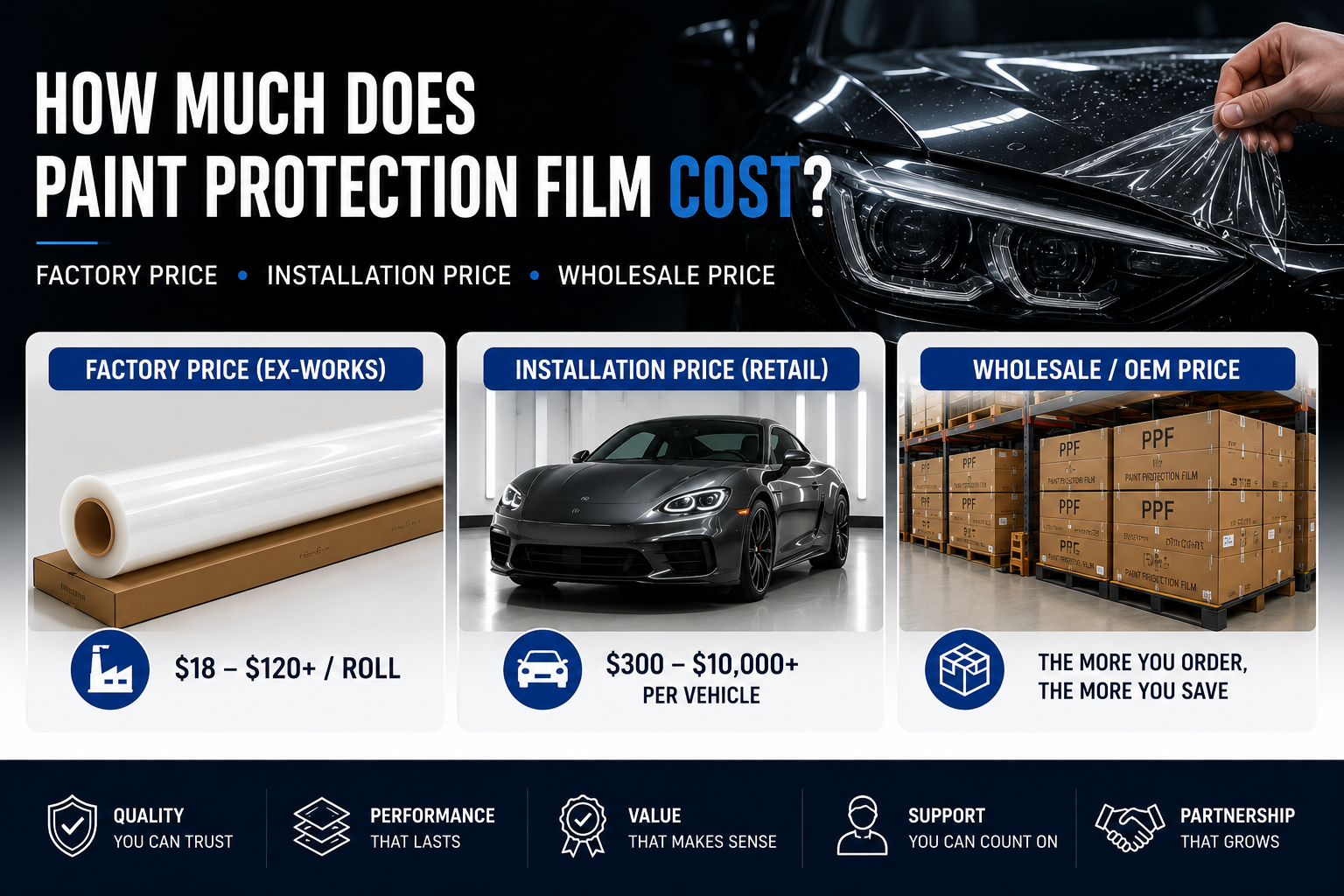
Infographic showing the difference between factory PPF pricing, installation pricing, and wholesale OEM pricing for automotive paint protection film.
PPF pricing has three layers that most buyers conflate: the raw film cost, the installed cost for a vehicle, and the cost of sourcing film wholesale for distribution or OEM programs. Each layer involves different economics, and understanding which layer you’re asking about determines what answer is useful.
This guide covers all three.
Layer 1: Film Manufacturing Cost (Wholesale / Sourcing)
This is what distributors, brand builders, and direct importers pay for the film itself, before installation labor.
Film cost per roll (ex-works China, as of 2026):
Product Tier
Film Type
Cost/Roll (1.52m × 15m)
Budget
PVC or low-grade TPU
$18–$35
Mid-range
TPU, standard top coat
$40–$65
Premium
TPU, self-healing top coat
$65–$100
Ultra-premium
TPU, premium top coat, low haze
$100–$160+
Landed cost adjustments: Add ocean freight, import duties (relevant for US buyers — Section 301 tariffs), insurance, and domestic logistics. Total landed cost is typically 25–45% above ex-works pricing depending on market and order volume.
For buyers importing directly: a mid-range TPU PPF roll at $55 ex-works China might cost $70–$80 landed in the US, or £55–£65 in the UK, after all import costs.
Layer 2: Installed Cost per Vehicle
This is what end customers (vehicle owners) pay a professional installer. It varies enormously by:
Coverage area: Partial front end vs. full bonnet vs. full vehicle
Product tier: Entry product vs. premium ceramic
Vehicle complexity: A simple sedan vs. a supercar with complex body lines
Installer market and positioning: Budget shop vs. premium detailing studio
Geographic market: Labor costs vary significantly
Reference installed costs (USD, Western markets):
Coverage Level
Budget Film
Mid-Range Film
Premium Film
Front bumper only
$150–$300
$250–$450
$450–$700
Partial front end (bumper + bonnet + mirrors)
$400–$700
$600–$1,100
$1,000–$2,000
Full front end
$700–$1,200
$1,000–$1,800
$1,800–$3,500
Full vehicle
$1,500–$3,000
$2,500–$5,000
$4,000–$9,000+
Geographic variation: These US-market figures are broadly representative for Australia and Western Europe. In Southeast Asia and the Middle East, film costs are similar (Chinese-manufactured product) but labor costs are lower — total installed costs run approximately 30–50% below US levels for equivalent specifications.
Layer 3: Distributor / Brand Builder Economics
For distributors buying wholesale to resell to installers, or brand builders sourcing for their own branded product line, the economics work differently.
Typical distributor margin: 25–50% above landed cost to installers, depending on market and product tier positioning.
Example economics for a mid-range TPU roll:
Ex-works China: $55/roll
Landed cost (US): $72/roll
Distributor price to installer: $95–$110/roll
Distributor gross margin: $23–$38/roll (32–53%)
At meaningful volume (300+ rolls/month), direct factory sourcing and volume pricing improve these economics significantly — landed cost might drop to $60/roll and distributor price to $85/roll, with similar or better margin.
What Drives Price Variation
1. TPU Quality and Grade
The most significant driver of film material cost. Premium TPU from Covestro or equivalent costs more than generic domestic TPU — and the self-healing, conformability, and UV stability of the finished film reflects this directly. A film with “TPU” in the name and a $25/roll price is not the same product as a film with premium-grade TPU at $70/roll.
2. Top Coat Technology
Self-healing top coats with HALS UV stabilizers and high elastomeric content cost more to formulate than basic hard coats. This is the second major cost driver — and the feature that most directly affects the end user experience.
3. Film Thickness
Thicker film (8.5 mil vs. 6.5 mil) uses more material. All else equal, a 7.5 mil film costs less than an 8.5 mil film from the same manufacturer.
4. Finish Type
Matte/satin finish PPF requires a different top coat formulation than gloss — typically commanding a 10–20% price premium. The matte top coat has lower material cost than the aesthetic premium suggests.
5. Order Volume
Per-roll costs decrease at scale. A 100-roll order pays more per roll than a 1,000-roll order from the same factory. At 500+ rolls/month, direct factory pricing vs. distributor pricing typically differs by 20–35%.
“Why is this installer quoting twice what another one quoted?”
This is the most common installer pricing question end customers ask — and it has a real answer.
Installers with higher prices typically offer:
Premium film tier (genuinely better material and self-healing performance)
More complex installation techniques (edge tucking vs. surface cuts, wet vs. dry application)
Longer warranties with genuine claims processes
Higher-skill installation on complex panels (doors, bumpers, bonnets with complex body lines)
The cheapest quote is not the best value if it uses budget film, surface-cut edges, and a warranty that amounts to “call us and we’ll see.”
FAQ
Is expensive PPF always better than cheap PPF?
More expensive film from a reputable manufacturer is typically better — the material inputs cost more for good reasons. But brand premium (paying for a famous name on the box) doesn’t always translate to better film. The right approach: evaluate test data (haze, self-healing speed, UV stability) rather than price alone. A mid-range product from a reputable manufacturer with current test data often outperforms expensive branded product from a manufacturer whose specs don’t hold up to scrutiny.
How much should I expect to pay for full-vehicle PPF on a luxury car?
Full-vehicle PPF on a Porsche 911, BMW M3, or equivalent using premium film from a reputable brand: $4,500–$8,000 in most US and European markets, installed. For supercars (Ferrari, Lamborghini, McLaren) with complex body panels: $7,000–$15,000+ from experienced premium installers.
Where can I find the cheapest PPF installation?
Price-comparison searching will find you budget options. The right question is whether the film and installation quality meet the protection standard you’re looking for. On a £40,000 car, saving £300 on PPF by using a cheaper product is rarely good economics.
Does PPF increase vehicle resale value?
Directly: not typically listed as a resale value add. Indirectly: paint in excellent condition (which PPF contributes to) consistently commands better prices, particularly for private sales and trade-in on high-value vehicles. For leased vehicles, PPF can prevent significant end-of-lease paint condition charges.
KSB Window Film provides transparent per-roll pricing at your specific volume tier — with landed cost estimates for your target market included. No inflated list prices with “special discounts.”