Ceramic Window Film vs. Carbon vs. Dyed: A Complete B2B Buyer’s Guide
Published: June 26, 2026 · 11 min read · Category: Window Film Buying Guide
About this article: KSB Window Film manufactures all three film types across our automotive and architectural range. Distributor and installer buyers ask us for this comparison regularly. The honest version is more nuanced than most guides suggest — every technology has applications where it’s genuinely the right choice.
Dyed vs Carbon vs Nano Ceramic window film comparison
The ceramic vs. carbon vs. dyed debate gets oversimplified in most buyer guides. “Ceramic is best, carbon is middle, dyed is entry level” — that framing isn’t wrong, but it misses the actual decision logic that professional buyers use. Dyed film isn’t inferior ceramic film; it’s a different product with different appropriate applications and different economics. Similarly, ceramic film isn’t always worth the premium — for certain applications, it’s overkill.
This guide covers the mechanism, performance, economics, and appropriate applications for each technology tier.
Dyed Film
What It Is
The oldest and simplest window film technology. A layer of organic dye is incorporated into the adhesive or a discrete dye layer in the film structure. The dye absorbs solar radiation — UV and some visible light — and converts it to heat in the film itself. Some of this heat dissipates outward through the glass; some re-radiates inward.
No metallic components. No conductive layers. Chemically straightforward.
Performance
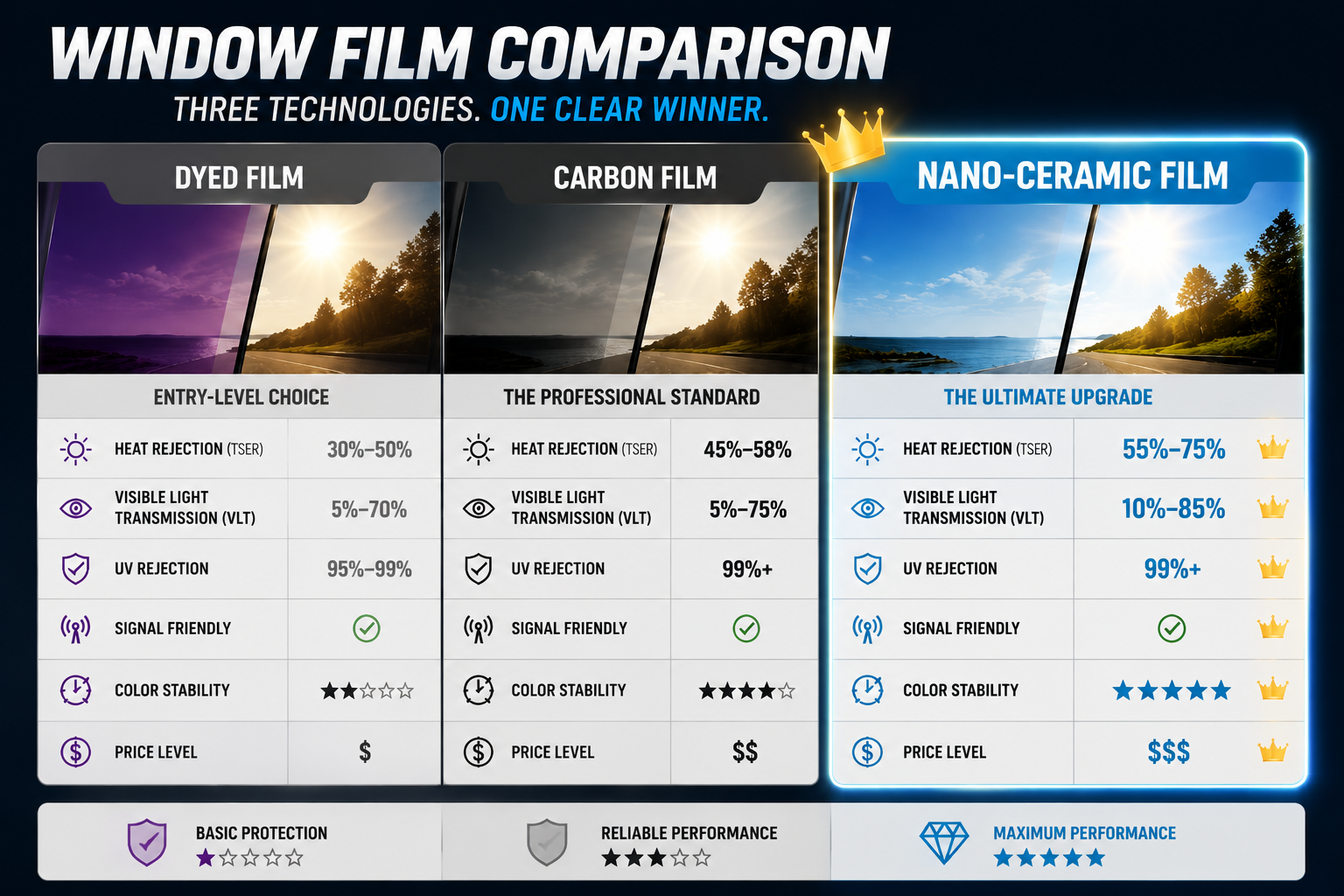
VLT: Available from 5% to 70%. Optical density is controlled by dye concentration.
TSER: 30–50% typical. The absorption mechanism is relatively inefficient for heat rejection because absorbed heat re-radiates inward — you’re absorbing energy in the film, but a fraction of it ends up in the car regardless.
UV rejection: 95–99%+ even in basic products. UV absorbers are cheap and effective; this is not a differentiator between tiers.
Signal interference: None. No metallic components.
Glare reduction: Good — controlled by VLT selection.
The Critical Limitation: Dye Fading
This is what defines the quality ceiling of dyed film. Organic dyes absorb UV radiation as part of their function — and UV absorption is also the mechanism that degrades them. Over time, the dye molecules break down, losing their absorptive capacity. Visible symptoms: the film fades (loses density), changes colour (typically from neutral to purple or blue in poorly stabilised products), and in severe cases, delamination.
How quickly this happens depends entirely on dye chemistry and stabilisation. Budget dyed film from manufacturers using low-quality dyes can show visible fading within 2–3 years in strong UV climates. Well-formulated dyed film with HALS stabilisers can maintain acceptable appearance for 5+ years.
The implication for buyers: dyed film quality varies more than any other category. The difference between budget and quality dyed film is larger than the difference between quality dyed and quality carbon film.
Who Buys It and Why
High-volume installer businesses with price-sensitive customer bases. Dyed film at 30–35% VLT professionally installed on rear side windows looks identical to ceramic or carbon at the same VLT at the time of installation. The difference emerges at year 3+.
Architectural film for opaque-opacity applications. Conference room and HR office frosted applications where the primary requirement is opacity and privacy, not solar control. Premium ceramic technology adds cost without adding relevant performance.
Markets with low-income elasticity for upgrades. In markets where the price difference between dyed and ceramic represents a significant spending decision for the customer, dyed film with an honest service expectation (3–5 years) is the appropriate product.
Carbon Film
What It Is
Carbon film replaced dyed film as the dominant technology tier in the professional market over roughly 2010–2020. Carbon particles — essentially very fine carbon black dispersed in a polymer matrix — provide both UV absorption and infrared absorption without the dye fading problem.
Carbon is extremely stable — it doesn’t photodegrade under UV the way organic dyes do. Carbon-based films maintain their optical properties over much longer service lives than dyed films. They also provide meaningfully better heat rejection because carbon absorbs more broadly across the infrared spectrum than most organic dyes.
No metallic components. No signal interference.
Performance
VLT: Available from 5% to 75%.
TSER: 45–58% typical for well-formulated carbon film. Better than dyed because carbon absorbs infrared more efficiently, though still limited by the absorption mechanism (absorbed energy partly re-radiates inward).
UV rejection: 99%+ standard.
Signal interference: None.
Durability: Significantly better than dyed film. Carbon film from quality manufacturers maintains VLT within 5% of initial value after 10+ years of field service. No colour shift. This is carbon’s key commercial advantage over dyed film.
Appearance: Carbon produces a slightly matte, darker appearance compared to the metallic sheen of some reflective films. Popular aesthetic in many markets.
Why Carbon Became the Professional Standard
Carbon film solved the service life problem of dyed film without the signal interference problem of metallic film. For most automotive and architectural applications through the 2010s, carbon was simply the most practical technology: better durability than dyed, no RF issues, good performance, reasonable price.
Its market position has been partially displaced by ceramic at the premium end — but for mid-market automotive and standard commercial architectural applications, carbon remains the rational default specification for many professional buyers.
Who Buys It and Why
Mid-market automotive installers wanting a durable product they can warranty confidently without the premium of full ceramic. 7-year warranties on carbon film are commercially sustainable with quality products; 10-year warranties push it.
Commercial architectural film for standard office solar control. Hotels, retail, offices where TSER 50–55% meets the project specification and ceramic’s additional performance isn’t needed.
Markets where ceramic price premium isn’t supported. In cost-sensitive markets, carbon is the quality choice that customers are willing to pay for. Ceramic adds 30–60% to price; carbon is the natural ceiling of what the market bears in many segments.
Ceramic film is the technology category that solved the fundamental limitation of absorption-based heat rejection: you can’t reject more heat than you absorb.
Ceramic film uses ceramic nanoparticles — most commonly titanium nitride (TiN), antimony tin oxide (ATO), or tungsten compounds — dispersed in a polymer coating. These particles have specific optical properties: they absorb strongly in the near-infrared (NIR, the heat-carrying wavelength range) while being relatively transparent to visible wavelengths.
This spectral selectivity is what makes ceramic technology different from both dyed and carbon at a fundamental physics level. Instead of absorbing broadly (and re-radiating some of that heat inward), ceramic nanoparticles target specifically the wavelengths that carry heat — and can do so while allowing significantly more visible light through.
The result: higher TSER at higher VLT. A ceramic film at 70% VLT can achieve TSER 60%+. A dyed or carbon film at 70% VLT typically achieves TSER 35–45%. The ceramic performance isn’t just incrementally better — it’s accessing a different part of the performance envelope.
The “Nano” Qualifier
“Nano-ceramic” is sometimes used interchangeably with “ceramic” and sometimes used to imply a premium tier above regular ceramic. The meaningful technical distinction: nanoparticle size.
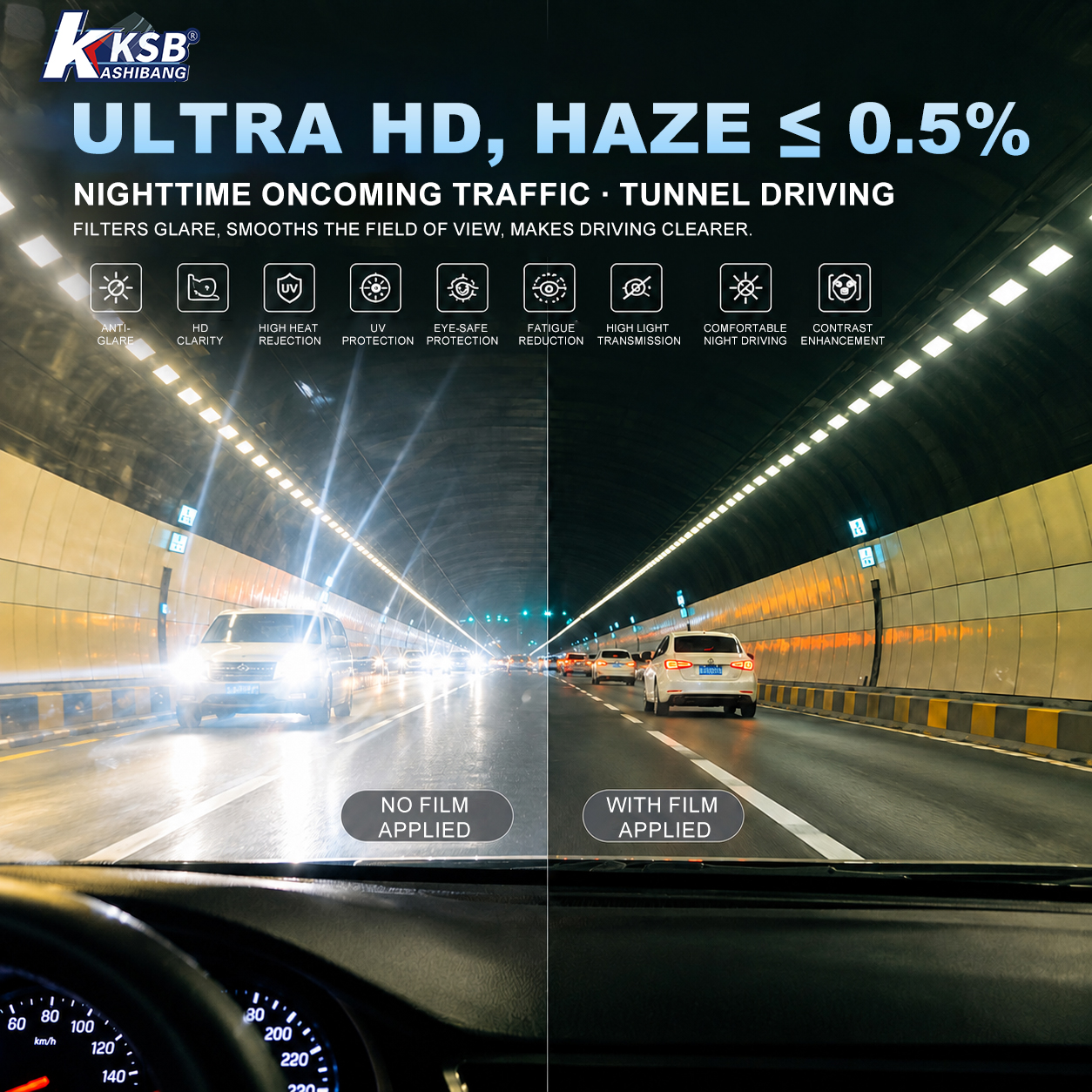
Ceramic particles at nanometre scale (10–100nm) are small enough not to scatter visible light — the film appears optically clear. Particles at micrometre scale (1,000nm+) scatter visible light, producing haze. Premium nano-ceramic film achieves optical haze below 0.5% despite containing absorptive particles — because the particles are small enough to not create light scattering.
This is why low-quality “ceramic” film can produce visible haze while premium nano-ceramic is indistinguishable from clear glass. Particle size is the differentiator.
Performance
VLT: Available from 10% to 85%+. Crucially, high VLT (65–80%) at high TSER (60–70%) is achievable — impossible with dyed or carbon.
TSER: 55–75% depending on specification. This range exceeds what dyed or carbon can achieve at equivalent VLT.
IR rejection: 75–95% in the NIR range (780–2,500nm). This is the metric that correlates with the subjective “radiant heat” sensation — how hot it feels in the car even when the air conditioning is managing temperature.
UV rejection: 99%+.
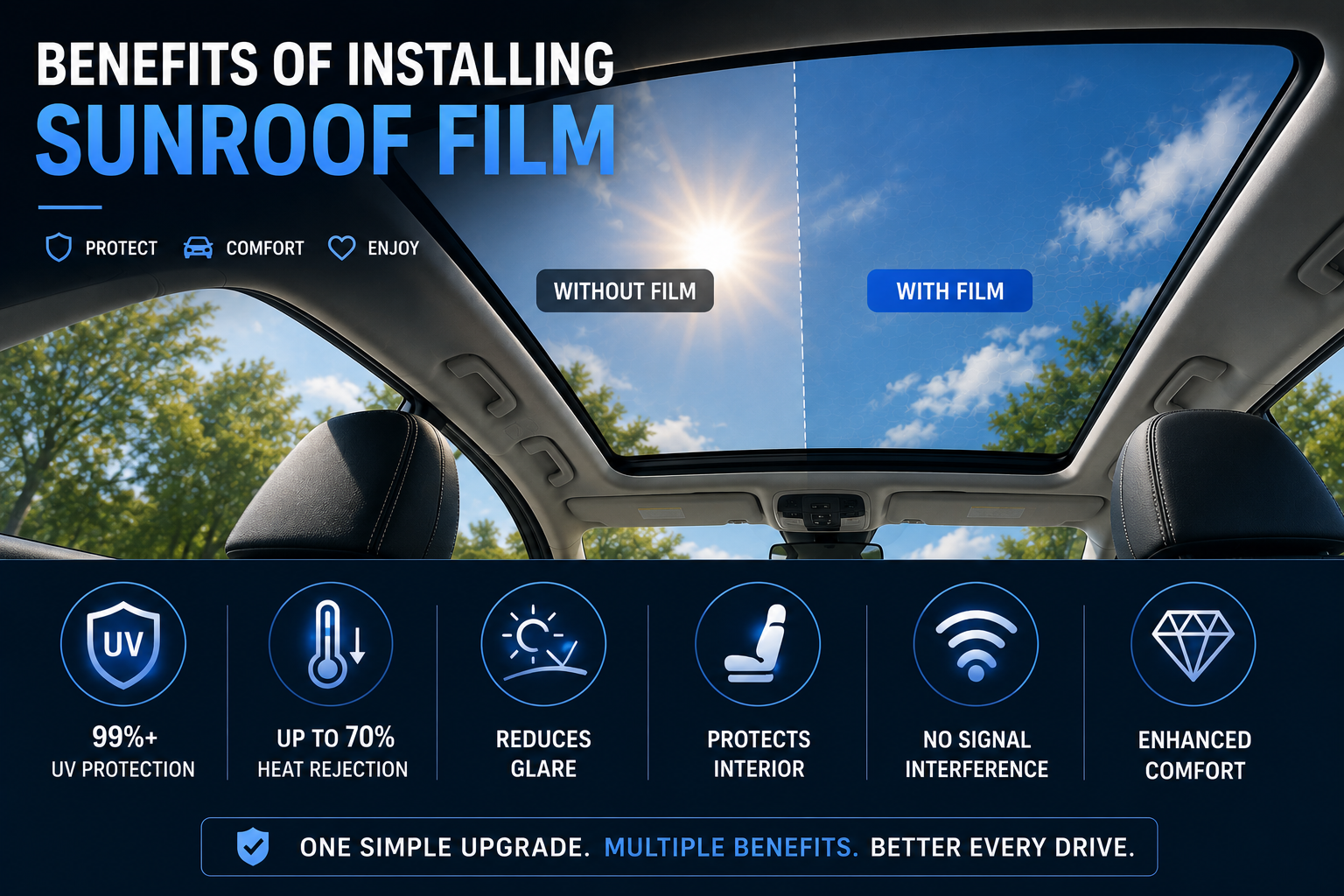
Signal interference: None. Ceramic nanoparticles are electrically non-conductive. GPS, cellular, satellite radio — all unaffected. This is why ceramic dominates panoramic sunroof and front window applications where phone and navigation systems are in proximity.
Optical quality: When manufactured properly (low haze, accurate nanoparticle dispersion), ceramic film is optically neutral — it looks like clear glass and doesn’t introduce visible distortion.
The Price Reality
Quality nano-ceramic costs more than carbon because:
Nanoparticle synthesis at controlled particle size is expensive
Uniform dispersion in the coating matrix requires precision
Optical quality requirements (haze) are stricter than lower-tier products
The customer is paying for a genuinely different performance capability
Typical price premium: ceramic is 60–120% more expensive per roll than carbon at equivalent VLT. For a full-car film installation, this translates to an installer charging $200–$500 more for ceramic over carbon.
Whether the premium is justified depends on the customer’s priorities. For a customer who wants maximum heat rejection with minimal darkening of the glass — on a luxury vehicle, for daily commuting in a hot climate, or for an EV where A/C load affects range — the premium is obviously justified. For a customer who primarily wants privacy and UV protection on rear windows — carbon achieves the goal at lower cost.
The Comparison That Actually Matters
Instead of ranking by tier, here’s the comparison by application:
Application
Best choice
Why
Front windscreen solar control
Nano-ceramic (high VLT)
Legal visibility, signal transparency, maximum heat
Front side windows (legal markets)
Nano-ceramic 70–75% VLT
Visibility, signal, heat
Rear side windows
Carbon or ceramic
Performance need and budget
Rear windscreen
Carbon or ceramic
Heat and UV; signal less critical
Sunroof / panoramic roof
Nano-ceramic only
Signal transparency essential; heat rejection key
Commercial architectural solar control
Ceramic or carbon
Performance specified by architect
Office privacy glazing
Dyed or frosted
Opacity is the requirement; TSER secondary
Safety film (fragment retention)
Safety-grade (separate category)
Thickness and adhesion are the spec, not solar
EV vehicle, range-conscious owner
Nano-ceramic on all glass
Reduced A/C load has direct range benefit
What About Metalized / Sputtered Film?
Metallic film — deposited by magnetron sputtering or evaporative deposition — provides very high TSER through reflectance rather than absorption. TSER 60–75% at VLT 30–55% is typical for quality sputtered metallic.
It’s not in the dyed/carbon/ceramic comparison because it occupies a different part of the application space: where maximum heat rejection is needed and appearance can be darker. The key limitation for automotive applications — particularly front windows and panoramic roofs — is signal interference. Metallic layers are conductive; they attenuate GPS, cellular, and satellite signals in the frequency ranges that modern vehicles rely on.
For rear windows and door glass on vehicles without electronic systems in the rear, sputtered metallic film delivers outstanding heat rejection at a price point competitive with mid-range ceramic.
FAQ
Can I mix different technologies on the same vehicle? For example, ceramic on front and carbon on rear?
Yes, and it’s a reasonable value engineering approach. Front side windows and the windscreen benefit most from ceramic (legal VLT requirements, signal transparency, occupant proximity). Rear side and rear windows can often use carbon with no practical compromise to the occupant experience, at lower cost. Many professional installers have a “hybrid” specification for customers who want a genuine performance upgrade without paying full ceramic on every pane.
A customer says their ceramic film isn’t any better than the carbon they had before. What happened?
Either the “ceramic” film isn’t genuinely nano-ceramic (low-quality products make the claim without the particle engineering), or the comparison is being made at equivalent low VLT where carbon and ceramic deliver similar heat rejection. The ceramic advantage is most pronounced at high VLT (65%+) where ceramic selectively rejects heat without darkening the glass. At 20% VLT, both technologies block most solar energy anyway — the ceramic premium at that darkness level is small.
KSB Window Film manufactures dyed, carbon, and nano-ceramic automotive and architectural film. Our export team can match the right technology to your specific market positioning and customer profile.