How to Choose a Reliable Chameleon Window Film Supplier
Published: October 26 2026 · 8 min read · Category: Chameleon Window Film
About this article: KSB Window Film manufactures chameleon window film and is one of the suppliers in this market. This evaluation guide is written to help buyers identify the real differentiators in a category where visual appeal can obscure product quality.
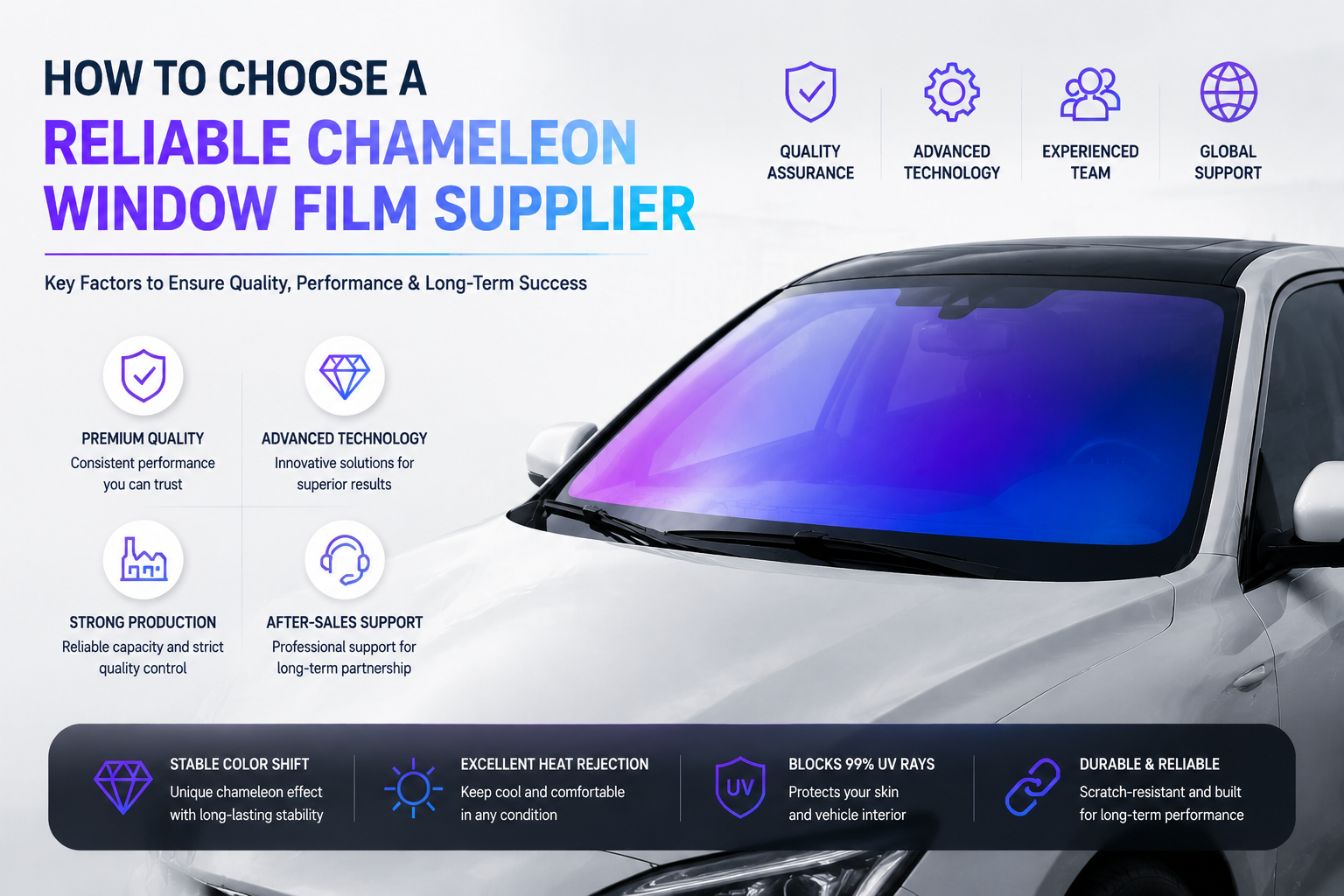
Guide to choosing a reliable chameleon window film supplier with advanced technology, stable color performance, quality control, and global support.
Evaluating a chameleon window film supplier is more complex than evaluating a standard solar control film supplier — because the primary product characteristic (visual colour shift) is easy to fake at the sample stage and hard to assess for long-term durability without proper testing. A sample that looks stunning in a showroom may lose its colour vibrancy within a year or develop edge issues that produce installer complaints.
This guide covers the evaluation criteria that matter specifically for chameleon film.
Why Standard Supplier Evaluation Misses Chameleon-Specific Issues
Standard window film evaluation focuses on: TSER, VLT, UV rejection, SGS test report, ISO 9001 certificate. These are valid and necessary criteria. But for chameleon film, they leave out the most important quality dimensions:
Colour consistency across batches. A 5% variation in TSER matters less than a visible colour difference between two rolls of “purple-to-green” that an installer uses on the same vehicle. TSER testing doesn’t capture this.
Colour durability over time. A chameleon film that looks vibrant at installation but shifts to a different base colour or loses saturation after 18 months of UV exposure has failed its primary function. Standard accelerated aging tests measure performance retention (VLT, TSER) but not colour shift stability.
Layer delamination risk. Chameleon film stacks are mechanically complex. If the dielectric and metallic layers don’t have adequate adhesion to each other and to the PET substrate, edge delamination or inter-layer separation produces visual defects that ruin the appearance.
Criterion 1: Colour Measurement and Batch Consistency
The question: “How do you verify colour consistency between production batches? Can you show me a batch record?”
What a credible answer looks like: The manufacturer uses spectrophotometric measurement of the reflected colour spectrum on every production batch, comparing it against a reference standard. They track CIE colour coordinates (L*, a*, b* values) and maintain batch-to-batch tolerance of ΔE < 2 (which is the threshold of perceptible colour difference to the human eye).
What a non-credible answer looks like: “We visually inspect each batch.” Visual inspection is not adequate for colour consistency — individual human colour perception varies and is unreliable for subtle differences that are visible when two rolls from different batches are installed adjacent.
Why this matters in practice: An installer who uses two rolls of chameleon film on the same vehicle — one roll from one batch, one from another — sees a visible mismatch if batch consistency isn’t controlled. The customer complaint is legitimate; the installer is in the middle; the distributor gets the return request.
Criterion 2: Long-Term Colour Stability
The question: “Do you have accelerated aging test data showing the colour shift maintains its character over time? Has the dominant and shift colour changed after 1,000 hours of UV exposure?”
What a credible answer looks like: ASTM G154 or ISO 4892 accelerated UV aging test results with spectrophotometric colour measurement before and after. The before/after colour coordinates should show minimal drift (ΔE < 3 acceptable, < 2 preferred).
Why some films fail this: Metallic layers (particularly silver) can oxidise over time, shifting their optical properties and therefore changing the interference colour. Budget chameleon film without protective dielectric layers over metallic components fails this test. Quality films with full dielectric layer encapsulation maintain colour over the test period.
Criterion 3: Manufacturing Method Verification
The question: “Is this film manufactured by magnetron sputtering? Can you describe your sputtering equipment and the layer count for this product?”
What to look for: Magnetron sputtering is the only commercially viable method for precise multilayer thin-film interference coating at these layer thicknesses. A supplier who can describe their sputtering equipment (number of targets, whether it’s inline or batch, the vacuum level they operate at) has genuine manufacturing capability. See How Chameleon Window Film Is Manufactured for the technical detail to reference.
Red flag: Vague references to “advanced coating technology” without description of sputtering equipment. Some lower-quality chameleon films are produced by wet coating with pearlescent pigments — these produce a surface shimmer effect but not true thin-film interference colour shift.
Criterion 4: Delamination and Edge Adhesion
How to test with samples:
Apply the chameleon film sample to glass
Allow 72 hours cure time
Apply perimeter masking tape along all four edges
Pull the tape sharply
Inspect the edges for any lifted or delaminated film
Quality chameleon film shows no edge lift in this test. Budget film with inadequate adhesion between layers often shows edge lift — a precursor to the real-world edge delamination that ruins the appearance over time.
Additional test: Flex the sample moderately (bend a 20cm × 20cm piece to 90° and return flat). Quality film shows no inter-layer cracking or adhesion failure. Budget film may show micro-cracking in the dielectric layers that’s visible as a change in the colour shift appearance.
Criterion 5: Visual Quality of the Colour Shift
This is subjective but important — and there are specific things to look for:
Vibrant, saturated colour at full shift: Premium chameleon film shows vivid, saturated colour (not washed-out or pastel) at the shift angle.
Clean colour transition: The colour shift should transition smoothly across the glass as your viewing angle changes, not show patchy areas of different colour (which indicates inconsistent layer thickness).
Consistent appearance across the roll: Hold a 1.5m length of film up to the light and check uniformity. Any visible bands or stripes of different colour indicate sputtering non-uniformity.
Effect visible in indirect light: Premium chameleon film shows meaningful colour shift even in diffuse indoor lighting. Budget film may only shift under direct sun, appearing as ordinary dark tint in most everyday conditions.
Criterion 6: References From Installers in Your Market
Ask for contact details of installers in comparable markets who’ve been using the product for 12+ months. The questions for references:
Has the colour remained consistent over time?
Have there been any edge lifting or delamination issues?
Have customers complained about colour mismatch between rolls?
What has the warranty claims experience been?
The Sample Evaluation Protocol
For any potential chameleon film supplier, request at least 2 rolls from 2 different production batches (to test batch consistency). Install both on the same piece of flat glass and compare:
Hold the glass at various angles under direct sunlight
Compare the colour shift between the two rolls at the same angle
If you see a visible difference, the supplier’s batch consistency is insufficient
FAQ
How long should samples take to arrive from a Chinese manufacturer?
For serious buyers, most established manufacturers ship samples within 3–5 business days by express courier. A manufacturer who takes 2–3 weeks to send samples either has inventory management issues or isn’t treating your enquiry seriously.
Should I pay for samples?
For small quantities of standard products: samples are often free or at a nominal cost. For custom colour development or large quantity requests before an order, paid samples are reasonable. Never proceed to a commercial order without receiving and evaluating physical samples.
KSB Window Film provides batch colour measurement records, accelerated aging test data, sputtering equipment description, and reference installer contacts for our chameleon film programme. We welcome the evaluation process.