Top Chameleon Window Film Manufacturers in China (2026 Guide)
Published: October 21, 2026 · 8 min read · Category: Chameleon Window Film
About this article: KSB Window Film manufactures chameleon window film and is one of the producers discussed in this guide. We’ve written it to be genuinely useful for buyers evaluating the Chinese chameleon film supply landscape.
China is the dominant global producer of chameleon window film. The thin-film interference technology that creates the colour-shifting effect originated in precision optical manufacturing, and Chinese manufacturers have developed significant capability in this niche. However, the quality range in the chameleon film category is wide — and the visual appeal of the product can mask performance and durability differences that matter over the film’s service life.
This guide identifies the manufacturers who’ve invested in the capability that quality chameleon film requires.
Why Chameleon Film Manufacturing Is Technically Demanding
Chameleon film requires manufacturing precision that standard automotive tint doesn’t:
Nanometre-level layer thickness control. The colour-shifting effect depends on optical interference from layers that are 20–100nm thick. Variation of even ±5nm in layer thickness shifts the interference colour. This requires magnetron sputtering (physical vapour deposition) rather than conventional coating — and precise process control within the sputtering system.
Multiple target material capability. A chameleon film stack uses alternating high and low refractive index materials — TiO₂ and SiO₂ are common, potentially combined with metallic layers. The sputtering system must handle multiple target materials with rapid switching between depositions.
Optical design expertise. Knowing which layer thicknesses and materials produce which colour combinations requires optical simulation capability (software modelling of light interference in multi-layer stacks) and iterative development. Manufacturers who can’t model their layer designs produce chameleon effects by trial and error — with inconsistent results.
Batch-to-batch colour consistency. A distributor ordering multiple rolls of “purple-to-green” chameleon film needs the colour to be consistent across rolls and orders. Achieving this requires tight process parameter control and sampling/measurement protocols on every production batch.
Manufacturers who meet all these requirements are a defined subset of the broader window film industry.
Notable Manufacturers (2026)
KSB Window Film (Dongguan, Guangdong)
Chameleon film range: Purple-to-green, blue-to-purple, green-to-gold, blue-to-green, red-to-purple, and custom colour combinations on request. VLT range: 35–70% depending on specification.
Manufacturing method: Magnetron sputtering with optical layer design via thin-film simulation software. Multi-target sputtering capability for TiO₂/SiO₂/metallic stacks.
Quality documentation: Batch colour consistency sampling (spectrophotometric measurement of interference colour per batch), SGS UV and performance test reports, haze measurement.
Colour stability: Dielectric protective layers over metallic components resist edge oxidation. Accelerated aging test documentation available.
OEM programme: Private label available from 100 rolls per colour/VLT combination. Custom colour development for volume buyers. Geographic exclusivity on custom specifications.
Export experience: Automotive installers and distributors across Southeast Asia, Middle East, Eastern Europe, Australia, and North America.
Best for: Distributors building chameleon film product lines; high-volume automotive installers requiring consistent colour across orders; OEM buyers developing branded chameleon products.
Shenzhen Namo New Material Technology
Products: Chameleon film range with focus on vibrant colour combinations. Strong domestic Chinese market presence.
Strengths: Wide colour range; competitive pricing; established in the chameleon film category since early market development.
Considerations: Export documentation for Western markets may be less developed. Verify batch consistency standards before large-volume orders.
Hangzhou Yilisite Optical Films
Products: Premium automotive film including chameleon series. Stronger in clear-to-moderate VLT range.
Strengths: Good optical quality; established installer relationships in premium automotive segment; some European export experience.
Guangzhou Tianxi Automotive Film
Products: Chameleon film within broad automotive film range. Multiple colour combinations.
Strengths: Competitive pricing; active in Southeast Asian distribution channels; flexible MOQ for regional distributors.
Evaluation Criteria Specific to Chameleon Film
Beyond the standard window film supplier evaluation criteria (manufacturing vs. trading, performance documentation, quality management), chameleon film buyers should verify:
Criterion 1: Colour Consistency Documentation
Ask: “How do you ensure colour consistency between production batches? What measurement do you use?”
A credible manufacturer uses spectrophotometric measurement of the interference colour — measuring the reflected spectrum — on samples from every batch. They can specify a tolerance for colour difference (CIE ΔE value, where ΔE < 2 is considered good colour consistency).
A manufacturer without colour measurement processes produces rolls that may vary in apparent colour between batches — creating installation problems for customers who order multiple rolls of the same colour combination.
Criterion 2: Layer Stack Documentation
Ask: “What materials and how many layers do you use for this colour combination?”
A manufacturer with genuine optical design capability knows their layer stack. This information may be commercially sensitive, but a credible manufacturer can describe the general approach (how many layers, what categories of materials) even if they don’t share exact thicknesses.
Criterion 3: Durability Data
Ask: “What accelerated aging testing have you done? Does the colour shift change after UV aging?”
Interference colours from metallic/dielectric stacks are generally stable, but lower-quality products using mostly metallic layers without protective dielectric layers can show colour shift after UV aging. Request ASTM G154 or ISO 4892 accelerated aging test results with colour measurement before and after.
Criterion 4: Sample Colour Shift Demonstration
Evaluate samples in different lighting:
Direct overhead sun
Indirect/diffuse lighting
Fluorescent indoor light
LED indoor light
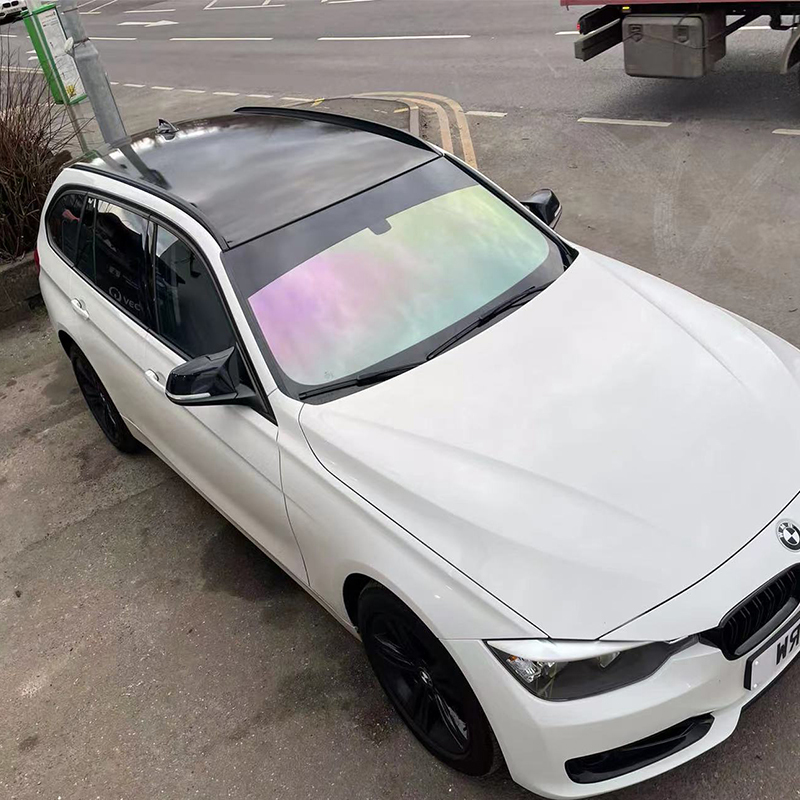
Quality chameleon film shows distinct, vibrant colour shift in natural sunlight and reasonable shift in strong artificial light. Budget chameleon film may only show the effect under specific direct sun conditions, appearing as ordinary dark tint in most everyday conditions.
FAQ
Why do some chameleon films look more vibrant than others?
The vibrancy of the colour shift depends on the quality and precision of the interference stack. More precisely controlled layer thicknesses produce more pronounced interference — the constructive interference peaks are sharper and the colour is more saturated. Budget films with less precise layer control produce weaker interference and more muted colour shifts.
How can I tell if a chameleon film is likely to be consistent between orders?
Ask the manufacturer for a batch record from a recent production run showing the colour measurement. If they can produce this, they’re measuring. If they can’t or won’t, consistency across orders is uncertain.
KSB Window Film provides colour samples in all combinations with batch consistency documentation and performance test reports. Start your evaluation with a sample order.