How to Specify Safety Window Film for a Commercial Project: A Step-by-Step Guide
Published: September 7, 2026 · 9 min read · Category: Safety & Security Film
About this article: KSB Window Film provides specification support to commercial building owners, facilities managers, and security consultants. This guide reflects the specification process we work through with buyers on commercial safety film projects.
A practical guide to selecting certified safety window film for commercial buildings, helping buyers choose the right product and avoid low-quality alternatives.
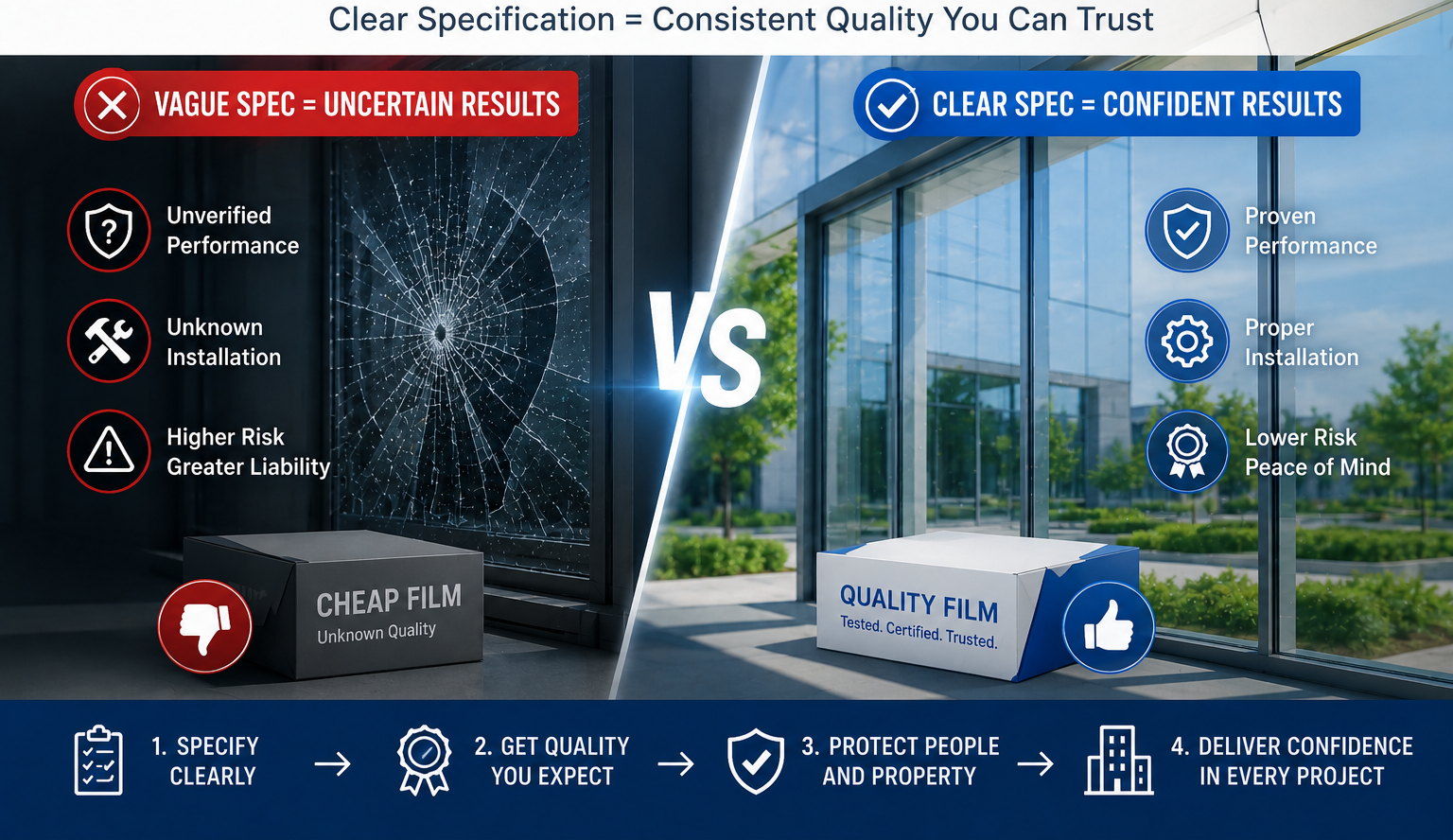
A safety film specification that’s vague is worse than no specification at all. It creates a situation where you’ve specified “safety film” and received a product that may or may not meet the performance requirement, installed in a way that may or may not be appropriate — and you have no basis for verifying either. When something goes wrong later (injury, forced entry, failed inspection), the vague specification is the problem.
This is a step-by-step guide to a complete safety film specification for a commercial project.
Step 1: Define the Threat (What Are You Protecting Against?)
Every safety film specification starts here. The threat determines the product. Different threats require fundamentally different specifications, and conflating them produces specifications that are over-specified for some areas and under-specified for others.
Ask:
Is the primary concern accidental breakage and glass injury (seismic, storm, accidents)?
Is forced entry delay the primary requirement (burglary, smash-and-grab)?
Is blast protection required (government, high-threat environment)?
Is it a combination?
For most commercial buildings, the answer is a combination: accidental safety for the whole building, forced entry delay for ground-floor entry-adjacent glazing.
Document the threat for each glazed area in the building — different zones will have different requirements.
Step 2: Survey the Glazing
A complete glazing survey provides the inputs for specification:
For each glazed area, document:
Location (floor, elevation, room function)
Glass type (clear/tinted, single/double, any existing coatings, tempered or annealed)
Frame type and condition (aluminium, timber, steel, uPVC; condition of seals and frame structural integrity)
Why glass type matters: Safety film compatibility varies by glass type. Double-glazed units require IGU-compatible film. Low-E coated glass requires compatibility verification. Films applied to incompatible double-glazed units can cause thermal stress cracking. See Window Film for Double-Glazed and Low-E Glass.
Why frame condition matters: Frame attachment — essential for security applications — requires frames in good structural condition with surfaces suitable for adhesive or mechanical bonding. Deteriorated frames may need repair before film installation.
Step 3: Determine the Required Performance Standard
Based on the threat assessment and the building’s regulatory environment, identify the performance standard required for each zone.
Reference standards:
Requirement
Standard
Application
Building code safety compliance (EU/UK)
EN 12600 B2 minimum (B1 for most applications)
All code-required safety glazing locations
Building code safety compliance (US)
ANSI Z97.1 Class B
All code-required safety glazing locations
Commercial security — basic
EN 12600 B1 + frame attachment
Ground floor general commercial
Commercial security — insurance requirement
LPS 1270 Class A1 or A2
Per insurer specification
High-value retail / bank branches
LPS 1270 Class A2 or A3
Per insurer and risk assessment
Government buildings — forced entry
LPS 1270 Class A3+
Per government security standard
Blast protection (US government)
GSA PBS-P100 / UFC 4-010-01
Federal buildings
Document the required standard for each zone.
Step 4: Select the Product
With the performance standard defined, specify the film product:
Specify:
Film thickness (mil or microns)
Film type (clear / tinted — specify VLT if tinted)
Finish (for any aesthetic requirements)
Manufacturer and product name, or alternatively, specification by performance standard (“to achieve EN 12600 Class B1(2) minimum”)
Guidance by standard:
EN 12600 B2: 4–6 mil clear safety film
EN 12600 B1: 6–8 mil
LPS 1270 A1–A2: 8 mil + frame attachment
LPS 1270 A3: 10–12 mil + structural frame attachment
For multi-function requirements (safety + solar control, or safety + privacy), specify a dual-function product or address each requirement separately.
Step 5: Specify the Frame Attachment Method
For any application requiring forced entry or blast resistance, specify the frame attachment method explicitly. Do not leave this to the installer’s discretion.
Choose:
Perimeter attachment tape (PAT): For standard commercial security (LPS 1270 A1–A2)
Structural silicone wet glazing: For high-security and blast applications (LPS 1270 A2+ and blast)
Mechanical channels: For the most demanding applications (highest LPS 1270 classes, government blast)
Specify the frame attachment in the same document as the film specification — it is part of the security system.
Step 6: Specify Installation Requirements
A complete specification includes installation quality requirements:
Glass preparation: “Glass surfaces to be cleaned with proprietary glass cleaner and IPA solution before film application. No contamination, adhesive residue, or moisture present at installation.”
Installation conditions: “Film to be applied at ambient temperature between 10°C and 35°C. No application during rain or in high-humidity conditions.”
Frame attachment: “Structural perimeter attachment tape [or silicone wet glaze] to be applied after film installation to all four edges, bonded firmly to both film surface and frame. Frame surfaces to be cleaned and primed per manufacturer requirements before attachment.”
Cure time: “Installation not to be subjected to water, cleaning, or physical stress for 72 hours post-installation.”
Inspection: “On completion, installer to provide photographic record of all installed areas and certify installation matches specification.”
Step 7: Specify the Documentation Package
For commercial projects, the documentation deliverables should be specified alongside the installation:
Required from the manufacturer:
Product certificate to the specified standard (EN 12600, LPS 1270, etc.) for the specific product installed
Product data sheet confirming performance parameters
A lower price that uses a non-compliant product or omits frame attachment is not a valid comparison to a compliant tender. Verify compliance before price.
FAQ
Who should write the safety film specification — the building owner, facilities manager, or a consultant?
For straightforward commercial projects (basic safety compliance or standard smash-and-grab security), a knowledgeable facilities manager can prepare an adequate specification using this guide. For government, blast, or insurance-driven specifications, a security consultant or specialist glazing engineer should write the specification — the liability implications of an inadequate specification justify the cost.
Can I specify performance standard without naming a specific product?
Yes — performance-based specification (“film to achieve EN 12600 Class B1(2) minimum”) is often preferred in competitive tendering as it allows multiple compliant products to be offered. The risk is that you need to verify the product offered actually meets the standard — always request the certification for the specific product before accepting a tender.
KSB Window Film provides specification support for commercial safety film projects — advising on product selection, certification requirements, and frame attachment method for your specific application. We can review a draft specification and confirm product compliance before you go to tender.