Published: October 22, 2026 · 7 min read · Category: Windshield Film
About this article: KSB Window Film manufactures windshield protection film with self-healing top coats. Self-healing claims are among the most misunderstood in the windshield film category — this guide explains what the technology can and cannot realistically achieve on a windshield application.
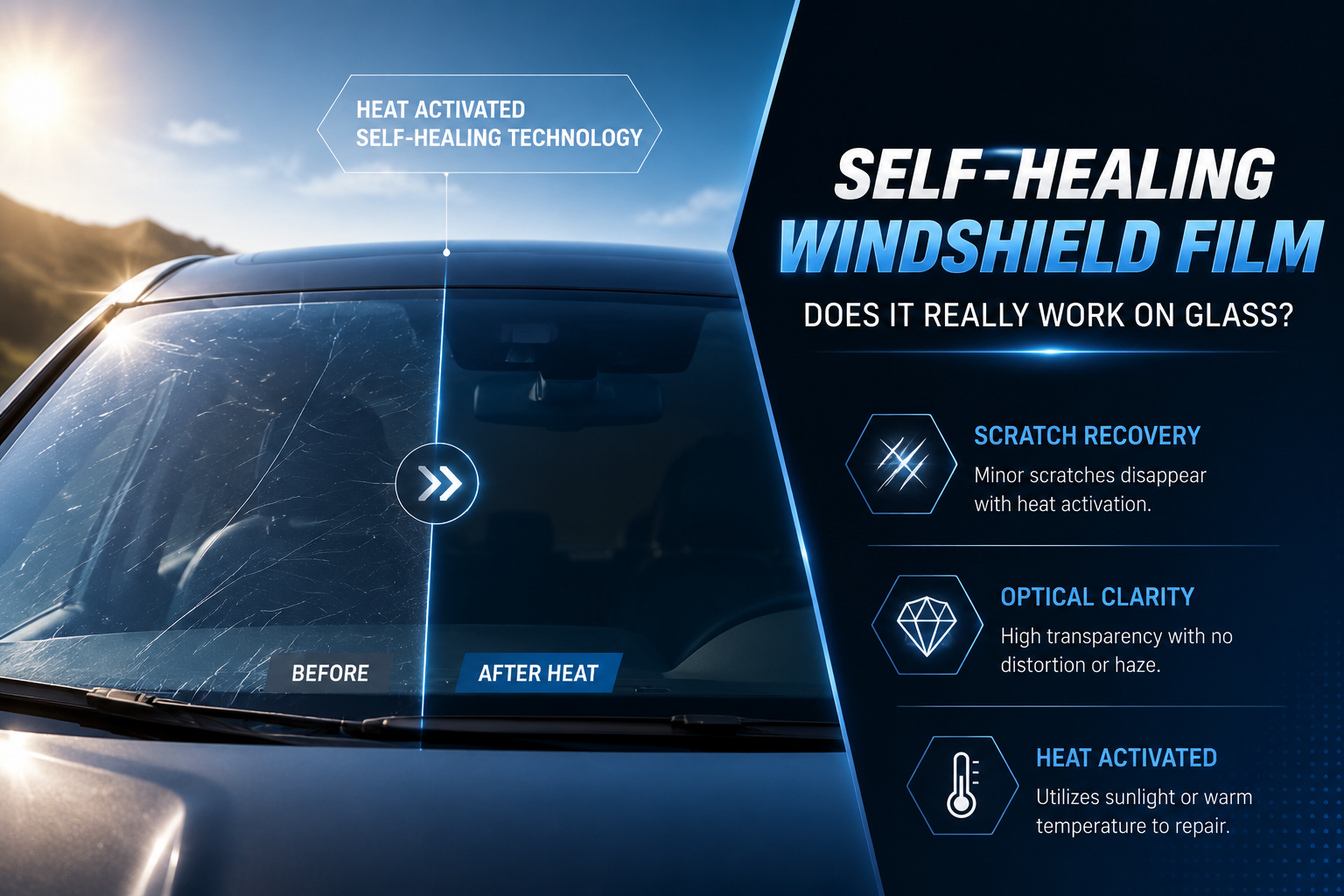
Self-healing is one of the most marketed features in premium automotive film. On body PPF, the claim is well-established — elastomeric top coats genuinely recover light scratches with heat, and the mechanism is understood. On windshield film, the same claim is made frequently, but the reality is more nuanced.
This article explains what self-healing means in the windshield film context, why the mechanism is real but more constrained than in body PPF, and what buyers should realistically expect.
The Self-Healing Mechanism
Self-healing in automotive film works through elastomeric polymer memory. The top coat is formulated with a cross-linked polymer network that has “memory” of its original surface geometry. When scratched, the polymer chains in the scratch zone are displaced rather than severed — the top coat deforms.
When heat is applied — from direct sunlight, a heat gun, or warm water — the polymer chains gain enough thermal energy to return toward their equilibrium configuration. The displaced material flows back toward the original surface geometry, closing the scratch.
The effectiveness depends on:
- Scratch depth: Shallow surface marks (from light contact, minor wiper debris) heal; deep scratches that cut through the top coat into the base film do not
- Temperature: Higher temperatures within the polymer’s working range = faster, more complete healing
- Cross-link density of the top coat: Looser cross-links = easier flow = better healing, but also lower hardness. Tighter cross-links = harder surface = less healing
Why Windshield Film Self-Healing Is Different From Body PPF
Body PPF self-healing top coats are optimised almost entirely for healing speed and completeness. The optical standard for a bonnet doesn’t constrain top coat formulation significantly. Engineers can dial in a relatively soft, highly elastomeric top coat that heals quickly and completely.
Windshield film cannot use the same top coat strategy for two reasons:
Wiper blade interaction. A soft, highly elastomeric top coat on a windshield gets swept by wiper blades thousands of times. Wiper blades exert shear force across the film surface. A very soft top coat deforms under repeated wiper shear — producing a gradual haze buildup as the surface micro-texture changes. This is the opposite of what’s needed for a clear windshield film.
Optical distortion risk. Very soft top coats have refractive index properties that are more sensitive to temperature-induced changes. A top coat formulation that flows enthusiastically under summer sun temperatures can introduce transient optical distortion when the windshield surface reaches 60°C+ in direct sunlight.
The formulation tradeoff:
| Property | Body PPF ideal | Windshield film ideal |
|---|---|---|
| Top coat hardness | 2H–3H (moderate) | 3H–4H (harder) |
| Self-healing speed | Fast (complete at 25°C) | Moderate (complete at 50–60°C) |
| Wiper resistance | Not relevant | Essential |
| Optical stability under heat | Less critical | Critical |
The result: premium windshield film achieves meaningful self-healing for light surface marks at elevated temperatures, but heals more slowly and less completely than premium body PPF at equivalent conditions.
What Self-Healing Windshield Film Actually Does
Surface marks from light contact (fingernail, gentle abrasion): These are shallow deformations in the top coat layer. Quality windshield film with a self-healing formulation heals these marks in direct sunlight (60°C glass surface temperature) within 20–40 minutes. At room temperature, healing is minimal.
Minor wiper debris scratches: Light debris trapped under a wiper blade creates shallow scoring across the film. After a warm day or heat gun application, these marks may partially or fully recover. This is the most practically valuable self-healing scenario for windshield film — wiper-induced micro-scratching is the primary ongoing surface stress.
Impact craters from stone chips: Film that has absorbed a stone chip impact — showing a crater or surface deformation at the impact point — does not self-heal this damage. Impact creates physical displacement and in some cases micro-fractures in the top coat. This is not a deformation of the polymer network that can flow back — it’s permanent structural damage. The impact zone must be replaced, not healed.
Deep scratches: Anything that cuts through the top coat layer to the base film does not self-heal. The healing mechanism is a top coat surface property; it doesn’t extend to structural film damage.
Testing Self-Healing on a Windshield Film Sample
Practical evaluation before specifying:
- Take a film sample of the product you’re evaluating
- Apply the sample to a flat glass surface and allow the adhesive to set for 48 hours
- Make a controlled light scratch with your fingernail across the surface
- Place the glass sample in direct sunlight on a warm day (or on a surface heated to 60°C)
- Assess after 20 minutes, 40 minutes, and 60 minutes
What to expect from quality self-healing windshield film:
- Light fingernail mark: 60–80% recovery within 30 minutes at 60°C surface temperature
- Full recovery on very light marks in 40–60 minutes
What to conclude from poor results:
- No recovery at all: no meaningful self-healing top coat — the claim is cosmetic
- Recovery only with heat gun at 80°C+: marginal self-healing that won’t function in real-world use without active heat application
Self-Healing and Service Life
The self-healing property extends functional service life by recovering minor surface damage before it accumulates into visible surface degradation. A windshield film without self-healing gradually loses optical clarity as micro-scratches accumulate — becoming hazy in the wiper sweep zone within 12–24 months of use.
A windshield film with genuine self-healing can recover most of this wiper-zone micro-abrasion on warm days. This extends the period before the film’s optical clarity degrades to the point of replacement from 1–2 years to 3–5 years in typical use.
Self-healing is not about recovering impact damage — it’s about maintaining optical quality over service life. This is the most practically important benefit of self-healing in windshield film.
FAQ
My windshield film has a scratch from a stuck wiper blade. Will it self-heal?
Light scoring from a sticky wiper blade — shallow marks that don’t penetrate through the top coat — may partially or fully recover on a warm sunny day. Parking the car in direct sunlight for an hour after a wiper event is worthwhile before assuming the film needs replacement. Deeper scoring that cut into the base film will not recover.
Can I use a heat gun to accelerate self-healing?
Yes, with care. A heat gun set to approximately 60°C surface temperature can accelerate healing of light marks. Don’t apply heat gun heat at high concentration for extended periods — localised overheating above 80°C can create adhesion issues or optical distortion in sensitive film formulations.
How do I know if my windshield film has genuine self-healing?
The fingernail test described above is the most reliable field assessment. Any product claiming self-healing should be able to demonstrate recovery of a light scratch in direct sunlight. If it doesn’t, the self-healing claim is cosmetic.
Further Reading
On this site:
- What Is Windshield Protection Film? A Complete Buyer’s Guide — Full product overview including top coat properties
- Optical Clarity Standards for Windshield Films — How top coat properties affect optical performance
- Self-Healing PPF Explained — Body PPF self-healing mechanism for comparison
External:
- SAE Technical Paper — Automotive Film Durability — Technical reference for automotive film weathering and durability
- ASTM D1044 Taber Abrasion Test — Standard for testing scratch resistance relevant to windshield film top coats
KSB’s Self-Healing Windshield Film: Tested, Not Just Claimed
KSB Window Film’s premium windshield film range includes genuinely self-healing top coat formulations, with test documentation showing healing performance at defined temperatures. We provide samples for independent assessment — we’re confident in the demonstration.
→ Request self-healing windshield film samples and performance data from KSB — we respond within one business day.
Get a Free Sample or Quote
Looking for a reliable window film supplier? Contact us today for fast response and professional support.