Published: July 10, 2026 · 8 min read · Category: Window Film Guide
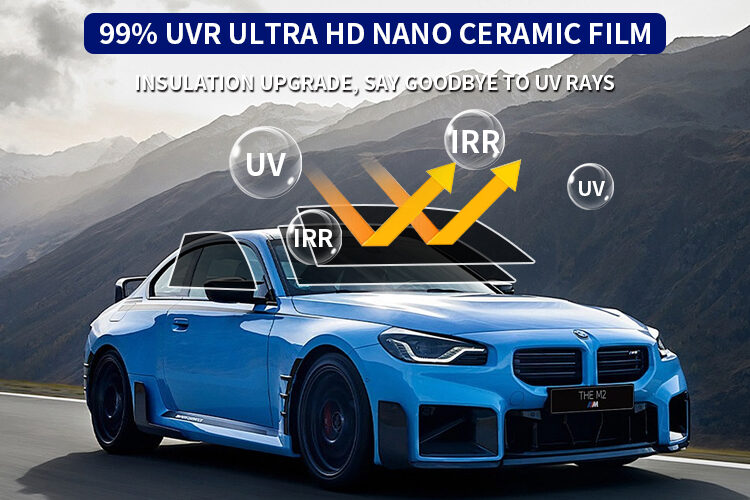
“Blocks heat” sounds simple. The physics behind it is more interesting, and understanding it helps explain why two films with identical VLT ratings can produce dramatically different interior temperatures — and why IR rejection claims deserve more scrutiny than most buyers give them.
This article explains exactly how nano ceramic film interacts with solar energy, why ceramic compounds are effective at heat rejection, and what the relevant performance metrics actually mean.
Solar Energy: What’s Coming Through the Glass
Sunlight isn’t just visible light. Solar radiation arriving at a window spans three categories:
Ultraviolet (UV): 280–380nm wavelength range. About 3–5% of total solar energy. Responsible for skin damage, fading of fabrics, and degradation of interior materials. Not felt as heat directly, but causes cumulative damage.
Visible light (VIS): 380–780nm wavelength range. About 43–44% of total solar energy. What we see. Provides daylight and glare.
Infrared (IR): 780–2,500nm wavelength range. About 53% of total solar energy. The heat portion. Felt directly as warmth — the sensation of sun on skin is primarily near-infrared. Not visible.
Unfilmed glass transmits most of each category reasonably freely. In a car or room, this is the mechanism of the greenhouse effect: solar energy enters, is absorbed by interior surfaces (seats, dashboard, carpet, walls), and re-radiated as longer-wavelength infrared that doesn’t easily escape back through the glass. The interior heats up.
The goal of heat-rejecting window film is primarily to intercept the IR portion before it enters — because that’s the majority of the solar heat load.
What Nano Ceramic Does to Incoming Solar Energy
Nano ceramic film doesn’t block solar radiation uniformly across all wavelengths. It’s selective — and that selectivity is the key engineering achievement.
Infrared: The Primary Target
Ceramic nanoparticles — titanium nitride, cesium tungsten oxide, and similar compounds — are specifically chosen because they absorb and reflect infrared radiation effectively.
Absorption: When infrared photons encounter ceramic nanoparticles, they’re absorbed and the energy is converted to lattice vibration (heat) within the particle. This heat is conducted through the film and glass outward — it dissipates through the exterior surface rather than entering the interior.
Reflection: Some ceramic formulations also reflect a portion of IR back outward before absorption occurs. This reflection component is particularly strong in cesium tungsten oxide (CTO) formulations, which have a strong near-IR reflection peak. The combination of absorption and reflection is why high-performance ceramic films achieve higher total IR rejection than carbon films that rely primarily on absorption.
UV: Blocked by Multiple Layers
UV blocking in nano ceramic film comes from both the ceramic coating and the film’s PET base. Most quality films block 99%+ UV across the full UV spectrum, regardless of VLT level. UV rejection doesn’t require dark film — this is one of the persistent misconceptions in window tinting.
Visible Light: Transmitted Selectively
This is the critical balance that nano-scale particle sizing enables. Ceramic particles at 5–100nm are smaller than the wavelengths of visible light (400–700nm). When particles are smaller than the wavelength they’re interacting with, they don’t scatter it — Rayleigh scattering only occurs when particles are comparable to or larger than the wavelength.
The result: the ceramic nanoparticles interact with IR (which has wavelengths of 780–2,500nm — larger than the particle size) through the resonance absorption mechanisms described above, while largely ignoring visible light wavelengths (smaller than or comparable to the particle size). This wavelength selectivity is what allows the film to block heat without necessarily blocking light.
This physical principle is why a quality nano ceramic film at 50% VLT can reject 65% of solar heat — more than a 20% VLT carbon film. Darkness and heat rejection are separable variables with ceramic technology.
The Role of TSER in Measuring Heat Rejection
TSER — Total Solar Energy Rejected — is the most meaningful single metric for evaluating a film’s heat rejection performance.
TSER represents the percentage of total incoming solar energy (UV + visible + infrared combined) that the film prevents from entering the interior. It’s calculated from the film’s performance across all three solar radiation bands.
A film with 65% TSER is keeping out 65% of the total solar energy that would otherwise enter through the glass. The interior receives 35% of what it would without film.
TSER is the right spec to compare across products because it integrates all three radiation bands into a single number. Films that achieve high IR rejection but pass more visible light than their VLT suggests will show a TSER that’s proportionally high. Films that achieve good visible light reduction but poor IR rejection will show a TSER that’s lower than their dark appearance might suggest.
For a 35% VLT automotive film, reference TSER ranges:
- Dyed film: 35–45%
- Carbon film: 45–55%
- Mid-tier nano ceramic: 55–65%
- Premium nano ceramic: 65–75%+
Why IR Rejection Claims Require Context
IR rejection percentage is the most marketed spec in nano ceramic film — and the most frequently cited without the context that makes it meaningful.
The issue: infrared radiation spans 780–2,500nm. Testing IR rejection at a specific single wavelength versus across the full range produces very different numbers. Ceramic materials often have strong absorption peaks at specific wavelengths — typically around 900–1,000nm — and different performance elsewhere in the IR spectrum.
A manufacturer measuring IR rejection at 950nm might honestly report 96% rejection. The same film measured across the full solar IR spectrum might achieve 60–65%. Both are accurate. Only the second represents what happens to the total IR load entering through the glass.
When comparing IR rejection claims across products, always check:
- Was it measured at a single wavelength or across the full spectrum?
- What standard was used — NFRC, ISO 9050, ASHRAE, or the manufacturer’s own methodology?
- Is there a third-party test report (SGS, Intertek) or just a manufacturer claim?
Full-spectrum, third-party verified IR rejection data is the only basis for meaningful comparison.
Heat Rejection in Practice: What to Expect
In real conditions, the heat rejection performance of nano ceramic film translates to:
Parked vehicle cabin temperature: In direct summer sun, a vehicle with quality nano ceramic film will have a measurably lower peak interior temperature than an unfilmed vehicle or one with dyed film. Studies have shown interior temperature reductions of 5–20°C depending on conditions, film specification, and glass area.
Air conditioning load: Less solar heat entering means the A/C works less to maintain a comfortable temperature. Fuel efficiency and electric vehicle range both benefit from reduced cabin cooling demand.
Surface temperature of interior materials: Dashboard, seats, and steering wheel are cooler to the touch with high-TSER film. This reduces UV and heat degradation of interior materials over time.
Occupant comfort: The sensation of radiant heat through glass — felt as the sun directly on skin — is reduced because the IR portion causing that sensation is being intercepted before it enters.
FAQ
Does nano ceramic film block heat even on cloudy days?
Yes, partially. UV and diffuse solar radiation still pass through cloud cover. On overcast days, total solar intensity is lower, so the heat load is lower — but the film still blocks the proportion of whatever solar energy is arriving. The difference between filmed and unfilmed glass is proportionally similar regardless of cloud cover.
Does the film get hot in the sun?
Yes. Absorptive mechanisms mean the film itself heats up slightly as it intercepts IR. Heat is then conducted through the glass outward and inward — but the portion going inward is much less than what would enter through unfilmed glass. This is normal and expected for absorptive films. Films with stronger reflective components (some CTO-based ceramics) run slightly cooler because more energy is reflected rather than absorbed.
Can a window film block 100% of heat?
No film blocks 100% of solar heat — it would also need to block 100% of visible light to do so, which would make the window opaque. The maximum TSER achievable with visible light transmission in the range of standard window film VLTs is roughly 75–80% for the most advanced current products.
Does higher VLT mean less heat blocking?
Not necessarily, especially with ceramic technology. Ceramic film can achieve good heat rejection at higher VLT levels because it selectively targets IR rather than blocking across all wavelengths equally. A quality ceramic at 50% VLT can outperform a carbon film at 20% VLT on TSER. Darkness and heat rejection are partially decoupled with ceramic.
Should I get a darker film to maximize heat rejection?
Not necessarily, and not if it creates VLT compliance issues with local regulations. A high-quality ceramic film at legal VLT levels will deliver better heat rejection than a darker but lower-tier film. Focus on the TSER number and the third-party test data, not just the VLT.
Further Reading
On this site:
- What Is Nano Ceramic Window Film? — Full product overview
- How Nano Ceramic Window Film Is Made — Production process for the ceramic layer
- Nano Ceramic vs Carbon Window Film: Which Is Better? — Head-to-head comparison of the two leading technologies
- Nano Ceramic vs Metalized Window Film: Pros and Cons — Comparing heat rejection, signal interference, and durability
External:
- Lawrence Berkeley National Laboratory — Window Research — Technical research on solar heat gain through glazing and film
- NFRC Testing Methodology — Solar performance measurement standards
- ASHRAE 90.1 Solar Heat Gain Standards — Building energy code reference for SHGC and solar control
Get a Free Sample or Quote
Looking for a reliable window film supplier? Contact us today for fast response and professional support.