Published: July 9, 2026 · 7 min read · Category: Window Film Guide
Metalized film was the performance leader in window tinting for years. Before ceramic technology became commercially accessible, if you wanted serious heat rejection without going to safety film grades, metalized was the answer. It worked well — still does, technically — but it came with a side effect that became increasingly problematic as vehicles loaded up with electronics: signal interference.
Nano ceramic arrived as the answer to that specific problem, delivering comparable or better thermal performance without the metallic content. The comparison between them is now fairly clean, because the argument for metalized film has narrowed to one scenario: price.
How Metalized Film Works
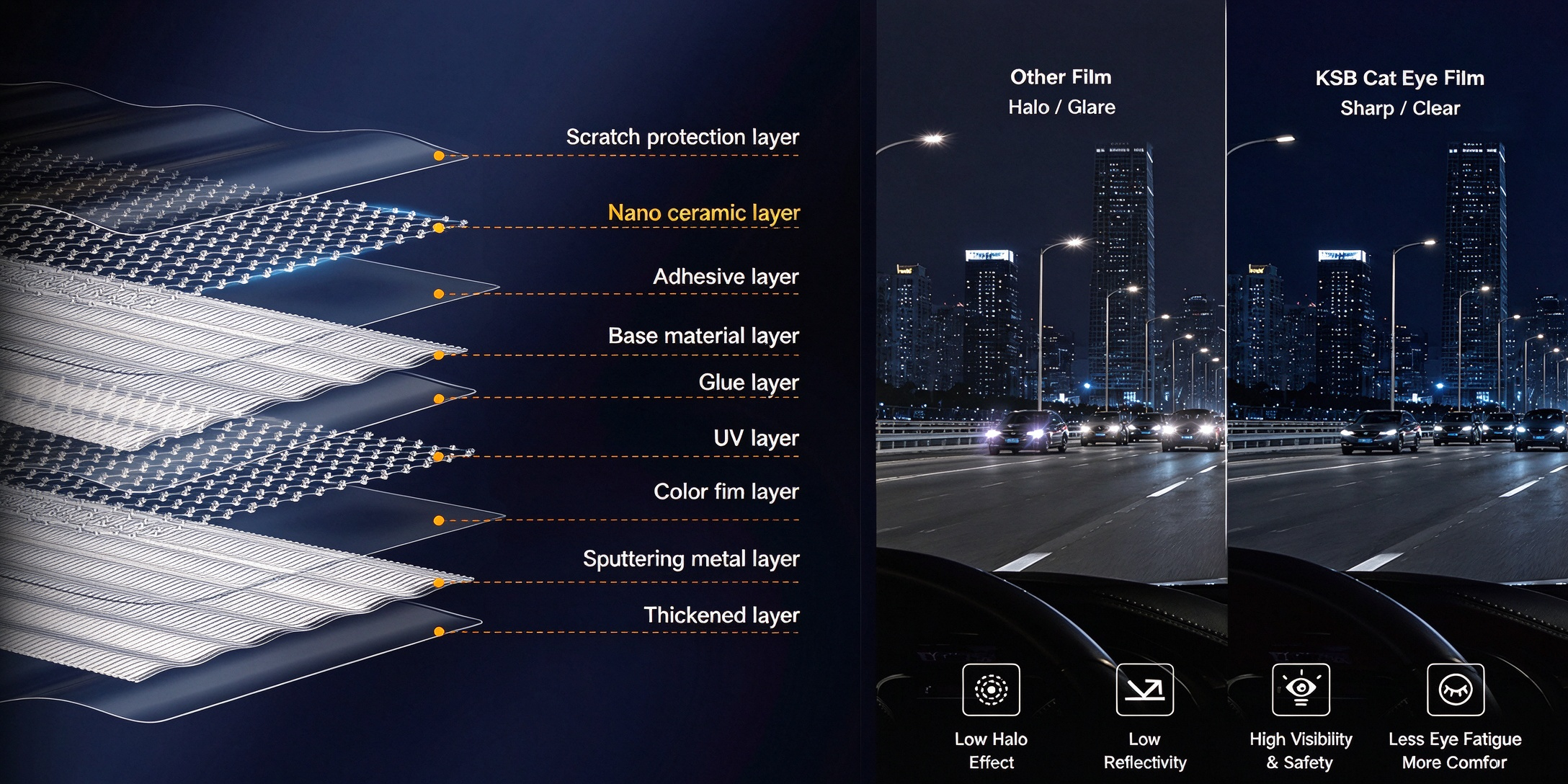
Metalized film uses thin layers of metal — most commonly aluminum, titanium, or nickel-chromium alloys — deposited onto the PET base film through a magnetron sputtering process. These metallic layers reflect solar radiation, including visible light, infrared, and UV. The reflection mechanism is why metalized film can achieve high heat rejection — it’s physically bouncing energy back rather than absorbing it.
The reflection also produces the characteristic appearance of metalized film: a silvery or mirror-like quality that’s more pronounced at some VLTs than others. Some buyers like the look. Many don’t.
The Signal Interference Problem
Metals conduct electricity. A metallic layer in a window film acts as a partial Faraday cage — it attenuates electromagnetic signals passing through it. The practical effects:
- Mobile phone signal weakened inside the vehicle
- GPS reception impaired or intermittent
- Electronic toll readers (E-ZPass, FasTrak, similar) may not function reliably
- Key fobs and remote start may have reduced range
- Bluetooth and Wi-Fi connectivity through the window degraded
In the early era of metalized film, these issues were either manageable or less critical — most people didn’t rely on constant mobile connectivity from inside their car. Today, impaired phone signal in a vehicle is a practical problem that most buyers are unwilling to accept. Electronic toll systems are standard infrastructure in many markets. GPS is used by nearly every driver.
This single issue has driven the shift toward ceramic. The thermal performance improvement of ceramic over metalized is meaningful, but the signal transparency of ceramic is the closer-to-binary differentiator for most buyers.
Performance Comparison
Heat Rejection
High-quality metalized film achieves good TSER — premium products in the 50–65% range at mid-range VLT. This is competitive with mid-tier nano ceramic but generally below premium ceramic. The reflection mechanism is efficient; the limitation is that very high heat rejection often comes with very high visible light reflectance (mirror effect) in metalized products, which limits how much heat rejection is achievable without a strongly reflective appearance.
Nano ceramic achieves 55–75%+ TSER at mid-range VLT from leading manufacturers, without the mirror-effect limitation. It can combine high heat rejection with relatively high visible light transmission more effectively than metalized film.
UV Blocking
Both categories block UV effectively — 99%+ for quality products. This is a point of parity.
Appearance
Metalized film has a characteristic reflective quality — ranging from subtle to obvious depending on VLT and metal layer composition. Some buyers appreciate the look; many find it either too obvious or too commercial. The appearance also tends to show imperfections — bubbles, streaks, or variations in the metallic layer — more visibly than non-metallic films.
Nano ceramic film is optically clean and neutral — no metallic sheen, no mirror effect. The appearance in moderate VLT ranges is close to how quality clear glass looks with light tinting.
Longevity
Both are durable compared to dyed film. Metalized films can show oxidation over time, particularly in high-humidity environments — the metal layer gradually reacts with atmospheric oxygen and moisture, which can produce edge discoloration or clouding. The PET encapsulation limits this but doesn’t eliminate it at very long timeframes.
Ceramic compounds are chemically inert — they don’t oxidize or react with atmospheric chemistry. Long-term stability of ceramic film is excellent.
When Metalized Film Still Makes Sense
The honest answer: rarely for new automotive installations. The signal interference issue is difficult to justify when ceramic alternatives exist at manageable price premiums.
Metalized film retains relevance in:
- Architectural applications where signal transparency is less critical (a building where phone use through the glass is not required)
- Certain building facade applications where the reflective appearance is architecturally desired
- Very price-sensitive projects where the ceramic premium is not within budget and the signal interference tradeoffs are acceptable
For automotive tinting in 2026, recommending metalized film over ceramic requires a specific rationale — budget being the most defensible one.
FAQ
Does nano ceramic film reflect as much as metalized film?
No. Metalized film reflects a significant portion of solar energy. Nano ceramic primarily absorbs and converts IR through the ceramic compounds — it has a much lower reflectance and therefore no mirror-effect appearance. This is both an aesthetic advantage and the reason ceramic can achieve high heat rejection without looking like a one-way mirror.
Is metalized film illegal anywhere?
The film itself isn’t typically banned — VLT regulations govern how dark windows can be tinted, not the specific technology. However, in some jurisdictions with specific electronic toll infrastructure requirements, window film that significantly impairs toll reader function can create compliance issues. Check local regulations for any technology-specific restrictions.
If metalized film is cheaper and performs well thermally, why is everyone switching to ceramic?
Signal interference is the primary driver. The shift has been accelerating as vehicle electronic systems have become more integrated and as phone connectivity has become more essential to daily driving. Ceramic’s thermal performance being comparable or superior is a secondary advantage that reinforces the switch, rather than the primary reason for it.
Can you see through metalized film from inside?
Yes — from inside, looking out, metalized film provides normal visibility (adjusted for the VLT level). The mirror effect is primarily visible from outside. This is useful for privacy but creates a strong contrast between interior and exterior appearance that not all buyers prefer.
What should I ask an installer to confirm they’re not using metalized film?
Ask specifically: is this film metallic or ceramic? Ask to see the product datasheet — metalized film will typically list aluminum, titanium, or similar metal content. Ceramic film datasheets describe ceramic or non-metallic content. You can also test signal interference by placing a call on your phone before and after installation.
Further Reading
On this site:
- What Is Nano Ceramic Window Film? — Full ceramic overview including how it differs from metallic technologies
- Nano Ceramic vs Carbon Window Film: Which Is Better? — The other major ceramic comparison
- How Window Film Is Manufactured: From Raw Materials to Finished Rolls — Sputtering technology used in both metalized and ceramic production
- Nano Ceramic vs Dyed Window Film: Complete Comparison— Comparing heat rejection, clarity, durability, and performance differences
External:
- IWFA Standards Library — Performance testing and comparison methodology
- FCC Wireless Device Regulations — Regulatory context for signal interference considerations in vehicle accessories
Get a Free Sample or Quote
Looking for a reliable window film supplier? Contact us today for fast response and professional support.