Published: July 6, 2026 · 9 min read · Category: Window Film Guide
Walk into any professional window tinting shop and ask for their best product, and nine times out of ten you’ll hear the same two words: nano ceramic. It’s become the premium tier label in the window film industry — the thing you upgrade to when you want the best heat rejection, the clearest optics, and the longest-lasting performance.
But “nano ceramic” gets applied to products at wildly different price and quality levels, and the marketing language around it is genuinely thick. Films that are more carbon than ceramic get called nano ceramic. Films with trace ceramic content get called nano ceramic. And genuinely premium, performance-engineered ceramic films get called nano ceramic too — sitting on the same shelf, sometimes at twice the price, with no obvious way to tell them apart from the outside of the box.
This article explains what nano ceramic window film actually is, how it works, what separates genuine performance ceramic from the label-only version, and what to look for before you buy or stock it.
What “Nano Ceramic” Actually Means
The term combines two descriptors that are each meaningful on their own.
Nano refers to scale. Nanoparticles are measured in nanometers — one nanometer is one billionth of a meter. To put that in perspective, a human hair is roughly 80,000 nanometers wide. The ceramic particles in quality nano ceramic film are typically 5–100 nanometers in size — small enough that they don’t scatter visible light, which is why the film can block heat while remaining optically clear.
This particle size is the key innovation. Earlier ceramic films used larger particles and had optical clarity problems — haziness, cloudiness, or an uneven tint. Reducing particle size to the nanoscale solved the transparency issue while preserving the thermal performance of the ceramic material.
Ceramic refers to the material class — inorganic, non-metallic compounds that are chemically stable, non-conductive, and specifically chosen here because they absorb or reflect infrared radiation (heat) effectively.
The most commonly used ceramic compounds in window film production include:
- Titanium nitride (TiN): A gold-colored ceramic with excellent IR absorption and very high thermal stability
- Cesium tungsten oxide (CTO): Highly selective near-infrared blocking with minimal visible light impact — used in some premium formulations
- Antimony tin oxide (ATO): Used for IR reflection in some product architectures
- Silicon nitride: Heat-stable, used in multi-layer ceramic constructions
The specific compound used is proprietary to each manufacturer and is a genuine performance differentiator. A supplier who can tell you exactly which ceramic material their film uses is far more likely to be actually manufacturing the product than one who talks about “proprietary nano ceramic technology” without specifics.
How It Works
Standard window glass transmits most of the solar energy that strikes it — visible light, ultraviolet, and infrared (heat) all pass through relatively freely. The result is the greenhouse effect that makes a car parked in summer feel like a furnace.
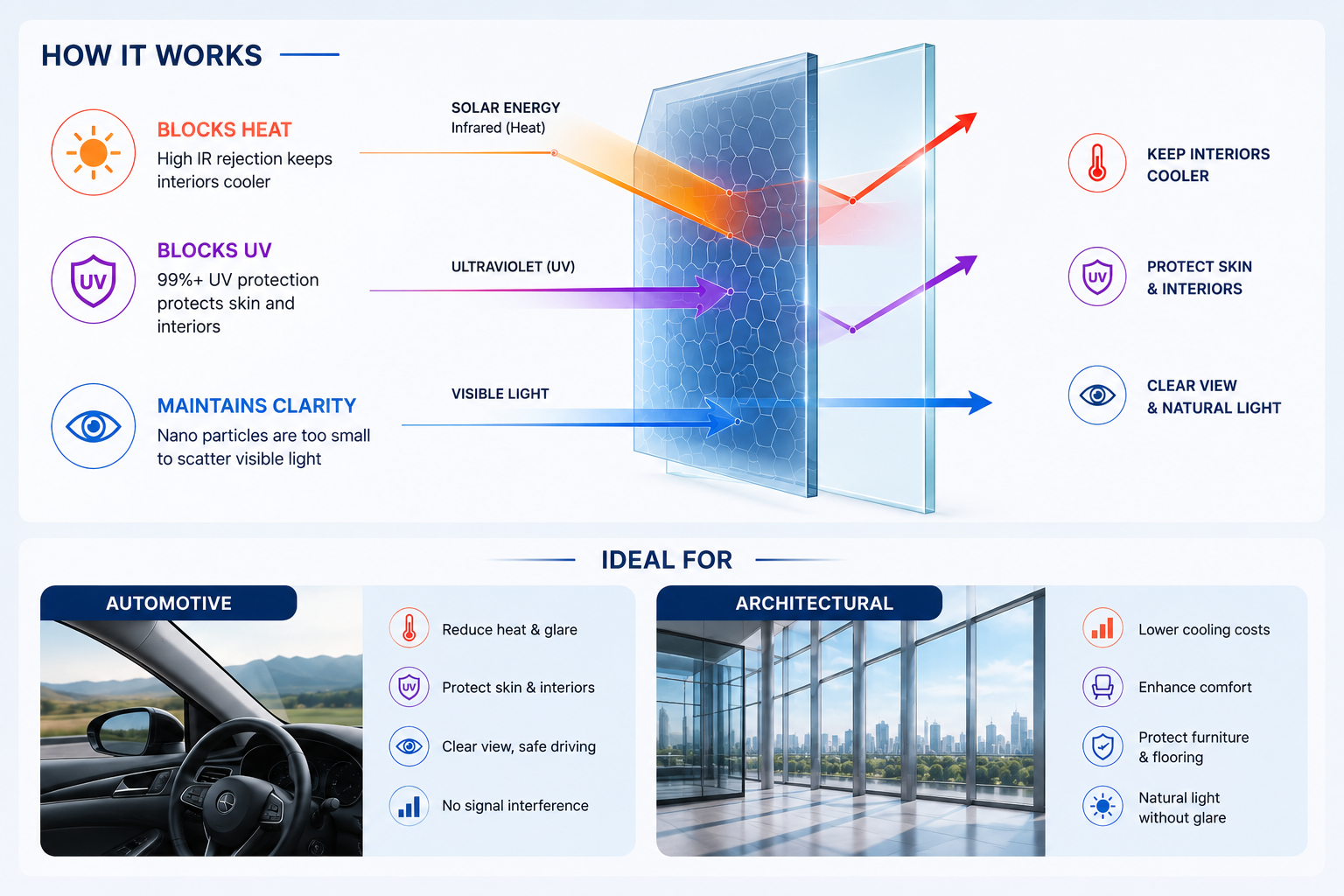
Nano ceramic film sits on the inner glass surface and interacts with incoming solar radiation in three ways:
Heat (infrared radiation): Ceramic nanoparticles absorb infrared wavelengths and convert that energy to low-level heat that dissipates through the glass rather than transmitting into the cabin or room interior. Better-engineered films also incorporate a reflective component — some IR is reflected outward before reaching the glass.
Ultraviolet radiation: Both the film’s PET base and the ceramic coating contribute to UV blocking. Quality nano ceramic film blocks 99%+ of UV-A and UV-B — the wavelengths responsible for skin damage and interior fading.
Visible light: This is where the nano-scale matters. Particles smaller than the wavelength of visible light (400–700nm) don’t scatter it — the film can selectively block IR and UV while remaining transparent. This is why nano ceramic film can deliver high heat rejection at 40% or 50% VLT, a combination earlier technologies couldn’t engineer. You get a cooler space without noticeably darker windows.
Nano Ceramic vs. Other Film Technologies
Understanding where nano ceramic sits in the broader technology landscape helps explain the price difference.
Dyed film absorbs solar energy through colorants. The film itself gets hot and re-radiates some heat inward. Modest UV and IR rejection, color that fades over time, least expensive. Entry-level category.
Metalized film uses thin metal layers (aluminum, titanium) to reflect solar energy. Good heat rejection, durable. The limitation: metal content interferes with mobile phone signals, GPS, and electronic toll systems — a deal-breaker for most buyers today. Also has a distinctive metallic sheen that’s not universally liked.
Carbon film replaces metal with carbon-based coatings. Better IR rejection than dyed film, no signal interference, stable color. Solid mid-tier option. Doesn’t hit the IR rejection levels of quality ceramic.
Nano ceramic film delivers the highest IR rejection, zero signal interference (ceramic is non-conductive), excellent UV blocking, optically clear appearance, and better long-term color stability. The premium category — with pricing to match.
The Specification That Most Often Gets Misleading: IR Rejection
IR rejection is the headline number for nano ceramic film. It’s also the most commonly manipulated specification in the industry, and understanding why helps you evaluate products and suppliers properly.
Infrared radiation spans roughly 780nm to 2,500nm. A film’s IR rejection can be measured at a specific single wavelength — often around 900–1,000nm where ceramic materials perform particularly well — or across the full solar IR spectrum. These produce very different numbers from the same film.
A manufacturer measuring at 950nm might accurately claim 96% IR rejection. The same film measured across the full solar IR spectrum might achieve 55–65%. Both numbers are technically correct. Only the second one reflects what happens in a real car on a real road.
What to ask: Request test reports that specify the measurement methodology. Full-spectrum solar IR testing to NFRC, ISO, or IWFA standards produces the number that matters. Single-wavelength claims without methodology disclosure are almost always the favorable number, not the representative one.
This single point — knowing how IR rejection is measured — separates buyers who make informed purchasing decisions from those who get surprised when a “96% IR rejection” film doesn’t perform as expected in the field.
Automotive vs. Architectural Applications
Nano ceramic technology appears in both automotive and building window film, but the products are engineered differently for each context.
Automotive nano ceramic film prioritizes optical clarity for driving safety, VLT compliance with local tinting regulations, conformability to curved glass surfaces, and signal transparency. Products range from very dark (5% VLT) to nearly clear (50%+ VLT). Performance is typically expressed in IR rejection percentages and UV blocking.
Architectural nano ceramic film addresses larger glass areas, building energy codes, compatibility with coated glass, and daylighting requirements. Transparency tends to be higher (50–70%+ VLT is common in commercial buildings). Key metrics are SHGC (Solar Heat Gain Coefficient), TSER (Total Solar Energy Rejected), and U-value impact.
The same manufacturer may produce both. The products themselves are different — don’t apply automotive-spec film to building glass or vice versa. Performance mismatches and adhesion problems can result.
Identifying Genuine High-Performance Ceramic
The practical challenge: “nano ceramic” on the label doesn’t tell you anything about the actual ceramic content or performance level. Here’s what does.
Third-party test reports. Current (within 12–18 months), product-specific SGS or Intertek reports are the baseline. If a supplier can’t provide them for the specific SKU you’re evaluating, that’s your answer. If they provide them, check the IR measurement methodology — full-spectrum or single-wavelength.
TSER at mid-VLT. A genuine high-performance nano ceramic film at 35% VLT should achieve TSER above 55–60%. Below that, the ceramic content probably isn’t doing the work the label implies.
Ask about the ceramic material. Titanium nitride, cesium tungsten oxide, or equivalent. A manufacturer who can specify their ceramic compound is working from a deliberate materials decision. One who says “proprietary nano ceramic particles” without further detail may not be making the film themselves.
The price. Quality nano ceramic film costs more to manufacture — genuine ceramic compounds, precision coating equipment, tighter QC. A film priced at the same level as carbon film but claiming nano ceramic performance is probably closer to carbon film in actual composition.
Cost Context
At the manufacturing level, quality nano ceramic film from established Chinese manufacturers runs roughly $8–$25 per square meter depending on product tier and order volume — significantly more than carbon film ($3–$8/sqm).
For retail automotive installation, a full car in nano ceramic typically runs $300–$900+ in most Western markets, depending on product, vehicle size, and installer. The premium over carbon or dyed film is real but justifiable for buyers who’ll keep the vehicle for several years in a hot climate — the heat rejection difference is measurable every single day.
FAQ
Does nano ceramic film block heat without blocking phone signal?
Yes. Ceramic compounds are non-conductive, so nano ceramic film has no effect on mobile phone signals, GPS, Wi-Fi, electronic toll readers, or any other wireless signals. This is one of its key advantages over metalized film, which does interfere. If signal performance matters — and for most people today it does — nano ceramic is the correct category.
How dark will nano ceramic film make my windows?
It’s available across a wide VLT range — typically 5% (very dark) through 70%+ (nearly clear). The thermal performance of a quality nano ceramic film is not dependent on darkness — a 50% VLT ceramic film can outperform a 20% VLT carbon film on heat rejection. Darker isn’t automatically better, and in markets with VLT regulations, there’s often no need to go dark to get good performance.
How long does nano ceramic film last?
Quality ceramic film from reputable manufacturers carries warranties of 5–15 years depending on product and application. Real-world lifespan for properly installed premium ceramic film is typically 8–15 years before meaningful performance degradation. Ceramic films outlast dyed and most carbon alternatives because the ceramic compounds don’t degrade under UV exposure the way organic dyes do.
Will nano ceramic film make a measurable difference to interior temperature?
Measurably yes, particularly in direct sun in hot climates. A film with 60%+ TSER can reduce cabin or room temperature by 5–15°C under equivalent direct-sun conditions compared to unfilmed glass. The difference is most noticeable in vehicles with large glass areas and in rooms with significant west or south-facing glazing exposure.
Can nano ceramic film be applied over existing tint?
Not recommended. Film-on-film applications create adhesion problems and compound VLT reduction that may exceed legal limits in tinted windows. Existing film should be removed and the glass cleaned thoroughly before applying new product.
Is nano ceramic film visible from outside?
In moderate-to-light VLT ranges (35–70%), a properly installed ceramic film is essentially invisible or shows only a very subtle quality to the glass. Dark films (5–20%) have an obvious visible effect. The key difference from metalized film: ceramic has no metallic sheen — the appearance in the transparent range is natural, glass-like.
What’s the difference between “ceramic” and “nano ceramic” film?
In current industry usage the terms are mostly interchangeable. “Nano ceramic” specifically emphasizes nano-scale particle sizing that achieves optical clarity alongside thermal performance. Historically, “ceramic” without the “nano” prefix sometimes referred to earlier products with larger particle sizes and lower optical clarity. Today, “nano ceramic” has become the default label for the premium ceramic film category across the industry.
Can it be used on home windows as well as car windows?
Yes, though the specific product matters. Automotive and architectural nano ceramic films are engineered differently — VLT ranges, adhesive systems, and performance metrics differ between the two. Use architectural-specification film on building glass and automotive-specification film on vehicles. Many manufacturers produce both, often under different product series names.
Further Reading
On this site:
- How Nano Ceramic Window Film Is Made — The production technology behind the performance
- Ceramic Window Film Supplier: What to Look for Before You Order — Evaluating suppliers and verifying claims
- What Certifications Should a Window Film Manufacturer Have? — How to read and verify the test reports that matter
- Why Do Window Film Prices Vary So Much? — Cost drivers including ceramic vs. other technology tiers
- Top 7 Window Film Manufacturers in China (2026 Verified List) — Verified manufacturers with genuine ceramic production capability
External:
- NFRC Certified Products Directory — Search NFRC-certified window film products for independently verified performance data
- IWFA Industry Standards — ANSI/IWFA test methodology reference for automotive film
- Lawrence Berkeley National Laboratory — Window Research — Independent research on solar control film and glazing performance
- SGS Window Film Testing — Third-party performance testing for film verification
Sourcing nano ceramic window film for distribution or OEM? Contact us — we work with verified ceramic film manufacturers across automotive and architectural categories and can match product specifications to your market requirements.
Get a Free Sample or Quote
Looking for a reliable window film supplier? Contact us today for fast response and professional support.