Reviewed by KSB PPF Product and Quality Control Team
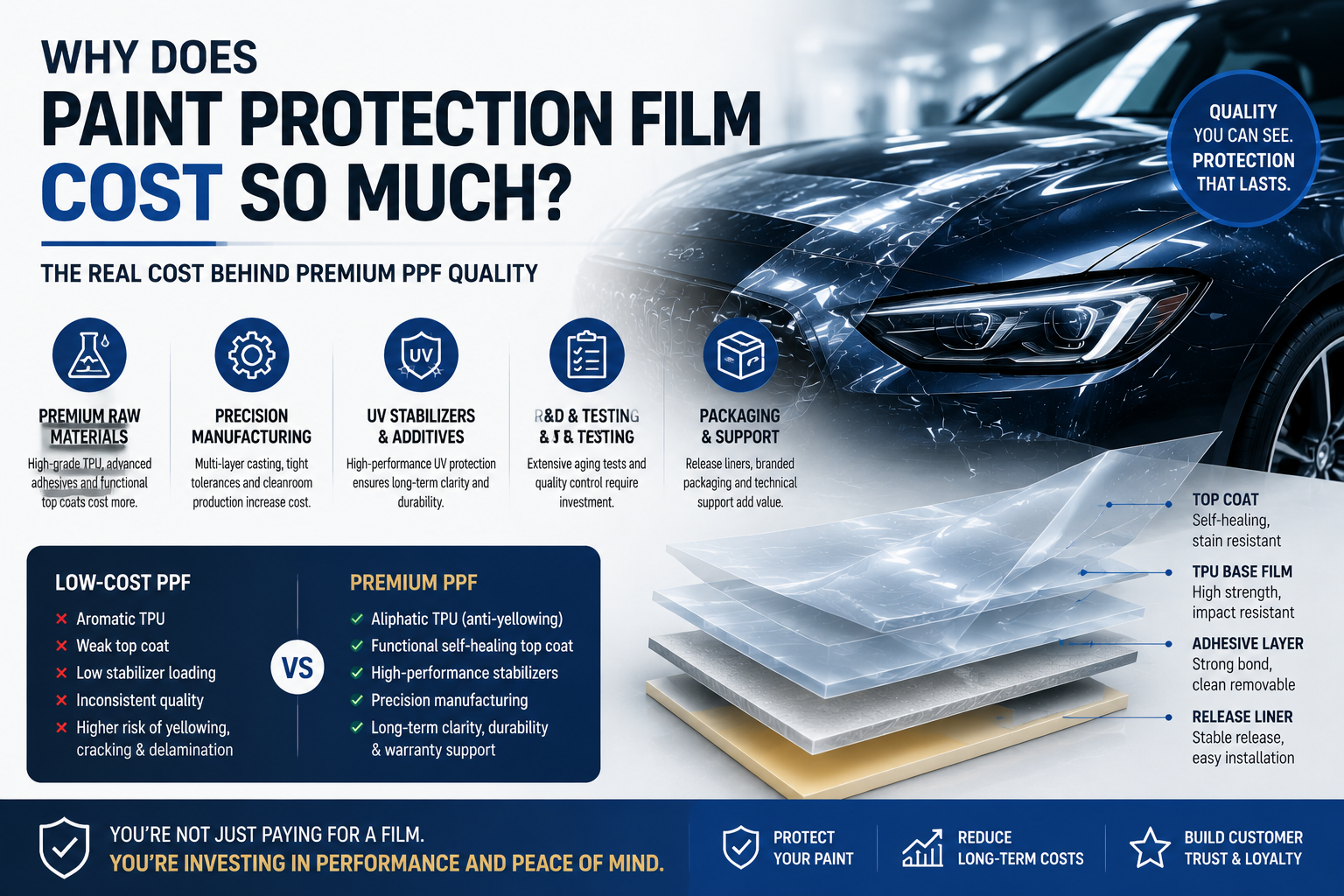
If you’ve been sourcing paint protection film for your brand or distribution business, you’ve probably noticed that PPF pricing varies enormously — from under $1 per square foot to well over $5, sometimes more at the installed level. For anyone trying to build a product line or evaluate suppliers, that range raises an obvious question: what exactly are you paying for?
The honest answer is that PPF is more expensive to make well than most people expect. This article breaks down where the cost actually comes from — which should help you evaluate supplier quotes, understand product tiers, and make sourcing decisions that hold up in the field.
The Raw Material Is Not Cheap
The base layer of a quality PPF is thermoplastic polyurethane (TPU), and not all TPU is the same. Films designed for long-term outdoor use require aliphatic isocyanate chemistry — which resists UV-induced yellowing significantly better than the aromatic alternative. Aliphatic TPU costs more to produce, and that cost is real.
Beyond the isocyanate type, the soft segment chemistry also matters. Polycarbonate diol (PCDL)-based TPU, which offers stronger hydrolysis resistance compared to conventional polyester-based alternatives, carries a higher raw material cost. Suppliers using cheaper polyester or aromatic TPU can price lower — but the performance difference shows up in service life and yellowing behavior.
The adhesive layer adds another cost variable. A pressure-sensitive adhesive that bonds reliably, allows repositioning during installation, and removes cleanly after years of exposure is not a commodity product. Cheap adhesive causes edge lifting, residue on paintwork, and installer complaints — problems that eventually come back to the brand, not just the installer.
Then there’s the top coat. Self-healing performance, stain resistance, and scratch recovery all depend on the chemistry of the outermost layer. A functional self-healing top coat that works at reasonable ambient temperatures requires specific polyurethane formulation work. Some lower-cost films have a top coat in name only — the self-healing effect is minimal or requires temperatures that aren’t realistic in the field.
Manufacturing Tolerances Are Tighter Than You’d Think
PPF is a multi-layer film, typically cast in a controlled environment. Maintaining consistent thickness across a roll — say, 7.5 mil ± 0.3 mil — requires precision equipment and strict process control. Inconsistent thickness causes installation problems: the film stretches unevenly, the adhesive doesn’t bond uniformly, and in cold conditions, thin spots can crack or lift.
Optical clarity is another manufacturing challenge. Any contamination in the casting environment, any variation in raw material quality, or any process instability can introduce haze or visible inclusions into a film that’s supposed to be invisible on a vehicle. Achieving consistent optical clarity across high volumes requires both equipment investment and quality control discipline.
Legitimate PPF manufacturers run inline inspection, conduct lot-by-lot quality checks, and maintain traceability. That overhead is part of the price.
UV Stabilizer Packages Are a Hidden Cost Driver
PPF sits in direct sunlight for years. Without adequate UV protection, even a well-formulated TPU will degrade — yellowing, losing mechanical strength, and eventually failing adhesion. Protecting against this requires a carefully selected package of UV absorbers and hindered amine light stabilizers (HALS), loaded at effective concentrations.
These additives are not cheap, and the difference between a stabilizer package that performs and one that barely meets minimums is not visible at purchase. It shows up 3–4 years later when your customer’s film has yellowed and your warranty is being called.
Suppliers who cut corners here often can’t be distinguished from those who don’t — until the film is in service.
Liner, Backing, and Packaging Are Not Trivial
The release liner that protects the adhesive layer during storage and installation affects the installation process directly. A liner that’s too difficult to remove slows installers down; one that leaves residue contaminates the adhesive. Quality liners have consistent release force and protect the adhesive layer without leaving contamination.
For OEM and private label buyers, packaging — branded boxes, labeled rolls, printed liners, carton marking — adds cost that some quotes include and others don’t. Make sure you’re comparing apples to apples when evaluating supplier pricing.
R&D and Testing Aren’t Free Either
A film that claims 10-year durability should have accelerated weathering data to support that claim. Running a xenon arc weathering test to 2,000+ hours, conducting hydrolysis resistance testing, evaluating adhesive peel strength after aging — this is real testing with real cost. Manufacturers who do it properly price it into their product. Those who don’t may still claim the same warranty period.
When you’re comparing two suppliers at different price points, ask specifically what accelerated testing has been done and request the data. The answer — or the absence of one — tells you something about how the product was developed.
What the Price Gap Between Suppliers Usually Reflects
When one supplier quotes significantly lower than another for ostensibly similar film, the difference almost always traces back to one or more of these:
- Cheaper raw materials — aromatic TPU instead of aliphatic, conventional polyester instead of PCDL, lower stabilizer loading
- Looser manufacturing tolerances — thicker average gauge to compensate for inconsistency, lower clarity standards
- Weaker top coat — minimal or non-functional self-healing, lower stain resistance
- Lower adhesive quality — adequate initial bond but poor long-term performance and removability
- No real aging data — warranty claims based on material specifications rather than actual testing
None of these compromises are immediately visible. They show up in field performance, installer feedback, and ultimately warranty claims. For a brand building market reputation, these hidden costs are real.
What You’re Actually Paying For in a Premium Film
A properly specified PPF — aliphatic TPU base, quality top coat with functional self-healing, well-formulated adhesive, appropriate UV stabilizer package, and consistent manufacturing — does several things that cheaper alternatives don’t:
It stays optically clear for longer. The anti-yellowing performance of aliphatic TPU with proper UV stabilization is meaningfully better than aromatic alternatives in long-term outdoor exposure.
It performs consistently across rolls and batches. Tight manufacturing tolerances mean installers don’t encounter problems mid-job. Consistency matters for professional installation networks.
It removes cleanly. A quality adhesive system that releases without residue after years of service protects both the customer’s paint and the installer’s reputation.
It supports the warranty you’re selling. If you’re offering a 7-year or 10-year warranty to your distribution channel, you need a film that can actually back it up.
How to Evaluate Pricing When Sourcing PPF
Rather than comparing price per square meter in isolation, consider the total picture:
Ask for the full material specification. TPU type (aliphatic or aromatic), soft segment chemistry, top coat formulation approach, adhesive system. Suppliers who know their product can answer these questions.
Request technical data sheets and aging test reports. Not every manufacturer will have extensive testing, but serious suppliers can produce documentation. Gaps here are informative.
Test samples before committing. Optical clarity, stretch and recovery, self-healing performance, adhesive bond, and clean removal are all things you can evaluate with samples before placing a bulk order.
Consider total cost of market. A cheaper film that generates installer complaints, early warranty claims, or customer dissatisfaction costs more than the price difference. Calculate warranty exposure against the volume you’re moving.
Clarify what OEM services are included. Private label packaging, branded rolls, custom box printing, and documentation support all have value. Some suppliers bundle these; others charge separately or don’t offer them at all.
A Note on Market Positioning
PPF is not a commodity product — even though pricing pressure sometimes makes it feel that way. Brands that have built durable market positions in PPF have generally done so on the back of consistent quality and reliable installer support, not the lowest price per roll.
If you’re building a PPF brand or expanding into a new market, the product you put your name on will define your reputation. The cost difference between an adequate film and a genuinely good one is usually smaller than the cost of managing quality problems in the field.
Frequently Asked Questions
Why is there such a large price range for PPF rolls from different suppliers? The price gap reflects real differences in raw materials, manufacturing quality, stabilizer loading, and testing investment. Two films at very different price points are often genuinely different products, not the same film at different margins.
Is aliphatic TPU always worth the extra cost for outdoor PPF? For transparent PPF used in outdoor automotive applications, aliphatic isocyanate chemistry is important for UV stability and anti-yellowing performance. Aromatic TPU is significantly more prone to yellowing under sunlight. For any product carrying a multi-year warranty, aliphatic chemistry is standard in quality PPF.
How do I know if a supplier’s warranty claim is realistic? Ask for accelerated weathering test data and hydrolysis resistance test results. Warranty claims based on material specifications alone, without actual aging data, carry more risk. Reputable suppliers can provide supporting documentation.
What’s the minimum I should test before a bulk order? At minimum: optical clarity, self-healing response, adhesive bond strength, clean removal, and stretch/recovery behavior. If the supplier has accelerated aging data, review it. If not, that’s a factor in your risk assessment.
Can I get private label PPF at a reasonable minimum order quantity? This depends on the manufacturer. Some OEM suppliers work with brands from relatively modest initial quantities, particularly if they have standard film constructions available for private labeling. Specify your packaging requirements, roll size, thickness and estimated volume when requesting a quote.
Looking for a Reliable PPF Supplier for Your Brand or Distribution Business?
If you’re sourcing PPF for private label, OEM, or wholesale distribution, we’re happy to walk you through our product range, share technical documentation, and provide samples for evaluation.
Tell us your target market, preferred thickness and finish, warranty requirement, and estimated annual volume — and we’ll recommend a suitable film construction with full OEM support.
Request PPF Samples | Get an OEM Quotation | Talk to a PPF Specialist
Reviewed by KSB PPF Product and Quality Control Team.
This article reflects general industry knowledge and KSB’s manufacturing experience. Specific performance outcomes depend on film construction, installation conditions, and end-use environment.
Get a Free Sample or Quote
Looking for a reliable window film supplier? Contact us today for fast response and professional support.